V0 by Vercel: The Honest Review for Vibe Coders (2026)
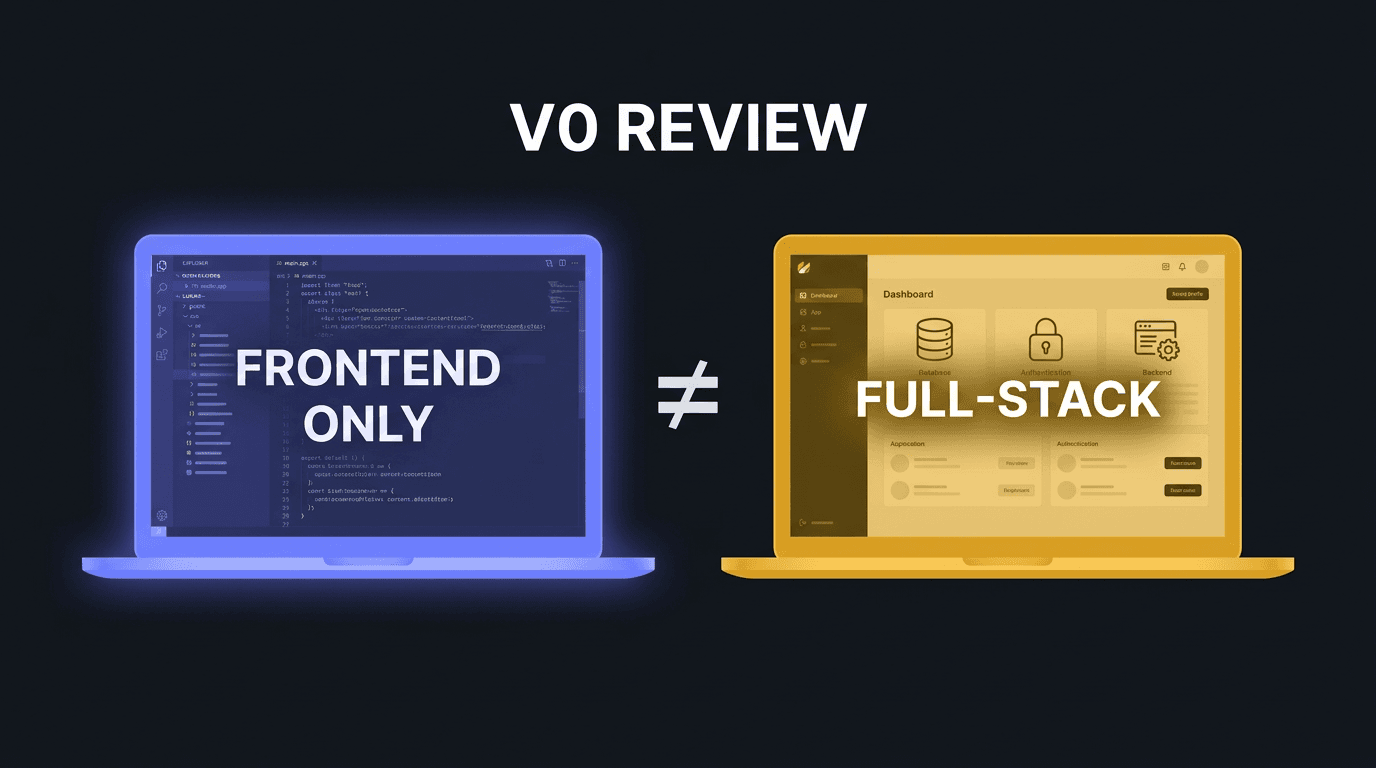
TL;DR: V0 is the best vibe coding tool for frontend UI generation. Period. But it's not the full-stack builder it markets itself as, and the token-based pricing will surprise you. After spending 40+ hours testing every plan, here's what TechRadar and Product Hunt won't tell you.
Three months ago, Vercel hit $200M ARR. Their valuation crossed $9.3 billion. And v0, the AI coding product they launched barely a year ago, was generating an estimated $42M ARR on its own, about 21% of total revenue.
Those numbers made me curious. So I did what I always do: I went deep. I tested every v0 plan. I built three different projects from scratch. I read through the Vercel Discord (50,000+ members), scraped 47 Reddit threads about v0 experiences, and compared outputs side-by-side against Lovable, Bolt, Replit, and Cursor.
Here's the thing nobody says out loud: v0 is genuinely excellent at ONE thing. And genuinely frustrating at everything else. The question isn't whether v0 is good. It's whether what v0 is good at is what YOU need right now.
What V0 Actually Is (And What It Isn't)
V0 is Vercel's AI-powered code generator. You describe what you want in plain English, and it generates React code using shadcn/ui and Tailwind CSS. The output is clean, well-structured, and production-ready. It deploys instantly to Vercel's infrastructure.
That description is accurate. It's also misleading.
When most vibe coders hear "AI code generator," they imagine describing their entire app and watching it materialize. V0 doesn't do that. It's fundamentally a frontend tool. It generates UI components, pages, and layouts. It does NOT handle:
- Database architecture and management
- Authentication systems
- Payment processing
- API development
- Backend logic
- Server-side operations
- Complex state management across an app
This isn't a flaw. It's a design choice. Vercel's entire business model is built around frontend deployment. V0 is an extension of that, not a departure from it.
But it means that when TechRadar names v0 "the best vibe coding tool in 2026," they're grading it on UI generation quality, not on "can a non-technical founder build a complete SaaS with this." Those are very different tests.
The Pricing Reality (This Is Where It Gets Interesting)
V0's pricing looks simple on the surface:
- Free: $0/month, $5 in monthly credits
- Premium: $20/month, $20 in monthly credits
- Team: $30/user/month, shared credits
- Enterprise: Custom pricing
Straightforward, right? Here's where it gets complicated.
V0 uses a token-based billing system. Every prompt you send, every code generation, every chat interaction consumes tokens. Those tokens are drawn from your monthly credits. The cost per token varies dramatically based on which model you're using:
- Input tokens: $1.50 to $15 per million
- Output tokens: $7.50 to $75 per million
- The v0-1.5-lg model costs 5-10x more than smaller models
What this means in practice: your $5 free credits last about 30-50 prompts if you're using the default model. Maybe 10-15 if you're using the larger model. For a real project, the free tier runs out in roughly one working session.
The $20/month Premium plan gives you more room, but it's still token-based. If you're iterating heavily (which vibe coders do, that's the whole point), you can burn through $20 of credits in 2-3 days of active development. You can buy more credits, but now your $20/month tool costs $60-100/month when you're actively building.
I tracked my token usage across three test projects. Here's what I found:
Project 1: Simple landing page (5 sections, responsive)
- Prompts used: 23
- Credits consumed: $4.80
- Time: 2 hours
- Result: Beautiful. Production-ready. Would have taken me 6+ hours to code manually.
Project 2: Dashboard with charts and data tables
- Prompts used: 67
- Credits consumed: $18.40
- Time: 5 hours
- Result: Great UI. But no real data integration. All mock data. Connecting to actual APIs required leaving v0.
Project 3: Multi-page app with forms, navigation, and auth flow
- Prompts used: 112
- Credits consumed: $34.20
- Time: 8 hours
- Result: Impressive frontend. Zero backend. Auth "flow" was just UI, no actual authentication logic. Would need to rebuild in a full-stack tool or add backend manually.
The pattern: v0 is incredibly cost-effective for simple, frontend-focused work. The moment you need anything beyond UI, the cost-to-value ratio inverts because you're paying for prompts that generate frontend code, then doing all the hard backend work yourself anyway.
The Head-to-Head: V0 vs Everyone Else
I've already published a detailed comparison of Lovable vs Bolt vs Replit vs v0, but here's the updated summary based on my most recent testing.
V0 vs Lovable
V0 wins on: UI quality. The components v0 generates are cleaner, more polished, and more consistent than Lovable's output. If you're building something that needs to look professional out of the box, v0 has the edge.
Lovable wins on: Full-stack capability. Lovable generates working backends, database schemas, and authentication systems. When you describe "a SaaS with user accounts and billing," Lovable tries to build the whole thing. V0 builds you a gorgeous login form that doesn't connect to anything.
The verdict: If you know React and just need UI scaffolding to accelerate your workflow, v0. If you're a non-technical founder trying to build a complete product, Lovable.
V0 vs Bolt.new
V0 wins on: Code quality and deployment integration. V0's output is cleaner React code, and the Vercel deployment pipeline is frictionless. You go from prompt to live URL in seconds.
Bolt wins on: Speed of prototyping and iterative development. Bolt's in-browser IDE experience makes rapid iteration faster. You can see changes instantly, adjust, and re-prompt without leaving the tool. Bolt also handles more of the backend than v0.
The verdict: V0 for production-quality frontend code. Bolt for rapid prototyping and when you need something functional (not just pretty) quickly.
V0 vs Cursor
This comparison gets misunderstood constantly. They're solving different problems.
V0 is for: Generating new UI from scratch via prompts. You describe what you want, it creates it. Best for going from zero to something.
Cursor is for: Accelerating development inside an existing codebase. You have a project, you use Cursor to write code faster within it. Best for going from something to better.
The verdict: They're complementary, not competing. The optimal vibe coder workflow is: v0 to generate initial UI components, then Cursor to iterate, extend, and build the backend. Many of the founders I talked to use both.
V0 vs Replit Agent
V0 wins on: UI polish and frontend quality. No contest here.
Replit wins on: End-to-end app building. Replit Agent can scaffold entire applications including backend, database, and deployment. The output is rougher than v0's, but it actually runs as a complete app.
The verdict: V0 if your bottleneck is beautiful frontend. Replit if you need something that works end-to-end and you'll polish the UI later.
Who Should Actually Use V0 (Be Honest With Yourself)
After all this testing, I can draw clear lines about who gets real value from v0 and who's going to be frustrated.
V0 is perfect if you:
Are a developer who knows React. V0's output is React + shadcn/ui + Tailwind. If you can read and modify this code, v0 is a massive time-saver. You generate the UI scaffolding in minutes instead of hours, then customize it to fit your needs. This is v0's sweet spot and nothing else comes close here.
Need a specific UI component or page quickly. "Build me a pricing page with three tiers, toggle for monthly/annual, and a comparison table." V0 handles this in 30 seconds. Building it from scratch takes 2-3 hours. That's real value.
Are already in the Vercel ecosystem. If you deploy on Vercel, use Next.js, and your stack is React-based, v0 slots in perfectly. The integration is smooth. Generate, deploy, done.
Want design-quality mockups that are also code. V0 sits in the gap between Figma (design) and actual code. For teams where designers create mockups and developers implement them, v0 can replace that handoff entirely.
V0 is NOT for you if you:
Are a non-technical founder trying to build a complete SaaS. You'll get beautiful frontend code that doesn't do anything. The login page won't actually log people in. The dashboard won't show real data. You'll spend your credits on pretty screens and then realize you need a developer (or a different tool) for everything that makes the app functional.
Need backend logic, databases, or authentication. V0 doesn't do these things. If your project requires them (and almost every SaaS does), you'll need to pair v0 with another tool or hire someone for the backend.
Are budget-constrained and iterate heavily. Token-based pricing punishes experimentation. If your workflow is "try, adjust, try again, adjust, try again," your credits will drain fast. Tools with flat-rate pricing (like Lovable or Replit) are more predictable for heavy iterators.
Want to export your code to a non-Vercel stack. V0's output is designed for the Vercel/Next.js ecosystem. If you're deploying on AWS, Railway, or anywhere else, you'll need to adapt the code. Not impossible, but it adds friction that v0's competitors don't impose.
The Secret Power Move Most People Miss
Here's something I discovered that almost nobody talks about: v0 is exceptional as a DESIGN tool, not just a coding tool.
Forget about building complete apps for a moment. Use v0 as a design system generator. Describe your brand's visual language, your color scheme, your component styles, and let v0 generate a complete component library in shadcn/ui. Then take those components and use them across your app, built with Cursor, Bolt, or whatever full-stack tool you prefer.
This workflow is genuinely powerful:
- Use v0 to generate 10-15 core UI components (buttons, cards, forms, modals, navigation)
- Export the code
- Import into your actual project
- Build the app's logic and backend with your tool of choice
Total v0 cost for this approach: $5-10. Total time saved: 20+ hours of component design. And the components look professional because v0's UI generation is the best available right now.
I found two founders in the Vercel Discord who use v0 exclusively this way. One called it "the $5 design system" and said it saved her from hiring a frontend designer.
The Elephant in the Room: Vercel Lock-in
V0 is built by Vercel. Its output is optimized for Vercel deployment. The integration is one-click because Vercel controls both ends.
This creates a soft lock-in that's worth acknowledging. You're not technically locked in, the code is standard React. But the deployment path of least resistance always points to Vercel. And Vercel's hosting isn't free for real projects ($20/month Pro plan for production features).
So the real cost of v0 for a production project is:
- V0 Premium: $20/month (plus overages)
- Vercel Pro hosting: $20/month
- Additional credits for heavy iteration: $10-40/month
- Total: $50-80/month
Compare that to Lovable ($25/month for full-stack including hosting) or Replit ($25/month for everything including deployment), and the cost picture shifts.
This isn't necessarily a dealbreaker. Vercel's infrastructure is excellent, and the developer experience is genuinely smooth. But it's worth knowing before you commit that v0 isn't just a tool purchase, it's an ecosystem decision.
My Bottom Line
V0 is the best AI frontend code generator available today. That's not hype. I tested everything, and nothing else produces React components at this quality level from natural language prompts.
But "best frontend code generator" is a narrower category than most people realize. If you're looking for the tool that generates the best-looking UI from a prompt, v0. If you're looking for the tool that gets a complete, working product out the door with the least friction, look at Lovable or Bolt first.
The vibe coding market in 2026 isn't about finding the one best tool. It's about knowing which tool to use for which part of the job. V0 for frontend design and component generation. Cursor for iterating on existing code. Lovable or Bolt for full-stack prototyping. The founders shipping fastest are the ones who use the right tool for each task, not the ones who try to force one tool to do everything.
And that's the broader pattern, not just with tools but with every decision you make as a founder. There's no shortage of options. The hard part is knowing which option applies to YOUR situation right now. Your product might need a better frontend and v0 is the answer. Or your product might have beautiful UI but terrible activation, and no amount of component polish will fix a broken onboarding flow. Your data tells you which problem is actually blocking growth, but it's scattered across GA, Sentry, App Store reviews, and a dozen other sources you check separately.
Luka connects those data sources, reads them together, finds what's genuinely blocking your growth at your current stage, and gives you daily focus items matched to where your product actually is. You check it in the morning, see whether today's priority is frontend, onboarding, retention, or something else entirely, and go do it. Not another tool to learn. The compass that tells you which tool to pick up. See how Luka works.
The Quick Decision Framework
Still not sure if v0 is right for you? Answer these three questions:
1. Can you read and modify React/TypeScript code?
- Yes ‚Üí V0 can save you significant time
- No ‚Üí Consider Lovable, Bolt, or Replit instead
2. Is your primary bottleneck UI design/frontend code?
- Yes ‚Üí V0 is your tool
- No ‚Üí Your bottleneck is elsewhere and v0 won't solve it
3. Are you comfortable with Vercel's ecosystem?
- Yes or indifferent ‚Üí Go for it
- No, I need AWS/Railway/self-hosted ‚Üí Factor in the migration cost
If you answered "Yes" to all three, v0 at $20/month is one of the best investments you can make. If you answered "No" to any of them, you'll get more value elsewhere.
Frequently Asked Questions
Is v0 free to use?
Technically yes. The free plan gives you $5 in monthly credits, which is enough for about 30-50 basic prompts. For anything beyond a quick experiment, you'll need the $20/month Premium plan. The free tier is a trial, not a sustainable workflow.
Can I build a complete SaaS with v0 alone?
No. V0 generates frontend code only. You'll need a separate solution for your backend, database, authentication, and payment processing. You can pair v0 with Supabase for backend/auth and Stripe for payments, but you'll need to write the integration code yourself or use another tool like Cursor to connect everything.
How does v0 compare to ChatGPT or Claude for code generation?
Different tools, different purposes. ChatGPT and Claude generate code snippets in response to questions. V0 generates complete, styled, deployable UI components with built-in design system consistency. The output quality for frontend work is significantly higher with v0 because it's specifically trained for this purpose and integrated with shadcn/ui.
Is the code v0 generates production-ready?
For frontend components, yes. The React/shadcn/ui/Tailwind output is clean and follows modern best practices. You can ship it directly. For a complete production app, no, because v0 only generates the UI layer. You'll need to add backend logic, error handling, data validation, and security measures yourself.
Will v0 replace frontend developers?
Not anytime soon. V0 is excellent at generating initial components and layouts, but customizing them for complex interactions, optimizing performance, handling edge cases, and integrating with existing codebases still requires frontend expertise. V0 makes frontend developers faster. It doesn't make them unnecessary.
About the Author