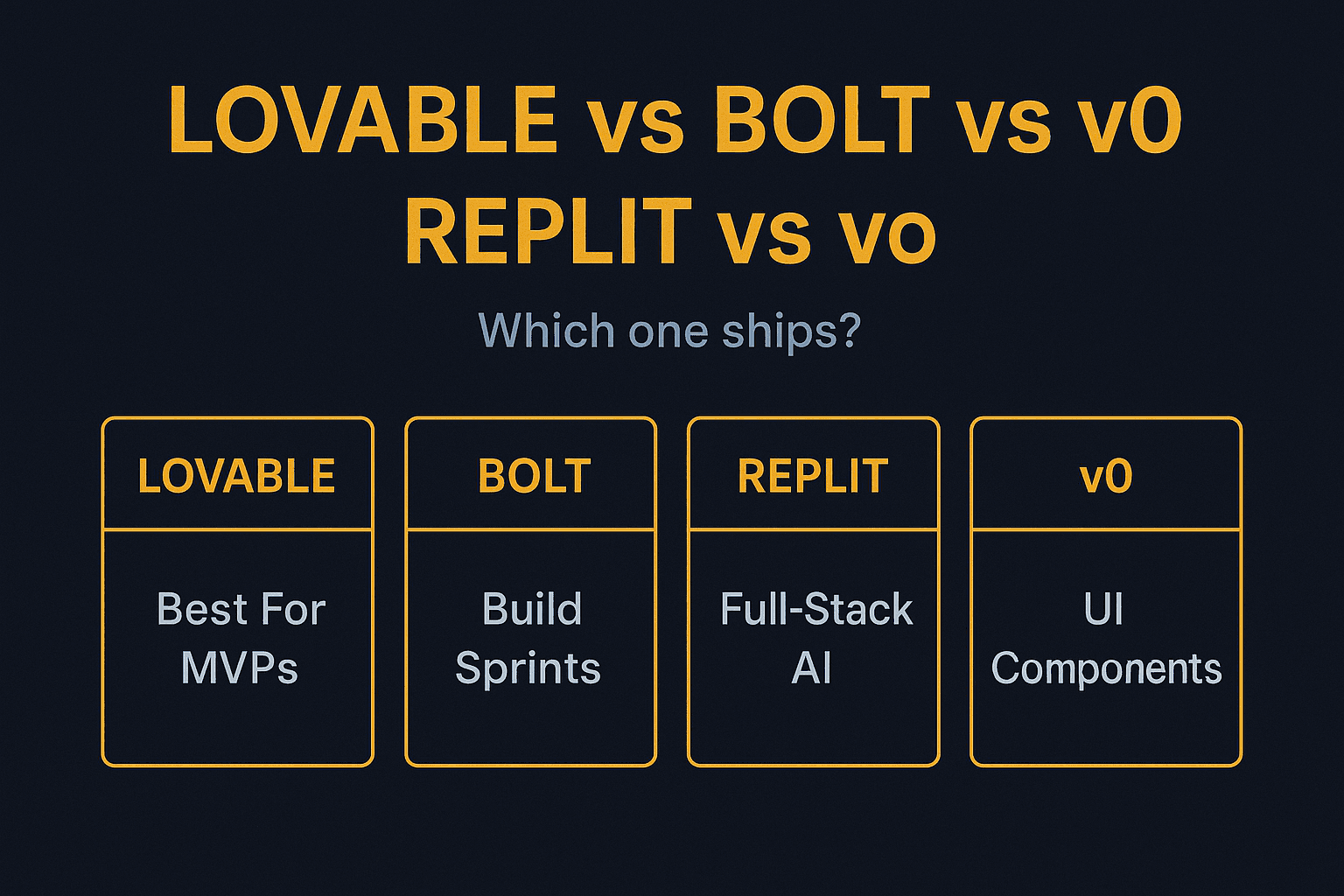
Lovable vs Bolt vs Replit vs v0: The Honest Comparison for Vibe Coders (2026)
TL;DR: After testing all four tools on real projects, here's the truth: Lovable wins for MVPs, Bolt wins for build sprints, Replit Agent wins for full-stack autonomy, and v0 wins for frontend components only. No single tool does everything. Pick based on your bottleneck, not the loudest hype.
I spent two weeks running the same project through all four tools. Built a task management app with auth, a database, and a real deployed URL. Then I built a more complex SaaS prototype. Then I went deep into indie hacker Twitter, Reddit, and Discord communities to see what's working in the wild, not just in controlled demos.
Here's what I found: the comparison posts that rank on Google right now are mostly wrong. Not because they're lying, but because they're comparing features instead of outcomes. Our ICP, which is indie builders trying to ship something real and get to $10K MRR, cares about one thing: does it actually ship?
Let me give you the honest breakdown.
The Tools, Fast
Before the nuance: here's the one-sentence version of each.
Lovable ($20/mo): Generates full-stack React apps with a clean UI. Best for non-technical founders who want something they can demo and iterate on fast.
Bolt.new ($20/mo): Token-based, fast, exports clean code. Best for developers who want to prototype quickly without getting locked in.
Replit Agent v3 ($20/mo Core, $100/mo Pro): True autonomous agent. Works for 200+ minutes without hand-holding, self-tests in a live browser, and deploys full-stack apps. Best for complex builds.
v0 by Vercel ($20/mo): Frontend only. Generates React/Tailwind components from prompts. You still need to wire up everything else. Best as a design accelerator for developers.
That's the short version. Now let me explain why the nuances matter more than the labels.
What I Actually Built (And What Broke)
Testing conditions matter. Here's what I built with each:
Project 1: Task management app with user auth, a Postgres database, and a deployed URL. This is the minimum viable "does it work in production" test. Not a demo. A real app.
Project 2: SaaS prototype with a landing page, pricing page, user dashboard, and basic CRUD operations. The kind of thing a vibe coder would ship as a first paying product.
Results:
Lovable handled Project 1 cleanly in about 45 minutes. The UI was the best of the four. The code is React-based and exportable. Where it struggled: the backend is Supabase-dependent by default. Fine if that's your stack. Annoying if you want to swap it out.
Bolt.new handled Project 1 faster (about 30 minutes) but the UI was less polished out of the box. The token-based pricing is actually a feature if you're doing heavy build sprints. You pay for what you use, not a flat subscription that runs out on day 12.
Replit Agent v3 was the most impressive at Project 2. It set up the entire environment, wrote the code, ran a browser test, fixed three bugs I hadn't noticed, and deployed to a live URL, all in one session. The "self-healing" browser testing is real and genuinely useful. The downside: it lives inside Replit's environment. Exporting and running the code independently adds friction.
v0 by Vercel got me a beautiful landing page and pricing section in 15 minutes. Then I needed to add auth, a database, and backend logic, and I was back to writing code manually. It's not an app builder. It's a component builder. The marketing has gotten ahead of the reality.
The Pricing Reality Check
Everyone says "only $20/month." Nobody talks about what you actually spend.
Lovable: Flat subscription, but it has daily message limits on the free tier and soft usage caps. Power users report burning through credits in a heavy sprint week.
Bolt.new: Token-based, which is better for irregular usage. You get a credit rollover, so unused tokens carry forward. If you build in bursts, this model saves money.
Replit Core ($20/mo): $25 in monthly credits included, but complex autonomous builds eat credits fast. A serious 3-hour Agent session can run $8-12 in credits. The $100/mo Pro plan makes sense for teams.
v0: $20/month or free tier with $5 in credits (which lasts about 10 generations). If you're using it as a component accelerator daily, the paid plan is worth it.
Real talk: if you're building actively, you'll probably run two of these tools together. The common combo right now is v0 for UI scaffolding and Replit for everything else. Or Lovable for the MVP, then Cursor for iteration after you have the foundation.
Where Each Tool Actually Wins
Lovable Wins: The Non-Technical Founder
If you can't code and you need something that looks good, works, and can be demoed to users or investors in a week, Lovable is the answer. The UI quality is genuinely better than Bolt.new out of the box. The Supabase integration is tight. The code is exportable if you eventually bring on a technical co-founder.
The pattern: Lovable to ship the first version, then hand off the codebase to a developer when you're ready to scale. Clean exit.
When NOT to use Lovable: If you care deeply about code quality and want to maintain the codebase yourself. The generated code works, but it's not the cleanest to extend.
Bolt.new Wins: The Build Sprint
Bolt.new is underrated for developers who want to move fast without commitment. The token model means you pay for sessions, not a subscription. The code quality is good and exports cleanly to any framework.
The pattern: Use Bolt.new to scaffold a feature or prototype fast, then drop the exported code into your main project. Many developers use it as a "working prototype generator" rather than a full product builder.
When NOT to use Bolt.new: If you want a fully polished UI out of the box. Bolt.new requires more manual styling work than Lovable.
Replit Agent v3 Wins: Full-Stack Autonomy
This is the tool that's matured the most in 2025-2026. Agent v3 can run for 200+ minutes autonomously, which means you can give it a complex spec at 9pm and come back to a working app. The browser-based self-testing is real, not a marketing claim.
For solo founders who want to delegate a full feature build, not just a scaffold, Replit is the closest thing to having an AI developer on call.
When NOT to use Replit: If you have strong opinions about your infrastructure. You're in Replit's environment, and getting out takes work. Also, the UI quality is behind Lovable.
v0 Wins: UI Component Acceleration
v0 is not an app builder. The marketing has caused confusion. What it actually does well: you describe a UI component or page layout, and it generates clean React/Tailwind code in seconds. For frontend developers, this is a serious velocity boost.
But you need to bring your own backend. v0 does not touch auth, databases, or deployment. If you're a developer who knows Next.js and just wants to stop manually coding UI, v0 makes sense. If you're a non-technical founder expecting a working app, you'll be disappointed.
When NOT to use v0: If you need a full-stack app. It's a design acceleration tool, not an app builder.
The Real Question Nobody Asks: What's Your Bottleneck?
Here's what the comparison posts miss. The question is never "which tool is best?" The question is "which tool solves YOUR actual bottleneck right now?"
If your bottleneck is speed to a working prototype: Lovable or Bolt. If your bottleneck is complex feature development that needs to run autonomously: Replit Agent v3. If your bottleneck is UI quality and you have backend skills: v0. If your bottleneck is code quality and maintainability: none of these are your answer. You probably need Cursor.
Most indie builders make the mistake of picking based on hype rather than bottleneck. They use Lovable when what they actually need is a developer. They use Replit for a frontend component when v0 would do it in 2 minutes. The tool choice should follow the problem, not the tweet thread.
This matters because tool-switching has a real cost. Every time you switch environments, you spend time migrating, debugging, and re-learning. The right tool is usually the one you can stay in longest without hitting a wall.
The harder version of this question: knowing which tool to use for TODAY's build is relatively easy once you've used them all. Knowing which part of your product to build today is the one that nobody has a great answer for. Most vibe coders are building the wrong thing at incredible speed. They ship fast, they get no traction, and they blame the tools. It's not the tools. It's the direction.
That problem, knowing what to actually point your build at, is exactly what Luka is built for. It connects to your real data: Google Analytics, Sentry, App Store reviews, and social signals, reads them together, and finds what's actually blocking your growth at your current stage. Not "you should improve activation" in the abstract. The specific issue, traced to specific data, matched to where your product is right now. You check it in the morning before you open Lovable or Replit or v0. You know what today's build should actually be solving. Close it, go build. See how Luka works.
The Stack Most Indie Hackers Actually Use
After talking to vibe coders who are past their first MVP and pushing toward real revenue, a clear pattern emerged. The solo builders moving fastest are not monogamous with their tools. They've built a stack.
The most common combo I see working:
Lovable for the MVP shell, Cursor for feature work. Get the initial product to a state you can show users in Lovable. Then export the code and bring it into Cursor for serious feature iteration. Lovable is faster for getting the skeleton right. Cursor is better once you have something worth extending.
v0 for landing page UI, Lovable for the actual app. v0 generates frontend components that are genuinely impressive in 10 minutes. Use it to build the marketing site and landing page, then build the product separately in Lovable or Replit.
Replit Agent for everything, Cursor for debugging. Replit v3's output is excellent for initial builds but requires debugging passes. Some builders use Cursor specifically to refactor and clean up what Replit generated.
The underlying principle: pick the tool that's fastest for each part of the job, not the one tool you want to be loyal to. The goal is a working product with paying users. The tools are infrastructure, not identity.
Common Mistakes When Using These Tools
Mistake 1: Using one tool for everything
No single tool is best at everything. The vibe coders who ship fastest usually use 2-3 tools with clear roles. Lovable for initial MVP, Cursor for feature iteration, v0 for UI components.
Mistake 2: Not exporting code before you're locked in
Bolt.new and Lovable both export code. Use this feature early, not when you're already deep in. Replit is harder to fully export. Know this before you build production features in it.
Mistake 3: Expecting the AI to catch business logic errors
All four tools will generate technically functional code that does the wrong thing. The agent can't tell if your pricing model is wrong, your onboarding flow is confusing, or your feature doesn't actually solve the user's problem. That's on you.
Mistake 4: Skipping tests because the AI wrote the code
Replit Agent v3 runs browser tests, which is impressive. The other tools do not. AI-generated code has bugs, often subtle ones. Don't ship without testing the core paths yourself.
Mistake 5: Rebuilding instead of iterating
The biggest time sink in vibe coding is abandoning a working codebase to restart with a new prompt. Iteration on existing code is where all these tools struggle. Start clean, but commit early to an iteration mindset.
Mistake 6: Not version-controlling the output
This sounds obvious but gets skipped constantly. AI-generated code changes fast and sometimes breaks things that were working. If you're not using Git (or at minimum manual file backups), you're one bad prompt away from losing a working state you can't recover. Every tool in this list generates code. Code belongs in version control. Set this up on day one, not after something goes wrong.
Mistake 7: Judging the tool on your first project
All four of these tools have a learning curve for getting good prompts. The first project you build with any of them will be slower and messier than the third. The builders who dismiss Replit or Bolt after one frustrating session often come back 3 months later when they've seen someone else using it well. Give each tool at least two complete projects before you decide it's not for you.
Apply This Today
Here's the decision tree:
"I can't code and need something real to show users this week" -- Lovable.
"I know some code and want to scaffold a feature fast" -- Bolt.new.
"I have a complex build and want the AI to just figure it out" -- Replit Agent v3.
"I know Next.js and want beautiful UI components fast" -- v0.
"I have something built and want to add features without switching tools" -- Cursor.
Pick one. Commit for 4 weeks. Learn it properly before deciding it's wrong for you. Most tool problems at week 1 are actually skill problems at week 4.
Frequently Asked Questions
Is Lovable or Bolt better for non-technical founders?
Lovable, consistently. The UI quality is better out of the box, the Supabase integration is tight, and the learning curve for non-developers is lower. Bolt.new is better for developers who want more control.
Can Replit Agent v3 really build a full SaaS app autonomously?
It can build a working prototype, yes. Whether it can build a production-ready SaaS app that handles real production load without developer review, no. The autonomous 200-minute sessions are impressive but the output still needs human review before going to real users.
Do I need to know how to code to use v0?
You need to know enough to wire up a backend. v0 generates frontend components. You still need to handle auth, databases, and server logic yourself or with another tool. Non-technical founders should not start with v0.
What does it cost to build an MVP with these tools?
At $20/month for any of these, you can build a working MVP in 2-4 weeks of consistent work. The real cost is your time, not the subscription fee. Replit Agent v3 can get expensive on the $25 credit plan if you're doing heavy autonomous builds.
Which tool has the best code quality for a developer to maintain?
Bolt.new consistently generates cleaner, more maintainable code than Lovable. v0 generates excellent frontend code. Replit's output is functional but tightly coupled to its environment. If code quality and long-term maintainability matter, start with Bolt.new or build in Cursor from day one.
About the Author