How Windsurf Built a Billion-Dollar AI Coding Company From Zero to 1M Users in 18 Months
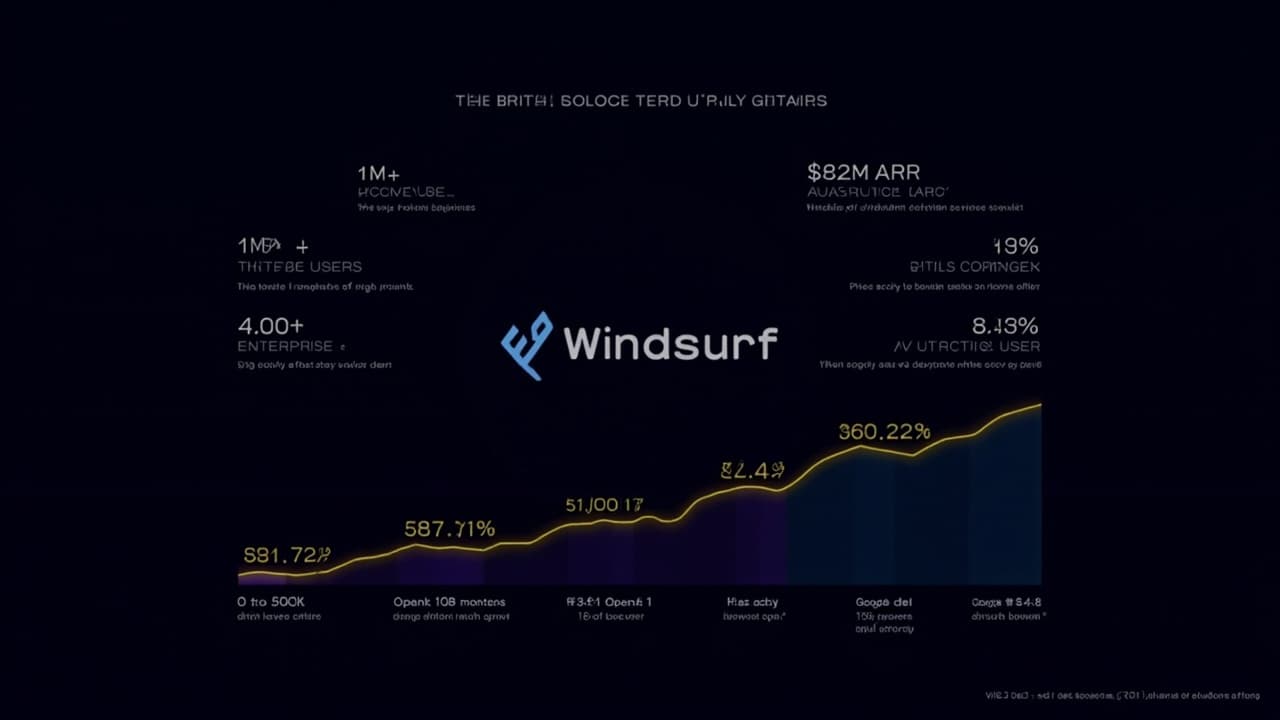
TL;DR: Windsurf (formerly Codeium) went from no product to 500K+ users in 18 months, hit $82M ARR, and got fought over by OpenAI ($3B offer) and Google ($2.4B deal). Their secret wasn't better AI. It was building a sales machine that scaled from 3 to 75 GTM reps in under a year while enterprise adoption exploded.
I dug through every public source I could find on Windsurf's trajectory. The SaaStr CRO Confidential interview with their VP of Sales, TechCrunch's ARR tracking, Reuters' acquisition reporting, the Panto statistics breakdown, and 20+ developer reviews comparing Windsurf to Cursor. After two days of research, the pattern I found isn't the one everyone's writing about.
Everyone's focused on Windsurf's AI capabilities. The real story is their GTM execution. They built an enterprise sales machine faster than almost any startup in history while simultaneously growing a million-user developer community. That dual-track approach is why Google, OpenAI, and Cognition all wanted to buy them.
The Revenue Timeline That Broke Records
Let me lay out the numbers because they're genuinely remarkable:
- April 2024: 500K+ active users, hundreds of enterprise customers
- February 2025: ~$40M ARR (TechCrunch)
- April 2025: ~$100M ARR (TechCrunch)
- July 2025: $82M ARR, 350+ enterprise customers (Reuters)
- March 2026: 1M+ active users, 4,000+ enterprise deployments, 59% of Fortune 500
Wait. February 2025 to April 2025 is two months. $40M to $100M in two months. That's $30M in new ARR per month. Even accounting for some reporting variance between TechCrunch and Reuters numbers, the growth velocity is staggering.
And the enterprise numbers tell an even more interesting story. Going from "hundreds" of enterprise customers in April 2024 to 4,000+ enterprise deployments by March 2026 means they were closing enterprise deals at a pace that would make most B2B SaaS founders weep.
The Rebrand That Almost Nobody Noticed
Here's a detail that gets overlooked. Windsurf wasn't always Windsurf.
The company started as Codeium. They built an AI coding assistant that worked across any IDE and supported 70+ programming languages. Pretty standard pitch in 2023. What wasn't standard was the adoption rate.
In April 2025, they rebranded from Codeium to Windsurf. Most companies rebrand because their old name isn't working. Codeium rebranded because they'd evolved past what the old name described. They weren't just a "code AI" anymore. They were building an agentic IDE, a tool where non-technical users could build entire applications.
The rebrand coincided with a shift in positioning. Codeium was "AI coding assistant." Windsurf was "the best AI for coding." Subtle difference. Massive strategic implication. They stopped competing in the assistant category and started competing for the entire IDE market.
The 3-to-75 GTM Scaling Playbook
This is the part that most AI startup founders should tattoo on their forearms.
When Graham Mareno joined as VP of Worldwide Sales, Codeium had approximately 200 customers generating low single-digit millions in revenue. The founders had already sold several million dollars of product themselves. No dedicated sales team. Just founders who could sell.
Graham's job: build a sales organization from scratch. Fast.
Here's what he did, and what he learned.
Hire people who bring their network
Graham's first move was blunt: "If you're hiring a sales leader who doesn't have four to six people they can recruit in four to six weeks, they're likely not ready to be a sales leader."
Over 90% of their 73 GTM hires were sourced directly by the leadership team. Not through recruiters. Not through job boards. Through personal networks built at companies like Grafana, Airtable, and Snowflake.
The lesson: your first sales hires set the culture and performance bar. When you bring in excellent operators early, they attract more excellent operators. It compounds.
Make the money obvious
Seven out of ten sellers who'd been at Windsurf for 6+ months had already exceeded their annual targets. Several were on track to earn $500K+ in W2 income. One seller closed $1.6M in four months and became a team leader.
Windsurf didn't hide this. They talked about comp openly in interviews. In sales, reputation for economic opportunity is self-reinforcing. Top talent goes where top talent is already making money.
Invest in enablement before you think you need it
Most founders resist hiring enablement specialists ($300K+/year) and RevOps people. They look expensive and their ROI is hard to quantify.
Windsurf hired them early anyway. The result: 90-day ramp periods for new sellers. In a market where AI products and messaging change constantly, getting sellers productive in 90 days instead of 180 is the difference between hitting quarterly targets and missing them.
Their enablement program included daily trivia games, weekly enablement calls, and periodic re-enablement sessions. Sounds like overkill. It's actually table stakes in a market moving this fast.
Make reps own their pipeline
Windsurf's sellers owned their own pipeline creation. This wasn't a cost-cutting measure. It was cultural. When reps generate their own pipeline, they develop a deeper understanding of the market, build direct relationships with prospects, and create accountability that no BDR team can replicate.
The Product That Made Enterprise Adoption Inevitable
The numbers on Windsurf's product usage are hard to process:
- 70M+ lines of code written by AI every day
- 94% of code output is AI-written
- 1M+ active users
- 59% of Fortune 500 companies building with it
That 94% number is the one that stops me. It means the average Windsurf user is writing 6% of their code manually and the AI handles the rest. That's not autocomplete. That's not code suggestion. That's a fundamentally different way of building software where the human's job shifts from "write code" to "describe intent and verify output."
For enterprise buyers, this translates directly to productivity metrics they can measure. If your developers ship 10x faster, the ROI calculation on a $30/user/month tool is trivially obvious.
Stack Overflow's 2025 survey found 84% of developers were using AI tools in their workflow. GitHub reported 90% of the Fortune 100 using Copilot. The market isn't debating whether to use AI coding tools. They're debating which one.
The Acquisition Saga That Proved the Market
In 2025, Windsurf became the center of what might be the most dramatic acquisition story in AI history.
First, OpenAI reportedly offered $3B to acquire Windsurf. That's a staggering number for a company that was at ~$40M ARR just months earlier. It valued Windsurf at roughly 75x ARR, a multiple that only makes sense if you believe the AI coding market is about to be enormous.
Then Google stepped in with a $2.4B "talent-and-licensing" deal, essentially buying access to Windsurf's team and technology while letting the company continue operating.
Finally, Cognition (the company behind Devin, the AI software engineer) acquired Windsurf. The price wasn't publicly confirmed, but Reuters reported the company was being discussed at valuations north of the $1.25B it had raised at in August 2024.
Three separate multi-billion-dollar offers in less than a year. That's not just validation of Windsurf. It's validation that the companies with the deepest pockets in tech all believe AI coding tools are infrastructure-level important.
What Windsurf Got Right That Most AI Startups Get Wrong
1. They didn't try to be everything at once.
Windsurf started as a code assistant (Codeium) and nailed that use case before expanding to an agentic IDE (Windsurf). Too many AI startups launch with a massive vision and half-built products. Windsurf earned the right to expand by dominating their initial niche first.
2. They respected the enterprise sales cycle.
Building an AI product is engineering work. Selling it to enterprises is sales work. These are different skills requiring different teams. Windsurf invested in dedicated sales infrastructure early and scaled it aggressively. Most AI startups try to go bottoms-up only and wonder why enterprise revenue doesn't materialize.
3. They priced for adoption, not for revenue maximization.
Free tier at $0. Pro at $15/month. Teams at $30/user/month. These prices are low enough that individual developers can expense them without approval. That bottoms-up adoption creates internal champions who then push for enterprise contracts. It's the same playbook that worked for Slack, Notion, and Figma.
4. They built trust through transparency.
94% AI-written code. 70M lines per day. 1M active users. Windsurf published their product metrics publicly. In a market full of vaporware claims and benchmark gaming, showing real usage data builds credibility that no marketing campaign can replicate.
The Mistakes They Admitted (And What You Can Learn From Them)
Graham was candid about what went wrong during the scaling process:
They underestimated the speed of market change. Their initial sales approach was built for specific customer segments. The AI landscape shifted so fast they had to pivot multiple times in the first few months. In AI, your sales playbook has a half-life of about 90 days.
They invested in enablement too late. Even though they hired enablement people relatively early, Graham wishes they'd done it two months sooner. At hypergrowth speed, two months of suboptimal seller ramp time translates to millions in lost deals.
They didn't solve territory management early enough. Managing 30+ enterprise sellers without clear territory boundaries created friction. Territory science matters even more in fast-growing markets because deal flow is high and overlap is inevitable.
They underinvested in post-sale. They were so focused on acquisition that deployment support and customer success lagged behind. In AI coding tools, the deployment experience IS the retention mechanism. If the AI doesn't work well in a customer's specific environment, they churn regardless of how good the demo was.
What This Means for Solo Founders and Small Teams
You're probably not building the next Windsurf. But the principles from their growth apply at any scale:
Your first sales hires matter more than you think. Even if it's just one person, hiring someone with an existing network of potential customers accelerates growth more than any marketing campaign.
Bottoms-up adoption is the best enterprise strategy for small teams. Make your product free or cheap enough for individuals to start using without procurement approval. Let internal champions sell for you.
Product metrics are marketing. If your product delivers measurable results, publish the numbers. "Our users ship 3x faster" is more compelling than any feature list.
Don't wait to structure your sales process. Even if you're the only person selling, document what works, what your ideal customer looks like, and what questions close deals. Future hires will need this on day one.
The AI Coding Market in Context
The broader market numbers put Windsurf's trajectory in perspective:
- GitHub has 180M+ developers on the platform
- GitHub Copilot has 20M+ paid users
- Gartner forecasts $2.52T in worldwide AI spending in 2026
- McKinsey found 23% of organizations are scaling agentic AI systems
- Stack Overflow says 84% of developers are using AI tools
The AI coding market isn't emerging. It's exploding. Developers are spending $15 billion globally on AI coding tools. Every Fortune 500 company is evaluating which tools to standardize on.
Windsurf positioned themselves at the intersection of individual developer adoption and enterprise procurement. That's the same intersection where Slack, GitHub, and Figma built category-defining businesses.
The data tells you what's happening across your product. But reading it across GA, Sentry, and App Store reviews separately means you're always looking at fragments, never the full picture. That's the exact correlation problem Windsurf solved for code generation and the exact correlation problem Luka solves for growth decisions. It connects your data sources, reads them together, finds the causal links, and gives you one clear daily priority matched to where your product actually is. Check it in the morning, know what to work on, go execute. See how Luka works.
Apply This Today
If you're selling to enterprises, write down your current sales process. All of it. Every step from first touch to closed deal. If you can't describe it clearly, you can't scale it.
Check your pricing against the "can one person expense this without approval" test. If the answer is no, you're blocking bottoms-up adoption.
Publish one product metric this week. Usage data, customer results, anything concrete. Real numbers build more trust than any testimonial.
If you have paying customers, ask three of them: "Who else in your company could use this?" Internal expansion is the lowest-friction growth channel.
Frequently Asked Questions
What is Windsurf and how is it different from Cursor?
Windsurf (formerly Codeium) is an AI-powered IDE where 94% of code output is AI-generated. Cursor enhances the coding experience for professional developers. Windsurf positions itself as a more autonomous coding environment where the AI does most of the work, while Cursor focuses on making skilled developers faster.
How much does Windsurf cost?
Free tier at $0, Pro at $15/month, Teams at $30/user/month, and custom enterprise pricing for larger deployments. The free tier is sufficient for individual exploration, and the Pro tier is cheap enough to expense without procurement approval at most companies.
Why did so many companies try to acquire Windsurf?
OpenAI ($3B offer), Google ($2.4B deal), and Cognition all pursued Windsurf because AI coding tools are seen as infrastructure-level technology. Whoever controls the developer workflow controls a significant part of the software creation pipeline. At $82M+ ARR with 4,000+ enterprise deployments, Windsurf proved product-market fit at scale.
Can Windsurf replace human developers?
Not yet, and probably not fully for a long time. The 94% AI-written code stat means humans still direct, verify, and debug. Complex architecture decisions, novel problem-solving, and integration work still require human expertise. But the role of a developer is shifting from "write code" to "manage AI code generation."
Is Windsurf good for beginners?
Yes. Their agentic IDE mode allows non-technical users to build applications through natural language descriptions. The free tier makes experimentation risk-free. For professional developers, the tool integrates across 70+ programming languages and any existing IDE.