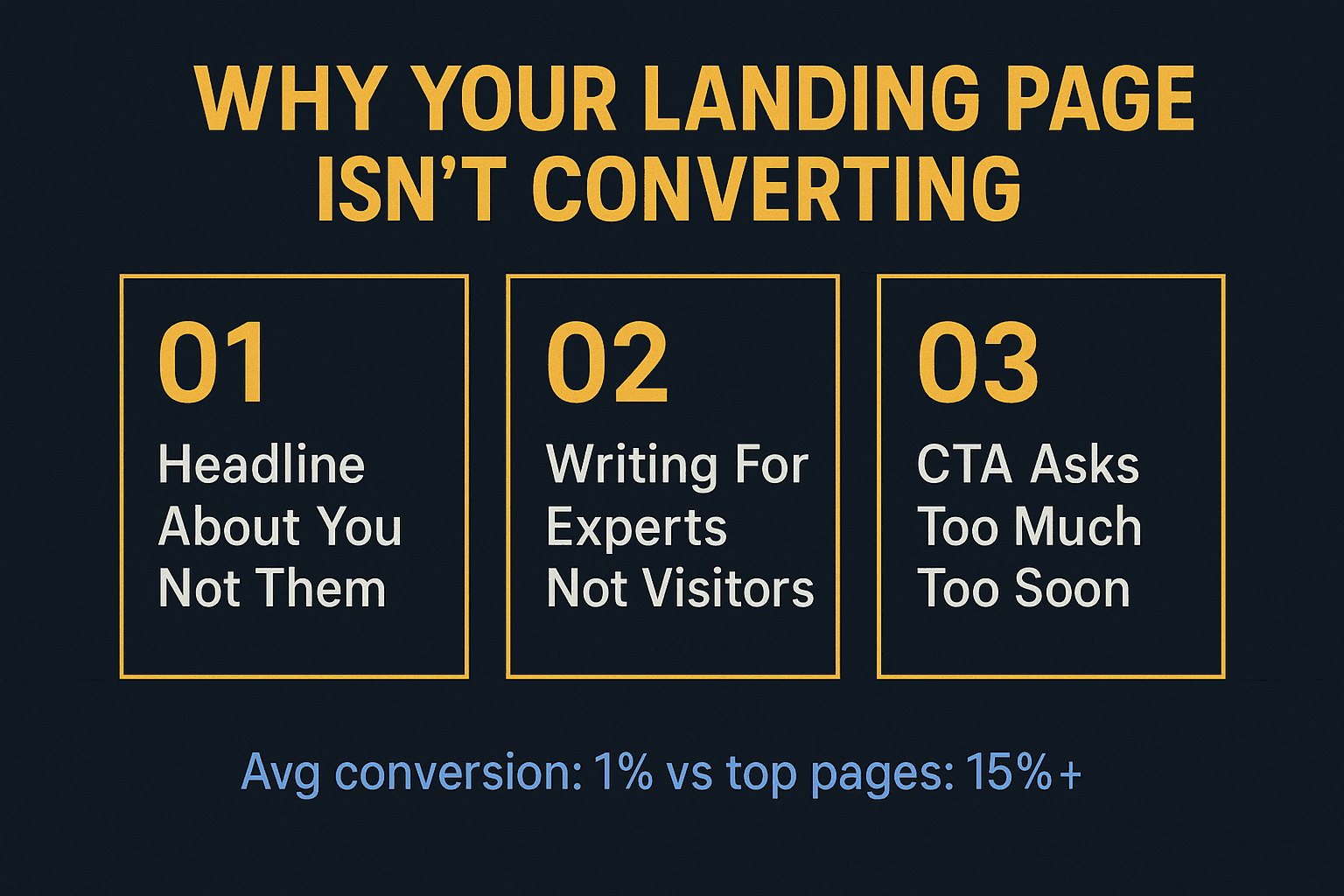
Why Your Landing Page Isn't Converting (And the Fixes That Actually Work)
TL;DR: Most landing pages fail for one of three reasons: the headline doesn't say what you actually do, the page is optimized for people who already understand the problem, or the CTA asks for too much before giving enough. All three are fixable. Here's how.
I reviewed 50 landing pages from indie hackers over the past month. Not famous companies with $10M marketing budgets. Real solo founders and small teams who asked for feedback in Reddit threads, Discord servers, and the Indie Hackers community.
The average conversion rate I estimated across them: under 1%. The top-performing ones in my sample were getting 8-12%. The gap between them wasn't design quality or traffic volume. It was three things, showing up in almost identical patterns across the worst performers.
Let me show you exactly what those patterns are and how to fix them.
The Numbers Are Probably Worse Than You Think
First, context.
The average B2B SaaS landing page converts at around 2.3-4.3%. That's the average. Median is lower. The top 10% of landing pages convert at 15-20%+. Most indie hacker landing pages I've seen are sitting at 0.5-1.5%.
That gap, between 1% and 10%, is not a gap in product quality or traffic quality. It's almost entirely a messaging and structure problem. The product is real. The traffic is real. The landing page is failing to do its job, which is to take someone who doesn't know you and give them enough reason to take the next step.
Here's the frustrating part: most founders who have low-converting landing pages have spent a lot of time on them. They've revised the design. They've added testimonials. They've adjusted the CTA color. None of those things moved the needle because they were not addressing the actual failure.
Let me walk you through the three failure modes.
Failure Mode 1: The Headline Is About You, Not Them
This is the most common problem and the highest-impact fix.
Most indie hacker landing pages have headlines that describe what the product is or what the founder built. "AI-powered email management." "The fastest way to organize your notes." "Built for teams who move fast."
None of those are bad sentences. But they are inside-out. They describe the product from the builder's perspective, not the outcome from the user's perspective.
Your headline has one job: make the person who needs what you have feel like "this is for me." Not "this sounds interesting." Not "I should come back to this." For me. Right now.
The headline that does this describes the outcome the user wants, not the mechanism you built to deliver it.
Weak headline pattern: "[Product category] + [differentiating feature]" Example: "AI email assistant that learns your style"
Strong headline pattern: "[Specific outcome] + [timeframe or qualifier]" Example: "Answer your inbox in 20 minutes a day. Not 3 hours."
The difference: the first describes what it is. The second describes what your life is like after using it.
The fastest way to test your headline: cover your product name and ask someone who doesn't know you to read just the headline. Can they tell you what specific problem it solves and who it's for? If they can't, the headline isn't specific enough.
A related mistake: being clever instead of clear. Wordplay and brand voice are fine in the body copy. The headline needs to land immediately with zero interpretation effort. You have about 5 seconds of attention from a first-time visitor. A clever headline that makes them think for 3 seconds has already spent most of that budget.
Failure Mode 2: Writing for People Who Already Understand the Problem
This one is subtle and kills a lot of otherwise strong products.
When you've been building something for 6 months, you understand the problem so deeply that you've forgotten what it's like not to understand it. You write copy that makes perfect sense to someone who has already felt the pain. Someone who hasn't felt it (or hasn't recognized it as a distinct problem) reads your page and bounces without knowing why.
I see this most often in tools built for specific workflows. The founder knows the workflow intimately. The copy assumes the reader does too.
Signs you're writing for people who already understand the problem:
- Your copy uses category jargon without defining it
- You talk about your solution before explaining the problem it solves
- Your value proposition assumes the reader agrees the problem exists and is painful
- Your "who this is for" section describes someone in the same situation as you when you built it
The fix is to front-load the problem statement and make it concrete.
Not: "Struggling with email overwhelm?" (assumes they've framed it this way) Not: "Take back control of your inbox" (vague, used by every email tool)
Better: "You spend 3 hours a day in email. Half of that is triaging messages that shouldn't need your time at all. Here's what that looks like fixed."
The structure that works: concrete problem (with specifics) -- here's why that's happening -- here's what it looks like solved -- here's how we solve it. In that order. Not: here's what we do, here's who it's for.
The goal is to have someone who doesn't know they have this problem read your page and recognize themselves. That requires describing the problem in a way that's more specific than what they would say themselves. When you get it right, they think "how did you know?" That's the feeling a converting landing page produces.
Failure Mode 3: The CTA Asks for Too Much
This is especially acute for tools with a paid tier or a sign-up wall.
The first ask you make of a visitor should be proportionate to how much trust you've built. Most landing pages ask for too much too soon.
If someone has been on your page for 30 seconds and you're asking them to enter a credit card, create an account, AND connect their data sources, you're asking for a commitment level that requires trust you haven't earned yet. Some people will do it. Most won't.
The way to think about CTAs: what is the minimum action that gets someone one meaningful step closer to experiencing value?
Not: "Start your free trial" with a 7-step sign-up form. Not: "Book a demo" when what they want is to see the product immediately.
Better: The lowest-friction path to value.
This looks different for different products:
- For a tool with an obvious "aha moment" in the product: "Try it free, no card required" with a single email field
- For a complex tool where context matters: "See a 2-minute example" with a short video, then the CTA
- For something that requires setup: "See how it works" with an interactive demo before the sign-up ask
The pattern: give value first, ask for commitment second. The CTA should feel earned, not demanded.
A specific version of this mistake: hiding the CTA because you're afraid of the "no." If the button is below the fold, uses low-contrast text, or is labeled vaguely, you're self-sabotaging. Be direct. If you believe in your product, make the CTA the clearest element on the page. A confident CTA converts better than a timid one.
The Three Fixes (In Order of Impact)
Based on reviewing 50 pages and the data on what actually moves conversion rates, here's the priority order:
Fix 1: Rewrite the headline (highest impact, fastest)
This is the single highest-impact change most landing pages can make. Before touching anything else, write 10 headline variations that describe the outcome, not the feature. Test them on people who aren't your friends. Pick the one that makes someone say "I need that" when they don't already know about your product.
Headline variants worth testing:
- Before/after: "From [current bad state] to [desired outcome]. In [timeframe]."
- Specific stat: "[Specific number] [units] saved/made/removed. For [who]."
- Plain description of outcome: "You'll never [pain] again."
Fix 2: Add a concrete problem statement in your first 100 words
After the headline, the first 100 words of your page should describe the problem in such specific, concrete terms that someone who has this problem nods their head. Not "many founders struggle with X." The exact form the problem takes in daily life.
This does double duty: it filters for the right audience (people who don't have this problem won't resonate, and that's fine) and it builds trust with people who do (you understand their problem, so they're more likely to believe you have a solution).
Fix 3: Reduce the first CTA to the minimum viable ask
Look at your primary CTA. What is the minimum number of steps a person needs to take to experience the core value of your product? Cut everything before that to the smallest it can be.
If you require an account, make creating the account one field (email) or social sign-in. If you require onboarding, shorten it ruthlessly. The first session should get to value in under 3 minutes. Everything that doesn't serve that is friction you're paying for in conversion rate.
Social Proof: A Note on What Actually Works
Most landing pages use social proof wrong. They collect testimonials that say "great product!" and put them in a carousel that 90% of visitors ignore.
Social proof that works is specific and credible:
- Named, attributed quotes from real users who describe a specific outcome (not just positive sentiment)
- Numbers that are meaningful to your ICP (not "10,000 users" if they don't know if those are paid users or free-tier signups)
- Case studies from people who look like your target user (not enterprise logos when you're selling to solo founders)
The best social proof on a landing page answers the reader's implicit objection: "This sounds interesting, but does it actually work for someone like me?" If your social proof doesn't answer that, it's not doing its job.
What Actually Doesn't Work (Save Your Time)
A/B testing CTA button colors. You've seen the posts about the "red button vs green button" debate. Color testing without fixing messaging is rearranging deck chairs. Fix the message first. Then optimize.
Adding more features to the page. The instinct when conversion is low is to add: more testimonials, more feature descriptions, more use cases. This usually makes it worse. Landing pages that convert well are almost always shorter and simpler than the founder's instinct suggests. Cut more.
Making the design more elaborate. Some of the highest-converting indie hacker landing pages are embarrassingly plain. Clarity beats beauty every time. A beautiful page with unclear messaging will underperform a plain page with a specific, compelling headline.
Chasing best practices from big companies. Stripe's landing page works for Stripe because their audience is developers who already know what payments infrastructure is. Your page needs to work for YOUR audience. Copy the principles, not the execution.
Before spending another week iterating on your landing page, ask one harder question. Is the landing page actually your bottleneck right now, or is there something else in your funnel leaking more? Some products send people to a perfectly good landing page, get sign-ups, and then lose 60% of users in onboarding. Fixing the landing page in that scenario doesn't move revenue. The real fix is somewhere else. You need your data to tell you where.
That cross-source view of where growth is actually blocking is what Luka does. It reads your Google Analytics, Sentry errors, App Store reviews, and social signals together, finds the causal links, and tells you which stage of the funnel is actually your bottleneck at your current stage. Not every stage at once. The one that, if you fixed it today, would actually move your numbers. Check it in the morning, know what to point your energy at, close it, go do it. See how Luka works.
Apply This Today
Here's the exact sequence:
Step 1 (today): Write 10 headline variations. Pick one. Put it live. Track for 7 days.
Step 2 (this week): Find 3 people who fit your target user profile who have never seen your landing page. Ask them to read it out loud for 60 seconds and tell you what they think the product does. If they can't describe it accurately, your messaging has a problem.
Step 3 (this week): Look at your funnel data. Where is the biggest drop-off? Landing page to sign-up, sign-up to first meaningful action, or somewhere in product? Fix the biggest leak first, not the most visible one.
Step 4 (ongoing): Read one great landing page per week with the same intentional attention you'd give a good book. What does the headline do specifically? How does it sequence the argument? Where is the first CTA and why there?
Landing pages are not a "launch and forget" asset. They're a continuously iterated argument for why someone should try your product. The founders who get good at this get dramatically better conversion numbers over time.
Frequently Asked Questions
What's a good landing page conversion rate for an indie hacker product?
Anything above 3% for a targeted traffic source is solid. Above 5% means your messaging is working well. Above 10% is exceptional and usually means you have strong message-market fit. If you're below 1%, the messaging needs significant work before the traffic quality or volume matters.
Should I hire a copywriter or fix it myself?
If you haven't run the 10-headline exercise and the "60-second user test" yet, do those first. Many founders discover they can dramatically improve conversion with 2-3 hours of focused rewriting. If you've done that and conversion is still low, then getting expert eyes on the messaging is worth it.
How do I know if my headline is specific enough?
The test: read your headline aloud. Can a stranger who doesn't know your product understand who it's for and what problem it solves in one read? If they have to ask a follow-up question to understand, it's not specific enough.
Does page length matter?
Yes, but not in the direction most people assume. Shorter is usually better for first-impression conversion. But longer pages can work for higher-friction purchases where trust needs to be built. The rule: every section must justify its presence by answering a question the target user has. If you can't explain why a section is there, cut it.
I've tried these fixes and conversion is still low. What now?
Go upstream to traffic quality. If you're getting general traffic (social media shares, Product Hunt spike), those audiences often convert poorly on landing pages because they're not in buying mode. High-intent search traffic converts much better. Check: are people finding you by searching for the solution you offer, or are they arriving with no context?
About the Author