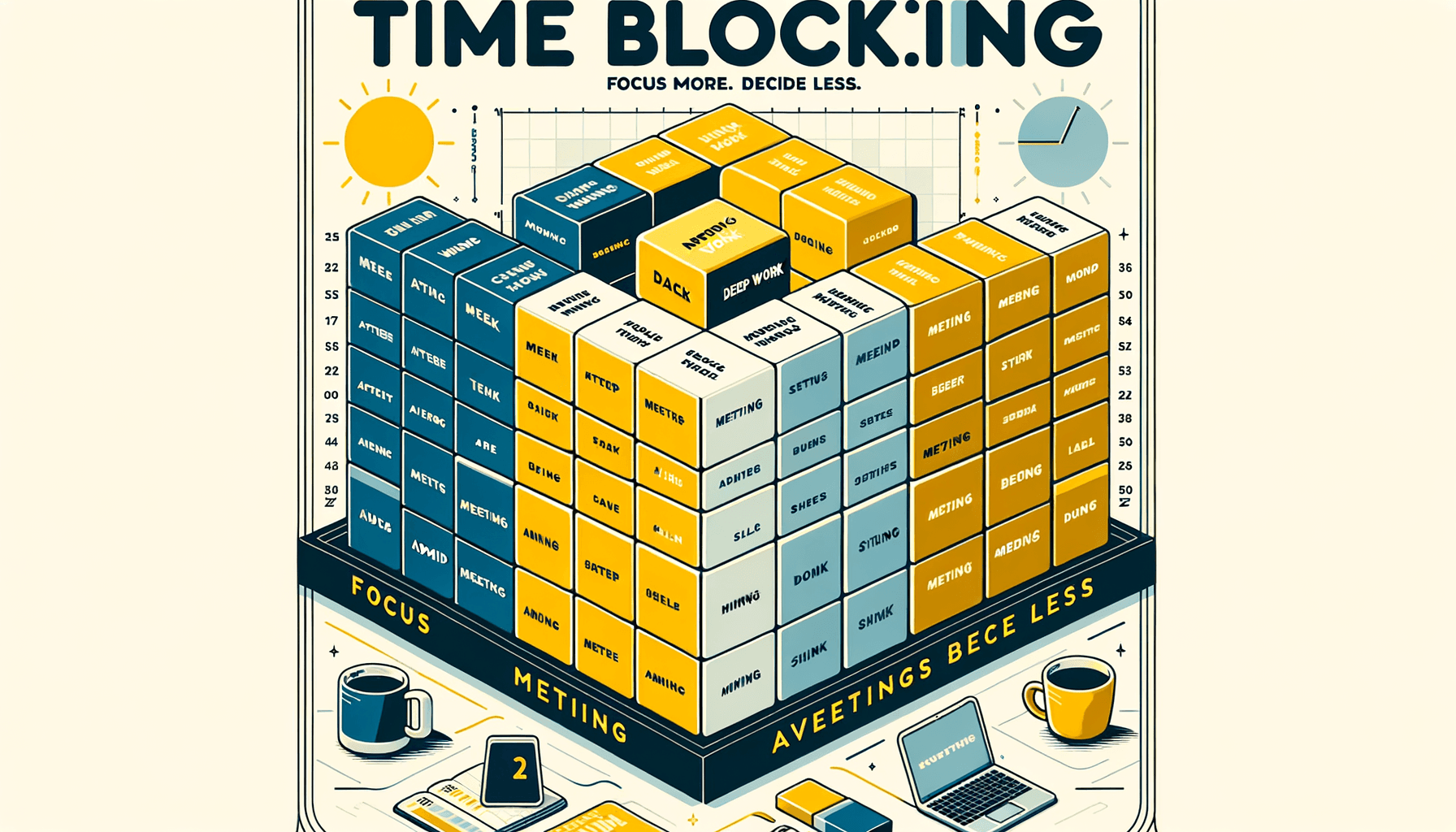
Time Blocking for Solo Founders: The Only Scheduling System That Works
TL;DR: Time blocking isn't about filling your calendar with tasks. It's about deciding in advance what you WON'T do during specific hours. Solo founders who time block consistently ship 2-3x more than those who "work on whatever feels urgent." Here's the exact system that works, and the common mistakes that break it.
I'm going to tell you something that sounds obvious but most founders get wrong: your calendar should look full even when you have no meetings.
Not full of calls. Full of work blocks. Dedicated hours where you decided what you're doing before the day started.
Most solo founders I talk to run their days reactively. They wake up, check email, respond to whatever seems urgent, and then wonder why they're exhausted by 6pm with nothing shipped. Their calendar shows three meetings. The rest is white space. And white space is where productivity goes to die.
Time blocking fixes this. Not by making you busier. By making you intentional.
What Time Blocking Actually Is
Time blocking is simple in concept: you assign specific tasks to specific time slots in advance. Instead of a to-do list you'll "get to eventually," you have a calendar that tells you exactly what you're doing at 10am on Tuesday.
But here's what most people miss: time blocking is primarily a constraint tool, not a scheduling tool.
The power isn't in knowing what you WILL do. It's in knowing what you WON'T do.
When you block 9am-12pm for deep work on your product, you're not just planning to work on your product. You're deciding that you won't check email, won't jump on random calls, won't "quickly handle" that customer support ticket. The block is a shield, not just a plan.
This distinction matters because solo founders face infinite demands on their time. Everything feels urgent. Everything has a "quick" reason to interrupt your focus. Without explicit blocks, you'll default to urgency every time.
Why Traditional To-Do Lists Fail Solo Founders
Before we get into the system, let's talk about why you probably tried time blocking before and quit.
To-do lists are seductive because they're open-ended. You write down 15 things, feel productive, and then spend your day fighting fires. At 8pm, you look at the list and realize you did 4 items, none of them the important ones.
The problem: to-do lists don't respect time.
Writing "build landing page" on your list treats it the same as "reply to John's email." Both are items. But one takes 4 hours of focused effort and one takes 5 minutes between other tasks.
When you don't assign time to tasks, you create two problems:
1. You underestimate how long things take.
This is called the planning fallacy. Humans consistently think tasks will take less time than they do. Without explicit time blocks, you'll plan for a fantasy version of your productivity.
2. You let urgent-but-small tasks eat your important-but-large tasks.
Small tasks feel like progress. Reply to an email? Done. Fill out that form? Done. But the big tasks that actually move your business forward require sustained focus. Without protected time, they never get the hours they need.
The Solo Founder Time Blocking System
Here's the system I recommend. It's not complicated. The challenge is actually following it.
Step 1: Define Your Three Work Types
Solo founders do three types of work:
Deep Work: Creating, building, thinking. Requires 2+ hours of uninterrupted focus. This is where leverage lives. Writing code, designing products, creating content, strategic planning.
Shallow Work: Administrative tasks, email, Slack, quick decisions. Necessary but not valuable. Should be batched and contained.
Meetings/Calls: Synchronous communication with others. Has its place but should be minimized and grouped.
Most founders spend 60-70% of their time on shallow work and wonder why they're not shipping. Aim for the opposite: 60%+ on deep work.
Step 2: Block Your Calendar in Advance
Every Sunday (or Friday afternoon), block the upcoming week. Here's how:
Deep work blocks first. These are non-negotiable. Minimum 2 hours each. Morning is usually best for most people. Put these on your calendar before anything else.
Example:
- Monday 9am-12pm: Deep work (product)
- Tuesday 9am-11am: Deep work (content)
- Wednesday 9am-12pm: Deep work (product)
- Thursday 9am-11am: Deep work (product)
- Friday 9am-12pm: Deep work (whatever needs it)
Shallow work gets one or two designated slots. This is when you check email, respond to messages, handle admin. Contain it.
Example:
- Daily 4pm-5pm: Email, admin, quick tasks
Meetings get compressed into one or two days. Don't let calls scatter across your week. Pick Tuesday and Thursday afternoons, or whatever works for you, and refuse calls outside those windows.
Example:
- Tuesday 2pm-5pm: Available for calls
- Thursday 2pm-5pm: Available for calls
Step 3: Protect Your Blocks Religiously
This is where most people fail. They block time, then ignore the blocks when something "urgent" comes up.
Here's the mindset shift: your deep work blocks ARE meetings. They're meetings with your most important work.
Would you cancel a meeting with an investor to answer a customer email? No. So don't cancel your deep work block either.
Practical protection tactics:
Turn off notifications during deep work. All of them. Slack, email, phone. Use Focus mode on Mac or Do Not Disturb on your phone.
Close email and Slack entirely. Not minimized. Closed. You can't be tempted by what you can't see.
Tell people when you're available. "I check email at 4pm daily." Set expectations so people don't expect instant responses.
Have a shutdown ritual. When your deep work block ends, deliberately transition. Close those tabs. Switch modes consciously.
Step 4: Buffer Between Blocks
Never schedule back-to-back blocks with no gap. You need transition time.
Recommended buffers:
- 15 minutes between different block types
- 30 minutes after intense deep work
- 10 minutes between meetings
These buffers aren't wasted time. They're recovery time. Your brain needs to context-switch. Fighting this just makes you slower.
Step 5: Review and Adjust Weekly
Every week, look at what actually happened versus what you planned.
Questions to ask:
- Did I protect my deep work blocks?
- What interrupted me? Can I prevent that next week?
- Were my time estimates accurate?
- Am I spending enough time on high-leverage work?
Time blocking isn't about perfection. It's about continuous improvement. You'll miss blocks, get interrupted, and underestimate tasks. That's fine. Adjust and try again.
The Deep Work Multiplier
Here's why deep work blocks are so powerful: focus compounds.
The first 30 minutes of a deep work session are warmup. You're getting into the problem, loading context into your brain, remembering where you left off.
Minutes 30-90 are where real progress happens. You're in flow. Solutions come faster. You see connections you missed before.
After 90-120 minutes, returns diminish. Your brain gets tired. Take a break.
This pattern explains why three 1-hour blocks produce less than one 3-hour block. You spend all your time warming up and never reach the productive zone.
It also explains why interruptions are so devastating. A 5-minute Slack check doesn't cost 5 minutes. It costs 25 minutes: the 5 minutes plus the 20 minutes to get back to where you were.
Protect long blocks. They're where the real work happens.
Common Time Blocking Mistakes
Mistake 1: Blocks That Are Too Specific
Don't block "Write landing page copy for launch" from 9-11am Monday. Block "Deep work: marketing" instead.
Why? Because you'll waste the first 15 minutes deciding what to work on, feel constrained if a better opportunity emerges, and feel like a failure if you don't finish the specific task.
Block the category of work. Decide the specific task when you start the block.
Mistake 2: Not Blocking Recovery Time
Working 8 deep work hours in a day sounds productive. It's not. It's a recipe for burnout.
Most people can sustain 4-5 hours of genuine deep work daily. The rest should be lighter work, recovery, or genuine breaks.
Build lunch into your calendar. Build a walk. Build time to stare out the window. This isn't laziness; it's sustainability.
Mistake 3: Calendar Tetris
Your calendar shouldn't look like a game of Tetris with every minute filled. You need slack in the system.
Unexpected things will happen. Calls will run long. Tasks will take longer than expected. If your calendar has no gaps, one delay cascades into chaos.
Build in buffer blocks. Call them "Flex time" or "Buffer" or "Overflow." Use them to catch up or, if everything's on track, take a break.
Mistake 4: Treating All Deep Work as Equal
Not all deep work blocks need the same energy. Some tasks require peak mental clarity. Others just need focus and time.
Match task difficulty to your energy levels:
- Peak hours (usually morning): Hardest, most creative work
- Medium energy: Technical work that requires focus but not creativity
- Low energy: Deeper admin, research, documentation
Know your personal energy patterns and schedule accordingly.
Mistake 5: Never Saying No to Meetings
Time blocking only works if you actually protect the blocks. This means saying no to meetings during deep work time.
Scripts that work:
- "I'm not available until 2pm. Would that work?"
- "I have that time blocked for focused work. How about Tuesday afternoon?"
- "Can this be an email or Loom video instead?"
Most meetings don't need to be meetings. Most "urgent" calls can wait a few hours. Set boundaries or your blocks will erode.
The Solo Founder Ideal Week
Here's a template ideal week. Adapt it to your reality, but start with something like this:
Monday
- 9:00am-12:00pm: Deep work (product)
- 12:00pm-1:00pm: Lunch / break
- 1:00pm-3:00pm: Deep work (product)
- 3:00pm-3:30pm: Buffer
- 3:30pm-5:00pm: Shallow work (email, admin)
Tuesday
- 9:00am-11:30am: Deep work (content or marketing)
- 11:30am-12:00pm: Buffer
- 12:00pm-1:00pm: Lunch
- 1:00pm-5:00pm: Meeting window / calls
Wednesday
- 9:00am-12:00pm: Deep work (product)
- 12:00pm-1:00pm: Lunch
- 1:00pm-3:00pm: Deep work (product)
- 3:00pm-3:30pm: Buffer
- 3:30pm-5:00pm: Shallow work
Thursday
- 9:00am-11:30am: Deep work (flexible - whatever needs it)
- 11:30am-12:00pm: Buffer
- 12:00pm-1:00pm: Lunch
- 1:00pm-5:00pm: Meeting window / calls
Friday
- 9:00am-12:00pm: Deep work (product)
- 12:00pm-1:00pm: Lunch
- 1:00pm-3:00pm: Shallow work / catch up
- 3:00pm-4:00pm: Weekly review
- 4:00pm-5:00pm: Plan next week
This gives you:
- 20-24 hours of deep work weekly
- Meeting calls contained to two afternoons
- Shallow work batched, not scattered
- Built-in buffers and recovery
Most importantly: you decide in advance what you're doing. You show up Monday knowing the plan. No decision fatigue about "what should I work on now?"
Handling the Objections
"But I need to be responsive to customers"
Do you? Or have you trained customers to expect instant responses?
Set expectations. "We respond to all emails within 24 hours" is reasonable. Check email twice daily during your shallow work blocks. Unless you're running a support team, you don't need to be in your inbox constantly.
"My business is too unpredictable"
Some businesses genuinely have random urgent demands. Most don't.
Track for a week: what actually interrupted you? Most "urgent" things could have waited 2-3 hours. The truly urgent things can break into your blocks. But make exceptions rare, not normal.
"I work better spontaneously"
Do you? Or do you just feel busier?
Try time blocking for two weeks. Actually measure output. Most people who "work better spontaneously" discover they're just more comfortable with chaos, not more productive.
"I've tried this before and quit"
Then you need smaller blocks or better protection. Start with one 2-hour deep work block daily. Build from there. Don't overhaul your entire schedule at once.
The Real Secret
Time blocking works because it forces you to make decisions in advance, when you're clear-headed and not emotional.
At 9am on Monday, you don't ask "what should I do now?" You look at your calendar and it says: "Deep work: product." So you start working on your product.
No negotiation. No "maybe I should check email first." No "let me just quickly handle this one thing." The decision was made Sunday. Now you execute.
This is the opposite of how most people work. Most people make hundreds of small decisions throughout the day: what to work on, when to check messages, whether this thing is urgent. Each decision drains willpower and opens the door to distraction.
Time blocking reduces those decisions to almost zero. You made them in advance. Your job now is just to follow the plan.
You just read that time blocking fails for solo founders because context-switching is baked into the job. Every customer conversation, every urgent bug, every unexpected opportunity breaks the block. The system needs to absorb that volatility, not resist it.
The problem is that even when you fix the time problem, the content problem remains: what do you put in the blocks? For most founders, the answer is whatever feels urgent, which means the important-but-not-urgent work, market research, competitive analysis, growth planning, never actually gets protected time.
Luka is a research and growth agent for solo founders. It handles the work that should go in your protected blocks but keeps getting displaced: market research, competitive analysis, content strategy, outreach. The work that benefits from focused thinking and never gets it. If time blocking hasn't solved the right problem yet, Luka is worth a look.
Apply This Today
Block your deep work time for next week. Right now. Open your calendar and add 2-hour blocks for your most important work. Do this before you close this article.
Pick one shallow work window. Decide when you'll check email and handle admin. Put it on the calendar. Commit to checking email ONLY during that window.
Compress your meetings. Look at next week's calls. Can any be rescheduled to cluster together? Can any be emails instead?
Protect one block this week. Just one. When something tries to interrupt it, say no. See how it feels to actually complete a full block of uninterrupted work.
Review on Friday. Did you protect your blocks? What got in the way? Adjust for next week.
Time blocking isn't complicated. It's just discipline. Start small, build the habit, and watch your output multiply.
Frequently Asked Questions
How long should a deep work block be?
Minimum 90 minutes, ideally 2-3 hours. Shorter blocks don't give you enough time to warm up and reach peak productivity. Longer than 3 hours leads to diminishing returns for most people. Cal Newport's research suggests 4 hours of deep work daily is about the maximum for sustained performance.
What if something truly urgent comes up during a block?
Handle it, then return to your block. The key word is "truly urgent." Your cofounder having an emergency? Handle it. A customer asking a question that could wait 2 hours? That's not urgent; that's a boundary problem.
Should I time block weekends?
That's personal. Some founders prefer complete separation between work and rest. Others like to do one focused block on Saturday morning. The key is being intentional either way: either fully off or deliberately on.
What tools should I use for time blocking?
Your existing calendar works fine. Google Calendar, Apple Calendar, Fantastical, whatever you already use. The method matters more than the tool. Some people like paper planners for this. Others use Notion or Obsidian. Use what you'll actually maintain.
How do I handle time zones and async teams?
Block your deep work during your peak hours, regardless of when others are online. Communicate your availability clearly: "I check Slack from 4-5pm UTC." Asynchronous communication works better with clear windows than with constant availability anyway.
About the Author