Why Taste is the Ultimate Competitive Advantage in the AI Age
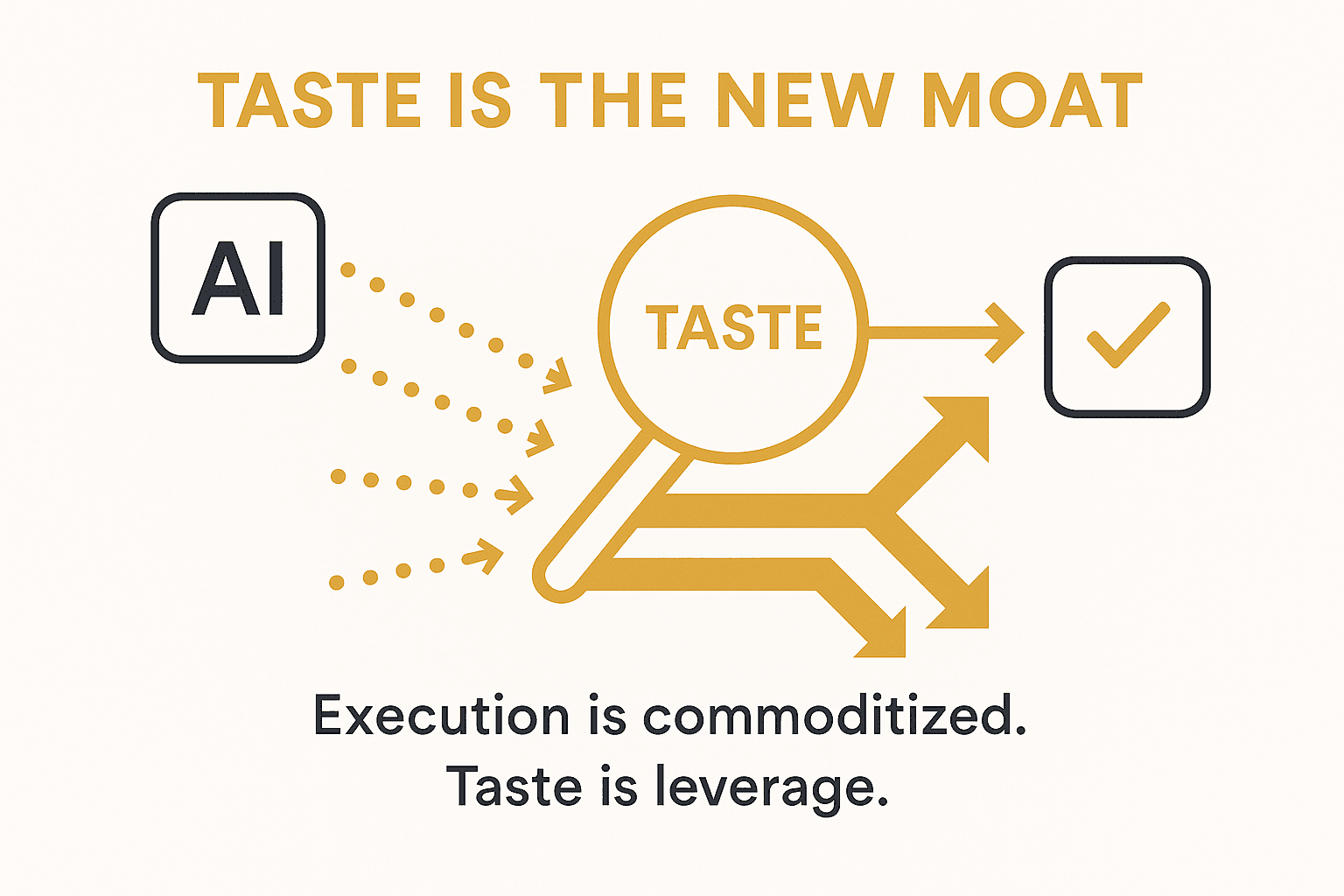
TL;DR: AI can generate code, copy, and campaigns in minutes. But it can't have taste. In a world where execution is commoditized, the founders who win are the ones who know what NOT to build. Taste is the new moat.
I spent two hours going through Matt Gray's latest carousel, the comments underneath it, and a rabbit hole of related posts about what separates premium brands from forgettable ones. After scrolling through hundreds of takes on AI and competitive advantage, a pattern emerged that nobody's talking about directly.
The best comment on the post nailed it: "Execution is getting automated. Taste is becoming the new leverage. The real advantage isn't tools. It's discernment. Knowing what not to build, not just what to ship."
That's the insight. Let me unpack it.
The Execution Commodity Problem
Here's what happened in 2024-2025: AI made execution cheap.
Cursor can write your code. Claude can draft your copy. Midjourney can generate your visuals. Bolt.new can build your entire MVP in an afternoon. The tools that used to require teams of specialists now run on $20/month subscriptions.
So what's left?
The founders still struggling are the ones who think the bottleneck is execution. They're wrong. The bottleneck moved.
The new bottleneck is taste.
You can have the right strategy. The right offer. The right systems. But if your taste is average, your brand will feel average. And average doesn't survive when anyone can ship.
What Taste Actually Means
Taste isn't some mystical aesthetic sense you're born with. It's a skill. A trainable one.
Taste is the thing that makes someone stop scrolling. It's the reason one brand feels premium and another feels generic. It's why some founders build audiences that actually care and others just accumulate followers who never engage.
More specifically, taste is:
Judgment — Knowing what's worth building and what's noise. The ability to look at ten options and pick the right one without analysis paralysis.
Curation — Understanding what to include AND what to leave out. Most people add. Taste subtracts.
Intuition trained by exposure — Pattern recognition built from consuming excellent work. You can't have good taste if you've only seen mediocre examples.
Taste shows up in the details:
- The font you choose
- The spacing in your slides
- The way you frame a shot
- The transitions in your videos
- The words you cut from your copy
- The features you DON'T build
It's not about more. It's about less, but better.
Why AI Can't Replicate Taste
AI is an execution machine. Give it a prompt, it produces output. But here's what it can't do:
It can't feel the cringe. When something is almost right but subtly wrong, humans feel it. AI doesn't. It can generate 50 logo options, but it can't tell you which one will make your brand feel trustworthy versus cheap.
It can't know your context. AI doesn't know that your audience hates corporate speak. It doesn't know that your competitor just used that exact hook. It doesn't understand the cultural moment you're trying to capture.
It can't say no. AI optimizes for prompts. It gives you what you ask for. Taste says "don't ask for that in the first place."
The founders using AI well aren't the ones generating more. They're the ones with enough taste to filter the output ruthlessly.
The Taste Deficit Problem
Here's why most founders have mediocre taste: they're consuming mediocre content.
Think about your average day. You scroll through your feed, see hundreds of posts, most of them forgettable. You watch videos that are fine but not memorable. You read copy that's competent but not compelling.
You're training your pattern recognition on average examples. Then you wonder why your own work feels flat.
The math is simple: garbage in, garbage out. If you spend 8 hours a day looking at mid-tier content, your internal quality bar calibrates to mid-tier.
This is why "reference hunting" is a real skill. Designers at top agencies don't just jump into execution. They spend hours curating examples of excellence. They study why a specific brand makes them feel something. They obsess over the small decisions that separate good from great.
Most founders skip this step because it feels unproductive. It's not shipping. It's not coding. It's not measurable.
But it's the work that makes the other work worth doing.
How to Actually Train Your Taste
Taste compounds. The more you refine it, the faster you recognize what works. And the faster you can ship things that feel premium without overthinking every detail.
Here's how to accelerate the process:
1. Curate ruthlessly
Create a swipe file, but be brutal about what goes in. The bar isn't "this is good." The bar is "this made me stop and feel something."
Most people's swipe files are too big. They save everything remotely interesting. That defeats the purpose. You want a small collection of excellence, not a large collection of decent.
Rule: For every 100 things you see, save 1. If you're saving more, your bar is too low.
2. Consume above your level
If you're building a SaaS for indie hackers, don't just study other indie hacker products. Study Apple. Study Stripe. Study the brands that make you feel something even when you're not their target customer.
The goal isn't to copy them. The goal is to understand the principles that make them work, then translate those principles to your context.
3. Study the decisions, not just the outcomes
When you find something excellent, don't just save it. Analyze it.
- Why did they choose this font over that one?
- Why is the spacing exactly this tight?
- What did they leave out that most people would include?
- What's the ONE thing they're optimizing for?
The magic is in the decisions, not the deliverable.
4. Practice the "subtraction edit"
Take something you've made. Now remove 30% of it. Force yourself to decide what's essential and what's decoration.
This is painful. Everything feels necessary when you made it. But taste is knowing what to cut, and you can only learn by cutting.
5. Expose yourself to bad examples
This sounds counterintuitive, but it works. Look at obviously bad design, copy, or products. Articulate WHY they're bad. What specific decisions made them fail?
Understanding failure sharpens your sense of success.
Taste as Competitive Moat
Let's get strategic about this.
In a market where anyone can ship, the differentiator is quality of judgment. Two founders with the same tools, same budget, same market will produce wildly different results based on their taste.
Founder A generates 50 landing page variations with AI, picks the one that tests best, ships it.
Founder B generates 50 variations, immediately eliminates 45 because they feel wrong, refines the remaining 5 based on principles they've internalized, ships one that didn't test best but FEELS right.
Short term, Founder A might win. Long term, Founder B builds a brand.
This is because taste creates consistency. Every decision flows from the same internal compass. Over hundreds of small decisions, that consistency compounds into something recognizable, something trustworthy.
Generic brands feel generic because each decision was made in isolation. They optimized individual pieces without a unifying vision. The pieces don't cohere.
Brands with taste feel intentional. You can sense that someone cared, even if you can't articulate why.
The Anti-Taste Trap
Here's where most founders go wrong: they confuse taste with perfectionism.
Taste doesn't mean spending weeks on font selection. It doesn't mean paralysis. It doesn't mean shipping nothing while you wait for inspiration.
Taste is a filter, not a blocker. It's fast pattern recognition: "This works, this doesn't, move on."
The founders with the best taste often ship the fastest. They've internalized quality so deeply that they don't need to deliberate. They see the right answer and execute.
The founders who ship slowly usually aren't perfectionists with high taste. They're uncertain people who haven't trained their judgment enough to trust it.
Speed and taste aren't opposites. They're correlated.
What This Means for You
If you're reading this, you probably build things. Products, content, brands. Here's how to apply this:
Today: Start a taste file. Create a folder where you save only the absolute best examples you encounter. Be ruthless about the bar.
This week: Pick one thing you've made recently. Remove 30% of it. Ship the leaner version.
This month: Identify three brands that make you feel something. Spend an hour each studying their decisions. Write down what you notice.
Ongoing: Notice when you're consuming average content. Deliberately seek better inputs. Your taste can only be as good as your references.
You just read that taste is the moat when execution is commoditized. The implication: you can't out-execute an AI model, but you can out-curate it. The problem most founders run into is that developing taste requires exposure. To your market, to what's working, to what competitors are doing and why. That exposure doesn't happen automatically.
Most solo founders are too deep in the build cycle to regularly consume the content, competitors, and market signals that sharpen taste. They surface for air and realize they've been making decisions in a vacuum.
Luka is a research and growth agent for solo founders. It handles the market and competitive research that keeps you calibrated to what's actually happening in your space: what competitors are shipping, what content is landing, where the market is moving. So your taste is informed, not just instinctive. Luka is worth looking at if you want your strategic judgment to stay sharp.
The Bottom Line
AI will replace execution. It already is. If your competitive advantage is "I can code fast" or "I can write copy," you're about to have a bad time.
But AI won't replace judgment. It won't replace the ability to see what others miss. It won't replace the conviction to build something that feels different.
Taste is the new moat. It compounds over time. It's hard to copy because it's not a tactic, it's a trained sensibility.
The question isn't whether you can build. Everyone can build now. The question is whether what you build is worth building.
Train your taste. It's the only advantage that gets stronger as AI gets better.
Frequently Asked Questions
Can taste really be learned, or is it something you're born with?
Taste is 100% trainable. It's pattern recognition built through deliberate exposure to excellent examples. Some people develop it earlier because of their environment, but anyone can build it through intentional practice. The key is consuming better inputs and actively analyzing what makes things work.
How do I know if my taste is good enough?
Look at your past work from 6 months ago. If you cringe, your taste is improving. If it still looks fine, you've plateaued. The gap between your taste and your ability is where growth happens. You also know your taste is developing when you start noticing details that you previously would have missed.
Isn't focusing on taste just an excuse to not ship?
Bad taste is an excuse not to ship. Good taste actually speeds you up. When you've internalized quality standards, you make decisions faster. You don't deliberate over 20 options because you can immediately eliminate 18. Taste is a filter that increases velocity, not a perfectionism trap that decreases it.
How long does it take to develop good taste?
Depends on how deliberately you practice. If you're actively curating references, studying decisions, and practicing subtraction, you'll see meaningful improvement in 3-6 months. If you're passively consuming whatever's in your feed, it'll take years or never happen at all.
About the Author