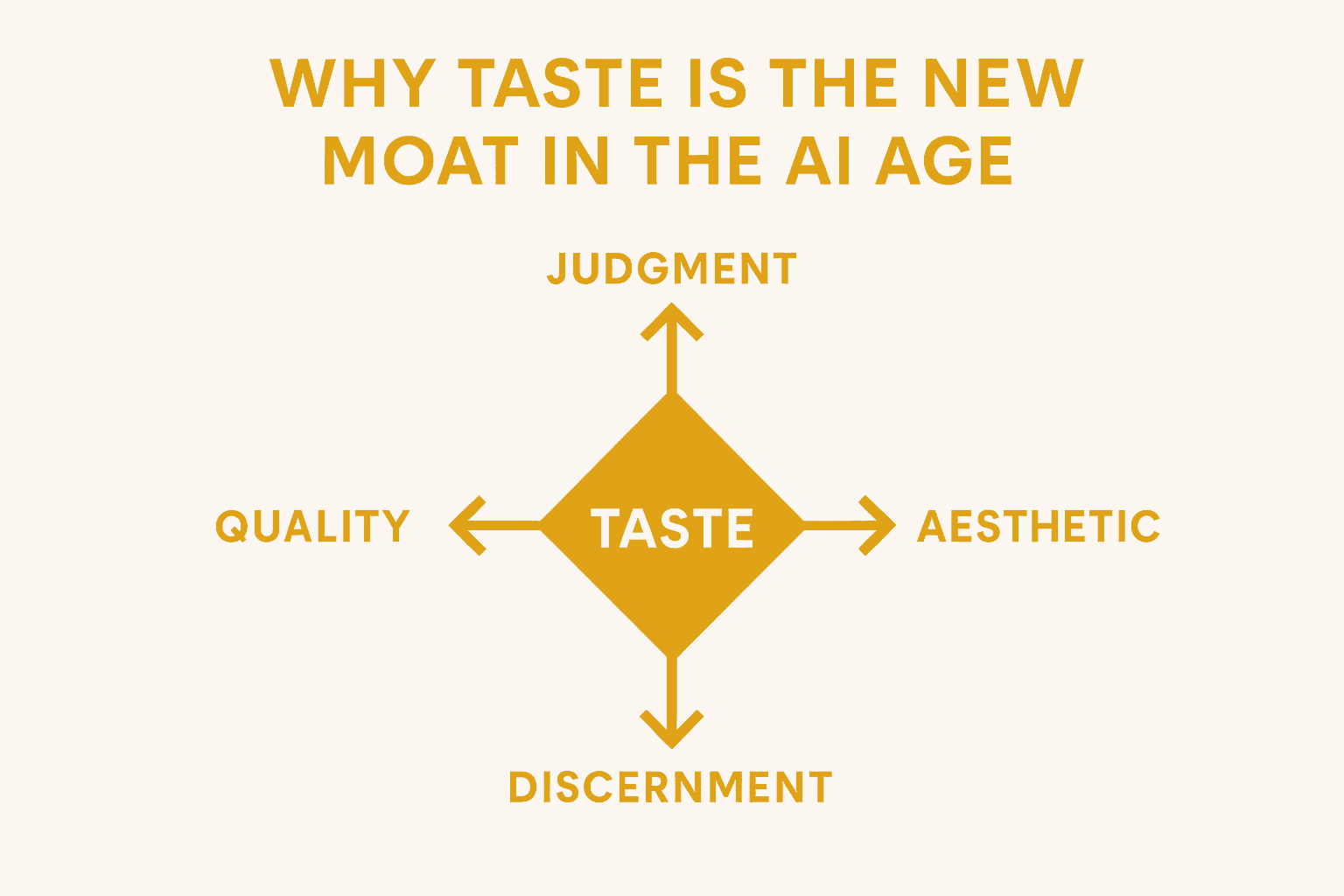
Why Taste Is the New Moat in the AI Age
TL;DR: I spent hours reviewing essays, founder interviews, and operator breakdowns on why product quality feels increasingly same-y in AI software. The pattern is clear: when everyone can ship fast, execution speed stops being the edge. Taste becomes the filter that decides what should exist, what should be cut, and what users remember.
I went down a rabbit hole on this one: Greylock’s updated moat thesis, founder commentary from AI-native operators, and product examples from tools that users describe as “feels right” instead of “has feature parity.” The common claim is not that taste suddenly appeared in 2026. It is that AI compressed build time so hard that directional judgment became the bottleneck. In plain English: building got cheaper, deciding got harder. If you are an indie founder, this is not a philosophy problem. It is a survival problem.
The Market Shift Nobody Wants to Admit
For years, startup advice treated speed as the king metric. Ship faster. Test faster. Iterate faster. That logic worked when product teams still faced heavy execution constraints. If a team needed two months to ship one substantial product change, then shipping cadence itself created competitive distance.
Now look around. Vibe coding stacks, code generation, no-code production workflows, and agent-assisted QA have reduced time-to-feature dramatically. That is good. But it changes where value accrues.
When most teams can now produce a usable version of the same feature in days, your edge is no longer “we shipped this.” Your edge is “we shipped the right version of this, for the right user, with the right emotional texture, at the right moment in the journey.”
That is taste.
Taste is not visual polish. It is not choosing a trendy font. It is not adding gradients and calling it premium. Taste is directional judgment under uncertainty. It is knowing which tradeoffs are worth making and which are expensive distractions.
What I Found in the Research
Three sources kept converging.
First, in Greylock’s “The New New Moats,” the argument is that value is shifting around the stack as open source and model availability expand. Bigger players still have scale advantages, but that does not erase startup opportunity. It changes where startups should differentiate. If capability diffusion is accelerating, then founders need defensibility outside raw model access.
Second, in operator-level writing like PodPlay’s “Taste as a Moat in the Age of AI,” you see a practical framing: when everyone can produce “pretty good,” what wins is curation, restraint, and coherent product POV.
Third, in broader founder discourse, the same pattern appears as a complaint: “Our team shipped more than ever this quarter and user love did not move.” That is exactly what you expect when output increases but selection quality does not.
Everyone Thinks More Features = More Growth
Everyone thinks shipping velocity alone compounds.
But after reviewing how strong products sustain preference, the better model is this:
- Velocity gives you opportunity volume.
- Taste determines opportunity quality.
- Quality determines retention, referral, and brand memory.
Founders who ignore this keep paying a hidden tax: feature drag. Every mediocre feature increases UI complexity, cognitive load, support burden, and onboarding friction. Then the team solves the complexity they created by adding more features. That spiral kills focus.
The 5 Components of Taste That Actually Matter
1) Restraint
Taste says no more than it says yes. Most founders say they value simplicity but still ship defensive features because competitors launched something similar. Restraint is not minimalism theater. It is refusing to expand surface area unless the addition creates obvious user leverage.
2) Sequencing
A high-taste product does not just have good features. It reveals them in the right order. Most activation problems are sequencing failures. Users are asked to do too much before first value.
3) Friction Design
Not all friction is bad. Good products remove bad friction and preserve constructive friction. For example, instant publishing might feel magical, but some workflows need a deliberate checkpoint to avoid expensive errors.
4) Narrative Consistency
Great products have coherent personality. The copy, interface, defaults, and onboarding all tell the same story. Low-taste products feel like five teams shipped five products under one logo.
5) Contextual Judgment
Taste is not universal. It is contextual. The right tradeoff for a consumer social app may be wrong for B2B infrastructure. Taste means choosing for your user’s emotional and functional context, not generic “best practices.”
Why AI Amplifies Taste Instead of Replacing It
A lot of founders secretly hope AI will answer direction questions too: what to build, for whom, when, and why. That expectation is understandable and mostly wrong.
AI is exceptional at generating candidate outputs. It can produce variants, summarize feedback, and accelerate experimentation. But it cannot, by default, own your point of view. It does not carry your risk tolerance, brand promise, customer intimacy, or strategic asymmetry.
When teams outsource judgment to generic prompts, they converge toward average. Average is usable. Average rarely wins.
The sharper move is using AI for breadth while retaining founder-level curation for depth.
A Practical Taste Operating System for Indie Founders
If you run solo or with a tiny team, you need process, not vibes.
Step 1: Define Your Product Taste Thesis
Write this in one paragraph:
- What should your product feel like in use?
- Which user behaviors do you optimize for?
- Which tradeoffs are non-negotiable?
If this is fuzzy, every sprint becomes reactive.
Step 2: Build a Kill List Before a Build List
Before planning features, list what you will not ship this quarter. This prevents reactive roadmap bloat.
Step 3: Introduce a “Should Exist?” Gate
For each proposed feature:
- Does it strengthen your product’s core promise?
- Does it reduce time-to-value?
- Would your best users miss it if removed?
- Does it increase long-term complexity more than user leverage?
If you cannot answer clearly, the feature should probably wait.
Step 4: Run a Weekly Taste Review
Not a bug review. Not a metrics review. A taste review.
Look at:
- Dead zones in onboarding
- Confusing copy
- UI decisions made for internal convenience
- Features with low adoption but high maintenance cost
Step 5: Track “Love Metrics,” Not Just Activity Metrics
Activity can rise while affinity falls. Track signals like:
- “Would be disappointed if unavailable” responses
- Direct recommendation rate
- Organic screenshots or unsolicited social proof
- Time-to-first-win perception, not just completion rate
What This Means for Builders Using Cursor, Lovable, Bolt, and Agents
Execution tools are incredible. Use them aggressively. They reduce shipping cost and increase creative throughput.
But they introduce a risk: overproduction without selection discipline. You can now produce low-leverage output faster than ever.
The founder advantage is no longer “I can ship.” The advantage is “I can choose.”
High-performing founders in 2026 are not anti-AI. They are anti-randomness. They use AI to expand option space, then apply hard judgment to narrow it.
Common Mistakes to Avoid
Mistake 1: Confusing polish with taste
A polished mediocre idea is still mediocre. Taste starts with structural decisions, not UI paint.
Mistake 2: Copying winning products without copying their context
You can clone a feature. You cannot clone the user base dynamics that made it work.
Mistake 3: Treating roadmap requests as roadmap truth
Users request what they can articulate, not always what creates durable value.
Mistake 4: Rewarding output volume internally
If your team celebrates number of releases more than user outcome quality, you are training for noise.
Mistake 5: Believing optionality is always good
Too many options reduce confidence. Great products often win by deleting options.
The more AI-assisted building gets normalized, the more painful this gets for founders: you can keep shipping and still feel directionless. You open analytics, then support logs, then social mentions, then app reviews, then bug reports, and every source points at a different fire. That’s exactly where Luka is useful. Luka connects your product signals across sources, correlates what they mean together, and surfaces the specific issue most blocking growth at your current stage. You check it in the morning, know exactly what to work on, and go do it. It is intentionally in-and-out. If you want to stop mistaking activity for progress, see how Luka works.
Apply This Today
If you only do one thing after reading this, do a 60-minute “taste debt” session.
- List your last 10 shipped changes.
- Mark each as core-leverage or peripheral-noise.
- Estimate maintenance cost for each.
- Delete or deprecate one low-leverage element this week.
- Add one high-conviction improvement to your first-value path.
Then keep this discipline every week for a month. Most founders discover their product does not have a speed problem. It has a selection problem.
Frequently Asked Questions
Is taste just another word for intuition?
No. Intuition can be random. Taste is trained judgment grounded in user context, product strategy, and repeated exposure to quality references.
Can early-stage founders build taste without a design background?
Yes. Taste is not exclusive to designers. It comes from deliberate analysis of great products, postmortems on weak decisions, and consistent user observation.
Does taste matter if I am still pre-product-market-fit?
It matters more. Early-stage teams have limited attention. Poor selection burns runway on features that don’t move activation or retention.
Should I prioritize taste over speed?
False tradeoff. You need both. Use AI to increase speed, then apply taste to control direction and prevent noise accumulation.
How do I know if my product lacks taste?
Look for symptoms: strong release volume, weak retention movement, confusing onboarding, feature sprawl, and users describing the product as “useful but messy.”
About the Author