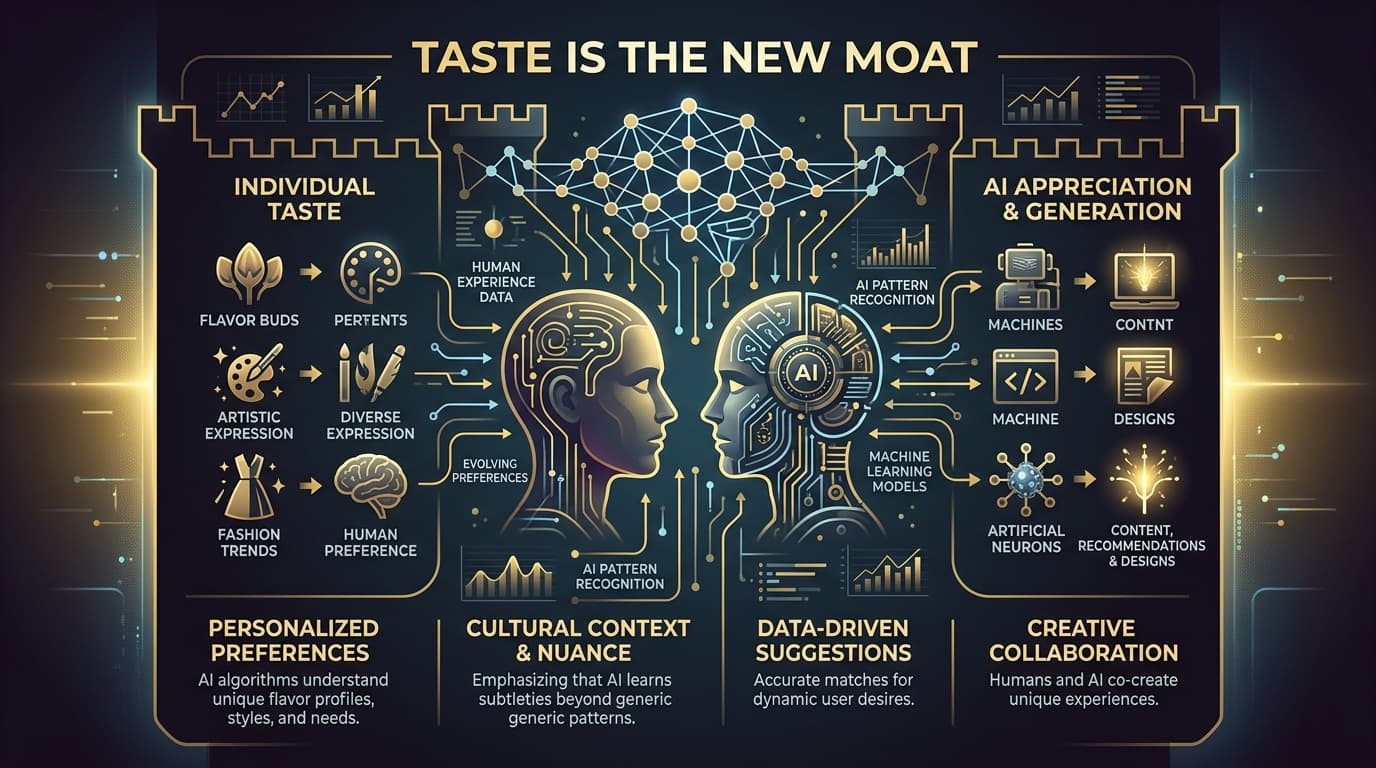
Why Taste is the New Moat in the AI Age (And How to Build It)
TL;DR: AI can generate anything. But it can't generate taste. That's your competitive advantage. After analyzing the most successful indie hackers and creators, the ones who thrive have one thing in common: they make better decisions about what to build than AI can direct them toward. Here's how to develop that taste.
Here's a pattern I've noticed in every successful builder I've studied in the last year. They don't outcode their competitors. They don't outwork them. They out-decide them.
They make better decisions about what to build, what to cut, what to ship, and what to ignore. And that ability to decide, to judge, to curatethat is taste.
AI can write code faster than any human. It can generate designs, write copy, and produce content at scale. But it can't look at ten directions and know which one matters. That requires something AI doesn't have: taste.
The Shift That Changes Everything
For the last decade, the moat was execution. The founder who could ship fastest, who could build the most features, who could iterate the quickest, won. Speed was the differentiator.
Now AI has commoditized speed. Anyone can generate a full-stack app in hours. Anyone can produce a landing page in minutes. Anyone can write marketing copy in seconds.
The bottleneck has shifted. It's no longer about what you can build. It's about what you should build.
And that's where humans have an advantage that AI can't replicate. Not forever, maybe. But for the foreseeable future, the edge belongs to those who can direct AI with judgment.
Taste is the ability to look at options and pick the right one. It's the judgment call that separates a product people love from a product that's just functional. It's the difference between something that feels inevitable and something that feels random.
What Taste Actually Means
Taste gets thrown around as a vague concept, so let me be specific. Taste is the ability to make decisions that other people haven't made yet but will later recognize as obvious.
When you choose the right feature to build, that's taste. When you cut the feature that seemed important but actually distracts from the core value, that's taste. When you pick the exact words on your landing page that convert while everyone else is writing generic copy, that's taste.
Taste is not about being different for the sake of different. It's about being right in a way that others can feel but can't quite articulate.
The best founders I've observed have taste that shows up in every decision. The colors they pick. The features they prioritize. The content they create. The users they serve. Every decision radiates a point of view.
Why AI Can't Replace Taste (Yet)
AI generates options. It produces variations. It can show you 100 versions of something and ask you to pick.
But AI can't decide which one matters.
Here's the fundamental limitation: AI optimizes for what it's told to optimize for. It can follow instructions. It can learn patterns. But it can't look at a direction and feel that it's right the way a human can.
There's something in the human experience that AI doesn't have access to. Cultural context. Emotional resonance. The unspoken sense of what feels right versus what just works.
When you're building a product, you're not just solving a problem. You're creating an experience. You're making someone feel something. AI doesn't understand that. It can't feel.
That's your moat. The ability to create something that resonates on a human level is not something AI can learn from data alone. It requires being human.
The Three Components of Taste
Based on studying founders who consistently make better decisions, I've identified three components that make up taste.
The first is pattern recognition from diverse exposure. The more high-quality work you've seen, the better you can judge what's good. This is why designers often have strong taste. They've looked at thousands of pieces of work and developed an intuition for what works.
The second is opinionated point of view. Taste is not neutral. It prefers some things over others. The founders with the strongest taste are the ones who will tell you exactly what's wrong with most products in their space. They have opinions that they can defend.
The third is the willingness to cut. Taste is as much about what you exclude as what you include. The best product decisions are often the decision to not build something. That requires conviction that AI can't have.
How to Develop Your Taste
Here's the practical part. You can develop taste. It's not innate. It's trained. And the training method is specific.
First, consume at scale. Look at hundreds of products, hundreds of landing pages, hundreds of pieces of content. Not passively. Actively judge everything. Ask yourself: what works, what doesn't, and why.
Second, form opinions and defend them. Don't be neutral. When you see something, decide if it's good or bad and articulate why. Write it down. Argue with yourself. Change your mind when the evidence warrants it, but stop being a blank slate.
Third, study the winners. Not just what they built, but what they chose to build. Why did they prioritize that feature? Why did they write those words? The decision is the interesting part.
Fourth, ship and iterate. Taste develops fastest when you're making decisions and seeing results. You need feedback loops. What you thought was good but wasn't? What you thought was risky but worked? These data points train your taste.
Fifth, find feedback from people with better taste than you. Surround yourself with people whose judgment you respect. Let them tear apart your work. The correction is where the learning happens.
What This Means for Indie Hackers
If you're building in the AI age, your job has changed. You're no longer the builder. You're the director.
Your value is not in the code you write. Anyone can write code now. Your value is in the decisions you make about what to build, what to prioritize, and what to ignore.
This is terrifying for some founders. It means you can't just work hard. You have to think well. You have to develop judgment. You have to cultivate taste.
But it's also liberating. It means the playing field has shifted from who can execute fastest to who can decide best. And that's a game anyone can play if they're willing to do the work.
The founders who thrive in the next five years will be the ones who treat taste as a skill to develop, not a talent they're born with. They'll be intentional about their consumption, their opinions, and their decisions.
The Taste Economy
What's emerging is what I call the taste economy. In this economy, the valuable skill is not production. It's curation. It's direction. It's the ability to look at what AI can do and point it toward what matters.
This is why I believe indie hackers have an advantage. You can move faster than big companies. You can make decisions faster. You can iterate faster. If you develop taste, you can direct AI to create things that large teams with their bureaucratic decision-making processes cannot match.
The bottleneck is no longer engineering. It's judgment. And judgment is human.
This is exactly the problem Luka is built to solve. You have data everywhere, and most of it is noise. What Luka does is read across your data sources, find the signals that actually matter, and tell you what to work on next based on where your product actually is. Not what feels urgent. What the data says is blocking growth. You check it in the morning and go execute on the priority that moves the needle. See how Luka works.
Apply This Today
Here's how to start developing your taste this week.
Audit your last 10 decisions. What did you choose and why? Would someone with better taste have chosen differently? What was the outcome? Write this down.
Pick one product or landing page you admire. Analyze every decision. Why those colors? Why that copy? Why that feature set? Write a breakdown.
Form an opinion about something in your space that you can defend. What is wrong with most products? What would you do differently? Write it down and share it.
Cut something from your product. One feature, one page, one workflow. If you're not willing to cut, you're not exercising taste.
Frequently Asked Questions
Can AI help develop taste?
AI can accelerate the process by showing you variations and options. But the judgment itself remains human. Use AI to explore the space, but you have to be the one who decides.
How long does it take to develop taste?
It depends on how intentionally you practice. If you're actively consuming, judging, and shipping, you can see meaningful improvement in three to six months. The key is consistency and feedback.
Is taste the same as design?
No. Taste extends beyond design. It encompasses product decisions, content strategy, user experience, pricing, and positioning. Design is one output of taste, but not the whole thing.
What if I don't have a design background?
Taste is not about formal training. It's about judgment. Anyone can develop it by being intentional about what they consume and forming strong opinions about what they see.
About the Author