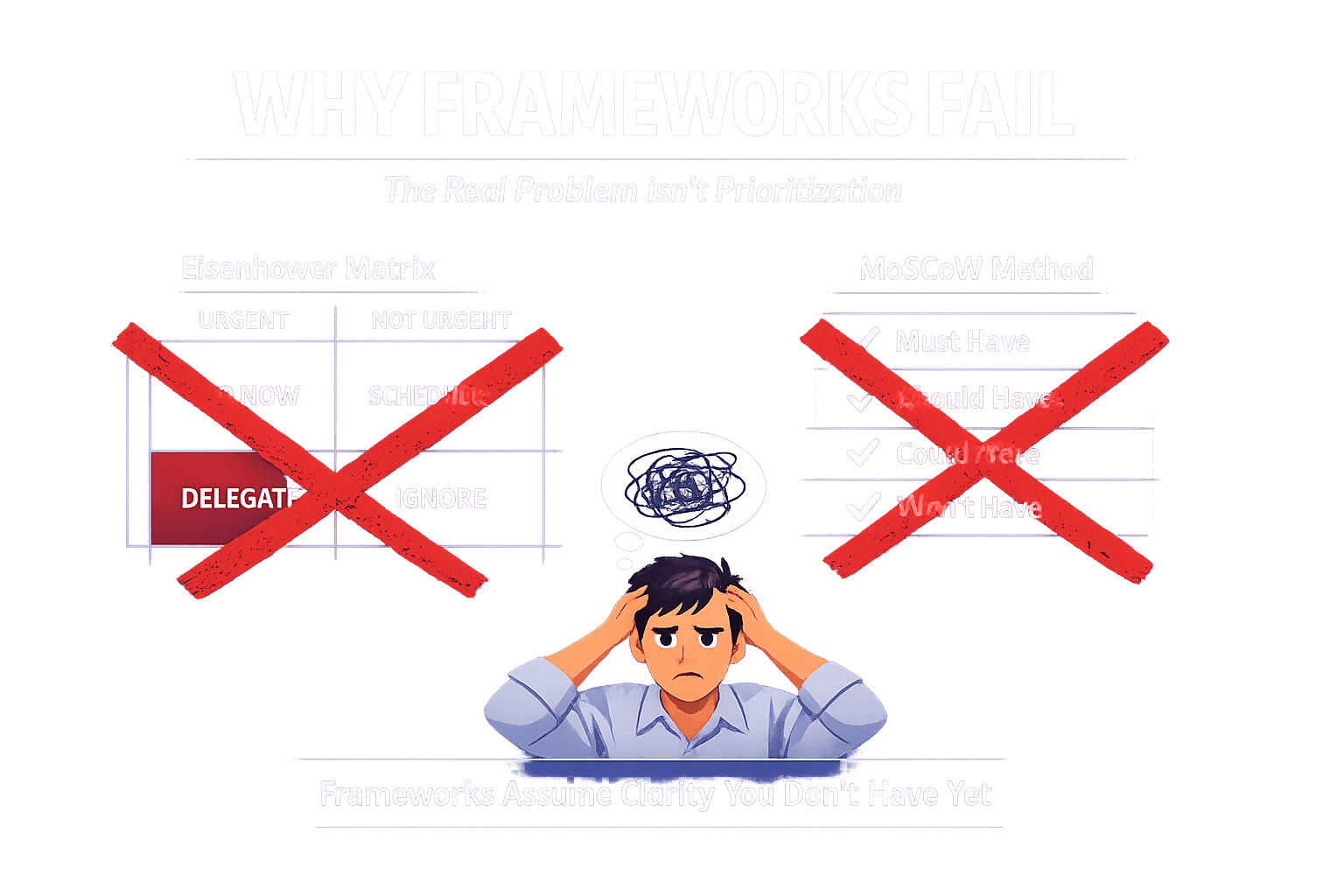
Why Prioritization Frameworks Fail Solo Founders (And What to Do Instead)
TL;DR: RICE, Eisenhower Matrix, MoSCoW - they're all designed for teams with dedicated product managers. For solo founders, these frameworks create more decisions than they solve. Here's what actually works when you're the only one making calls.
The Uncomfortable Truth About Prioritization Frameworks
Every prioritization framework has the same fundamental problem: you make dozens of micro-decisions to make one actual decision.
Take RICE scoring - the darling of product management Twitter. To prioritize 5 features, you need to:
- Estimate Reach for each (5 decisions)
- Estimate Impact for each (5 decisions)
- Determine Confidence for each (5 decisions)
- Calculate Effort for each (5 decisions)
That's 20 decisions to make 1 choice. And here's the kicker: most of those estimates are complete guesswork anyway.
I've watched solo founders spend entire afternoons building elaborate Notion databases with weighted scoring systems, color-coded priorities, and dependency mappings. Then they ship nothing for a week because they're too exhausted from deciding what to decide.
This is insane.
Why These Frameworks Exist (And Why You're Not the Target)
RICE was invented at Intercom - a company with hundreds of employees, multiple product teams, and stakeholders who need to justify decisions to each other. The framework exists to create alignment across large organizations and give PMs ammunition for executive debates.
The Eisenhower Matrix was designed for, well, a president running an entire country. He had a staff of hundreds to delegate to.
MoSCoW prioritization comes from enterprise software development where scope creep and stakeholder management are existential threats.
None of these contexts match yours.
You're a solo founder. You don't need to justify decisions to anyone. You don't have a team to delegate "important but not urgent" tasks to. You don't have competing stakeholders demanding features.
You have one problem: deciding what to work on today.
Using enterprise frameworks for this is like using a chainsaw to butter toast.
The Real Enemy: Decision Fatigue
Here's what nobody talks about: the scarcest resource for solo founders isn't time. It's decision-making capacity.
Research from Columbia and Stanford shows that people make worse decisions as they make more of them. Judges grant parole at 65% in the morning but only 10% before lunch - not because criminals get worse throughout the day, but because decision fatigue sets in.
Every time you evaluate "is this a 3 or a 4 on the impact scale?" you're burning cognitive fuel that could go toward actual work.
The frameworks that promise to reduce decision fatigue actually amplify it. They just disguise the decisions as "process."
The goal isn't better prioritization. It's fewer prioritization decisions.
What Actually Works for Solo Founders
I've tried everything. Here's what I've landed on after burning months of productivity on framework theater:
1. The One Question Filter
Ask yourself: "If I could only ship one thing this month, what would it be?"
That's your priority. Full stop.
Not "what are my top 3 priorities" - that's just a shorter list to stress about. One thing.
This question forces clarity because it makes trade-offs explicit. You can't hedge with "well, these are all important." Pick one.
Write it on a sticky note. Put it on your monitor. When you catch yourself working on something else, ask why.
2. The 5-Minute Timer Rule
For any decision that doesn't involve significant money or irreversible consequences: set a 5-minute timer. Decide before it rings.
This sounds reckless until you realize most decisions don't improve with more analysis. You're not discovering new information - you're just cycling through the same considerations with increasing anxiety.
The research backs this up: quick intuitive decisions and slow analytical decisions have roughly the same accuracy for most choices. The difference is one takes 10x longer and leaves you depleted.
Things that deserve more than 5 minutes:
- Hiring decisions
- Major financial commitments
- Shutting down a product line
- Legal stuff
Everything else? Timer.
3. Kill the List
Stop maintaining a backlog of ideas. Seriously.
Every item on your "someday maybe" list creates a tiny cognitive tax. Your brain keeps track of unfinished loops. Psychologists call this the Zeigarnik effect - incomplete tasks occupy mental bandwidth even when you're not actively thinking about them.
A backlog of 50 features isn't an asset. It's 50 open loops draining your focus.
Instead:
- Write ideas in a daily note
- If something is still relevant next week, you'll think of it again
- If you forget it, it wasn't important
This feels scary at first. "What if I lose a great idea?"
You won't. Good ideas are sticky. They come back. Bad ideas fade, which is exactly what you want.
4. Revenue-First Filtering
Before adding anything to your radar, ask: "Will this make money in the next 30 days?"
If no - skip it. This includes "building audience," "improving documentation," and "refactoring for scale."
This sounds aggressive because it is. But here's the reality: as a solo founder, you're probably 3-6 months from running out of runway at any given time. Everything that doesn't generate revenue is a bet that something else will.
Make fewer bets. Make them pay off faster.
5. The Anti-Roadmap
Traditional roadmaps are fantasies dressed up as plans. They pretend you know what you'll be working on in Q3 when you can barely predict next week.
Instead, maintain a "current bet" and a "next bet."
Current bet: The one thing you're focused on right now. Next bet: The one thing you'll focus on after this ships.
That's it. Two items. When the current bet ships (or fails), the next bet becomes current, and you pick a new next bet.
This keeps you focused while acknowledging that priorities change. No elaborate quarterly planning. No Gantt charts. Just the current thing and the next thing.
The Framework I Actually Use
After years of experimentation, here's my entire prioritization system:
Every morning, answer one question: "What's the one thing that, if I do it today, will make everything else easier or unnecessary?"
Write it down. Do that thing first.
That's it. No scoring. No matrix. No database. One question, one answer, one morning ritual.
Some days the answer is obvious. Some days I sit with the question for 10 minutes. But I never spend hours maintaining a prioritization system.
The time I save goes into actual work.
When Frameworks Make Sense
I'm not saying frameworks are always wrong. They make sense when:
- You have a team that needs alignment on what to build
- You have stakeholders who demand justification for priorities
- You're scaling past yourself and need to delegate decision-making
- You face genuine uncertainty about which of two equally-viable paths to take
But if you're a solo founder in the early stages? Skip the frameworks. Your job is to ship, learn, and iterate as fast as possible. Every hour spent on prioritization theater is an hour not spent learning from customers.
The Uncomfortable Takeaway
Most prioritization frameworks exist to help large organizations create the illusion of rational decision-making. They're political tools dressed up as productivity tools.
For solo founders, they're worse than useless - they're actively harmful. They consume the cognitive resources you need for actual work and give you nothing but the feeling of being productive.
The founders who break through aren't the ones with the best prioritization systems. They're the ones who make fast decisions and course-correct based on reality.
Stop optimizing your decision process. Start deciding faster.
You just read about why RICE scores and MoSCoW matrices are the wrong tool for the job. The frameworks aren't the problem. They add decision overhead to a process that should reduce it. A framework that takes 20 minutes to apply per task is a worse problem than no framework.
The underlying issue isn't methodology. It's that solo founders are making too many decisions in domains they haven't researched enough. You shouldn't need a framework to decide whether to pursue enterprise customers if you've already done the analysis on who's actually buying.
Luka is a research and growth agent for solo founders. It does the pre-work that makes the decisions obvious: market analysis, customer segment research, competitive positioning, growth channel evaluation. The kind of work that means you don't need a framework because the answer is clear. Luka is worth looking at if you're spending more time prioritizing than executing.
Action Steps for This Week
Day 1: Delete your backlog. All of it. If something matters, you'll remember it.
Day 2: Write down your one priority for the month. Tape it to your monitor.
Day 3: Practice the 5-minute timer on every decision. Notice how often you decide in the first minute anyway.
Day 4: Count how many hours you spend on "meta-work" (planning, organizing, prioritizing). Be honest.
Day 5: Take those hours back. Ship something.
This is part of what Luka does - cutting through the noise to tell you what actually matters today. Not a prioritization framework. Just clarity.
About the Author