Why Less Ambitious Goals Grow Faster: The ScreenshotOne Story
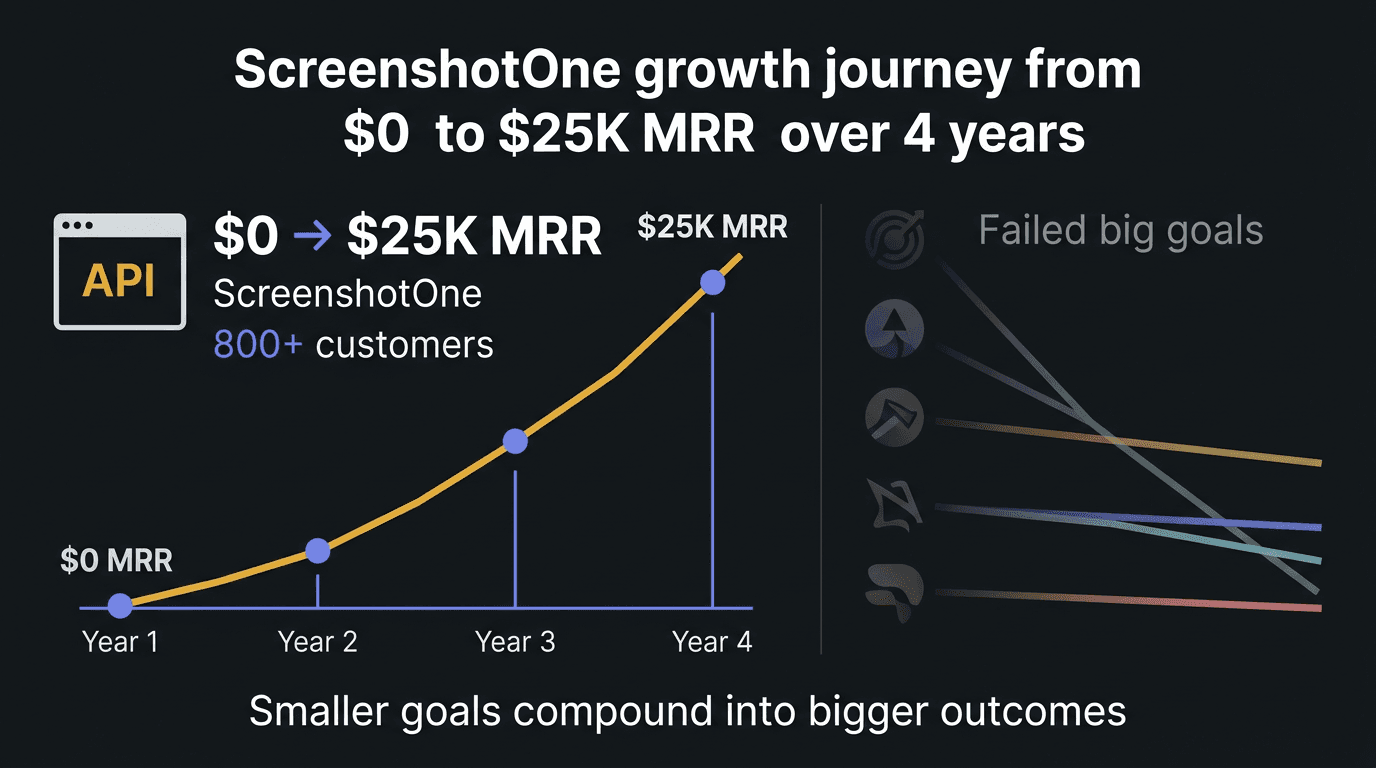
TL;DR: Dmytro Krasun failed repeatedly because his goals were too big. When he downsized his ambitions and focused on achievable steps, he built ScreenshotOne to $25K+ MRR in four years. The counterintuitive lesson? Smaller goals compound into bigger outcomes.
I spent three hours reading Dmytro Krasun's journey with ScreenshotOne. His story kept circling back to one confession that made me pause: he only started seeing results when he downgraded his ambition. Not hustled harder. Not worked more hours. Just made his goals smaller and more achievable.
That sounds wrong. Everything about startup culture tells you to think bigger, aim higher, shoot for the moon. But Dmytro's numbers don't lie. After years of failing with grand plans, he focused on one narrow problem, took small steps, and crossed $25K MRR with 800+ paying customers.
Here's what I found when I dug into why smaller goals actually grow faster.
The Trap of Ambitious Goals
Dmytro had been a software engineer for 10+ years. Computer science degree, solid career, the whole package. He wanted entrepreneurship. He craved autonomy and independence. He kept trying to start something.
He failed every time.
The pattern is familiar to anyone who's built anything. You come up with an ambitious idea. You plan everything out. You get overwhelmed. You quit.
What's happening isn't a motivation problem. It's an architecture problem.
When you set a massive goal, you create a psychological burden. Every day you don't hit that goal feels like failure. The gap between where you are and where you want to be grows. Your brain interprets that gap as pain. Eventually, the pain exceeds your tolerance and you stop.
This is why so many indie hackers start strong and fade. It's not burnout. It's goal fatigue.
The Smaller Goals Framework
Dmytro's breakthrough came from a simple shift: instead of setting goals that excited him, he set goals he could actually hit.
This sounds unambitious. It's not. It's strategic.
When you hit a goal, your brain releases dopamine. That dopamine fuels the next action. The next action gets you closer to the outcome. The cycle compounds.
The math works like this:
- Big goal: Hit rate 10%, dopamine hit 0 (because you rarely hit it), momentum dies
- Small goal: Hit rate 80%, dopamine hit frequent, momentum builds
Momentum beats intensity every time.
The mistake most founders make is optimizing for the size of the goal instead of the probability of completion. Dmytro flipped that equation. He asked: "What's the smallest goal I can set that still moves me forward?"
That question changed everything.
How ScreenshotOne Started
Dmytro spent five months building ScreenshotOne, from January to May 2022. This wasn't an AI-powered rapid build. No coding agents to accelerate him. Just one engineer pushing through the hard parts.
The initial stack was simple:
- One server
- Go for everything
- JavaScript for managing browsers
Notice what's missing. No microservices architecture. No complex infrastructure. No "scale-ready" systems.
He built the smallest possible version that worked.
Over time, the stack evolved. It grew to include Next.js for the dashboard, Astro for marketing, TypeScript for browser management, Cloudflare for caching and storage, Kubernetes for hosting. But all of that came after the product was working and generating revenue.
This is the pattern I see in almost every successful indie hacker story. They start with a narrow problem, build a simple solution, ship it, and iterate. They don't architect for scale. They don't plan for hypothetical users. They don't over-engineer.
They ship the smallest thing that solves one problem for one person.
The Two-Year Realization That Changed Everything
Dmytro spent two years growing ScreenshotOne before the most important insight clicked.
He didn't know who he was building for.
This sounds ridiculous. How do you build something for two years without knowing your customer? But it's more common than you think.
Most founders start with a problem they find interesting. They build a solution. They ship. They wait for users.
Those users don't arrive. Or they arrive but don't convert. Or they convert but churn quickly.
The problem isn't the product. The problem is the market alignment.
When Dmytro finally identified who ScreenshotOne was actually for, everything changed. His marketing. His copy. His feature prioritization. His pricing. All of it aligned around a specific customer with a specific need.
His advice to anyone starting: either build for yourself, or invest heavily in understanding who you're building for.
This is the mistake I see repeated constantly. Founders build for "small businesses" or "developers" or "creators." Those aren't customers. Those are categories. Within each category are thousands of sub-segments with different problems, different budgets, different behaviors.
The sharper your customer definition, the faster your growth.
What Actually Worked for Growth
Dmytro experimented with multiple channels in the early days. He posted about his product everywhere. He ran paid ads.
The channel that finally worked? Reddit.
But he's quick to point out that Reddit won't work for everyone. The lesson isn't "use Reddit." The lesson is "experiment until you find what works for your product and audience, then double down."
This is where most founders fail. They read a case study about someone succeeding with a specific channel, try it for two weeks, see no results, and conclude the channel is dead.
Real channel discovery takes months. You have to test different angles, different messaging, different formats. You have to track results meticulously. You have to iterate.
Dmytro's growth formula was simple but brutal:
- Build product analytics (he used PostHog)
- Track visitor to user to paying customer conversion
- Track which sources drive each conversion
- Identify the leak in the funnel
- Fix that specific leak
- Repeat
If you don't have visitors, work on attraction. If you have visitors but no signups, fix the signup flow. If you have signups but no conversions, improve the onboarding or pricing.
The mistake is trying to fix everything at once. The fix is identifying the single biggest leak and patching it.
The Revenue Model
ScreenshotOne uses a subscription model with pay-as-you-go for extra requests. This hybrid approach works well for developer tools.
Subscriptions create predictable revenue. You know roughly how much you'll make next month. That stability matters when you're a solo founder with no outside funding.
Usage-based pricing lets high-volume customers pay more without feeling penalized. It also creates a natural upsell path. Someone on a $19/month plan who needs more requests might end up paying $100/month as they scale.
This model isn't right for every product. But for infrastructure tools where usage correlates with value, it's hard to beat.
The Psychology Behind Small Goals
There's a reason small goals work better than big ones, and it's not just about motivation. It's about how your brain processes progress.
When you set a massive goal, you create what psychologists call an "approach-avoidance conflict." You want the outcome, but the path to get there feels threatening. The gap between where you are and where you want to be creates anxiety. Your brain responds by avoiding the task.
Small goals eliminate this conflict. The path is short enough that it doesn't feel threatening. You can see the end from the beginning. Action becomes the natural response instead of avoidance.
This is why Dmytro's framework is so powerful. He didn't just set smaller goals randomly. He created a system where every goal was achievable, every completion built momentum, and every step moved him closer to the bigger outcome.
The startup world loves to celebrate big swings. Moonshots. 10x thinking. But when you look at the actual track record, consistent small progress beats erratic big swings almost every time.
What This Looks Like in Practice
Let's make this concrete. Say you're at $0 MRR and want to get to $10K.
The wrong approach: Set a goal to hit $10K MRR. Obsess over the gap. Feel overwhelmed. Make sporadic progress. Eventually quit.
The right approach: Break it down.
- Week 1: Get your first user. That's it. One person paying anything.
- Week 2: Get your second user. Two paying customers.
- Week 3: Get to 5 users.
- Week 4: Get to 10 users and $100 MRR.
- Week 5-8: Get to $500 MRR.
- Week 9-16: Get to $1K MRR.
- Week 17-32: Get to $2.5K MRR.
- Week 33-52: Get to $5K MRR.
- Year 2: Get to $10K MRR.
Notice how each goal is achievable. You can see the path. The brain doesn't fight you.
Also notice how long this takes. A year to $5K MRR isn't exciting. But it's realistic. And realistic beats exciting when you're actually trying to build something.
The founders who quit are the ones who expected $10K MRR in six months. The founders who succeed are the ones who expected it in two years and kept showing up.
The Advice He Ignores
Dmytro's most surprising advice: ignore most advice.
His reasoning is sharp. Most people, himself included, don't know how to extract lessons from their experiences. And even when they do, those lessons are often outdated by the time they're shared.
Instead of chasing the latest thread or podcast, he recommends reading the classics. Economics, business, history, biology. Fundamental principles that don't expire.
This resonates with what I've seen. The indie hackers who chase tactics bounce from strategy to strategy without building momentum. The ones who understand principles can adapt to any platform, any algorithm, any market condition.
Tactics are shortcuts. Principles are the real foundation.
What's Next for ScreenshotOne
Dmytro's goals now focus on automation. He wants the product to run itself for a week while he's hiking with no internet access.
This is the real freedom of successful indie hacking. Not a massive exit. Not a huge team. The ability to step away and have the business keep running.
He's also targeting $50K MRR, doubling his current revenue. That's ambitious, but it's built on a foundation of smaller, achievable goals. He's not trying to 10x. He's trying to 2x.
The Real Lesson
The ScreenshotOne story isn't about a brilliant idea or a magic growth hack. It's about persistence applied through a specific framework:
- Set smaller goals. Make them achievable enough that you hit them consistently. Use that momentum to fuel the next step.
- Start simple. Ship the smallest version that works. Add complexity only when users demand it.
- Know your customer. This takes time. It's worth the investment. Everything flows from this clarity.
- Experiment relentlessly. Find what works for your product and audience. Double down when you find it.
- Fix one leak at a time. Funnel optimization is sequential, not parallel.
- Read fundamentals, not tactics. Principles compound. Tactics expire.
Dmytro's journey proves that you don't need a viral launch or a massive following to build a sustainable business. You need narrow focus, achievable goals, and the willingness to keep showing up.
That's the part most founders miss. They're looking for the shortcut. The growth hack. The algorithm exploit.
Those things work until they don't. The builders who last are the ones who make small, consistent progress toward a clear destination.
Smaller goals. Faster feedback loops. Compounding momentum.
That's the formula. It's not sexy. But it works.
The hard part isn't knowing this framework. It's having the discipline to follow it when your brain is screaming at you to think bigger. To do more. To move faster.
But here's what I've learned from studying dozens of indie hacker success stories: the founders who win aren't the ones with the grandest visions. They're the ones who can sustain progress over the longest timeline.
And the only way to sustain progress is to make it achievable.
That's the exact problem Luka is built for. When you're staring at multiple dashboards, trying to figure out which lever to pull, the temptation is to pull all of them. Luka connects your analytics, error data, and user signals, correlates them, and gives you one clear priority for today. You check it in the morning, know what to work on, close it, go do it. Not everything. Just the one thing that matters most. See how Luka works.
Frequently Asked Questions
Why do smaller goals work better than big goals?
Smaller goals have higher completion rates. When you complete a goal, your brain releases dopamine, which fuels motivation for the next action. This creates a compounding effect. Big goals rarely get completed, so you rarely get the dopamine hit. Over time, this kills momentum.
How do I know if my goals are too big?
If you consistently miss your goals or feel overwhelmed by them, they're too big. A good goal should feel achievable within your current resources and time constraints. The test: can you visualize the specific steps to complete it? If not, it's too abstract.
What if my goal is genuinely ambitious, like reaching $10K MRR?
Break it down. $10K MRR isn't a goal, it's an outcome. The goals are the specific actions that lead to that outcome: launch the product, get 10 users, get 50 users, get 100 users, raise prices, add a second tier. Each of these is achievable. Stack them together and you hit the outcome.
How long did it take ScreenshotOne to reach $25K MRR?
Four years. That's not a typo. Real businesses take time. The founders who seem like overnight successes usually spent years building in obscurity before the inflection point.
What should I do if I don't know who my customer is?
Talk to your users. If you don't have users, talk to the people you think are your users. Ask about their problems, not your solution. Look for patterns in their language, their pain points, their budgets. The customer profile emerges from these conversations.
How do I set smaller goals without losing ambition?
You don't lose ambition, you restructure it. Instead of one massive goal, create a ladder of smaller goals. Each rung should be achievable within a week or two. The cumulative effect delivers the big outcome, but your brain gets regular wins along the way.
What if my market is too small for a narrow focus?
A small market you dominate is worth more than a large market where you're invisible. Dmytro focused on screenshot APIs, which is a narrow niche. But within that niche, he became the go-to solution. Depth beats breadth in the early stages.
How do I maintain momentum when progress feels slow?
Track your small wins. When Dmytro says he made progress by achieving small things, he means he literally tracked and celebrated them. The human brain needs evidence of progress. If you don't acknowledge your small wins, you'll feel like you're stuck even when you're moving forward.
Should I build for myself or for a market I research?
Dmytro recommends building for yourself if possible. You understand your own problems deeply. You're your own best customer. If that's not feasible, invest heavily in customer research before you write a single line of code. Building for a market you don't understand is expensive guesswork.
About the Author