Decision Fatigue: Why You Made 47 Decisions Before 10 AM and Now You Can't Focus
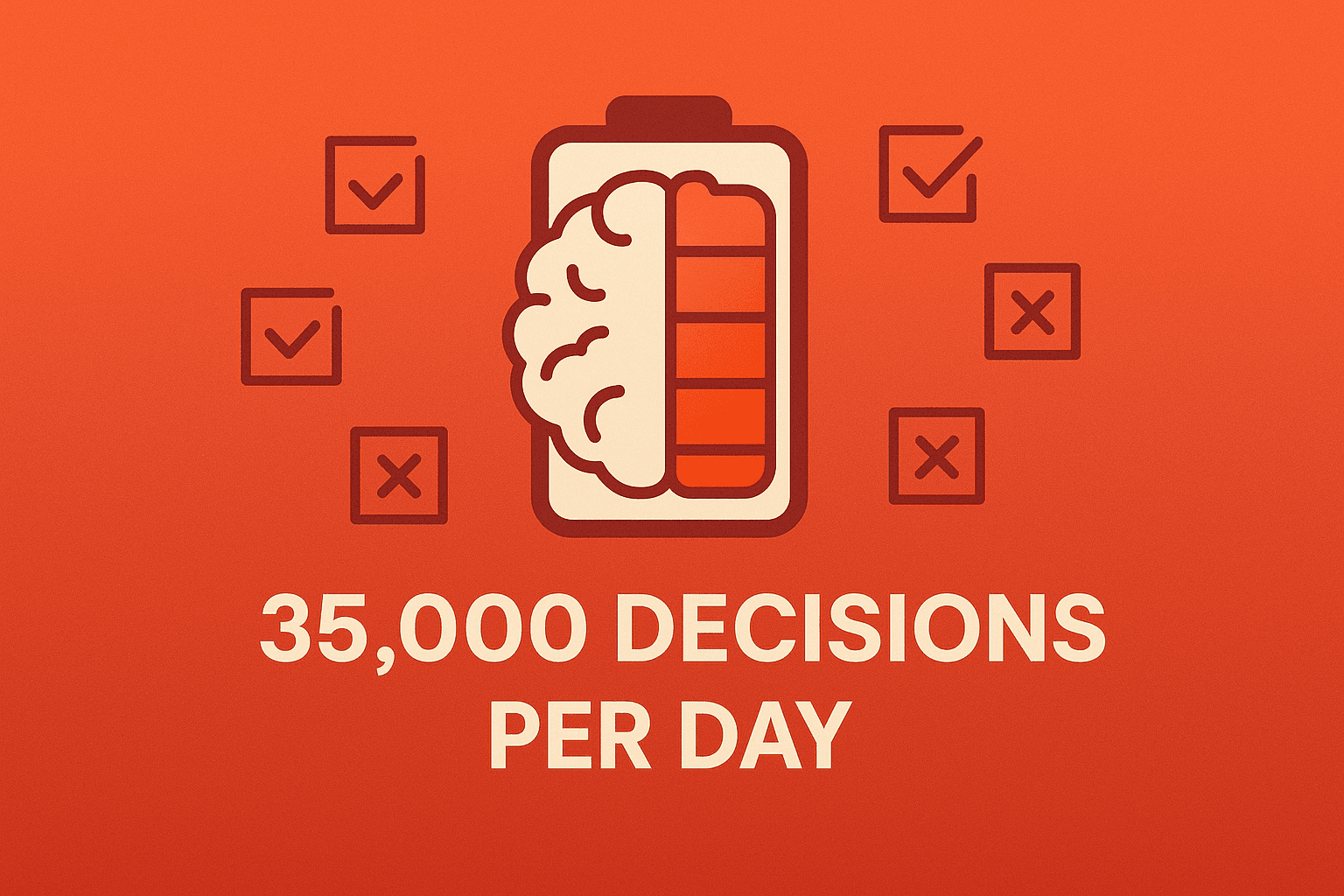
TL;DR: You're not lazy. You're not unmotivated. You're not bad at building. You're exhausted from making too many decisions. The average person makes 35,000 decisions per day. As a solo founder, you make more. By noon, your brain is empty. Here's how to fix it.
Every morning, you wake up with a full tank of decision-making fuel. Every decision burns some of that fuel. Big decisions burn more. Small decisions still burn some. By mid-afternoon, the tank is empty, and you're sitting there wondering why you can't focus on the thing that actually matters.
This isn't a willpower problem. This is a resource allocation problem. And most productivity advice makes it worse.
The Science Behind Your Afternoon Slump
In 2011, researchers studied judges making parole decisions. What they found was disturbing: the biggest predictor of whether a prisoner got parole wasn't the severity of their crime or their behavior in prison. It was what time of day their case was heard.
Prisoners who appeared in the morning got parole 65% of the time. Same judges, reviewing prisoners in the afternoon? 10%.
The judges weren't getting meaner as the day went on. They were getting tired. Making decisions depletes a finite cognitive resource. When that resource runs out, we default to the safest option (in this case, denying parole).
For solo founders, this plays out differently. You're not denying parole. You're doing something worse: you're defaulting to the easiest tasks instead of the important ones.
Your morning: "I should work on distribution strategy." Your afternoon: "I'll just fix this CSS issue instead."
The CSS issue isn't more important. It's just easier. It requires fewer decisions. Your depleted brain gravitates toward it automatically.
Why Solo Founders Have It Worse
A typical employee makes decisions within their lane. A marketing person makes marketing decisions. An engineer makes engineering decisions.
As a solo founder, you make ALL the decisions:
Technical: What stack to use? How to structure the database? Which library to pick?
Design: What color? What layout? What copy?
Product: Which feature first? What to cut? How much scope?
Business: What to charge? Who to target? Where to market?
Operations: What tools? What process? What automation?
Personal: When to work? When to rest? How much is enough?
Each of these categories generates dozens of micro-decisions daily. And they all come from the same depleted pool of cognitive resources.
By noon, you've made hundreds of decisions. And now you're supposed to work on the hardest thing: figuring out how to get customers.
No wonder you end up on Twitter instead.
The Four Decision Traps
Trap 1: Optionality Hell
"I'll just keep my options open."
More options feel better but are actually worse. Every option you keep open is a decision you haven't made. It sits in your mental RAM, taking up space, waiting to be resolved.
The founder with 5 possible pricing models in mind isn't being thorough. They're avoiding the decision. Meanwhile, their competitor picked $29/month and moved on.
The Fix: Constrain options artificially. Give yourself 2-3 options maximum. Pick one. If it's wrong, you can change it later. The cost of picking wrong is almost always lower than the cost of not deciding.
Trap 2: Trivial Decision Expansion
"I need to get this right."
You spent 45 minutes choosing a shade of blue for your landing page. That blue will affect nothing. But it felt important because you were looking at it.
Trivial decisions expand to fill the cognitive space available. The less important a decision is, the easier it is to overthink, because the consequences are low enough that you can afford to deliberate forever.
The Fix: Put time limits on trivial decisions. Logo? 30 minutes. Color palette? 15 minutes. Font? 10 minutes. If you haven't decided when the timer rings, flip a coin. Literally.
Trap 3: Decision Stacking
"While I'm at it..."
You sit down to decide your pricing. Good. But then you think: "Well, pricing depends on positioning. And positioning depends on target audience. And target audience depends on..."
Now you're not making one decision. You're trying to make fifty interconnected decisions simultaneously. Your brain freezes. Nothing gets decided.
The Fix: Separate decisions ruthlessly. Make the first decision with incomplete information. Accept that later decisions might invalidate it. That's fine. A decision made and revised beats a decision never made.
Trap 4: Reversibility Blindness
"This is a one-way door."
Most decisions feel permanent but aren't. Your pricing isn't a tattoo. Your tech stack isn't a marriage. Your landing page copy isn't carved in stone.
When you treat reversible decisions as irreversible, you spend 10x the cognitive resources on them. You analyze, you stress, you delay.
The Fix: Ask "What's the cost of being wrong?" For most decisions, it's a few hours of work to fix. That's not a one-way door. That's a turnstile. Walk through it.
The Decision Reduction Framework
The goal isn't to make better decisions. The goal is to make fewer decisions. Here's how:
Strategy 1: Pre-Decide Everything Routine
Take all routine decisions and make them once, forever.
Morning routine: Same wake time, same breakfast, same first activity. Work uniform: Same clothes every day (or a rotation that requires no thought). Default tools: One notes app, one task manager, one calendar. No switching. Weekly schedule: Same activities on same days. Tuesday is marketing. Thursday is building.
Every routine decision you eliminate saves cognitive fuel for decisions that actually matter.
Steve Jobs wore the same black turtleneck every day. Zuckerberg wears the same gray t-shirt. This isn't quirky. It's strategic.
Strategy 2: Batch Similar Decisions
Your brain incurs a "switching cost" every time you move between decision types. Design decisions use different mental muscles than technical decisions.
Instead of making decisions as they come up, batch them:
Design decisions: All in one 2-hour block
Technical decisions: All in another block
Business decisions: Weekly strategy session
Admin decisions: One hour per week, no more
Within each batch, you're warmed up. The decisions flow faster. You're not constantly context-switching.
Strategy 3: Default to "No" or "Later"
Most decisions don't need to be made right now. Many don't need to be made at all.
New feature idea? Default: Later. Add it to a list and review the list monthly. Interesting opportunity? Default: No. Unless it's obviously better than what you're doing. Tool recommendation? Default: Keep what you have. Unless what you have is actively broken.
"No" and "Later" aren't decisions. They're non-decisions. They preserve fuel.
Strategy 4: Use Arbitrary Constraints
Constraints eliminate decisions. Embrace them.
Time constraints: "I have 30 minutes to pick a name. Whatever I have at the end, I'm using." Option constraints: "I'm only considering these 3 options. Nothing else exists." Budget constraints: "I'm spending max $50 on this. That eliminates 80% of options." Scope constraints: "This feature must ship in one day. Whatever fits in one day is the spec."
Constraints feel limiting. They're actually liberating. You're not choosing from infinite options anymore. You're choosing from 3.
Strategy 5: Outsource Decisions
Some decisions can be made by someone else. Or by a system. Or by a rule.
To rules: "If a customer support ticket takes more than 5 minutes, refund automatically."
To tools: "Let Stripe choose the optimal payment retry schedule."
To experts: "Ask my designer to pick colors. They know better anyway."
To randomness: "When trivial, flip a coin."
You don't need to be the one deciding everything. You need to be the one deciding the important things.
The Protected Hours System
Here's the practical implementation:
Morning: High-Fuel Decisions (7-11 AM)
Your decision fuel is full. Use it on:
- Strategy questions
- Hard problems
- New initiatives
- Creative work
No email. No Slack. No meetings. Nothing that reacts to other people's decisions.
Midday: Medium-Fuel Execution (11 AM - 2 PM)
Your fuel is depleting. Use it on:
- Implementation of morning decisions
- Writing and creating
- Structured work with clear parameters
Afternoon: Low-Fuel Tasks (2-5 PM)
Your fuel is low. Use it on:
- Routine tasks that don't require decisions
- Batched communication (email, messages)
- Administrative work
- Learning/consumption
Evening: Refuel (5 PM+)
Your fuel needs to regenerate. That means:
- Not working
- Not making decisions
- Physical activity, social time, rest
Tomorrow's high-fuel period is built on tonight's recovery.
What This Looks Like in Practice
Before (Decision Chaos):
7:00 - Wake up, check email, respond to urgent thing 7:30 - Decide what to work on today 8:00 - Start building feature, hit a design question, debate options 8:45 - Still debating design options 9:00 - Context switch to support ticket 9:30 - Back to feature, forget where I was 10:00 - Meeting 11:00 - Try to focus, brain fuzzy 11:30 - Give up, scroll Twitter 12:00 - Lunch, think about how unproductive morning was 1:00 - Try again, but brain is empty 2:00 - Do easy admin tasks because they're all I can manage 5:00 - Feel guilty, keep working 8:00 - Still working, but poorly 11:00 - Collapse, do it again tomorrow
After (Decision System):
7:00 - Wake up, same routine, no decisions required 8:00 - Start pre-decided priority. One thing. Already decided yesterday. 10:00 - Complete priority or make significant progress 10:30 - Short break 11:00 - Secondary work, still focused 12:00 - Lunch 1:00 - Batched email/communication (30 min max) 1:30 - Execution tasks, no new decisions 3:00 - Admin batch 4:00 - Plan tomorrow's priority (one decision, made while fuel remains) 5:00 - Done. Actually done. Rest.
Same hours. Dramatically different output.
The "What Should I Work On" Problem
The most expensive decision you make every day is: "What should I work on?"
If you're making this decision every morning, you're burning fuel before you've even started. By the time you've decided, you've lost 30-60 minutes and depleted resources.
The Fix: Decide Tomorrow's Priority Today
At the end of each work day, while you still have some fuel left, answer one question: "What is the ONE thing I'll work on first tomorrow?"
Write it down. Be specific. Not "work on marketing" but "write 3 cold DMs to potential customers."
Tomorrow morning, you don't decide. You execute. The decision was already made.
This single habit reclaims your most valuable cognitive hours.
When Decision Fatigue is Actually Decision Avoidance
Sometimes "I can't decide" is really "I don't want to decide."
Some decisions are scary. Choosing a niche means excluding people. Setting a price means risking rejection. Launching means risking failure.
Decision fatigue becomes a convenient excuse. "I'm too tired to think about this clearly" is easier than "I'm afraid of what happens if I commit."
How to Tell the Difference:
- If you're tired on ALL decisions, it's real fatigue.
- If you're only tired on the scary decisions, that's avoidance.
The fix for avoidance is different: you need to confront the fear, not optimize the schedule. But that's a different problem for a different post.
You just read about a problem most productivity content doesn't acknowledge: it's not that you need better tools or more discipline. It's that you're running your high-stakes decisions on a depleted brain. The system works against you by design.
Most productivity fixes address the symptom. The actual fix is reducing decision volume, specifically the thinking-heavy work that requires fresh cognitive resources and keeps getting scheduled at the wrong time.
Luka is a research and growth agent for solo founders. It handles the high-cognitive-load work that's eating your best hours: market research, competitive analysis, content strategy, growth planning. The work that's always "when I have headspace," which for most founders means never. If decision fatigue is running your days, Luka is worth looking at.
Frequently Asked Questions
Doesn't this make me too rigid?
No. Structure creates freedom. When routine decisions are handled, you have MORE flexibility for the decisions that matter. You're not rigid. You're selective.
What if I'm a night owl?
The principles apply regardless of when you work. Your "high-fuel" hours are whenever you have the most energy. For some people, that's 10 PM - 2 AM. Fine. Protect those hours for important decisions.
How long does it take to see results?
You'll feel the difference within a week. Protecting your morning hours alone will change how much you accomplish. The full system takes 2-3 weeks to become habit.
What about urgent decisions that can't wait?
True urgencies are rare. Most "urgent" things are just poorly planned. But when genuine urgency happens, handle it. The system is a default, not a prison. Just get back to the system after.
Can I use decision fatigue as an excuse to skip hard things?
No. Re-read the avoidance section. If you're consistently "too tired" for the important work, the problem isn't fatigue. It's fear. Address the fear.
About the Author