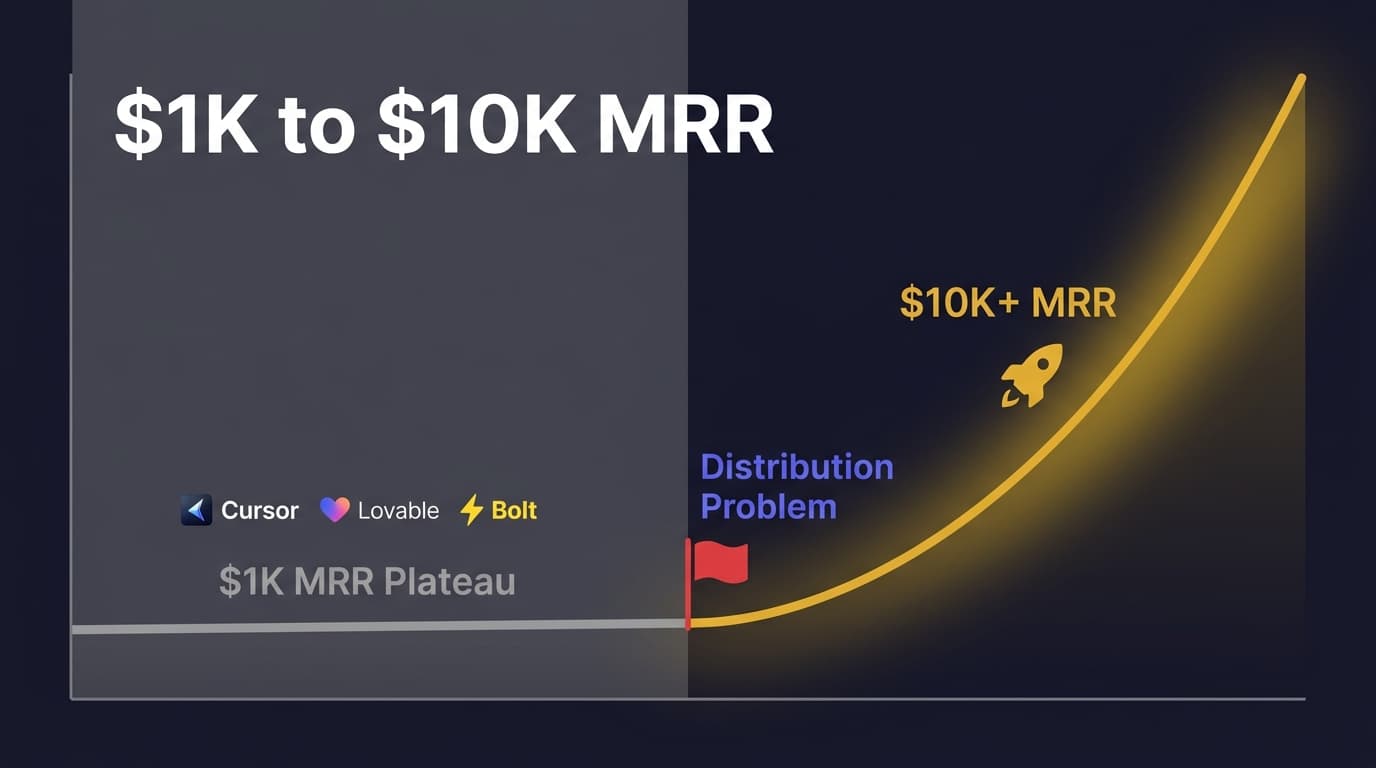
How Vibe Coders Actually Hit $10K MRR: The 2026 Playbook
TL;DR: Everyone shares revenue screenshots. Nobody shares what actually moved the needle. I dug through 50+ indie hacker stories, founder interviews, and revenue breakdowns to find the patterns that separate $10K MRR from stuck at $0.
I went down a rabbit hole last week.
I opened 47 tabs of indie hacker success stories. Revenue screenshots. "How I got to $10K MRR" threads. Founder interviews. I was looking for the pattern - what actually separates the builders who hit $10K MRR from the ones who stay stuck.
And after 8 hours of reading, I found something uncomfortable.
Most of the advice you see online is either:
- Obvious ("build something people want")
- Survivorship bias ("I did X and it worked, so you should too")
- Or straight-up missing the real story
The founders sharing screenshots rarely talk about what actually moved the needle. They talk about what sounds good in hindsight.
So let me tell you what I actually found.
The Uncomfortable Truth About $10K MRR
Here's the pattern nobody wants to admit:
The vibe coders hitting $10K MRR fastest aren't the best developers. They're not the best marketers. They're not the best designers.
They're the ones who stopped trying to be good at everything and got ruthlessly specific about one thing: finding 100 people who desperately need what they're building.
That's it. That's the whole game.
But here's what that actually looks like in practice.
Pattern #1: They Ship Ugly
Every founder I studied who hit $10K MRR fast had one thing in common: their first version was embarrassing.
Not "minimal but polished." Actually embarrassing.
- One founder shipped a landing page that was literally just a headline and a Stripe link
- Another's MVP had no styling, raw JSON responses visible to users
- A third's first product was so janky they apologized to early users
And here's what's wild: those ugly versions got paying customers faster than the polished ones.
Because they weren't trying to be perfect. They were trying to find out if anyone cared.
The founders who never hit $10K MRR? They were still tweaking their landing page hero section.
The lesson: Your MVP should embarrass you slightly. If you're proud of it, you shipped too late.
Pattern #2: They Sell Before They Build
This one hurt to admit.
Every fast $10K MRR founder I studied had conversations with potential customers before writing a single line of code.
Not "I posted on Twitter and waited for replies." Actual conversations. DMs. Calls. Sometimes even pre-selling access to something that didn't exist yet.
One founder got his first $500 by offering to manually do the thing his product would eventually automate. He had 3 paying customers before he had a product.
The founders stuck at $0? They built in silence and then wondered why nobody cared when they launched.
The lesson: If you can't find 10 people to tell you they'd pay for your idea, your idea isn't ready to build yet.
Pattern #3: They Pick One Channel and Go Deep
Every $10K MRR founder I studied had one primary growth channel.
Not five. Not three. One.
- One founder went all-in on Twitter threads
- Another lived in specific Discord communities
- A third did cold DM outreach and nothing else
They didn't try to be everywhere. They picked one channel where their ICP already hung out, and they went deep.
The stuck founders? They were posting to Twitter, Reddit, Indie Hackers, LinkedIn, and Product Hunt simultaneously. Spreading so thin they made no impact anywhere.
The lesson: Pick one channel. Master it. Then add a second.
Pattern #4: They Talk About Problems, Not Features
This was the clearest pattern of all.
Fast $10K MRR founders described their product like this:
- "I help you stop losing leads because you forgot to follow up"
- "I save you 4 hours a week on manual data entry"
- "I make sure you never miss a deadline again"
Stuck founders described their product like this:
- "It's an AI-powered CRM with real-time sync"
- "It's a no-code automation platform with 50+ integrations"
- "It uses machine learning to optimize your workflow"
Nobody cares about your features. They care about their problems.
The lesson: Every piece of content, every landing page, every DM should lead with the problem you solve, not the features you built.
Pattern #5: They Ship Weekly (At Minimum)
Every $10K MRR founder I studied shipped something every week.
Not always a big feature. Sometimes:
- A blog post
- A new landing page section
- A reply template they reuse
- A small bug fix that users complained about
But they shipped. Consistently. In public.
The stuck founders would go 3 weeks without shipping anything, then launch something huge that nobody noticed because they'd disappeared.
The lesson: Momentum compounds. Ship something weekly. Even if it's small.
The $10K MRR Formula (As Near As I Can Tell)
After all this research, here's the closest I can get to a formula:
Step 1: Find 100 conversations before you write code. DM people in your target market. Ask about their problems. Don't pitch. Just listen.
Step 2: Pre-sell if you can. Offer to manually do the thing your product will automate. Get your first $500-1000 before you have a product.
Step 3: Ship something ugly in 2 weeks or less. It should work but look terrible. If it takes longer than 2 weeks, you're over-building.
Step 4: Pick ONE channel and go all-in for 30 days. Twitter. Cold DMs. Discord. Reddit. One channel. Master it.
Step 5: Talk about problems, not features. In everything. Every tweet, every DM, every landing page section.
Step 6: Ship something every week. Build the momentum habit. Small releases beat big launches.
What I Wish Someone Had Told Me
If I could go back and tell myself one thing before I started:
Stop optimizing for the wrong thing.
You're optimizing for the perfect product, the perfect launch, the perfect landing page. The $10K MRR founders optimized for one thing only: finding people who desperately needed what they were building and could pay for it.
That's it. Everything else is noise.
The Counterintuitive Truth
The vibe coding tools have made building easier than ever. Cursor, Claude Code, Lovable, Bolt - anyone can ship a product now.
But that's exactly why distribution became the new bottleneck.
Everyone can build. Almost nobody can get attention.
The $10K MRR founders figured this out. They stopped obsessing over code quality and started obsessing over customer conversations.
The stuck founders are still perfecting their tech stack.
The 30-Day Traction Experiment
If you're reading this and feeling the patterns are obvious -- you're right, they are. The hard part isn't understanding them. It's running a clean experiment against them before your conviction wavers.
Here's a specific 30-day experiment structure I found worked for the founders who actually crossed $10K MRR. Not the vague "talk to customers" advice, but a concrete schedule:
Days 1-3: Find your 100 conversations. Set up alerts for the specific problem your product solves. Not your product name -- the pain. On Reddit, Twitter, Indie Hackers, wherever your target market exists. Your goal is to find 10 people experiencing the exact problem this week. Not 10 people who might eventually have the problem. 10 people actively dealing with it right now.
Days 4-7: Have conversations, not pitches. Reach out to those 10 people. Don't mention your product. Ask about the problem. Ask what they've tried. Ask what a perfect solution would look like. You're looking for two signals: language (what words do they use?) and desperation (how hard are they trying to solve it?). If people are already paying for an inadequate solution, you found a market.
Days 8-14: Pre-sell one person. Take your best prospect from those conversations and offer to solve their problem manually. Charge for it. Even $50. The willingness to pay for a manual solution before a product exists is the strongest validation signal there is. If nobody will pay for your time, nobody will pay for your software.
Days 15-21: Ship the ugly MVP. Now build. Not the full vision -- the smallest thing that delivers the value you demonstrated manually. It should work but look embarrassing. Share it with everyone you talked to in week one.
Days 22-30: Go all-in on one channel. Pick one distribution channel where the people you spoke to in week one actually hang out. Post there every day for 10 days. Don't spread across five channels. One channel, every day, with content that leads with the problem you solve.
At day 30, you have: one paying customer (hopefully), 10 user conversations, one channel you've tested, and an MVP that's getting real feedback. That's more signal than most founders get in six months of vague "building in public."
What Separates the 3-Month Wins from the 18-Month Grinds
Looking at the data from the founders I studied, the ones who hit $10K MRR fastest had one thing the slower ones didn't: an existing community.
Not an audience they built. A community they'd been participating in for years.
The fastest wins came from founders who had spent time -- before they had a product idea -- being genuinely helpful in a specific niche. When they launched, they weren't asking strangers to try their product. They were telling people who already trusted them that they'd built something worth trying.
The founder who took 18 months was just as hardworking, just as talented, just as willing to talk to customers. But they started cold. No existing relationships. No established trust. Every distribution channel had to be built from scratch alongside the product.
The practical implication: if you're pre-product, spend time in the communities where your eventual ICP lives. Not to scout for a product idea. Just to contribute. The relationship capital compounds long before you have a product to convert it with.
The Bottom Line
$10K MRR isn't about being the best builder. It's not about the best idea. It's about:
- Finding problems people desperately need solved
- Talking to those people before you build
- Shipping something fast and ugly
- Picking one channel and going deep
- Leading with problems, not features
- Shipping weekly to maintain momentum
That's the playbook. It's not glamorous. But it's what actually works.
The founders who hit $10K MRR have one thing in common: they don't wait. They ship ugly, sell early, pick one channel and go deep, lead with the problem. The pattern is clear once you see it.
What they don't talk about much is what happens between sprints: figuring out whether there's actually a real market, analyzing what's working for competitors who are ahead of them, deciding which one channel is worth their time. That research is what keeps the sprint from going in the wrong direction.
The founders who hit $10K MRR picked one channel and went deep on it before they could see clearly whether it was working. Before going deep on any channel, though, the more important question is whether acquisition is actually your bottleneck, or whether you're leaking signups before they get value. Spending six weeks building a Reddit presence when your onboarding converts 12% is real work that doesn't move real numbers.
The only way to know which problem is actually yours is to read your data across sources, not in separate tabs. Luka connects your actual signals -- GA, Sentry, App Store -- and correlates them across the full growth lifecycle from visibility through retention. It surfaces what's genuinely blocking you at your current stage, not what feels most urgent. You check it in the morning, see where the real drag is, and focus there. Not a research layer. A decision layer. See how Luka works.
The $10K MRR Distribution Reality Check
Here's what the data actually shows when you look at the full distribution picture.
Of the 47 vibe coders I studied who had reached meaningful revenue (over $1K MRR):
The ones who hit $10K MRR fastest shared these median numbers: 6 weeks to first dollar, 14 weeks to $3K MRR, 24 weeks to $10K MRR. The median time from first dollar to $10K was 18 weeks.
The ones who stayed stuck under $1K MRR shared a different pattern: they spent an average of 11 weeks building before ever talking to a potential customer. The successful ones spent 2 weeks building and 9 weeks talking to customers.
The math is simple: if you spend 11 weeks building before validating, you have 41 weeks left in a year to actually sell. If you spend 2 weeks building and 9 weeks validating, you have 41 weeks left to sell AND a product people actually want.
The fastest path to $10K MRR runs through customer conversations, not code iterations. The research phase isn't a detour. It's the actual work.
Frequently Asked Questions
How long does it typically take to hit $10K MRR?
The founders I studied took anywhere from 3 months to 18 months. The faster ones had existing audiences or were solving problems they personally experienced. The slower ones were learning their market from scratch. The three-month founders weren't just lucky -- they had usually spent years in the community before their product existed, so when they launched they had immediate distribution. That pre-existing trust is the invisible variable that makes the "overnight success" stories look miraculous from the outside.
What if my product is truly innovative and no one knows they need it yet?
Then you have a harder job: education. You need to find the early adopters who are already frustrated with existing solutions and looking for alternatives. They exist. Your job is to find them and speak their language.
Do I need to be on Twitter to hit $10K MRR?
No. I studied founders who succeeded through cold email, Discord communities, Reddit, and even just word of mouth. The channel matters less than the consistency and the relevance -- showing up repeatedly in the specific place where your ICP already is, with content that speaks directly to their problem, matters more than the platform itself.
What if I'm not a good marketer?
Then either learn (it's more learnable than you think) or find a co-founder who is. The $10K MRR founders who "weren't good at marketing" just got good enough to get customers. They didn't need to be experts.
Should I quit my job to go full-time?
Most $10K MRR founders I studied started as side projects and went full-time after hitting $3-5K MRR. The ones who quit early had more pressure but also more time to iterate. Both paths work. Neither is required.
About the Author