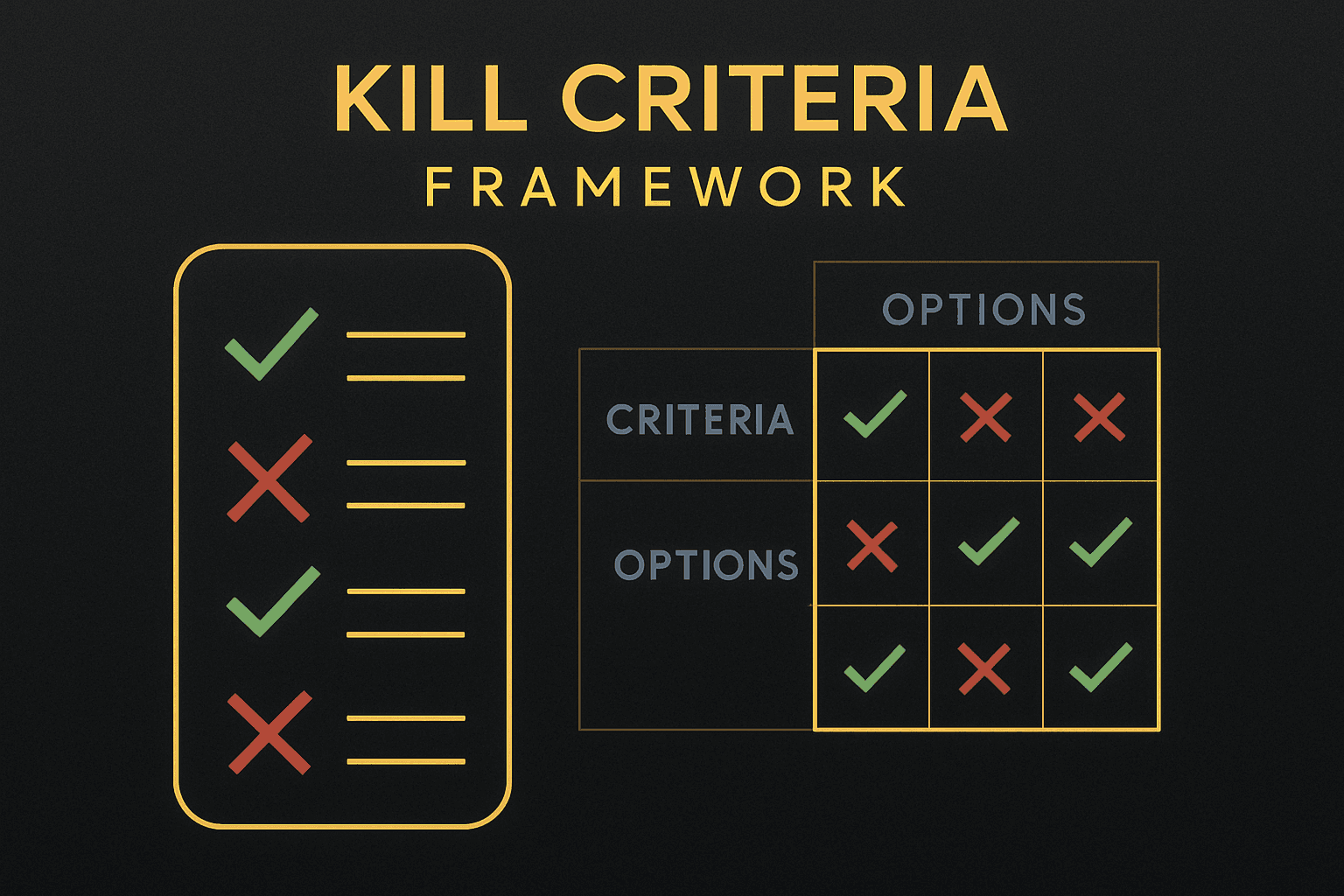
The Kill Criteria Method: When to Pivot vs. When to Push Through
TL;DR: Most founders decide to pivot on emotion or push through on ego. The survivors decide before they start. Set kill criteria upfront: if X doesn't happen by date Y, you pivot automatically. No emotion. No daily decision tax.
Ricky asked the question every solo founder avoids.
When do you give up? When do you push harder?
I read 15 replies from founders stuck in the same loop. Some said "trust your gut." Others said "look at the data." Nobody had an actual system.
Then I found the pattern. The founders who survive don't decide in the moment. They decided months ago, before they even launched.
Here's the framework they use.
The Pivot Problem Nobody Talks About
Here's what happens to most solo founders:
Month 1: Launch with excitement. Everything is possible.
Month 3: Growth is slower than expected. You tell yourself it takes time.
Month 6: Still not where you hoped. But you've invested so much. Quitting feels like failure.
Month 9: You're exhausted. The product isn't working. But now you're too deep to stop.
Month 12: You finally quit. A year lost. Money gone. Energy spent.
What went wrong?
The problem isn't the product. It's the decision framework.
When you wait until you're "in it" to decide whether to continue, you're deciding with emotion. Sunk cost fallacy kicks in. Fear of failure takes over. You can't think clearly.
The founders who make clean decisions set the rules before the game starts.
What Is a Kill Criteria?
A kill criteria is a pre-commitment to quit.
It's a specific, measurable condition that, if not met by a specific date, triggers an automatic pivot or shutdown.
No emotion. No daily debate. No decision fatigue.
The decision was already made. You're just executing it.
Why Kill Criteria Work
Your brain is not designed for good decisions under stress.
When you're 6 months into a product that's not growing:
- Sunk cost fallacy tells you to keep going because you've invested so much.
- Optimism bias tells you it's about to turn around.
- Identity attachment tells you quitting makes you a failure.
Kill criteria bypass all of this.
You made the decision when you were calm, objective, and unattached. The stressed version of you doesn't get to override that.
This is the same reason successful traders use stop-losses. When the stock hits a certain price, they sell automatically. No debate. The decision was made before they bought.
How to Set Your Kill Criteria
Here's the exact framework:
Step 1: Define Success
What does "working" look like for your product?
Be specific. Not "get some users" but "50 weekly active users." Not "make money" but "$500 MRR."
Vague criteria = vague decisions.
Step 2: Set a Timeline
How long are you willing to give this?
Most products can be validated or invalidated in 90 days. Some need 6 months. Almost nothing needs a year without clear signals.
Be honest about opportunity cost. Every month you spend on this is a month you're not spending on something else.
Step 3: Write the Criteria
Put it in writing. Something like:
"If I don't have 50 weekly active users by March 31, I will pivot to a different problem."
"If I don't have $1,000 MRR by June 1, I will shut down and start over."
"If I don't get 10 paying customers in 90 days, I will reconsider the entire business model."
Step 4: Remove Escape Hatches
The whole point is that future-you can't renegotiate.
Tell someone else your criteria. Make it public. Put it in a document you can't delete.
When March 31 comes and you have 47 users, you might be tempted to extend the deadline. Don't. That's the sunk cost talking.
The criteria says 50. You got 47. Time to pivot.
The Kill Criteria Template
Here's a template you can fill out right now:
KILL CRITERIA DOCUMENT

Product: [Your product name]
Launch date: [Date]

SUCCESS METRIC 1:
- Metric: [e.g., Weekly active users]
- Target: [e.g., 50]
- Deadline: [e.g., 90 days from launch]
- Consequence if missed: [e.g., Pivot to different customer segment]

SUCCESS METRIC 2:
- Metric: [e.g., Monthly recurring revenue]
- Target: [e.g., $500]
- Deadline: [e.g., 120 days from launch]
- Consequence if missed: [e.g., Change pricing model or shut down]

SUCCESS METRIC 3:
- Metric: [e.g., Customer feedback score]
- Target: [e.g., 8+ average rating from 20 customers]
- Deadline: [e.g., 60 days from launch]
- Consequence if missed: [e.g., Major product revision]

SIGNATURE: [Your name]
DATE: [Today's date]

I commit to these criteria. If they're not met, I will execute the stated consequences without renegotiation.
Print this. Sign it. Put it somewhere you see it every day.
Kill Criteria in Action: Three Examples
Example 1: The Pivot
Sarah built a time-tracking tool for freelancers.
Her kill criteria:
- 100 signups in first 30 days
- 10 paying customers in first 60 days
Result: 87 signups, 3 paying customers.
Did she meet the criteria? No.
What she did: Pivoted. Instead of freelancers, she focused on agencies. Same product, different customer.
90 days later: 200 agency signups, 35 paying customers.
The pivot saved the business. But she never would have pivoted without the pre-commitment.
Example 2: The Shutdown
Marcus built a habit tracker with AI insights.
His kill criteria:
- 50 weekly active users in 90 days
- $200 MRR in 120 days
Result: 23 weekly active users, $47 MRR.
Did he meet the criteria? No.
What he did: Shut it down. He didn't extend. He didn't pivot. He stopped.
6 months later: He launched something different. A tool that solved a problem he'd experienced himself.
The shutdown hurt. But it freed him to build something that actually worked.
Example 3: The Push Through
Jenny built a newsletter tool for creators.
Her kill criteria:
- 500 subscribers in 60 days
- 5 paying customers in 90 days
Result: 612 subscribers in 45 days, 7 paying customers in 80 days.
Did she meet the criteria? Yes.
What she did: Pushed through. The signals were positive. She doubled down.
The criteria gave her confidence to keep going, because she knew exactly what success looked like.
What Makes Kill Criteria Fail
Mistake 1: Vague Metrics
"Our product needs traction."
What does traction mean? 10 users? 100? 1,000?
If you can't measure it, you can't evaluate it. And you'll always find a way to convince yourself you're making progress.
Mistake 2: Moving Deadlines
March becomes April becomes May.
The whole point of kill criteria is that the deadline is fixed. If you keep extending, you've just created an elaborate way to avoid deciding.
Mistake 3: Soft Consequences
"If we don't hit our targets, we'll... reconsider our approach."
No. That's not a kill criteria. That's a suggestion.
A real kill criteria has a hard consequence: "We will pivot" or "We will shut down."
Mistake 4: No Accountability
If only you know about your kill criteria, it's easy to ignore.
Tell a cofounder. Tell a mentor. Tell your audience. Make it real.
The Psychology of Pre-Commitment
Why does this work?
Because humans are terrible at making decisions when we're emotionally involved.
When you're 6 months into a product:
- You're attached to your vision
- You've told people about it
- You've invested time and maybe money
- Quitting feels like admitting defeat
None of those things should matter. Either the product is working or it's not. But your brain doesn't work that way.
Pre-commitment works because it makes the decision when you're objective.
You wrote the rules before you had anything to lose. The stressed, attached version of you doesn't get to override that.
This is the same logic behind:
- Ulysses contracts (giving someone else power over your decisions)
- Automatic savings (money you never see, you never spend)
- Public commitments (telling others your goals makes you more likely to achieve them)
Kill criteria are Ulysses contracts for your product.
Kill Criteria for Different Stages
Pre-Launch
Before you build anything:
- "If I can't find 10 people who say they'd pay for this, I won't build it."
- "If I don't get 50 waitlist signups in 2 weeks, I'll reconsider the problem."
Early Traction
First 90 days:
- "If I don't have 100 weekly active users in 60 days, I'll change the product or target market."
- "If I don't have 5 paying customers in 90 days, I'll pivot or shut down."
Growth Stage
After product-market fit:
- "If growth drops below 10% MoM for 3 consecutive months, I'll investigate and potentially change strategy."
- "If churn exceeds 10% monthly, I'll pause growth efforts and focus on retention."
The Kill Criteria method works because you make the decision before the emotional investment kicks in. But there's a step most founders skip before writing their kill criteria: defining what success actually looks like given the market they're in. "Reach $10K MRR in 90 days" is not a useful kill criterion if you haven't done the analysis to know whether that's realistic for this niche, with this pricing, in this timeframe.
Setting kill criteria without market research is just making up numbers and calling it discipline.
Luka is a research agent for solo founders. It does the market analysis that gives your kill criteria a foundation, competitor revenue estimation, niche size, pricing benchmarks, what comparable products typically achieve in year one. So your criteria reflect reality instead of optimism. If you're using kill criteria on your current project, Luka is worth checking out before you set the numbers.
Apply This Today
Write down your current project. What are you building?
Define success. What specific metrics would tell you it's working?
Set deadlines. When will you evaluate those metrics?
Write the consequences. What exactly will you do if the metrics aren't met?
Tell someone. Accountability makes it real.
Commit. No renegotiation when the date arrives.
Frequently Asked Questions
What if I'm close to the target but not quite there?
The criteria says 50 and you got 47. You want to extend. Don't.
Close is not success. The whole point of kill criteria is to remove gray areas. If 47 was acceptable, you should have set the target at 47.
What if the market changed and that's why I missed?
If external factors made your criteria impossible, that's useful information. Either the market doesn't want this, or the timing is wrong. Either way, pivot.
Can I adjust criteria based on new information?
Not after you've started. New information should inform your NEXT set of criteria, not your current one.
What if I'm emotionally attached and can't follow through?
That's exactly why you tell someone else. Make it a real commitment, not just a document on your laptop.
How often should I set new criteria?
Every time you start something new, and every time you pivot. Each phase of a product needs its own evaluation framework.
About the Author