The Ivy Lee Method: Why a 100-Year-Old System Still Beats Every Productivity App
TL;DR: In 1918, Charles Schwab paid $25,000 (about $500K today) for a 15-minute productivity lesson. The method is stupidly simple: write 6 tasks, do them in order, repeat. It works because it eliminates the decisions that drain you before you even start working.
The $25,000 Lesson
Here's a story that should make every productivity app founder uncomfortable.
In 1918, Charles Schwab was running Bethlehem Steel, one of the largest companies in America. He was obsessed with efficiency - not just in the factories, but in how his executives managed their time.
He hired Ivy Lee, a publicity expert who'd later become known as the father of modern PR. Schwab's request was simple: "Show me a way to get more things done."
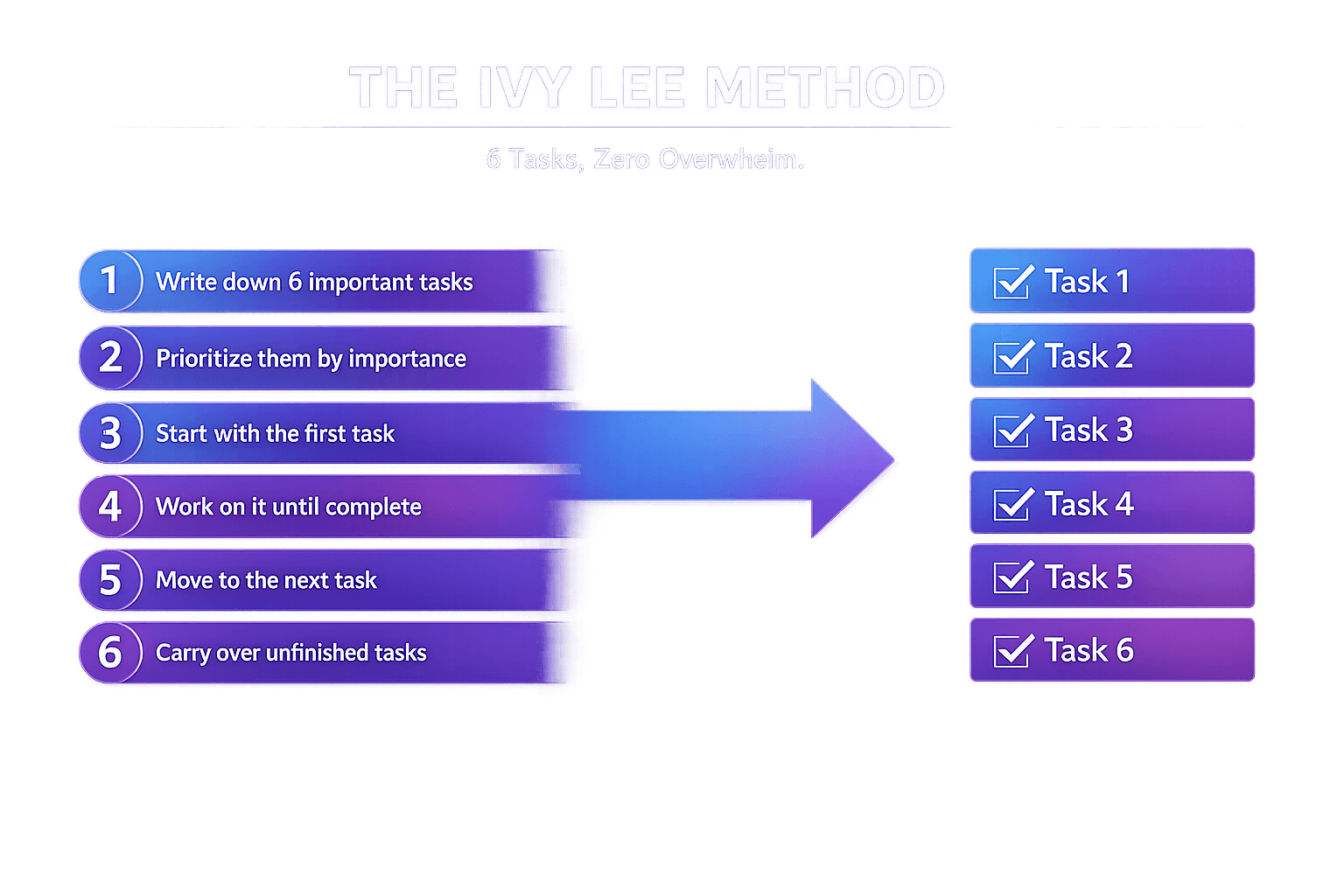
Lee asked for 15 minutes with each executive. His instructions:
- At the end of each workday, write down the six most important things you need to accomplish tomorrow
- Prioritize them in order of importance
- When you arrive tomorrow, work on task #1 until it's complete
- Move to #2. Then #3. And so on.
- At the end of the day, move unfinished items to a new list of six for the next day
- Repeat
That's it. The entire method fits on an index card.
Schwab told Lee to let him test it for three months, then send a check for whatever he thought it was worth. Three months later, Lee received $25,000 - roughly $500,000 in today's money.
Schwab later said it was the most profitable business lesson he'd ever learned.
Why This Works (When Fancy Systems Fail)
I've tried everything. Notion databases with 47 properties. OmniFocus with nested projects and contexts. Getting Things Done with its elaborate capture-process-organize-review workflow. Bullet journaling with color-coded rapid logging.
I always came back to something close to the Ivy Lee method. Here's why:
1. It Eliminates Morning Decisions
Most productivity systems require you to decide what to work on when you sit down. That's exactly when your decision-making capacity should go toward actual work, not meta-work.
The Ivy Lee method moves that decision to the night before. You plan when you're wrapping up, not when you're trying to start. By morning, the decision is already made. You just execute.
This sounds trivial until you count how many mornings you've spent "getting organized" instead of working.
2. It Forces Real Prioritization
Six items. Not seven. Not "top priorities plus a few nice-to-haves." Six.
This constraint is the feature, not a bug. When you can only pick six, you have to actually think about what matters. You can't hedge by putting everything on the list.
And the ordering matters even more. You don't get to start #2 until #1 is done. No bouncing between tasks based on mood. No "I'll do this quick thing first to warm up."
The most important thing gets done first, or it doesn't get done.
3. It Creates Focus Through Constraint
Modern productivity culture is obsessed with capturing everything. Every idea, every task, every "someday maybe" goes into the system.
This creates the illusion of control while actually fragmenting your attention across dozens of open loops.
The Ivy Lee method is aggressively reductive. You don't manage a backlog of 200 tasks. You manage six. The rest doesn't exist until tomorrow's planning session.
This feels limiting until you realize how much mental energy you're spending on tasks you're not actually going to do today anyway.
4. It Provides Closure
Every day ends with a clear ritual: review what happened, plan tomorrow, close the loop.
Most people end their workday by... stopping. They leave tasks half-finished, plans unmade, mental threads dangling. Then they spend the evening with a vague sense that they should be doing something.
The nightly planning session is a psychological off-switch. Once you've written tomorrow's list, today is done. You've transferred the responsibility to tomorrow-you, and tonight-you can rest.
The Psychology Behind It
The Ivy Lee method works because it's designed around how humans actually function, not how productivity gurus wish we functioned.
Zeigarnik Effect: Your brain keeps incomplete tasks in active memory, creating a low-grade cognitive drain. By capturing tomorrow's priorities, you're giving your brain permission to let go.
Decision Fatigue: Every choice depletes your mental energy. By front-loading decisions to the previous evening, you preserve your best thinking for actual work.
Single-Tasking: Despite what we tell ourselves, humans can't multitask on cognitive work. We can only task-switch, and every switch has a cost. The Ivy Lee method's "finish #1 before starting #2" rule eliminates switching costs.
Parkinson's Law: Work expands to fill the time available. Having only six slots creates artificial scarcity that compresses tasks to their essential scope.
Common Mistakes (And How to Avoid Them)
Mistake #1: Putting Too Many Small Tasks
"Reply to emails" isn't a task for this list. Neither is "check Slack" or "review analytics."
These are maintenance activities, not priorities. If you fill your six slots with small stuff, you'll feel productive while avoiding the important work that actually moves the needle.
Fix: Each task should represent meaningful progress on something that matters. If it takes less than 30 minutes, it probably doesn't belong on the list.
Mistake #2: Not Actually Prioritizing
Writing six tasks is easy. Ordering them honestly is hard.
We naturally want to put the comfortable tasks first - the ones we know how to do, the ones without ambiguity. The important-but-hard tasks get pushed to #5 or #6, where they're unlikely to get done.
Fix: Ask yourself: "If I could only complete one task tomorrow, which would have the biggest impact?" That's #1. Repeat for #2-#6.
Mistake #3: Abandoning the System When It Gets Hard
Some days, you won't finish all six. Some days, you won't finish #1. Some days, you'll realize your priorities were wrong and everything needs to change.
This isn't the system failing. This is the system working - it's showing you reality.
Fix: When you don't complete everything, don't add more tomorrow to "catch up." Just make a new list of six. The backlog doesn't carry forward; it disappears. If something was truly important, it'll make tomorrow's list.
Mistake #4: Over-Engineering It
The temptation is to add features. "What if I tracked time on each task? What if I categorized by project? What if I added a weekly review?"
Stop. The power is in the simplicity. Every addition is a decision you don't need to make.
Fix: Use paper. Seriously. An index card or a simple note. The moment you put this in an app, you've added friction.
The Ivy Lee Method works because it forces you to commit to priorities before the day starts, not while you're already overwhelmed by it. The constraint is the point: six tasks, ranked, done in order. No negotiating with yourself at 2 PM about what's really important.
But the method only works as well as your task list. If the six tasks you're picking from are "respond to this email, fix this bug, schedule this call," you're optimizing the execution of the wrong work. The method doesn't fix the input; it fixes the execution. You still have to figure out what the right six things are.
Luka is a research and growth agent for solo founders. It handles the strategic tasks that should be on your list but keep slipping: competitor analysis, outreach drafts, market research, content strategy. The work that's always "next week" until it's three months late. If you want to start filling your Ivy Lee list with work that actually matters, Luka is worth looking at.
My Modified Version
I've been using a variation of this for two years. Here's what I changed:
Three tasks instead of six. I found that six was still too many. With three, I finish almost every day. The psychological reward of completion compounds over time.
One "big rock" rule. At least one of the three must be a significant project task, not maintenance or admin. This prevents the list from filling with easy wins.
Morning review, not just evening planning. I take 2 minutes each morning to confirm the list still makes sense. Sometimes overnight thinking reveals a better priority.
Weekly purge. Every Sunday, I delete any recurring tasks that I've been moving forward without completing. If I'm consistently avoiding something, either it's not important or there's a blocker I need to address.
How to Start Today
Tonight before bed:
- Get an index card or open a plain text note
- Write "Tomorrow" at the top
- List the six most important things you need to do
- Number them 1-6 in order of importance
- Put the card where you'll see it first thing
Tomorrow morning:
- Look at the card
- Start #1 immediately - before email, before Slack, before anything
- Work on #1 until it's done or you're truly blocked
- Move to #2
- Repeat until end of day
Tomorrow evening:
- Cross off completed tasks
- Write a new list of six for the next day
- Include any unfinished items if they're still priorities
- Close the notebook. You're done.
Do this for one week. That's it. One week of actually following the system before you decide it's too simple to work.
I guarantee you'll accomplish more in that week than in most months of elaborate productivity systems.
The Deeper Lesson
The Ivy Lee method isn't really about productivity. It's about clarity.
Most of us aren't unproductive because we lack tools or systems or motivation. We're unproductive because we're unclear about what actually matters. We substitute activity for progress, busy-ness for effectiveness.
Six tasks. In order. Every day.
It's almost embarrassingly simple. That's why it works.
Luka helps you figure out what those six tasks should be - cutting through the noise to surface what actually matters today.
About the Author