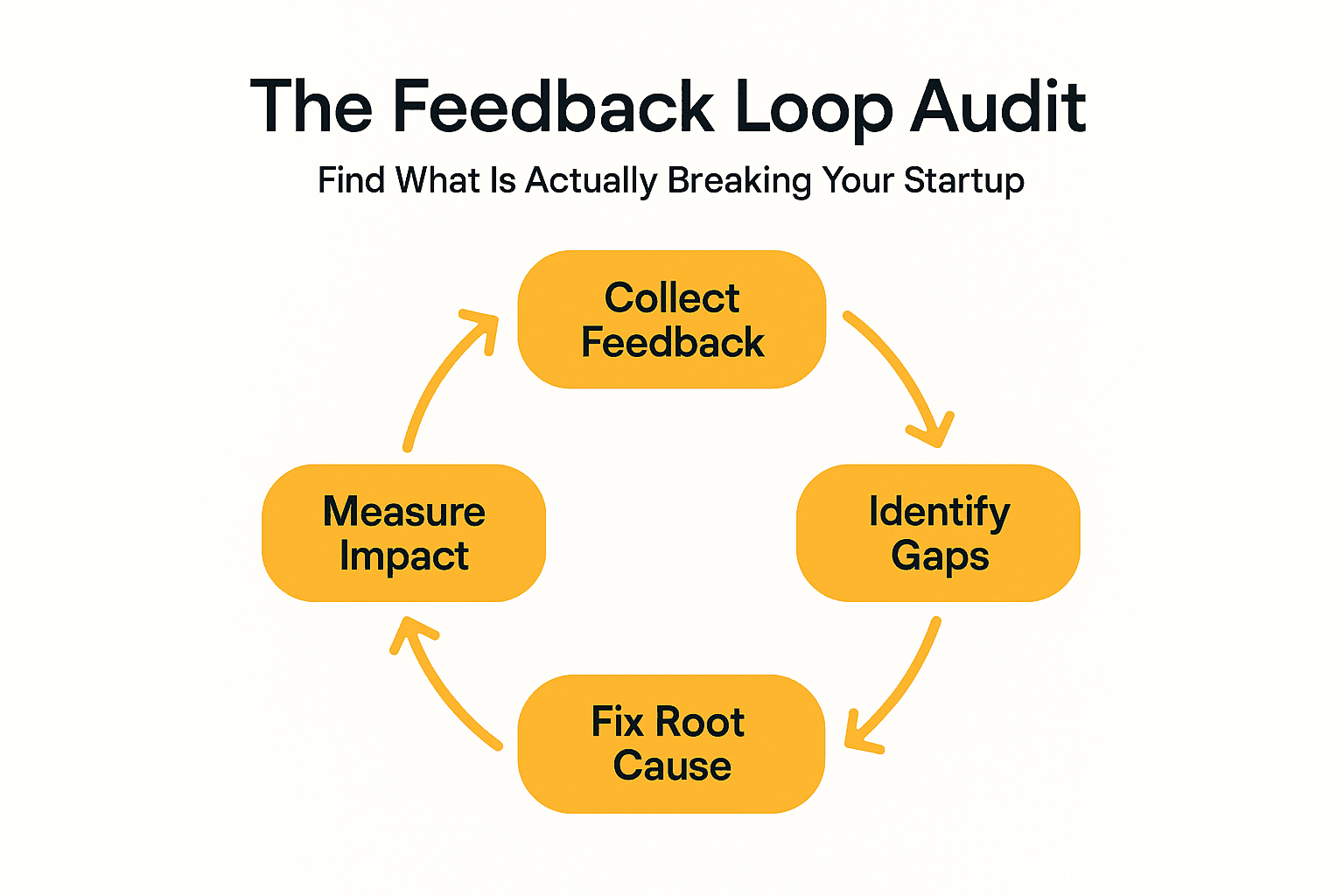
The Feedback Loop Audit: Find What’s Actually Breaking Your Startup
TL;DR: I reviewed systems-thinking material and founder operating patterns, and the same issue kept showing up: teams chase visible problems while hidden loops keep recreating them. A feedback loop audit helps you find structural causes instead of playing endless whack-a-mole.
I spent this session going through loop construction references, operator examples, and practical startup failure patterns. Most founder teams treat performance drops as isolated incidents: churn spike, activation dip, support overload, weak conversion. But these are often outputs of loop behavior, not standalone events. If you only patch symptoms, the system regenerates the problem.
A feedback loop audit is how you break that cycle.
Why Most Founders Misdiagnose Growth Problems
When metrics wobble, pressure rises. Under pressure, teams prefer fast visible actions:
- add a feature
- rewrite landing copy
- run a discount
- launch a campaign
- message churned users
None of this is inherently bad. The issue is causal shallowness.
You can run five smart tactics and still miss the structural loop driving the outcome.
Example:
- Conversion falls.
- Team blames copy.
- Copy improves, conversion barely moves.
- Team blames traffic quality.
- Acquisition changes, support tickets rise.
- Retention drops.
This is not bad execution. This is bad system visibility.
Feedback Loops in Plain Founder Language
A feedback loop means your outputs eventually influence your inputs.
Two loop types matter most:
Reinforcing loops (R)
Change in one direction compounds more change in the same direction.
Good reinforcing loop:
- Better onboarding -> faster user success -> better reviews/referrals -> higher-quality traffic -> higher activation -> stronger onboarding outcomes.
Bad reinforcing loop:
- Poor onboarding -> confusion -> support burden -> slower product improvements -> poorer onboarding.
Balancing loops (B)
The system pushes against change and moves toward stability or constraint.
Example:
- More users -> more incidents -> team bandwidth consumed -> slower roadmap delivery -> lower user value gain -> growth slows.
Balancing loops are not enemies. They are system constraints. If you ignore them, they silently cap growth.
The Hidden Startup Loops You Should Audit First
1) Acquisition-Activation Loop
If acquisition quality and activation quality are misaligned, growth looks busy but brittle.
Signals:
- top-funnel up, activation flat
- trial starts up, week-1 retention down
- paid traffic scales, payback worsens
2) Complexity-Usability Loop
More features increase choice and edge cases, which increases confusion, which increases support load, which reduces capacity for simplification.
Signals:
- roadmap full, customer clarity low
- documentation growth without support reduction
- recurring “where do I start?” feedback
3) Reliability-Reputation Loop
Product instability harms reviews and trust, degrading acquisition quality and increasing churn risk.
Signals:
- errors correlate with review sentiment drops
- launch spikes followed by reliability complaints
- churn reasons referencing “can’t trust it yet”
4) Team-Focus Loop
Frequent priority shifts reduce deep work, creating slower outcomes, which triggers more panic reprioritization.
Signals:
- weekly direction changes
- many starts, few finishes
- sprint outcomes with low user impact
5) Pricing-Expectation Loop
Pricing changes shape customer expectations and support behavior.
Signals:
- lower entry price increases low-intent demand
- support burden rises post-pricing experiment
- enterprise asks increase without delivery capacity
The Feedback Loop Audit (Step-by-Step)
This is a practical 90-minute process.
Step 1: Choose one painful outcome
Pick one symptom, not ten. Example: “day-7 retention dropped from 24% to 17%.”
Step 2: List adjacent variables
Identify 8-12 factors likely connected:
- onboarding completion
- error frequency
- support response time
- acquisition channel mix
- feature discoverability
- pricing clarity
- first-value speed
Step 3: Map causal links (+ / -)
For each pair, ask whether movement tends to move in same direction (+) or opposite (-).
Step 4: Identify loop types
Mark reinforcing loops (R) and balancing loops (B).
Step 5: Locate delays
Where does feedback arrive late?
Common delays:
- churn impact visible after 2-6 weeks
- reputation effects after public review cycles
- onboarding improvements reflected after cohort maturation
Step 6: Find leverage points
Ask which one or two variables can change loop behavior with minimal complexity increase.
Step 7: Design one intervention
Define one structural change, owner, expected delay, and disconfirming metric.
Step 8: Review weekly
Do not remap from scratch every time. Update and learn.
A Concrete Example: “More Leads, Less Revenue”
A founder reports this paradox:
- Lead volume up 40%
- Conversion down 18%
- Support load up 60%
- Revenue nearly flat
Loop audit reveals:
- broader targeting lowered lead quality
- low-quality leads increased clarification/support work
- support burden reduced onboarding guidance quality
- weak onboarding lowered conversion
- conversion pressure triggered broader targeting again
That is a bad reinforcing loop.
Intervention was not “work harder.” It was:
- tighten acquisition ICP filters,
- simplify onboarding to first win,
- add one qualification checkpoint before support-heavy workflows.
Result: fewer leads, higher conversion quality, lower support drag, improved net revenue efficiency.
Why Founders Avoid Loop Audits (and Why That’s Expensive)
Reason 1: It feels abstract
Yes, at first. But so did cohort analysis once.
Reason 2: It exposes uncomfortable truths
Loop maps often show that the team itself is part of the problem dynamic.
Reason 3: It slows urgent action
Temporarily. Then it accelerates durable action.
Reason 4: It kills vanity progress
You stop shipping performative output and start fixing structural bottlenecks.
Common Mistakes During a Loop Audit
Mistake 1: Mapping too many variables
Start small. Ten variables is enough for meaningful insight.
Mistake 2: Confusing correlation with causation certainty
A loop map is a hypothesis model, not absolute truth. Validate by intervention.
Mistake 3: Ignoring team behavior variables
Founder energy, context switching, and ownership fragmentation are system variables too.
Mistake 4: No delay assumptions
Without delay windows, teams prematurely declare interventions dead.
Mistake 5: Solving every loop at once
Pick one high-leverage loop and execute.
The Founder Dashboard Problem
Most founders are overloaded with disconnected information:
- analytics dashboards
- bug tracking
- app reviews
- social mentions
- billing events
- support tickets
Every source looks important. None gives a unified causal picture. So prioritization becomes emotional and reactive.
That is exactly where founders lose months.
When your day starts with five conflicting data stories, the right move is not “be more disciplined.” The right move is getting one synthesized priority grounded in correlated evidence. Luka is built for this reality. It connects your cross-source product signals, identifies the causal bottleneck at your current maturity stage, and turns it into focused daily actions. You check it in the morning, know what to work on, and leave. In-and-out by design so execution stays the main event. If you want to stop firefighting loops blindly, see how Luka works.
Apply This Today
Run a mini loop audit this afternoon:
- Pick one stubborn metric.
- Map one reinforcing and one balancing loop.
- Identify one delay.
- Ship one structural intervention this week.
- Track one falsification metric.
If you do this consistently, your team will make fewer dramatic mistakes and more compounding decisions.
Feedback Loop Audit Template (Copy/Paste)
Outcome:
Time window:
Variables (8-12):
Reinforcing loops:
Balancing loops:
Delays expected:
Leverage point chosen:
Intervention this week:
Disconfirming evidence:
Owner:
Review date:
Frequently Asked Questions
How often should I run a feedback loop audit?
Weekly for active bottlenecks, monthly for broader system health.
Do I need special software?
No. A whiteboard, docs page, or simple diagram tool is enough.
Can solo founders do this alone?
Yes. In fact, solo founders benefit most because decision quality compounds directly into runway efficiency.
What if my map is wrong?
That is normal. Treat it as a testable model and refine based on intervention outcomes.
What is the fastest sign the audit worked?
You stop cycling through random tactics and begin running focused interventions with clear expected effects and timelines.
About the Author