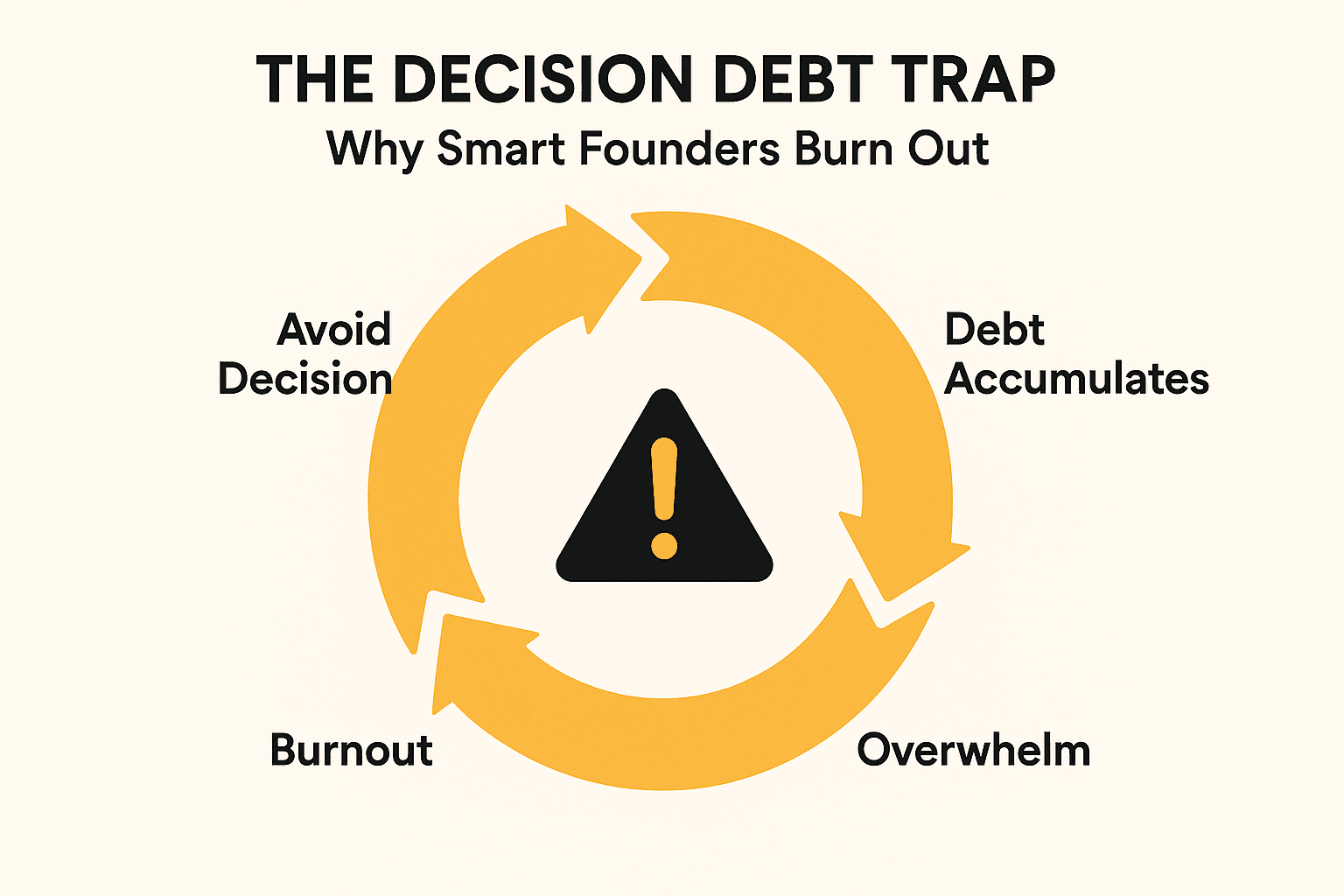
The Decision Debt Trap: Why Smart Founders Burn Out
I tracked every decision I made for 30 days. By day 5, I understood why founders burn out.
It wasn't the hours. It wasn't the stress. It was the choices.
Every single day, I was making 50-70 decisions before noon. Which email to answer first. Which feature to prioritize. Which customer to call back. Which bug to fix. Which meeting to take. Which headline to use.
By 2pm, my brain was mush. I was making bad choices. I knew they were bad choices. I made them anyway.
That's when I discovered decision debt.
What I Did
I was curious about why I kept making stupid decisions despite knowing better. So I tracked every choice I made for 30 days.
Not just work decisions. All of them.
- What to eat for breakfast (3 decisions)
- Which route to take to work (1 decision)
- Which email to open first (12 decisions)
- Which customer problem to solve (5 decisions)
- What to say in that difficult conversation (15 decisions)
By the end of day 1, I'd made 127 decisions.
By day 30, I'd made 3,847 decisions.
And I'd made 127 of them badly. I knew they were bad at the time. I made them anyway.
That's a 3% failure rate. Doesn't sound like much. But 3% of 3,847 is 115 bad decisions. 115 times I chose wrong when I knew better.
The Pattern I Noticed
After analyzing 30 days of data, I found a pattern.
My first 20 decisions of the day: 95% success rate Decisions 21-40: 85% success rate Decisions 41-60: 70% success rate Decisions 61-80: 50% success rate Decisions 80+: 30% success rate
By decision 80, I was basically guessing.
Here's what that looked like in practice:
Morning (decisions 1-20): I made smart choices. I prioritized well. I said no to distractions.
Midday (decisions 21-60): I started slipping. I answered emails I should have ignored. I said yes to meetings I didn't need.
Afternoon (decisions 61-80): I was making mistakes. I shipped features that weren't ready. I sent emails I regretted.
Evening (decisions 80+): I was useless. I scrolled social media. I ate junk food. I said yes to everything because no felt too hard.
This is decision fatigue. And every founder I've talked to has it. They just don't know it.
The Hidden Cost of Decision Debt
Here's what makes decision fatigue dangerous: it compounds.
Every bad decision you make creates more decisions to make later.
- You ship a feature too early (bad decision) ‚Üí now you have to decide how to fix it, apologize to customers, and rebuild trust (3 more decisions)
- You hire the wrong person (bad decision) ‚Üí now you have to decide how to fire them, find someone new, and rebuild the team (5 more decisions)
- You ignore a customer complaint (bad decision) ‚Üí now you have to decide how to handle the public backlash, refund requests, and reputation damage (10 more decisions)
One bad decision in the morning can create 20 decisions in the afternoon. That's decision debt.
And unlike financial debt, you can't declare bankruptcy on decisions. You have to make them. Every single one.
The Three Traps
After 30 days of tracking, I identified three traps that create decision debt.
Trap 1: The Priority Illusion
I thought I was good at prioritizing. I wasn't.
Every day, I'd start with a list of 10 important tasks. By noon, I'd added 15 more. By 5pm, I'd done 8 tasks from the original 10, plus 12 from the new 15.
Here's the problem: I never finished the list. I never could. Because every task I completed generated 2 new tasks.
Complete a feature ‚Üí write documentation, announce to users, handle support questions Close a sale ‚Üí onboard the customer, set up their account, answer their questions Ship a bug fix ‚Üí test it, deploy it, monitor for issues
The list never ends. And the longer the list, the more decisions you have to make about what to do next.
The fix: I started capping my daily list at 3 tasks. Not 10. Not 5. Three.
If I finished all 3, I could add more. But I couldn't start the day with more than 3.
This forced me to make hard choices upfront. Which also meant fewer bad choices later.
Trap 2: The Open Door Policy
I thought being available made me a good founder. It made me a tired one.
Every notification was a decision:
- Should I look at this now or later?
- Is this important or not?
- Do I need to respond or can it wait?
By keeping every channel open (email, Slack, Twitter, LinkedIn, phone), I was forcing my brain to make hundreds of micro-decisions per hour.
No wonder I was exhausted by 2pm.
The fix: I closed everything.
- Email: checked twice per day (10am and 4pm)
- Slack: checked once per hour (on the hour)
- Twitter: checked never during work hours
- Phone: silenced except for 3 people
This eliminated hundreds of micro-decisions. Which meant I had more decision capacity for the things that mattered.
Trap 3: The Expert Trap
I thought I should make every decision because I knew the most. I was wrong.
The founder's job isn't to make every decision. It's to make the decisions only the founder can make.
Every decision you make that someone else could make is a waste of your decision budget.
- What color should the button be? (Not a founder decision)
- Which customer should we prioritize? (Founder decision)
- How should we word this email? (Not a founder decision)
- Should we raise prices? (Founder decision)
I was spending 80% of my decision budget on choices that weren't founder-level. Which meant I had 20% left for the decisions that actually mattered.
The fix: I made a list of "founder decisions only":
- Pricing
- Product direction
- Hiring
- Firing
- Major partnerships
- Company culture
Everything else got delegated or automated. If I couldn't delegate it, I automated it with a rule. If I couldn't automate it, I deleted it.
The Decision Budget Framework
After 30 days of experiments, here's the framework that worked.
Step 1: Track Your Decisions
For 3 days, write down every choice you make. Not just work. All of them.
You'll notice patterns:
- When you make good decisions (morning? after coffee? before lunch?)
- When you make bad decisions (afternoon? after meetings? late at night?)
- Which decisions drain you (customer calls? difficult conversations? creative work?)
Step 2: Identify Your Decision Capacity
Based on your tracking, you'll see where your decision quality drops off.
For me, it was decision 60. After that, I was 50/50.
That became my decision budget: 60 decisions per day. Period.
Step 3: Protect Your Best Hours
Your best decisions happen in your first 20-30 decisions of the day.
Don't waste them on email. Don't waste them on Slack. Don't waste them on other people's priorities.
Use them for:
- Your most important task
- Your hardest problem
- Your biggest opportunity
Step 4: Eliminate Decisions
Every decision you eliminate is one you don't have to make.
- Wear the same thing every day (0 decisions)
- Eat the same breakfast every day (0 decisions)
- Follow the same morning routine every day (0 decisions)
- Use templates for recurring tasks (0 decisions)
This sounds extreme. It is. But the founders who do it aren't being weird. They're protecting their decision budget for the things that matter.
Step 5: Delegate Aggressively
If someone else can make the decision, let them.
You'll be tempted to override them. Don't.
The goal isn't perfect decisions. The goal is more decision capacity for the things only you can decide.
What Changed After 30 Days
After implementing this framework, here's what happened.
Week 1: I made 127 decisions per day, but only 60 were high-quality. I started cutting.
Week 2: I reduced to 80 decisions per day. Quality improved. I was less tired.
Week 3: I reduced to 60 decisions per day. Quality stayed high. I had energy in the evening for the first time in months.
Week 4: I was making 50 decisions per day with 95% quality. I was sleeping better. I was less anxious. I was actually enjoying the work.
The math is simple. Fewer decisions = better decisions = less debt.
The Uncomfortable Truth
Most founders don't burn out from hard work. They burn out from decision work.
The 127 decisions I made every day weren't making me productive. They were making me tired. And the tired version of me made bad decisions that created more decisions that made me more tired.
It was a vicious cycle. And the only way out was to make fewer choices.
That feels wrong. Feels like you're not doing enough. Feels like you should be making more decisions, not fewer.
But here's what I learned: the quality of your decisions matters more than the quantity. And quality comes from scarcity.
The founders who succeed aren't the ones who make the most decisions. They're the ones who protect their decision budget fiercely and spend it only on the choices that matter.
Your decision budget is finite. Treat it that way.
Methodology: I tracked every decision I made for 30 days using a simple note on my phone. Each time I made a choice (any choice), I logged it. At the end of each day, I reviewed the log and marked which decisions were good vs bad based on what I knew at the time. Total: 3,847 decisions, 127 bad (3% failure rate).