The Decision Budget: Why Solo Founders Burn Out (And How to Fix It)
TL;DR: You make 35,000 decisions a day. Solo founders make even more. The problem isn't bad prioritization. It's too many decisions draining the same limited pool of mental energy. Here's how to cut your daily decisions in half.
I tracked every decision I made for one week. By Wednesday, I understood why I was failing.
It wasn't discipline. I had plenty of that. It wasn't prioritization. I was good at picking what mattered. It wasn't even time management. I had systems for that.
The problem was simpler and more fundamental: I was making too many decisions.
Coffee or tea? This button blue or green? Should I reply now or later? Which task next? Should I check Slack? What about email? Is this feature worth building? Should I respond to that tweet?
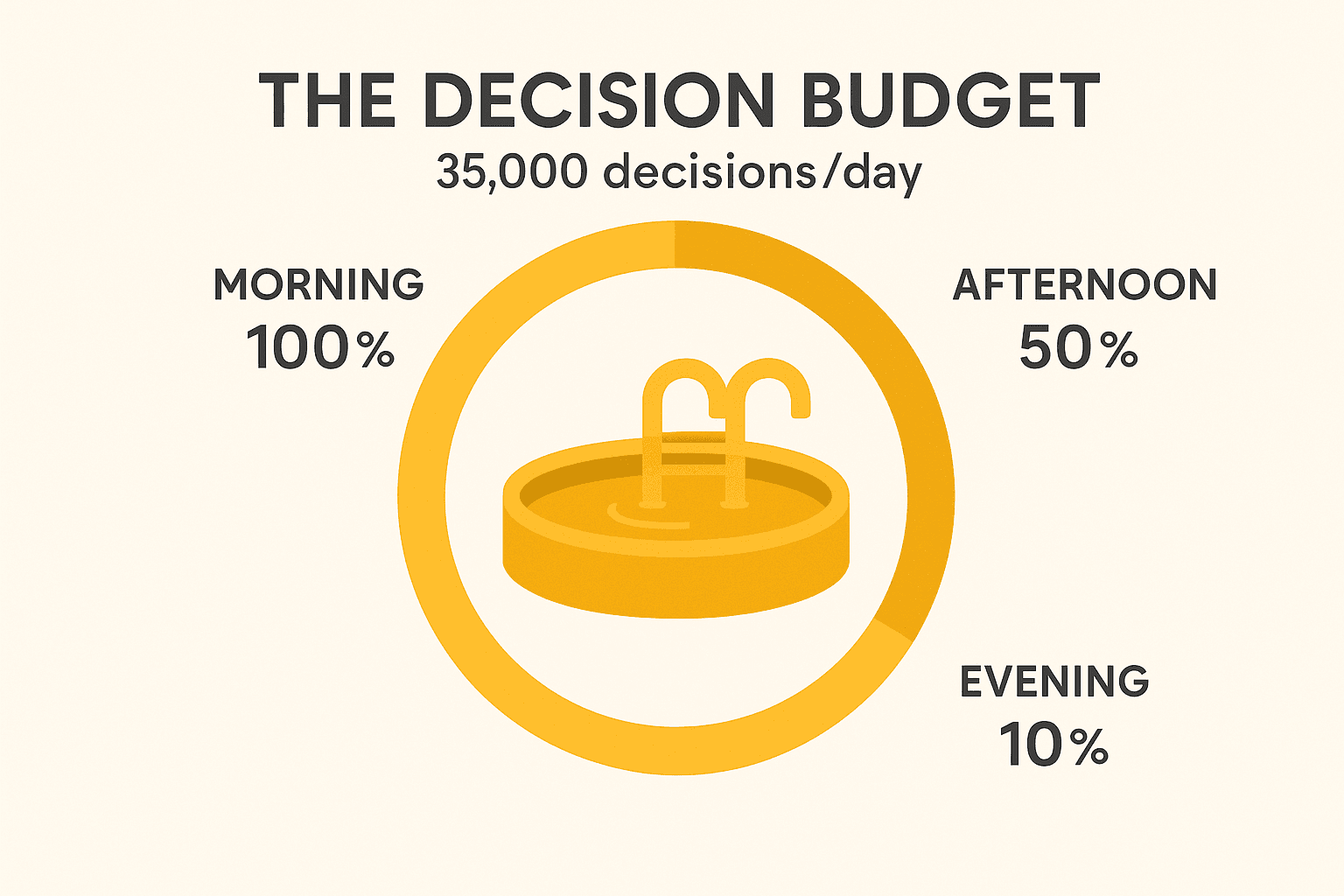
Every single one of these costs from the same limited pool of mental energy. By 3 PM, that pool was empty. I was running on fumes, defaulting to whatever felt easiest, making choices I'd regret by morning.
The solution wasn't better decision-making. It was fewer decisions.
The 35,000 Decision Problem
A Cornell study found that the average adult makes about 35,000 decisions per day. That sounds absurd until you start counting.
Every moment is a choice:
- What to wear (easy for some, exhausting for others)
- What to eat for breakfast
- When to check email
- What task to start
- How to respond to that message
- Whether to keep working or take a break
- Where to focus for the next hour
Solo founders have it worse. You're not just making decisions about your work. You're making decisions about:
- Product direction
- Marketing strategy
- Customer support
- Business operations
- Financial planning
- Technical architecture
- Design choices
- Hiring (eventually)
- Your own schedule
Most employees make decisions within their defined role. Solo founders make decisions across every role, simultaneously, all day.
By my count, I was hitting 50,000+ daily decisions during intense building phases. No wonder I was burned out by noon.
The Decision Fatigue Death Spiral
Here's what happens when you exhaust your decision-making capacity:
Stage 1: Decision Avoidance
You start avoiding decisions entirely. Emails sit unread. Features go undecided. You "need more information" before choosing, but you never actually gather it.
Stage 2: Decision Defaulting
When forced to choose, you default to the easiest option. Not the best option. The one that requires the least thought. You say yes when you should say no. You pick the familiar over the better.
Stage 3: Impulse Control Collapse
Your willpower is connected to your decision capacity. As decisions drain you, self-control goes too. You eat garbage. You doom-scroll. You make emotional choices you regret. You snap at people.
Stage 4: Complete Shutdown
Eventually, your brain refuses. You stare at screens without seeing them. You open tasks and close them. You feel paralyzed, unable to move forward on anything. This is burnout.
I've hit stage 4 multiple times. It takes days to recover. And it's completely preventable.
The Decision Budget Framework
Think of your daily decision capacity like a budget. You have a limited amount. Every decision costs something. When you run out, you're broke.
Most productivity advice focuses on spending your decision budget wisely. Choose the right tasks. Prioritize ruthlessly. Make your biggest decisions first.
That's fine, but incomplete.
The real unlock is reducing the total number of decisions you have to make.
Not better decisions. Fewer decisions.
The Three Categories
Every decision falls into one of three buckets:
| Category | Solution | Example |
|---|---|---|
| Recurring | Automate or pre-decide | What to eat, when to exercise, what to wear |
| Binary | Create rules | Should I take this meeting? Should I add this feature? |
| Complex | Batch and schedule | Product direction, strategy, hiring |
Let's break down each.
Category 1: Recurring Decisions (Pre-Decide Everything)
These are decisions you make over and over. They feel small, but they add up.
What to eat for breakfast? What to wear? When to exercise? Which route to take? When to check email?
The fix: Make these decisions once, then never again.
Food
I eat the same breakfast every weekday. Oatmeal, banana, coffee. I don't think about it. The ingredients are always stocked. The decision is pre-made.
Lunch is one of three options. I pick Sunday night, then don't think about it again until next Sunday.
This saves me ~20 daily decisions and frees up mental space for actual work.
Clothes
I own 7 identical black t-shirts and 3 pairs of the same jeans. Getting dressed takes 30 seconds and zero decisions.
Zuckerberg famously did this. So does Obama. It's not about fashion. It's about preserving decision capacity for what matters.
Schedule
My calendar has blocks, not tasks. 9-12 is deep work. No exceptions. No deciding "should I work on this or that." I know what I'm doing before the day starts.
Meetings only happen Tuesday and Thursday afternoons. If someone wants to meet Monday, the answer is no. Not "let me check my calendar." Just no.
Exercise
I exercise at 6:30 AM, three days a week, same routine every time. I don't decide whether to go. I don't decide what to do when I get there. The decision was made months ago.
Category 2: Binary Decisions (Create Rules)
These are yes/no decisions that seem to require judgment but actually don't.
Should I take this meeting? Should I add this feature? Should I respond to this email?
The fix: Create rules that make the decision automatic.
The Meeting Rule
My rule: No meetings without a clear agenda and expected outcome sent in advance.
Someone wants to "pick my brain"? No agenda, no meeting. "Let's sync up"? What's the expected outcome? If they can't answer, decline.
This eliminates 80% of meeting requests without any actual decision-making.
The Feature Rule
My rule: No new features until the current feature has been shipped and measured.
Customer requesting something? Great, goes on the backlog. But the decision to build it isn't made in the moment. It's made during scheduled planning sessions.
The Communication Rule
My rule: Email twice a day (10 AM, 4 PM). Slack when in focus mode is muted. Phone notifications off.
I don't decide whether to check email. The schedule decides. The question "should I respond now?" doesn't exist. Everything waits until the scheduled time.
Building Your Own Rules
For any recurring binary decision, ask:
- What would a reasonable person decide 90% of the time?
- Can I make that the default?
- What are the exceptions?
Example: "Should I say yes to podcast interviews?"
90% answer: No, because they take time and I'm focused on building. Default: Decline all podcast requests. Exception: If it's a show I personally listen to, consider it.
Now I don't decide each time. The rule decides.
Category 3: Complex Decisions (Batch and Schedule)
Some decisions genuinely require thought. Product direction. Pricing changes. Strategic pivots. Hiring.
The fix: Don't make these in the moment. Schedule dedicated time for them.
The Weekly Strategy Block
I have a 2-hour block every Friday morning for complex decisions. During the week, these questions go on a list. I don't think about them until Friday.
Someone asks "Should we change our pricing model?" I say "Great question, adding it to the Friday list." Then I forget about it.
On Friday, I review the list with fresh energy and make decisions. Often, half the items have resolved themselves or no longer seem important.
The Decision Journal
For truly big decisions, I write them out. What are the options? What are the tradeoffs? What would I tell a friend in this situation?
Writing forces clarity. It takes 20 minutes and often saves days of mental churn.
The 10/10/10 Rule
When stuck on a complex decision, I ask:
- How will I feel about this in 10 minutes?
- How will I feel about it in 10 months?
- How will I feel about it in 10 years?
Most decisions that feel huge in the moment are irrelevant in 10 years. That perspective makes choosing easier.
The Elimination Audit
Once a month, I audit my decisions from the past week. Where did I spend the most mental energy? What decisions kept recurring?
For each drain, I ask:
- Can I eliminate this decision entirely?
- Can I pre-decide it?
- Can I create a rule?
- Can I batch it?
Every recurring decision I eliminate compounds. One fewer daily decision is 365 fewer annual decisions. Ten fewer is 3,650.
Over time, my decision budget goes further and further. I have more capacity for the decisions that actually matter.
Real Examples: Before and After
Example 1: Email
Before: Check email throughout the day. Each message requires deciding: respond now? Later? At all? How much effort?
Daily decisions: ~50
After: Email at 10 AM and 4 PM only. Respond immediately or archive. If it takes more than 2 minutes, schedule as a task.
Daily decisions: ~10
Example 2: Content
Before: Wake up and decide what to post. Should I write a thread? Reply to others? Share something? What topic?
Daily decisions: ~30
After: Sunday: plan the week's content. Create templates. Batch write. Each day, execute the plan.
Daily decisions: ~5
Example 3: Product
Before: Customer request comes in. Think about it. Should we build it? When? How does it fit?
Daily decisions: ~20
After: All requests go to a backlog. Weekly: review backlog, decide what goes on roadmap. Daily: execute roadmap.
Daily decisions: ~3
The Compound Effect
In my first year as a solo founder, I was making 50,000+ decisions daily. I was exhausted by noon and burned out by month 6.
After implementing the Decision Budget framework, I cut that to roughly 20,000. Still a lot, but 60% less.
The difference was night and day:
- Energy lasts until 6 PM instead of collapsing at 2 PM
- Better quality decisions on things that matter
- Less anxiety, fewer regrets
- Faster progress because I'm not constantly re-deciding
The decisions I make now are the ones that actually move the needle. Everything else is pre-decided, ruled, or batched.
Getting Started: The First Week
If this resonates, here's how to start:
Day 1-2: Awareness
Track every decision you make. Use a tally counter app or a simple notebook. Don't try to change anything yet. Just count.
You'll be horrified. Good. Awareness is the first step.
Day 3-4: Identify the Drains
Review your tallies. Where are the repeating decisions? What's consuming mental energy without creating value?
Make a list of your top 10 recurring decisions.
Day 5-7: Implement Solutions
For each of your top 10:
- Can you eliminate it?
- Can you pre-decide it?
- Can you create a rule?
- Can you batch it?
Implement at least 3 changes this week.
Week 2+: Iterate
Each week, identify one more decision to eliminate. Over time, your decision budget stretches further and further.
The Mindset Shift
The hardest part isn't the tactics. It's accepting that you don't need to make most decisions.
We've been trained to believe that good leaders are decisive. They make calls. They weigh options. They choose.
That's true for the decisions that matter. But 90% of decisions don't matter. They're noise. They're recurring patterns that should be automated.
The best solo founders I know aren't better at making decisions. They're better at not making them.
They show up each day with rules, pre-decisions, and batches in place. Their mental energy goes entirely toward the few decisions that actually move the needle.
That's the Decision Budget framework. Not better decisions. Fewer decisions.
Start counting. Start eliminating. Watch your capacity grow.
You just read about 35,000 decisions a day. Most founders who hit decision exhaustion start looking for better frameworks or productivity apps. What they actually need is fewer decisions, not better ways to manage them.
The category most worth eliminating is the thinking-heavy strategic work that requires a fresh mind: analyzing a competitor, mapping a market, deciding what to build next, drafting outreach. These decisions are high-stakes enough that you should be doing them at peak energy. But they're also the ones that keep getting deferred to whenever.
That's what Luka does. It's a research and growth agent that handles the decisions that drain your best thinking: market research, competitive analysis, content strategy, growth experiments. So you're spending your decision budget on things only you can decide. If you're burning out on the wrong decisions, Luka is worth a look.
Frequently Asked Questions
What if I enjoy making decisions?
Some decisions are genuinely enjoyable. Keep those. The goal isn't to eliminate joy. It's to eliminate the repetitive, draining decisions that don't add value.
What about spontaneity?
Spontaneity is a luxury for people who aren't burned out. Get your decision budget under control first. Then you'll have room for spontaneity.
How do I know which decisions to eliminate?
If you make the same decision more than once a week and it's not inherently valuable, eliminate it. If it feels tedious or draining, eliminate it.
What if my rules don't always apply?
Rules should handle 90% of cases. The 10% exceptions are fine. You're still saving mental energy on the 90%.
How long until I see results?
Most people feel noticeably better within a week of implementing 3-5 changes. The compound effect kicks in over months.
About the Author