TL;DR: You sit down to work. First 45 minutes: 20 min checking metrics, 15 min re-reading slack, 10 min reorganizing your task list. You did not do anything wrong. You made 14 micro-decisions that should not have required deliberation.
You sit down to work. First 45 minutes: 20 min checking metrics, 15 min re-reading slack, 10 min reorganizing your task list. You did not do anything wrong. You made 14 micro-decisions that should not have required deliberation.
The Problem: Cognitive Overhead
Most productivity systems count time. They do not count cognitive overhead. And cognitive overhead is what actually drains you. Every unnecessary micro-decision is a tax on the decisions that actually matter.
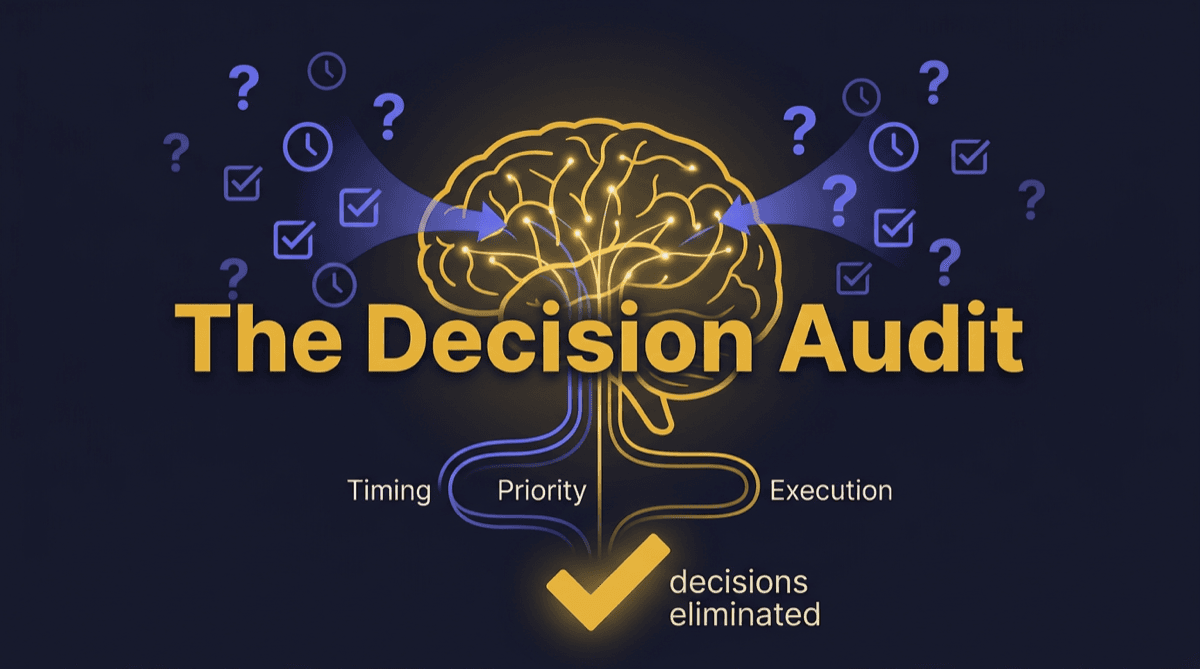
The Decision Audit
20 minutes every Friday. One question: what decisions did I make this week that I should not have had to make?
The answers are usually obvious. The fixes are usually permanent.
Three Categories of Recurring Decisions
Timing decisions: When should I check slack? These are the easiest to eliminate permanently.
Priority decisions: What should I work on first? These usually are not ambiguous. They are just made without data.
Execution decisions: How should I structure this? These look like creative work but are often just perfectionism.
How to Eliminate Timing Decisions Permanently
Pick your windows. Write them down. You check slack at 9am and 2pm. Done. That decision is now permanent. You will never think about it again.
How to Eliminate Priority Decisions
When you look at what actually moved the needle last week, the answer is obvious. The agony comes from deciding without looking.
How to Eliminate Execution Decisions
Define the standard in advance. "Emails to users are plain text, under 150 words, one clear ask." When the standard exists, the decision is a checklist.
Three Decisions to Make Right Now
- Your single metric for the week (one number, not five)
- Your communication windows (pick times, write them down, do them every day)
- What you are explicitly NOT doing this week
About the Author