The Cold DM Playbook: How to Get Your First 10 Customers Without Ads
TL;DR: Your first customers won't come from ads, SEO, or product-led growth. They'll come from you manually reaching out to people who have the problem you solve. Here's the exact playbook that works.
Your first 10 customers won't come from ads. They won't come from SEO. They won't come from a viral Product Hunt launch.
They'll come from you, manually messaging strangers who have the problem you solve.
I've watched dozens of solo founders waste months on "scalable" channels before they have anything worth scaling. Building landing pages nobody visits. Running ads to cold traffic that doesn't convert. Writing blog posts for keywords they'll never rank for.
Meanwhile, the founders who hit $10K MRR fastest are doing something that feels uncomfortable: cold outreach.
Here's exactly how it works.
Why Cold DMs Work (And Why You're Avoiding Them)
Let's address the elephant in the room: cold DMs feel spammy.
You've received garbage pitches in your inbox. Automated templates with your first name mail-merged. "Quick question" subject lines that are never quick and never questions.
That's not what we're talking about.
Real cold outreach is a conversation. You find someone with a problem. You start talking. If your solution fits, you mention it. If not, you've still made a connection.
The founders who call this "spammy" are the same ones with zero customers six months after launch. They're waiting for customers to find them. That's not how early-stage works.
The Math That Changes Everything
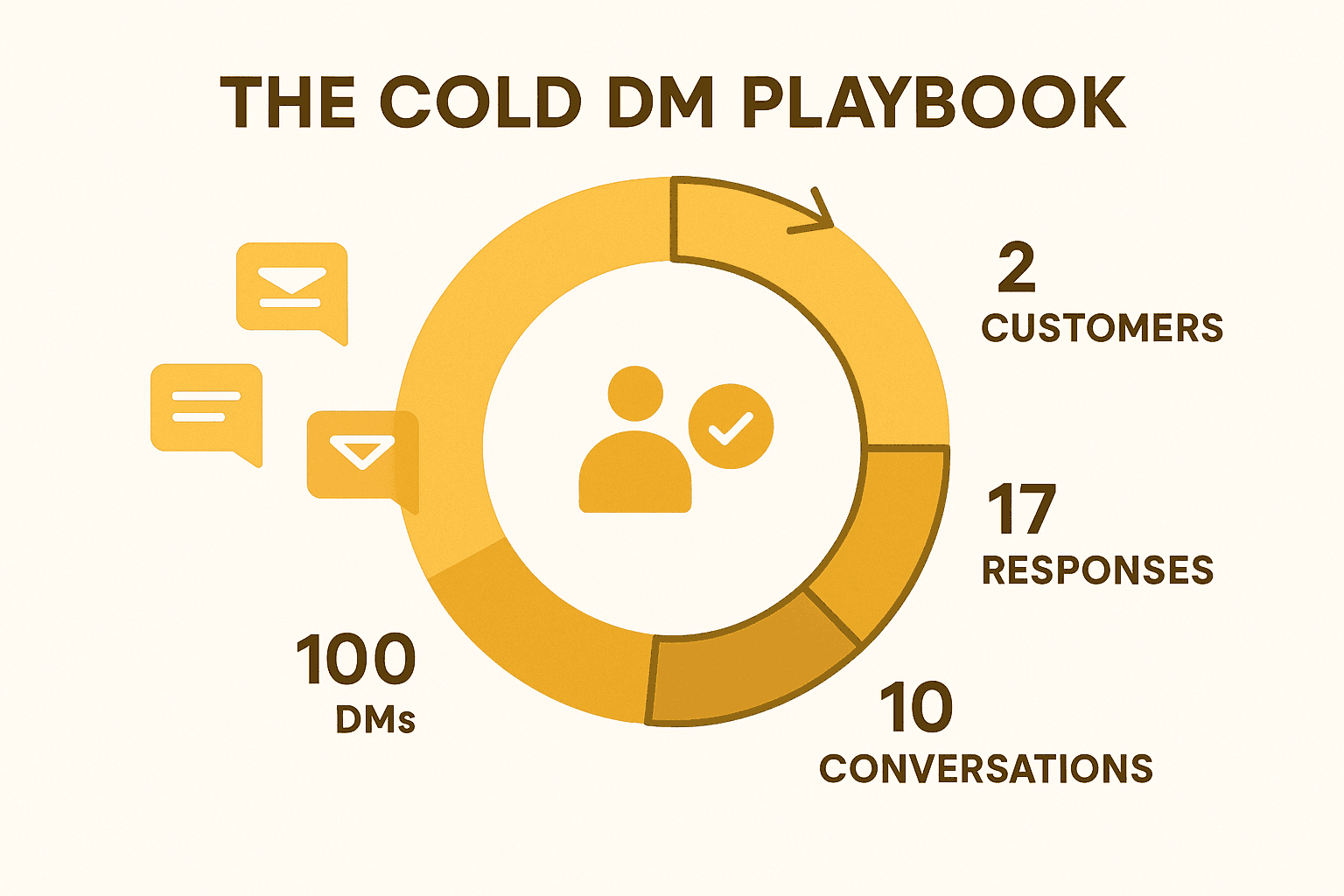
Let's run the numbers on cold outreach:
| Step | Conversion | Running Total |
|---|---|---|
| DMs Sent | 100% | 100 |
| Opened/Read | 70% | 70 |
| Responded | 25% | 17 |
| Had Conversation | 60% | 10 |
| Tried Product | 50% | 5 |
| Paid | 40% | 2 |
100 cold DMs = 2 paying customers.
If your product costs $50/month, that's $100 MRR from a few hours of work. Do that for a month and you have $400+ MRR and actual feedback on your product.
Compare that to ads: You spend $500, get 1,000 clicks, and maybe 1 conversion. The math isn't even close.
Step 1: Find Where Your ICP Actually Lives
Your ideal customer is already somewhere online, complaining about the problem you solve. Your job is to find them.
The Platform Hierarchy
Here's where solo founders find their first customers, ranked by effectiveness:
- Twitter/X - Best for B2B, tech, creators
- Discord - Best for communities, developers, gamers
- Reddit - Best for niche problems, consumers
- LinkedIn - Best for enterprise, professional services
- Slack - Best for industry-specific, SaaS
- Indie Hackers - Best for founders selling to founders
Pick ONE platform. Not three. Not "all of them eventually." One.
How to Find Your Specific Communities
Let's say you're building a tool for freelance designers.
Twitter/X:
- Search "freelance designer" + "frustrating"
- Search "invoicing nightmare"
- Find accounts with 1K-50K followers in your niche
- Look at who engages with their posts
Discord:
- Search "freelance designer discord" on Google
- Look for servers with 500-5,000 members (big enough to matter, small enough to stand out)
- Check the #introductions channel
Reddit:
- r/freelance
- r/design
- r/antiwork (people complaining about their jobs = your customers)
Write down 3-5 specific places. These are your hunting grounds.
Step 2: Lurk Before You Speak (48 Hours Minimum)
This is where most founders fail. They find a community and immediately start pitching.
Don't.
Spend 48 hours just reading. You're learning three things:
- Language - What words do they use? What's the jargon?
- Pain points - What do they complain about repeatedly?
- Culture - What's acceptable? What gets you banned?
I cannot overstate this: If you don't know their language, your outreach will sound like an outsider trying to sell. It's immediately obvious and immediately ignored.
What to Look For
As you lurk, take notes on:
- Repeated complaints (this is product direction)
- Questions nobody answers well (this is content opportunity)
- People who seem influential (this is who to help first)
- What gets engagement vs. what gets ignored
By the end of 48 hours, you should be able to write a post that sounds like you belong there.
Step 3: Provide Value First (The Trust-Building Phase)
Now you start participating. But here's the rule:
No pitching. No links. No "I built a thing."
For the next 7-14 days, you're just a helpful person. You answer questions. You share knowledge. You engage with others' content.
Value First Examples
Bad: "Hey, I noticed you're struggling with invoicing. I built a tool for that! Check it out: [link]"
Good: "For invoicing, I'd recommend setting up a Notion template with auto-calculations. Here's how: [actual helpful explanation]. Let me know if you want me to walk through any of it."
See the difference? The second one actually helps. It builds trust. It makes them want to know more about you.
The Engagement Ladder
| Week | Activity | Goal |
|---|---|---|
| 1 | Answer 3-5 questions daily | Get noticed as helpful |
| 2 | Start discussions, share insights | Build reputation |
| 3 | DM people who engaged with your content | Start conversations |
| 4+ | Mention your product in context | Convert to customers |
This feels slow. It's not. It's faster than any other method because you're building trust while learning.
Step 4: The Cold DM That Actually Gets Responses
After weeks of being helpful, you've earned the right to reach out. Here's how.
The Anatomy of a Good Cold DM
Line 1: Specific observation Reference something they said, built, or shared. This proves you're not mass messaging.
Line 2: The hook Why you're reaching out. Make it about them, not you.
Line 3: The soft ask A question, not a pitch. Give them an easy way to respond.
Example DMs by Platform
Twitter/X:
"Saw your thread on design client management. The part about scope creep hit hard. I've been working on something related to this. Would love your take on it if you have 2 min?"
Discord:
"Hey! Your question in #freelance about tracking time across projects is something I've been obsessing over. Built a system for it. Would you be open to trying it and giving feedback?"
LinkedIn:
"Your post on proposal automation resonated. I'm building a tool specifically for freelance designers facing this. Not looking to pitch, just want feedback from people who get it. Open to a quick chat?"
What NOT to Do
- Don't send the same message to 100 people
- Don't lead with your product
- Don't ask for "15 minutes on a call" (too big of an ask)
- Don't follow up more than once
- Don't use fake personalization ("I noticed you're interested in design")
Step 5: The Conversation ‚Üí Customer Path
Someone responded. Now what?
First Response: Curiosity, Not Pitch
They said yes to chatting. Your goal now is to understand their problem, not to pitch your solution.
Ask questions:
- "What have you tried so far?"
- "What's the most frustrating part?"
- "If this were solved, what would change for you?"
Take notes. These answers are gold for your product and marketing.
Second Exchange: The Light Demo
If their problem matches your solution, offer to show them:
"Based on what you're describing, I think what I built might help. Want me to show you a quick 3-minute video of how it works? No pressure either way."
Notice: 3 minutes. Low commitment. "No pressure." You're making it easy to say yes.
Third Exchange: The Trial
They liked the demo. Now:
"Happy to give you free access for a month to try it. If it works for you, we can talk pricing. If not, no hard feelings and I'd love your feedback either way."
Free trial. Clear next step. Exit ramp if it's not a fit.
Fourth Exchange: The Close
After they've used it:
"How's it going with [product]? Anything confusing or not working for you?"
If positive, they'll often ask about pricing on their own. If they don't:
"Would you want to keep using it? It's $X/month and I can lock you in at early supporter pricing."
That's it. No high-pressure tactics. No manipulation. Just a conversation that naturally leads to a transaction.
Common Mistakes That Kill Cold Outreach
Mistake 1: Starting Too Early
You don't have a product yet? Don't do cold outreach. You're wasting their time and your credibility.
Have at least a working prototype before reaching out. "It's coming soon" isn't good enough.
Mistake 2: Targeting Too Broad
"Small businesses" isn't a target. "Freelance web designers with 2-5 years experience who struggle with client invoicing" is a target.
The more specific, the more your message resonates.
Mistake 3: Expecting Instant Results
This isn't a hack. It's a process. You might send 20 DMs before getting one good conversation. That's normal.
The founders who quit after 10 failed DMs never learn what's actually wrong with their approach.
Mistake 4: Pitching Before Helping
If your first interaction is a pitch, you've already lost. The value-first approach isn't optional. It's the whole strategy.
Mistake 5: Not Following Up
Someone said "interesting, but busy right now"? That's not a no. Follow up in 2 weeks.
Most of your customers will come from the second or third touch, not the first.
The cold DM that gets a response isn't generic. It's specific to the person's situation, their platform, their pain, right now. The research that makes that possible is most of the work: finding where your ICP actually lives, understanding what problems are active in those communities today, mapping the language they use to describe their pain.
Most founders skip the research and wonder why their DMs get ignored. A DM that could have been sent to anyone gets treated like it was sent to no one.
Luka is a research agent for solo founders. It handles the upfront ICP research, community mapping, pain point analysis, language research, so your cold DMs have the specificity that gets responses. If you're building your first customer base through outreach, Luka is worth looking at before you start writing messages.
The 30-Day Cold Outreach Plan
Here's the exact schedule I'd follow:
Week 1: Foundation
- Day 1-2: Find 3-5 communities where your ICP lives
- Day 3-4: Lurk, take notes, learn language
- Day 5-7: Start answering questions (3-5 per day)
Week 2: Reputation
- Answer questions daily
- Start your own discussions
- Identify 20 people to eventually reach out to
Week 3: Outreach
- Send 5 DMs per day to warm contacts (people who engaged with your content)
- Track responses in a simple spreadsheet
- Have conversations, don't pitch
Week 4: Conversion
- Demo for anyone interested
- Offer free trials
- Ask for feedback
- Close your first customers
By the end of 30 days, you should have:
- 2-5 paying customers
- A list of 10+ warm leads
- Clear feedback on your product
- Understanding of your ICP's language
That's more progress than most founders make in 6 months of "building in public."
Why This Works When Everything Else Fails
Cold outreach works because it bypasses the biggest problem early-stage founders face: obscurity.
You're not fighting for attention against million-dollar ad budgets. You're not waiting for Google to notice your content. You're going directly to the people who need you.
It's uncomfortable because it requires rejection. You'll message 100 people and 80 will ignore you. That's fine. The 20 who respond are worth more than 10,000 anonymous website visitors.
The founders who succeed fastest aren't the ones with the best products. They're the ones willing to do the uncomfortable work of talking to strangers.
Start today. Find your community. Lurk for 48 hours. Then reach out.
Your first 10 customers are waiting.
Frequently Asked Questions
How many DMs should I send per day?
Start with 5-10 personalized DMs daily. Quality matters more than quantity. A single great conversation beats 50 ignored templates.
What if I get rejected or ignored?
That's normal. Expect a 70-80% ignore rate even with good messages. Don't take it personally. Adjust your approach and keep going.
Should I use automation for cold DMs?
No. Automated DMs get you banned and destroy your reputation. Every message should be personally written for that specific person.
How do I know if my product is ready for outreach?
If someone could use it today and get value, you're ready. It doesn't need to be perfect. It needs to solve a real problem.
What about LinkedIn Sales Navigator?
It's useful for B2B but overkill for getting your first 10 customers. Master the basics before adding paid tools.
About the Author