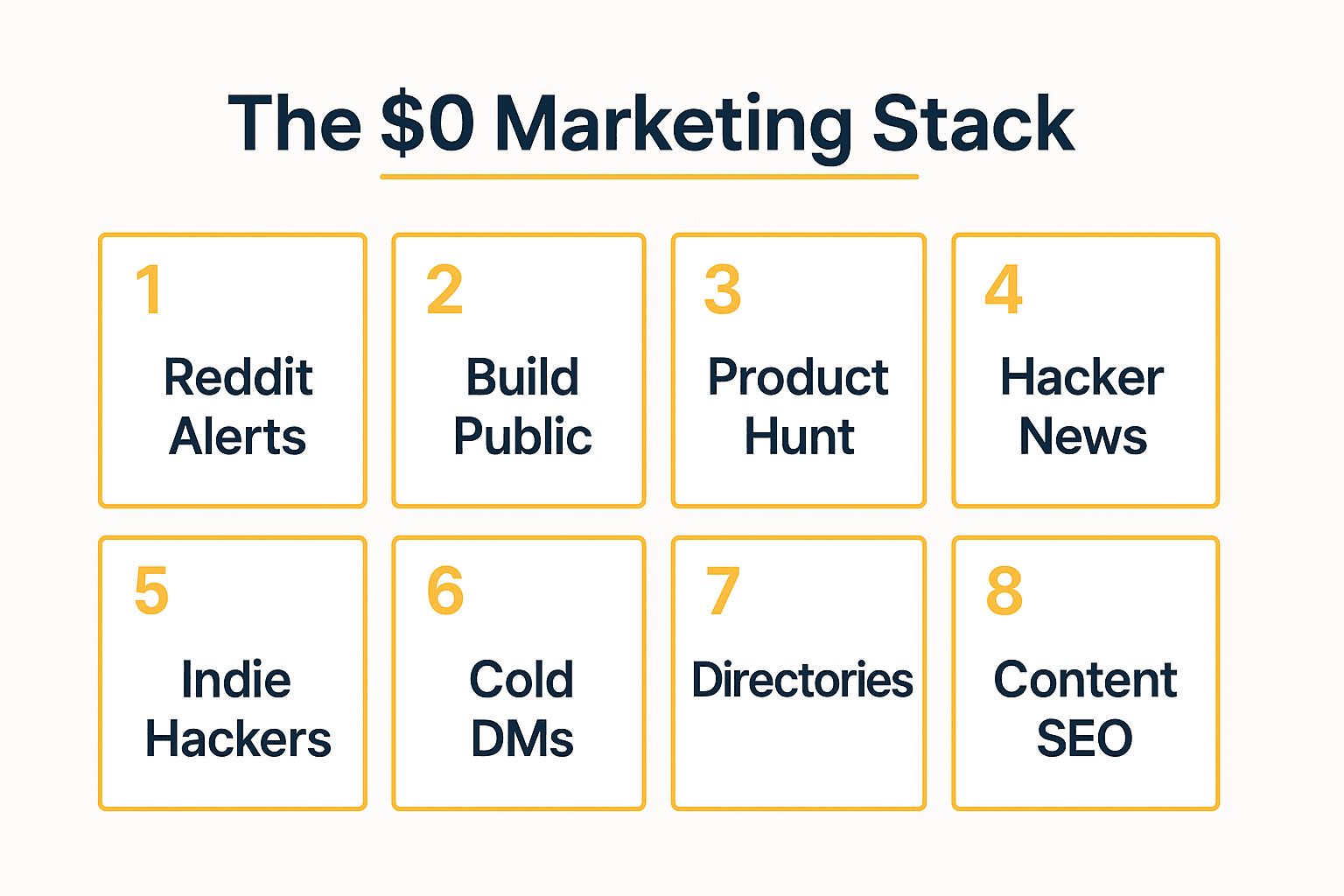
The $0 Marketing Stack: How Solo Founders Get Their First 1,000 Users Without Spending a Cent
I set up keyword alerts for every term related to my niche. For six months, I responded to every relevant question on Twitter, Reddit, Indie Hackers, and random forums within five minutes of it being posted. Zero ads. Zero agency. Zero budget. The result: 20K MRR with a solo team.
That's not my story. It's a post that went viral on Reddit's r/SaaS in August 2025. More than 800 comments from founders who either recognized the exact pattern or were stunned that it actually worked.
I spent two days going through that thread, 40+ similar case studies, and every credible $0 growth story I could verify. After cross-referencing what worked versus what founders just thought worked, a pattern emerged that nobody presents as a system. It's scattered across individual success stories, hidden inside anecdotes, and buried under generic advice like "build in public."
Here is the actual $0 marketing stack - the channels that repeatedly produce first users without an ad budget - and exactly how to use each one.
Why Paid Ads Are the Wrong Starting Point
Let me short-circuit the obvious question: why not just run some Facebook or Google ads?
Three reasons, and they compound.
First: Paid ads require product-market fit to be efficient. Before you know what message converts and who actually buys, paid traffic is expensive noise. You're paying to discover things you should discover cheaply.
Second: Solo founders don't have the budget to run learning cycles. A proper paid acquisition experiment costs $3,000-$10,000 minimum to generate statistically meaningful data. That's several months of runway for most bootstrappers.
Third: Organic channels give you signal ads never do. When someone finds you on Reddit and signs up, you learn what problem statement attracted them, what community they're in, and what language they used to describe their own pain. That information improves your positioning. Paid acquisition gives you a conversion rate and an audience ID. That's not the same thing.
The $0 marketing stack isn't about being cheap. It's about building the input layer for your growth engine before you pay to scale it.
The $0 Stack: 8 Channels That Actually Work
1. Subreddit Keyword Alerts - The Fastest First Users
This is the single highest-ROI activity in the $0 stack for most SaaS products.
How it works: Set up alerts (using tools like F5Bot, which is free, or Zapier + Reddit search) for 10-15 keywords directly related to the problem your product solves. Not your product name - the problem.
If you built a tool that helps developers manage API keys: alert for "api key management," "accidentally committed api key," "api key best practices," "store api keys," "rotate api keys."
Every time someone posts any of those phrases anywhere on Reddit, you get an email within minutes.
What you do: Read the post. If it's someone having the exact problem your product solves, respond with a genuinely helpful answer. Don't lead with the product. Answer the question first. Then at the end, naturally mention: "I also built something for this - happy to give you access if you want to try it."
The viral founder from the Reddit thread did this for six months across Twitter, Reddit, Indie Hackers, and niche forums. Not occasionally. Every relevant question. Within five minutes. Six months straight.
That sounds exhausting. It is. But it also means you're present at the exact moment someone is experiencing the pain you solve - which is as high-intent as distribution gets.
Realistic output: 50-200 qualified users in 3-6 months depending on niche volume. More importantly: direct conversations with your ICP about what they need, what language they use, and what adjacent problems they have.
2. Build in Public on X - The Long Game That Compounds
Building in public means sharing your journey, your numbers, your failures, and your learnings as you go. Not fake it till you make it. Real updates. Real milestones.
Why it works: Your ICP is on X watching other indie builders. When you share authentic progress - "just got to $500 MRR, here's what moved the needle" - you attract attention from people who want to solve the same problems. Some of them become customers. More of them become amplifiers.
The practical approach:
- Post weekly updates with specific numbers (not vague: "made progress." Specific: "activated 12 new users this week, 3 churned, here's what I changed.")
- Share learnings with genuine insight, not generic wisdom
- Engage with other builders' posts - not to self-promote, but to add real value
- Thread format outperforms single posts: "5 things I learned from my first 100 customers" gets more reach than "lesson learned: listen to users"
What not to do: Don't share every update in a self-congratulatory tone. "Just hit $1K MRR üöÄüöÄüöÄ" with no substance gets ignored. "Just hit $1K MRR. Here's the one channel that drove 80% of it, and why I almost gave up in month 3" performs because there's something to read.
Realistic output: 100-500 followers in year one who are genuinely interested in your space. Within that: 20-50 product leads from direct conversations. The compound effect over 18-24 months is significant; the first 3 months feel like shouting into a void.
3. Product Hunt Launch - One Spike, Done Right
Product Hunt launches produce a burst of traffic that plateaus fast, but for first users, the burst is real.
The anatomy of a successful PH launch:
- Build a hunter audience before you need it - comment on other launches, support builders you respect. This takes weeks, not hours.
- Prepare genuine testimonials from beta users (5+ minimum) before launch day
- Schedule for Tuesday-Thursday. Avoid Mondays (overlooked) and Fridays (dead).
- Be present all day on launch day - respond to every comment within minutes
- Post the launch in every community where you have genuine relationships (not spam)
What Product Hunt is actually good for: Early adopters who love new products and share them. Backlinks for SEO. The PH "Top Product" badge that signals credibility on your landing page for months after.
What it's not good for: Sustained organic acquisition or reaching a narrow B2B ICP. If you're building a developer tool, you'll do better with Hacker News. If you're building a consumer app, PH is more relevant.
Realistic output: 200-1,000 sign-ups from a solid launch. Maybe 5-15% activate meaningfully. That's enough to learn from.
4. Hacker News (Ask HN + Show HN) - The Developer Trust Signal
Hacker News has a notoriously skeptical audience. That's the point. If your product or idea survives HN commentary, the signal-to-noise ratio of feedback is higher than almost anywhere else.
Two formats that work:
Ask HN: "Ask HN: How do you currently handle [specific problem your product solves]?" - Not a product pitch. A genuine question you want answered. This generates real feedback and often creates organic conversations where you can mention your solution naturally.
Show HN: "Show HN: [Product name] - [one sentence of what it does]." This is for when the product is ready. Rules: it must be a real product with a live URL, and you should be in the comments all day engaging honestly.
What moves you up the HN rankings: Votes from early upvoters in the first 90 minutes matter most. Build genuine relationships with a few HN regulars before you launch there. Getting 20 upvotes in the first hour is more important than 200 over the next week.
Realistic output: 100-500 visitors from a good Show HN. Lower conversion rate than targeted subreddit replies, but higher-quality feedback and stronger credibility signal.
5. Indie Hackers - The Founder Community That Converts
Indie Hackers is where bootstrappers compare notes. The community is smaller than Reddit or X but more specifically targeted to your ICP if you're building SaaS or digital products.
What works on IH:
- Milestone posts: "I just crossed $1K MRR - here's the one thing that worked." Genuine stories with specific numbers consistently get engagement.
- Product interviews: IH has a product section where you can add your product and post updates. Free. Targeted distribution to bootstrapper audience.
- Comments: Respond to posts from founders who mention problems you understand - not to promote, but to engage genuinely. Build presence before you need it.
What doesn't work: Generic "just launched, check it out!" posts. These get scrolled past. The community respects founders who give before they ask.
Realistic output: 50-200 engaged leads from active IH participation. More importantly: conversations with founders at similar stages who share their experience (and often become customers if they're in your ICP).
6. Cold DMs - Outbound That Doesn't Feel Outbound
Cold DMs have a reputation problem because most cold DMs are terrible. The same thinking that produces bad cold email produces bad cold DMs: volume over relevance, pitch before relationship.
The version that works is different.
The framework:
- Find 10 people who are publicly experiencing the exact problem you solve (use social listening, Reddit monitoring, keyword alerts)
- Read their recent posts or activity before messaging
- Open with something specific to them - not "I saw you're a founder" but "I saw your post about struggling to manage DB connections across environments - that's exactly what caused me to build what I'm working on"
- Offer something useful before asking for anything - a template, a resource, early access, a direct answer to their question
- No pitch in the first message. Ever.
Where to find the right people:
- X users who tweeted about your problem recently
- Reddit comments on relevant threads
- IH founders who described the problem in a post
- Discord/Slack community members who posted questions in your niche
Realistic output: 20-40% positive response rate when done with genuine relevance. The number feels small but the quality of each conversation is extremely high. Each conversation is a mini user interview and potentially a customer.
7. Directories and Aggregators - Passive Traffic That Accumulates
There are hundreds of directories, aggregators, and listing sites where you can submit your product for free. Individually, most send negligible traffic. Collectively, they produce a trickle of highly motivated visitors - people who are actively searching for solutions.
The highest-ROI directories by category:
For SaaS/web apps:
- AlternativeTo (especially powerful if you position against an established product)
- Capterra (free listing, reviews take time to accumulate but matter)
- G2 Crowd (same as Capterra - start early, reviews compound)
- Betalist (pre-launch interest signal)
- There's a Thing For That
For developer tools:
- GitHub Awesome lists (genuinely valuable if your tool belongs)
- Dev.to product listing
- StackShare (where developers compare tools)
For productivity tools:
- Product Hunt (ongoing visibility after launch)
- Notion templates gallery (if you have a Notion component)
The work: Submitting to 50+ directories in one focused afternoon. After that, the backlinks and passive traffic are permanent without ongoing effort.
Realistic output: 5-20 visitors per directory per month, compounding as you accumulate reviews and category rankings. Not a primary channel. A long-tail multiplier.
8. Content SEO - The Channel That Takes 6 Months to Pay Off
Every channel in this list produces results in weeks. SEO takes 6+ months minimum. I'm including it because starting it now is the right move even if you won't see results for months.
The $0 content approach:
- Identify 5-10 long-tail search queries your ICP uses when searching for their problem (not your solution - the problem)
- Write one thorough, genuinely useful post for each query
- Post structure: answer the question completely, go deeper than any existing top result, include specific examples and data
The mistake most founders make: Writing about their product instead of writing for their searcher. "Why [Product Name] is the Best Tool for X" gets zero organic traffic unless you're already famous. "How to X without [common frustration]" gets traffic from people actively searching for that solution.
Distribution amplifier: Post each article to relevant subreddits, IH, and X when you publish. The organic seeding gets early reads and signals to search engines that the content is worth ranking.
Realistic output: Zero traffic for 3-6 months. Then: 500-5,000 monthly organic visitors per well-written article in an addressable niche. Compounds indefinitely. This is the only channel in the $0 stack with unlimited upside.
How to Prioritize the Stack for Your Stage
Not all 8 channels are equal at every stage. Here's how to think about sequencing:
0 users ‚Üí 100 users: Focus 80% of your time on Reddit keyword alerts and cold DMs. You need conversations, not traffic. These two channels give you direct access to people experiencing the problem today. Every conversation is user research and sales at the same time.
100 users ‚Üí 500 users: Add Product Hunt / Hacker News launch. Start building in public on X. Submit to 30+ directories in one session. You have enough product to demo publicly and enough learning to share authentically.
500 users ‚Üí 1,000 users: Content SEO starts now. Deepen IH presence with milestone posts. Shift from cold DMs to warm inbound (people reaching out because they saw your build-in-public content). Your keyword alert replies should be generating referrals as satisfied users share your product organically.
What to measure: At every stage, track source-to-activation rate - not just sign-ups. Reddit reply converts to sign-up. Does that sign-up activate? Does it stay? If Reddit converts but doesn't activate, that's an onboarding problem, not a distribution problem.
The $0 marketing stack works because it builds the input layer for your growth engine before you pay to scale it. Before going deep on any distribution channel, the harder question is whether acquisition is actually your bottleneck right now, or whether it's activation - people finding you and dropping off before they get value. Spending weeks building a content machine when your onboarding is leaking 40% of signups is real work that doesn't move real numbers. Luka looks at your data across the full growth lifecycle, identifies which stage is blocking growth at your current MRR, and gives you daily focus items to fix the right thing first. See how Luka works.
The Anti-Patterns That Waste Time
1. Spreading across all channels at once. Founders hear "you need to be on Reddit, X, IH, PH, and LinkedIn simultaneously" and try to do it all. Each channel gets 2 hours per week and none of them get traction. Pick two channels, go deep, get to 100 users, then expand.
2. Optimizing for vanity metrics. Twitter followers and Reddit karma are not customers. They're potential distribution. A founder with 200 Twitter followers and 30 paying customers is ahead of a founder with 5,000 followers and 3 customers.
3. Pitching before contributing. Every community - Reddit, IH, Discord servers - has institutional memory for self-promoters who only show up to share their product link. You become radioactive. The investment in genuine contribution before self-promotion isn't optional; it's the price of entry.
4. Giving up at month 2. The viral Reddit founder mentioned six months of consistent keyword alert responses before it compounded into meaningful MRR. Most founders quit these channels at week 6 because it feels like manual labor with no return. It is manual labor. The return is delayed by design. Consistency is the moat.
The One Thing Most Founders Miss
After reviewing every case study in this research, one pattern appears in almost every $0 to $10K MRR story that worked.
The founder didn't try to reach everyone. They found the specific place online where their exact ICP congregates, appeared there consistently and helpfully, and let the product be the punchline after the helpfulness.
That's it. Not a hack. Not a viral moment. Not a growth framework. Sustained presence in the right place, with genuine value delivery, for longer than most people are willing to sustain it.
The $0 marketing stack isn't eight separate channels. It's one strategy - find your people, show up where they are, be useful - expressed through eight different distribution surfaces.