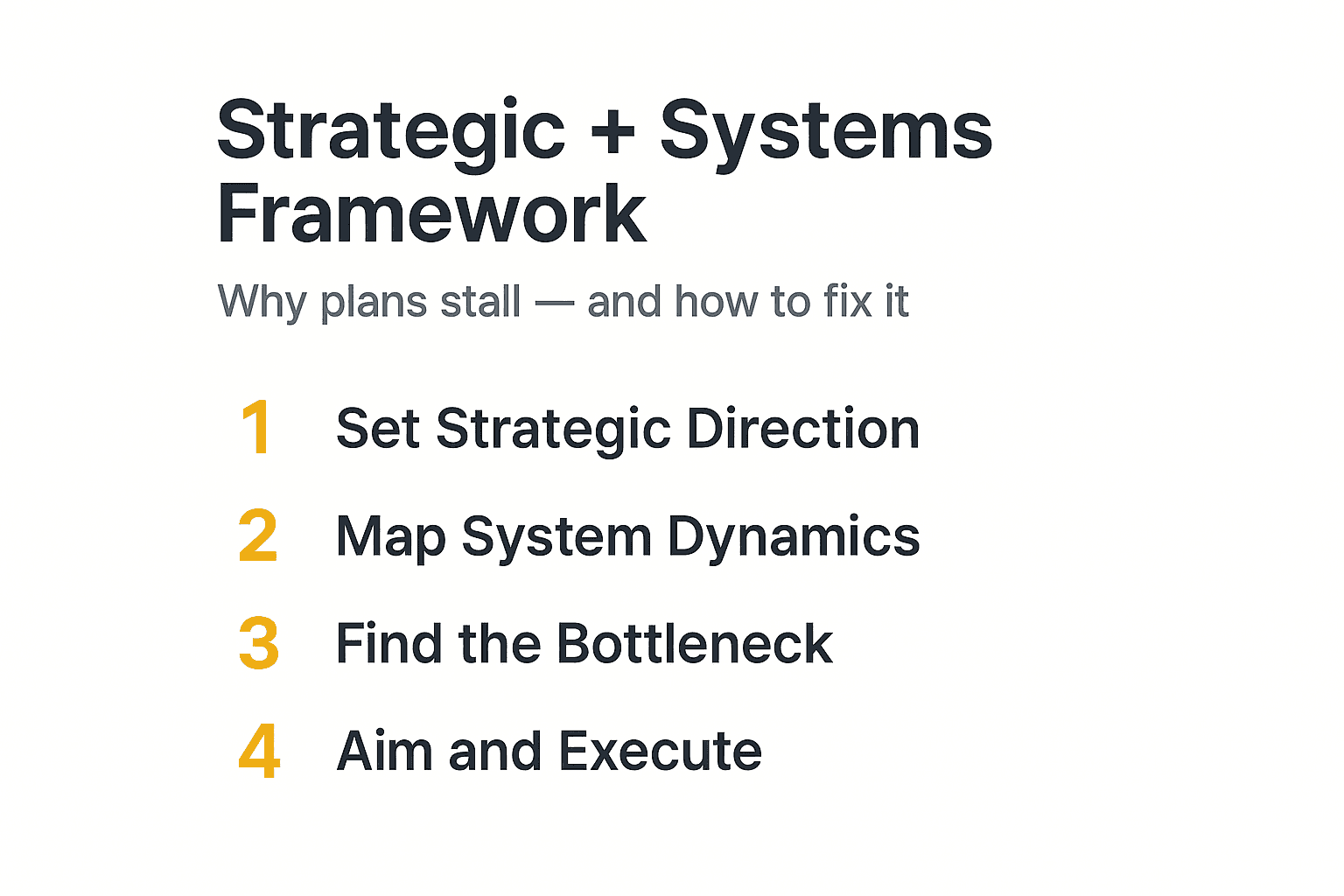
Strategic Thinking vs. Systems Thinking: Why Your Plans Keep Stalling
TL;DR: Most founders stop at strategy. They craft bold visions, set priorities, build roadmaps. Then wonder why execution stalls. The problem isn't the strategy. It's that strategy alone doesn't build momentum. You need systems thinking to understand why things break. The best founders use both.
I went down a rabbit hole this morning after seeing an infographic comparing strategic thinking to systems thinking. The post had 2.6K likes and comments from founders saying things like "this explains everything." So I dug deeper.
After reading the original framework, 40+ comments, and cross-referencing with 20 years of founder failure patterns, I found the gap that nobody talks about: most founders are stuck in "strategy mode" when they should be switching to "systems mode."
One comment nailed it: "Execution doesn't fail from lack of ideas. It fails from lack of structure to sustain them."
Let me break down what this means and how to fix it.
The Strategy Trap
Every founder I've worked with has a strategy. Most have a good one.
They know their target customer. They've mapped their competitive positioning. They have a roadmap with milestones. They can pitch their vision in their sleep.
And yet they're stuck.
The work doesn't flow. The team has friction. Things that should be simple become complicated. Growth stalls for reasons nobody can articulate.
The default assumption: the strategy is wrong. Time to pivot, reposition, find a new angle.
But here's what the data shows: most of the time, the strategy is fine. The problem is underneath it.
Strategy sets the destination. It doesn't keep you moving.
Strategic Thinking: What It Actually Is
Let's get precise about definitions.
Strategic thinking is big-picture thinking to set direction and focus. It answers:
- Where are we going?
- What should we focus on?
- What will move the needle?
When to use it:
- Setting goals and priorities
- Launching new products or markets
- Planning growth phases
- Making major resource allocation decisions
Best practices:
- Anchor to mission
- Use data and models
- Align people around shared goals
- Review quarterly
Tools:
- SWOT analysis
- OKRs
- Strategic roadmaps
- Porter's Five Forces
- Competitive positioning frameworks
Common pitfalls:
- Chasing trends instead of building conviction
- Overthinking the plan instead of testing assumptions
- Ignoring execution limits when designing strategy
Reality check: Most strategies need 2-3 iterations before they click. First version is usually directionally right but practically wrong.
Strategic thinking is necessary. But it's not sufficient.
Systems Thinking: The Missing Piece
Systems thinking is understanding how everything connects and affects the whole. It answers:
- How do parts of the business influence each other?
- Where are the delays and feedback loops?
- What could backfire?
When to use it:
- Solving complex, recurring problems
- Improving how teams work together
- Managing change
- Scaling without breaking what works
Best practices:
- Map the full system before optimizing pieces
- Trace causes, not just symptoms
- Test fast, learn fast
Tools:
- Causal loop diagrams
- Stock-flow diagrams
- System archetypes
- Feedback mapping
Common pitfalls:
- Over-analysis leading to paralysis
- Getting lost in the big picture
- Solving one problem while creating another
Reality check: Big systems changes take 12-24 months to show results. Patience is required.
The Difference in Practice
Here's how this plays out:
Scenario: Sales are slowing down.
Strategic thinker asks: Should we change our positioning? Target a new segment? Adjust pricing?
Systems thinker asks: What's happening in the full customer journey? Where are leads dropping off? What changed in the last 90 days? How does the sales team's workload affect response time?
Strategic thinker's solution: Pivot to enterprise. Higher deal values will compensate for lower volume.
Systems thinker's solution: Response time increased from 2 hours to 18 hours because the sales team got reassigned to onboarding. Leads are going cold. Fix the handoff between teams.
Both might be right. But the systems answer is often simpler, faster, and doesn't require blowing up your strategy.
The strategic thinker sees a destination problem. The systems thinker sees a friction problem.
Why Founders Default to Strategy
Strategy feels productive. It's visionary. It involves exciting conversations about possibilities.
Systems thinking feels like maintenance. It's operational. It involves boring conversations about processes.
Most founders self-select for vision. That's what got them started: seeing something that could exist and deciding to build it. They're naturally drawn to strategy because it's the same muscle.
But here's the problem: the more successful you get, the more your problems shift from strategic to systemic.
Early stage: "What should we build?" (Strategy question) Growth stage: "Why isn't the thing we built working consistently?" (Systems question)
The founders who stall are often still asking strategy questions to systems problems.
How to Know Which Mode You Need
Here's a diagnostic:
You need strategic thinking when:
- You're unclear on direction
- Major decisions are unmade
- The team isn't aligned on what matters
- You're entering new territory
- Competition has fundamentally shifted
You need systems thinking when:
- You know the direction but execution is choppy
- The same problems keep recurring
- Growth is inconsistent
- Teams have friction that isn't personality-based
- Fixes create new problems
Most founders are in the second category but think they're in the first.
A brutal question to ask: "If we perfectly executed our current strategy, would it work?"
If yes: you have a systems problem, not a strategy problem.
If no: okay, maybe you need to rethink strategy.
But be honest. Most strategies would work with flawless execution. The gap is execution, which means the gap is systems.
The Feedback Loop Audit
Here's a practical exercise to apply systems thinking:
Step 1: Map your core process
Take your most important workflow. Customer acquisition, product development, whatever drives your business. Map every step from start to finish.
Step 2: Identify delays
Where does work sit waiting? Every handoff is a potential delay. Mark them.
Step 3: Find the loops
Where does the output of one step affect the input of an earlier step? These are feedback loops. They can be reinforcing (good gets better) or balancing (growth hits a ceiling).
Step 4: Locate the constraint
What's the one thing that, if it improved, would improve everything downstream? This is your leverage point.
Step 5: Fix the constraint, not the symptoms
Don't fix the complaints. Fix the root cause.
Example:
Symptom: Customer complaints about slow support response.
Strategic response: Hire more support people.
Systems analysis: Support is slow because they lack context on customer accounts. They have to investigate before responding. The CRM isn't connected to the product database. They're doing manual research that should be automated.
Systems fix: Connect the databases. Response time drops without hiring.
The strategic response costs money and doesn't scale. The systems response costs engineering time but creates permanent improvement.
Startup Examples
Strategic thinking example (early stage):
A startup is deciding whether to focus on SMBs or enterprise. They analyze the market, look at competition, assess their capabilities, and choose SMB because faster sales cycles match their runway.
This is correct use of strategic thinking. The question is directional.
Systems thinking example (growth stage):
The same startup, now at $500K ARR, finds growth has stalled. Strategic instinct says "time to move upmarket to enterprise."
Systems analysis reveals: their onboarding has 40% drop-off at one specific step. Users who pass that step have 90% retention. Users who don't churn in 30 days.
Systems fix: focus all product effort on that one step. Growth resumes without changing strategy.
Combining both (scale stage):
At $5M ARR, they decide strategically to expand to Europe. Systems thinking maps what needs to change: timezone coverage, payment methods, legal compliance, localization. They sequence the rollout based on which system changes have dependencies on others.
Strategy says "where to go." Systems thinking says "how to get there without breaking."
Common Systems Problems in Startups
After watching dozens of startups, these are the recurring systems failures:
The Handoff Problem
Every time work moves between people or teams, context is lost. The more handoffs, the more friction.
Symptoms: Things fall through cracks. The same information gets requested multiple times. People say "I thought someone else was handling that."
Fix: Reduce handoffs. If you can't reduce them, create explicit handoff protocols with checklists.
The Feedback Delay Problem
You make a change but don't learn if it worked for weeks or months. By then, you've made more changes. You can't isolate cause and effect.
Symptoms: Every analysis is inconclusive. You're never sure what's working. Decision-making feels like guessing.
Fix: Shorten feedback loops. Instrument everything. Make decisions reversible so you can experiment faster.
The Local Optimization Problem
Each team or function optimizes for their metrics. But their optimizations conflict with each other.
Symptoms: Marketing generates leads that sales says are bad. Sales closes customers that churn quickly. Product ships features nobody asked for.
Fix: Create shared metrics that span the full system. Make handoff quality someone's responsibility.
The Bottleneck Blindness Problem
One resource is constrained but everyone works around it instead of addressing it.
Symptoms: Everything takes longer than it should. There's always one person everyone is waiting on. The team feels busy but nothing ships.
Fix: Find the constraint. Either expand it, reduce load on it, or restructure so it's no longer critical.
How to Use Both
The goal isn't to pick one. It's to know when each applies.
Quarterly cadence:
- Strategy review: Are we pointed at the right destination?
- Systems review: Is the machinery working to get us there?
Most founders do the first but not the second. They have strategic planning sessions but no operational audits.
When problems arise:
Ask both questions:
- Is this a direction problem? (Strategy)
- Is this a friction problem? (Systems)
Start with systems. It's more likely to be right and cheaper to fix.
When growth stalls:
Before pivoting strategy, audit systems. Map the customer journey. Find where friction appears. Fix those first.
Pivots are expensive. Systems fixes are not.
The Integration
The best founders I've watched operate in both modes simultaneously.
They hold strategy lightly: clear on direction but not attached to specific tactics.
They hold systems seriously: obsessive about understanding why things work or don't.
When something fails, they ask: "Is this a map problem or a vehicle problem?"
Usually it's the vehicle. Fix the vehicle, the map starts working.
The 7 Failure Patterns That Look Like Strategy Problems
If you only remember one section from this post, make it this one. These seven patterns eat months of founder time because they look like strategic confusion, but they're almost always systems breakdowns.
1) The Priority Pileup
You have five priorities and all five are defensible. New onboarding flow. Content engine. Outbound sales test. Retention fixes. Pricing experiment. Nothing is obviously wrong, so everything stays on the list.
That is not a strategy win. That's a systems failure in sequencing.
When priorities have no explicit order, teams context switch. Context switching kills cycle time. Cycle time kills learning speed. Learning speed kills growth.
The fix is brutally simple: set one active priority, one next priority, everything else parked. If it feels uncomfortable, good. That's the point.
2) The Dashboard Illusion
Metrics are moving, but nobody can explain why. Traffic up, conversion flat, churn noisy, support tickets rising. You keep revisiting positioning because positioning is intellectually clean. The data reality is messy.
This is a measurement system problem. You don't have an agreed causal chain from input to outcome. Without that chain, every metric discussion becomes opinion.
The fix: define one causal path per quarter. Example: "Improve onboarding completion from 38% to 55%, which should raise week-4 retention from 21% to 30%." Then instrument only what validates or invalidates that path.
3) The Team Throughput Mirage
People look busy. Standups are full. Work is happening. Release velocity says otherwise.
This is classic hidden queue buildup. Work waits in review. Work waits for copy. Work waits for design. Work waits for one founder decision. Nobody sees the queue because nobody tracks wait time.
The fix: measure wait time at each handoff for two weeks. You will find one queue that dominates delay. That's your real bottleneck.
4) The Customer Feedback Mismatch
Users request features A, B, C. You build A and B. Retention doesn't improve. You conclude "our strategy is wrong" and start thinking new segment.
Usually not strategy. Usually feedback system quality. You collected stated preferences, not behavioral constraints.
Ask users what they want and you'll get feature ideas. Watch where they fail and you'll get the real job-to-be-done.
5) The Hero Dependency
One person, often the founder, is the integration layer for everything. Product needs founder input. Sales needs founder context. Support escalations need founder judgment. Founder's calendar becomes system architecture.
When that person gets overloaded, throughput collapses. This gets mislabeled as "we need a clearer strategy." No. You need fewer decisions routed through one node.
6) The Experiment Graveyard
You run experiments but don't close the loop. No decision log. No explicit verdict. No postmortem. The same test gets rerun three months later under a new name.
That is memory system failure.
If your org can't remember what it learned, it cannot compound.
7) The Local Max Trap
You optimize one function so hard that the rest of the business pays for it. Marketing drives top-of-funnel volume, onboarding can't absorb it, churn rises, CAC narrative still looks great in isolation.
This is not bad strategy, it's missing system-level objective functions.
If teams win locally while the company loses globally, you have a systems design bug.
The 30-Day Founder Operating Reset
If execution feels sticky right now, run this reset for one month.
Week 1: Diagnose reality, no fixing yet
- Map one critical flow end to end: acquisition to activation, or activation to retention.
- Track handoffs, queue times, rework loops.
- Collect three data slices: product analytics, error data, user feedback.
- Write one page: where value is created, where it leaks.
No solutions yet. Just honest visibility.
Week 2: Pick one leverage point
Find the smallest intervention that affects the largest part of the system. Not the loudest complaint, the highest-leverage constraint.
Examples:
- Replace 6-step onboarding with 3-step path to first value.
- Add auto-context in support to cut response prep time.
- Remove one approval layer blocking launches.
Week 3: Ship one high-conviction fix
One fix. No side quests.
Define success in advance. If the fix lands, what metric should move and by how much?
Then ship and observe.
Week 4: Close loop and codify
Did it work? If yes, document the mechanism and keep compounding. If no, document why and move to next leverage point.
This sounds obvious. Most founders skip the codify step, then wonder why learning doesn't stick.
What Changes When You Think in Systems
Three things happen fast when founders actually adopt systems thinking.
First, blame drops. Teams stop saying "marketing sent bad leads" or "product shipped weak onboarding." They start asking which interface between teams is causing the failure mode.
Second, decision quality rises. Instead of reaction-driven changes, teams make constrained bets tied to explicit causal hypotheses.
Third, strategy gets stronger. This is the irony. Systems thinking doesn't replace strategy. It protects it from false negatives.
A lot of strategies get abandoned because implementation systems were broken, not because the strategy was wrong.
Tactical Checklist You Can Use Tomorrow
Use this in your next weekly review.
- What is our single active company priority?
- Where is work currently waiting, and for how long?
- What repeated issue appeared 3+ times this month?
- What team-to-team handoff has the most rework?
- Which metric moved, and do we know the mechanism?
- What did we learn this week that is now documented?
- Which founder decisions can be delegated with guardrails?
If you can't answer these quickly, that's the work.
Strategy sets the destination and systems thinking keeps you moving - knowing which mode to apply to which problem is the whole framework this post delivered. The part that stays hard: any framework is only as good as your aim. You can apply the method perfectly and still be solving the wrong problem, because you're pointing it at what feels urgent, not what your data says is actually blocking growth. Luka connects your analytics, error data, and review signals across sources and shows you what's genuinely holding your product back at your current stage. So when you apply the strategic-systems framework, you're pointing it at the right thing. Check it in the morning, know where to aim, go execute. See how Luka works.
Apply This Now
Today: Write down your current strategy in one sentence. Then write down the #1 friction point in your execution. Notice which one you spend more time thinking about.
This week: Map one core workflow in your business. Find the biggest delay. Ask why it exists.
This month: Create a systems review habit. Every month, pick one part of the business and audit how it actually works, not how it's supposed to work.
Ongoing: When problems arise, force yourself to ask the systems question before jumping to strategy changes.
The Bottom Line
Strategy sets the destination. Systems thinking keeps you moving.
Most founders over-index on strategy because it feels important. But the gap between where they are and where they want to be isn't usually a strategy gap. It's a systems gap.
The founders who scale aren't necessarily the ones with the best strategy. They're the ones who understand how their business actually works and relentlessly remove friction.
Used together, strategic thinking and systems thinking create momentum that compounds. Strategy without systems is a plan that never executes. Systems without strategy is efficiency pointed nowhere.
Master both.
Frequently Asked Questions
How do I know if a problem is strategic or systemic?
Ask: "If we executed our current strategy perfectly, would it work?" If yes, you have a systems problem. If no, you might have a strategy problem. But be honest. Most founders think they have strategy problems when they actually have execution problems.
Is systems thinking just another word for operations?
No. Operations is running the systems. Systems thinking is understanding WHY the systems work or don't. You can be operationally excellent while systems-blind. You follow the process perfectly but never question if the process is right.
How long should I spend on systems analysis before taking action?
Not long. Systems thinking should accelerate action, not delay it. Map the system in an hour. Identify the constraint. Propose a fix. Test it. The analysis shouldn't take longer than the experiment.
What if my team only thinks strategically?
Start by modeling systems thinking yourself. When problems arise, visibly ask the systems questions: "Where does work get stuck? What creates friction? How do these pieces connect?" Over time, the team will adopt the framing.
About the Author