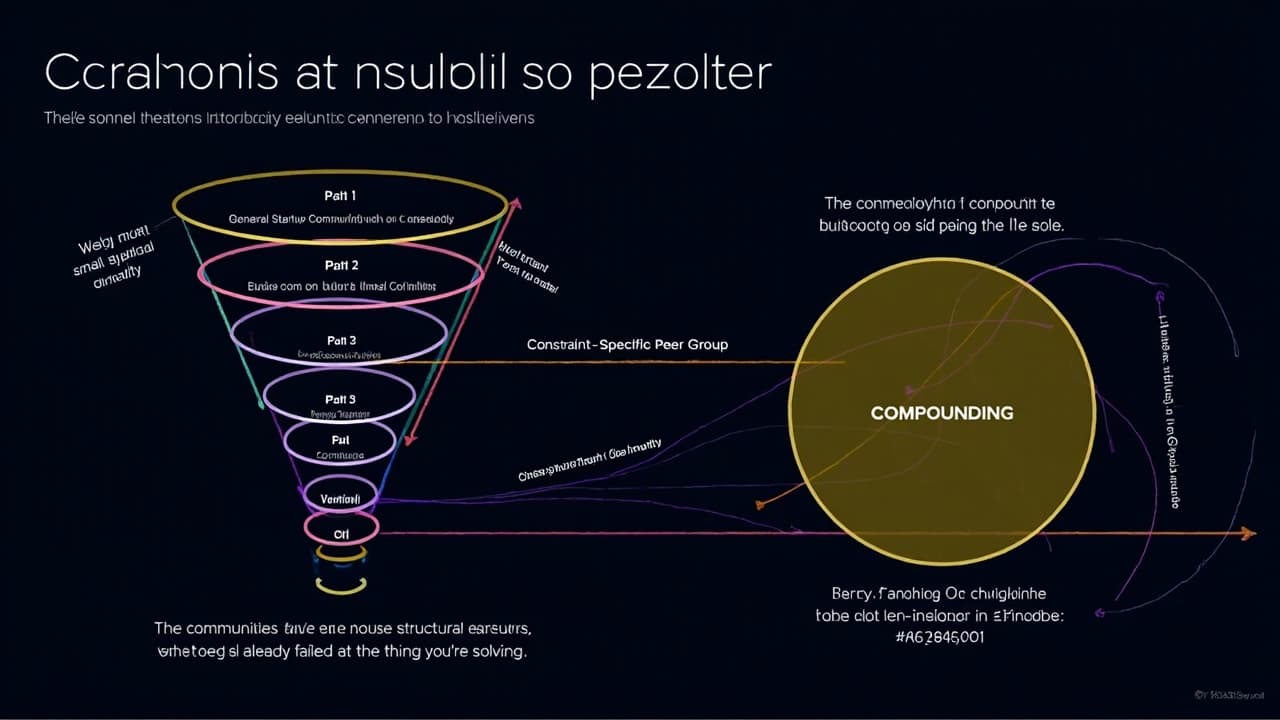
Why Most Solo Founders Are Building in the Wrong Community (And the One That Actually Moves the Needle)
TL;DR: Most indie hackers are optimizing for the wrong distribution channel and it's costing them real growth. The communities that look active aren't where your customers are. The one that actually compounds has a specific structure. Here's how to find it.
Last month I watched two solo founders with nearly identical products, similar audiences on paper, and completely different growth trajectories. One was growing at 15% week-over-week. The other was stuck at the same 200 users he'd had three months ago. The difference between them wasn't product quality, pricing, or even the quality of their content. It was which community they'd chosen to build inside.
This is the variable nobody talks about with enough specificity. "Community" gets treated like it's either everywhere or nowhere, which is useless. The actual data on which communities drive compounding growth for indie hackers, which ones are ghost towns wearing active makeup, and what the structural difference is between the two: that's what I spent two weeks mapping.
Here's what I found.
The Four Community Archetypes Indie Hackers Default To
Before the framework, let's name what most founders are actually doing, because the default paths are all slightly wrong in the same way.
Archetype One: The General Startup Community
This is where most founders start. Indie Hackers. Product Hunt discussions. General startup Twitter. The pitch is that broad reach means access to everyone. The reality is that broad reach means you're competing for attention inside a community where nobody shares your specific problem and nobody has a specific reason to care about your specific solution.
The founders who thrive in these communities are the ones with exceptional distribution skills, large existing audiences, or viral-ready products. For everyone else, these communities are where go-less-nowhere lives. The traffic is real. The conversion is terrible. You're shouting into a room full of other founders selling to each other.
Archetype Two: The Tool-Specific Community
Cursor users. Lovable users. Bolt users. The specific Discord or Slack around a tool that your ICP also uses. The pitch is that you're in the same room as your users. The reality is more complicated.
These communities have high noise-to-signal ratios because they're full of people at every stage of the journey, most of whom are not your customer and never will be. They're great for learning the tool. They're terrible for distribution because the person next to you in the Discord is a fellow builder, not a buyer.
There's an exception here that I'll get to. Tool communities that have a specific structural feature can work. Keep reading.
Archetype Three: The Vertical Community
A community organized around a specific industry or job title. Accountants who use SaaS tools. E-commerce founders running Shopify stores. Developers at Series A startups. The pitch is that everyone's problem is adjacent, so the conversation has natural relevance. The reality is that vertical communities are usually small enough that you can reach everyone, but also small enough that you've quickly reached everyone who was ever going to convert.
These communities work best for the first three to six months of a product's life, when there's still fresh conversation to have. After that, the early adopters have already heard of you, and you're either expanding the conversation or stagnation.
Archetype Four: The Micro-Community
This is the least populated but the highest-performing archetype for compounding growth. A micro-community is small, specific, and organized around a shared constraint rather than a shared tool or industry. Not "solo founders" but "solo founders who have crossed $10K MRR and are now figuring out how to build a team." Not "AI builders" but "AI builders who are actively in the process of firing their first customer."
The constraint creates intimacy. Intimacy creates trust. Trust creates the conditions for word-of-mouth compounding that no other community archetype can match.
The Structural Feature That Separates Compounding Communities From Stagnant Ones
Here's the insight that took me longest to land on and that nobody states this way:
The communities that compound are the ones where the members have already failed at the thing you're promising to help them solve.
This sounds obvious. It isn't. Most founders look for communities full of people who want to become something. They're optimizing for aspiration. The compounding communities are full of people who tried to become that thing and encountered a specific problem along the way. They're organized around the failure point, not the aspiration.
A community of people who want to hit $10K MRR is a content consumer community. A community of people who tried to hit $10K MRR and got stuck at $2K with unclear next steps: that's where your product has natural evangelists, because everyone in that room has a visceral understanding of exactly the problem you're solving.
The question to ask of any community before you invest significant time in it: what problem did the members fail at before they found this community?
If you can't answer that question specifically, the community is likely aspirational rather than experiential. Aspirational communities are places where people go to feel like they're doing something. Experiential communities are places where people go to solve something. Only the second one compounds.
The One Community Type That Actually Compounds
Here's the specific structure I keep finding in communities that actually drive compounding growth for indie hackers:
The Constraint-Specific Peer Group
It's small. Eight to twenty people maximum. They meet on a defined cadence. Everyone in the room has the same constraint and is at a different stage of trying to solve it. The conversation is specific enough that someone can say "I tried X last week and it didn't work" and everyone in the room knows exactly what X means because they've all tried X or something adjacent.
This is structurally different from every other community type because the value comes from the peer relationship, not from content consumption. It's not a place you go to read. It's a place you go to be known by the same eight people who are trying to do the same thing, for a specific reason, right now.
The compounding mechanism here is concrete. When one person in that group finds something that works, the other seven people apply it within two weeks. When one person gets stuck, the other seven have specific context to help unstick them. The feedback loops are tight and the trust is high because the group is small enough that everyone has visible accountability to each other.
You cannot fake this structure by calling a large community a "family" or a "collective." The smallness is not incidental. It's the feature that makes the compounding possible.
Where Most Founders Go Wrong
The mistake I see most often is founders joining fifteen communities, being active in three, posting in two, and hoping that volume compounds into something. It doesn't. Scattered attention in multiple communities produces the appearance of distribution without any of the depth that drives actual word-of-mouth.
The second mistake is mistaking activity for progress. Posting regularly in a community where your content performs well is not the same as being in a community that compounds. Content performance is a vanity metric inside communities. What you want is conversations. Relationships. Specific people who now know you, trust you, and have recommended you to someone else because of a real interaction, not because you dropped a link in a thread.
The third mistake is optimizing for the wrong metric when evaluating a community. Most founders look at follower counts, post engagement, and reply rates. The metric that actually matters: how many people in this community have had a real conversation with me about their actual situation in the last thirty days? That number, tracked monthly, tells you more about compounding potential than anything else.
How to Find the Right Community
If you're evaluating where to build, ask three specific questions before committing meaningful time:
One: what did the members fail at before they found this community? If the answer is vague or aspirational, the community is not a compounding environment.
Two: do the members have specific context to help each other, or are they all starting from zero? A room where everyone is equally lost is a support group, not a compounding peer network.
Three: can I point to a specific conversation in this community where someone recommended a product to someone else because of a genuine problem they were trying to solve together? If that never happens, the community is not a distribution environment. It's a content environment.
The communities that compound are the ones where the members have specific context, shared constraints, and real conversations that lead to real referrals. Everything else is noise.
About the Author