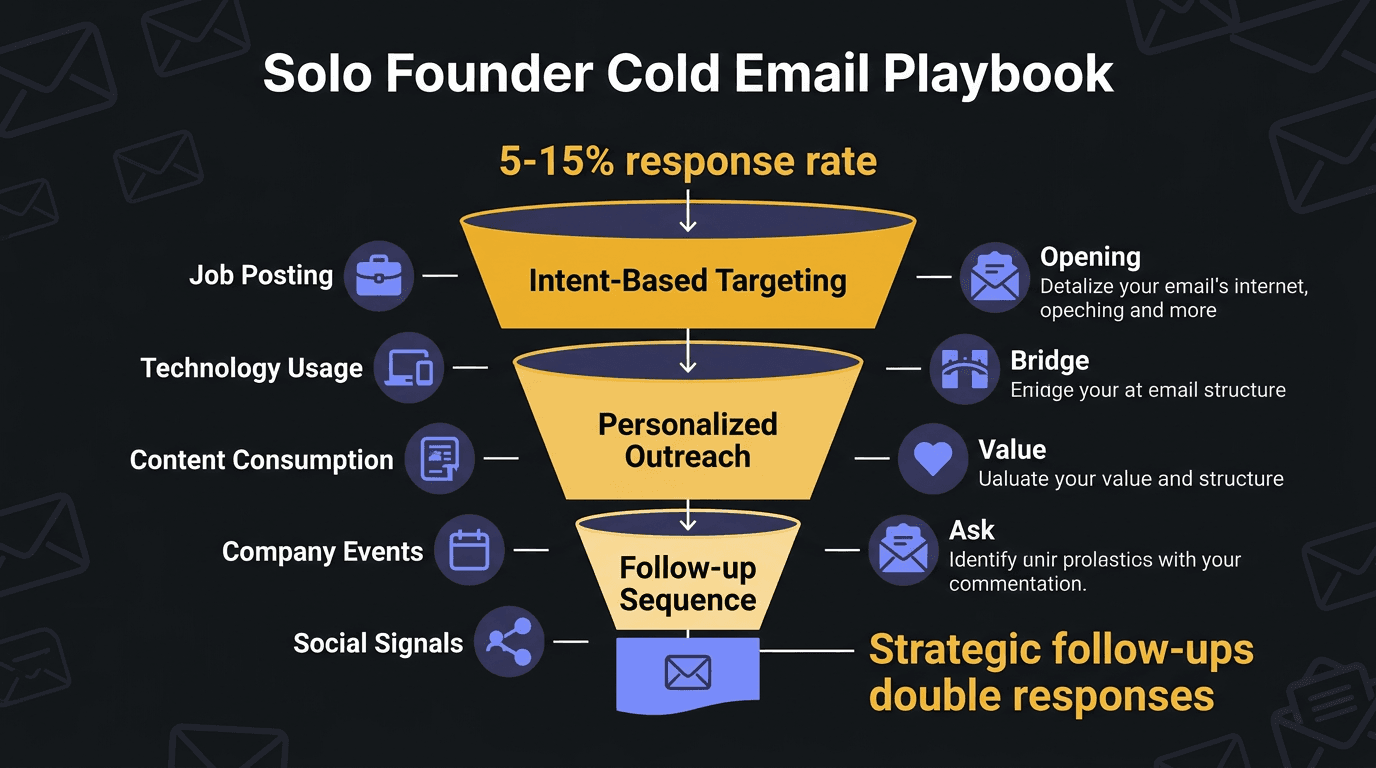
TL;DR: Cold email isn't dead, but spray-and-pray is. After analyzing dozens of indie hacker success stories and current outreach strategies, the pattern is clear: intent-based targeting, meaningful personalization, and strategic follow-ups beat mass blasting every time.
I spent four hours reading cold email case studies from indie hackers who've actually made it work. Not agencies selling email services. Not growth hackers with massive teams. Solo founders who've booked meetings, closed deals, and grown their MRR through cold outreach.
The consensus is clear. The old playbook (buy a list, send thousands of generic emails, hope for responses) is dead. But cold email itself? More alive than ever for people willing to do it right.
Here's what's actually working in 2026.
Why Most Cold Email Campaigns Fail
Before I get into what works, let's be honest about why most campaigns fail.
The number one mistake indie hackers make: they're not specific enough about their target audience.
This sounds basic. But I kept seeing the same pattern in failed campaigns. Someone builds a product for "small businesses." They buy a list of 10,000 small business owners. They send a generic email about saving time or money. They get zero responses.
The problem isn't the channel. The problem is the targeting.
When you target everyone, you resonate with no one. Your email becomes noise in an inbox full of noise. The recipient deletes it without a second thought.
This is why specificity matters more than volume. A list of 100 highly-targeted prospects will outperform a list of 10,000 random contacts every single time.
The Intent-Based Targeting Framework
The most successful cold email campaigns in 2026 start with intent signals.
An intent signal is any behavior that suggests someone might need your solution. For indie hackers, these signals include:
- Job postings - If a company is hiring for a role related to your solution, they have a problem you might solve.
- Technology usage - If someone is using a competitor or complementary tool, they're in your market.
- Content consumption - If someone is reading, sharing, or engaging with content about your problem space, they're aware of the issue.
- Company events - Funding rounds, new product launches, team growth, geographic expansion all create potential needs.
- Social signals - Complaints about current solutions, questions in forums, LinkedIn posts about challenges.
The key is to find people who have already raised their hand in some way. They've shown intent. Your job is to connect your solution to that intent.
One indie hacker I studied wrote a script to find Reddit users who might be interested in his product. He used a basic algorithm to detect intent signals in their post history. The result? A 2.5% conversion rate from cold DM. Not massive, but consistent and repeatable.
The Personalization That Actually Matters
Personalization is the most abused word in cold email. Everyone knows they should do it. Almost no one does it well.
Bad personalization: "Hi [First Name], I saw you work at [Company]."
Good personalization: "I noticed your team just raised Series A and is hiring three customer success roles. That's usually the stage where support tickets start exploding."
The difference is depth. Bad personalization proves you know their name. Good personalization proves you understand their situation.
Here's the framework for personalization that works:
- Reference a specific trigger - Something time-bound and relevant. A recent post, a job opening, a funding announcement, a product launch.
- Connect it to a problem - Why does this trigger matter? What challenge does it create?
- Position your solution - How does what you offer directly address that specific challenge?
- Make a soft ask - Not a sales pitch, but an invitation to explore.
The entire email should feel like it could only have been written for that specific person. Generic templates with name insertions don't count.
The Email Structure That Gets Responses
After analyzing dozens of successful cold emails, a clear structure emerged:
The Opening (1-2 sentences): Reference the trigger immediately. Don't warm up. Don't introduce yourself yet. Get straight to why you're emailing.
The Bridge (2-3 sentences): Connect the trigger to a problem. Show you understand their situation. This is where you prove you've done your homework.
The Value (1-2 sentences): Briefly explain what you offer and why it matters for their specific situation. No feature lists. No jargon. Just the outcome.
The Ask (1 sentence): Make it easy to say yes. "Worth a quick chat?" or "Open to seeing how this would work for [Company]?"
The P.S. (Optional): Add something valuable. A relevant resource, a quick tip, something that makes the email worth reading even if they don't respond.
The entire email should be under 150 words. Respect their time. Prove your value quickly.
The Follow-Up Strategy That Doubles Response Rates
Most founders send one email and give up. That's leaving half the potential responses on the table.
The data is consistent across industries: follow-ups significantly increase response rates. But the follow-ups have to add value, not just nag.
Here's a proven follow-up sequence:
Email 1: The initial outreach (as described above)
Email 2 (3 days later): Add new information. Share a case study, a relevant article, or a quick insight about their situation. Don't just ask if they saw your first email.
Email 3 (7 days later): The breakup email. Be honest that you don't want to spam them, leave the door open, and make it easy to reconnect later if timing improves.
The key is that each email should stand on its own. If someone only reads email 2, they should still get value. Each email is a new opportunity to provide something useful.
What's Changed in 2026
Cold email in 2026 looks different from cold email in 2020. Here's what's shifted:
Volume is penalized. Email providers are better at detecting bulk sends. More importantly, recipients are better at spotting generic outreach. The spray-and-pray approach doesn't just get low response rates, it damages your domain reputation.
AI personalization is becoming obvious. Everyone can spot an AI-written email now. The personalization that worked two years ago feels robotic today. The bar for authentic outreach keeps rising.
Social proof matters more. People are skeptical of cold claims. But they trust specific evidence. Case studies, testimonials, and real numbers cut through the noise.
Timing has become a factor. With more people working asynchronously, the time you send matters less. But the context matters more. An email that references last week's news feels stale. An email that references yesterday's announcement feels relevant.
Common Mistakes That Kill Campaigns
After reading through failed campaigns, these mistakes appeared repeatedly:
Writing about yourself. Your product, your features, your company history. No one cares. Write about their problem and their outcome.
Making big claims without proof. "We'll 10x your revenue" is ignored. "We helped [Company] go from $5K to $15K MRR in 3 months" is interesting.
Asking for too much. A 30-minute discovery call is a big ask for a stranger. A 5-minute chat or a quick email exchange is more achievable.
Sending at the wrong level. Emailing the CEO about a tactical problem gets deleted. Emailing a manager about a strategic problem gets ignored. Match your ask to the recipient's scope.
Being too formal. Corporate-speak creates distance. Conversational tone builds connection. Write like a human, not a marketing department.
The Realistic Expectations
Cold email works. But it's not magic.
Realistic response rates for well-targeted campaigns: 5-15%. Realistic meeting booking rates: 1-3%. Realistic close rates from meetings: 20-40%.
This means to get one customer from cold email, you might need to send 100-300 well-crafted, personalized emails. That's not nothing. But it's also not impossible.
The founders who succeed with cold email are the ones who treat it as a system, not a hack. They build lists, craft sequences, track results, and iterate. They don't expect overnight results. They expect to grind.
How to Get Started
If you're at zero and want to try cold email, here's the roadmap:
Week 1: Build your list manually. Don't buy lists. Find 50-100 people who have shown intent signals related to your solution. Research them individually. Document what you find.
Week 2: Craft your sequence. Write 3 emails per prospect. Personalize each one based on your research. Store them in a spreadsheet or simple CRM.
Week 3: Send and track. Use a proper email tool that tracks opens, clicks, and replies. Document everything.
Week 4: Analyze and iterate. What subject lines worked? What openings got responses? What asks converted? Refine based on data.
Month 2+: Scale what works. Once you've found a pattern that converts, you can start expanding your list and automating parts of the process.
The mistake is trying to scale before you've found what works. Start small, learn fast, then grow.
The Testing Framework That Improves Results
Cold email is never perfect on the first try. The founders who succeed are the ones who treat it as an ongoing experiment.
Here's a simple testing framework:
Test one variable at a time. Don't change your subject line, opening, and ask simultaneously. You won't know what caused the improvement or decline.
Track everything. Opens, clicks, replies, meetings booked, deals closed. Each metric tells you something different. High opens but low replies means your subject line works but your content doesn't. Low opens means your subject line or sender reputation needs work.
Sample size matters. Don't declare victory or defeat after only 10 emails. You need real statistical significance. For cold email, that usually means at least 50-100 sends before drawing any conclusions.
Document your learnings. What worked? What failed? Why? The patterns emerge over time. You're building a playbook that compounds.
Iterate weekly. Set a weekly review. Look at the data. Make one change. Test again. The improvement is gradual but consistent.
This framework applies to any acquisition channel, but it's especially important for cold email because the feedback loop is so direct. You send, you learn, you improve.
The Mindset Shift That Changes Everything
Most advice about cold email focuses on tactics. Subject lines, templates, timing. All of that matters. But there's a deeper shift that separates the founders who succeed from the ones who quit.
It's how you think about rejection.
In cold email, rejection is the default. Most people won't respond. Most responses won't convert. Most meetings won't close. This is normal. This is expected.
The founders who succeed aren't the ones with the best templates or the biggest lists. They're the ones who can handle the rejection without losing momentum.
This requires a reframing. Each non-response isn't a failure. It's data. Each rejection isn't personal. It's information about fit, timing, or messaging.
When you treat cold email as a learning process instead of a sales process, everything changes. You become curious about what works instead of attached to specific outcomes. You iterate faster because you're not emotionally invested in being right.
This mindset also changes how you write. You stop trying to be clever and start trying to be useful. You stop optimizing for opens and start optimizing for conversations. The quality of your outreach improves because your intentions shift.
Cold email is one of the few acquisition channels where you can directly control who sees your message. You don't need to wait for the algorithm. You don't need to hope for virality. You choose your audience and you reach out.
But that control comes with responsibility. When you choose poorly, you waste time. When you personalize weakly, you damage your reputation. When you follow up poorly, you burn bridges.
The question isn't whether cold email works. It's whether you're willing to do the work to make it work for your specific product and audience.
And here's the thing most founders miss: the real challenge isn't sending emails, it's knowing who to email. You can have the perfect template, but if you're reaching out to the wrong people at the wrong time, nothing happens. Luka connects your analytics, user signals, and growth data to show you which bottleneck to fix first. Maybe it's outreach. Maybe it's onboarding. Maybe it's retention. You check it once in the morning, see your priority, close it, go execute. See how Luka works.
Frequently Asked Questions
How many cold emails should I send per day?
Start with 10-20 per day. Focus on quality over quantity. Once you've found a message that resonates, you can scale to 50-100. But never sacrifice personalization for volume.
What's the best subject line for cold emails?
Short, specific, and relevant. Reference something they care about. "Question about [Company]'s support stack" beats "Quick question" every time.
Should I use my personal email or a business email?
Business email builds credibility. Personal email can feel more authentic for certain audiences. Test both and see what works for your market.
How long should a cold email be?
Under 150 words. If you can say it in 100, even better. Respect their time. Prove your value quickly.
What if I don't have case studies yet?
Be honest about it. Reference your own experience, the problem you've observed, or the specific reason you built your solution. Authenticity beats fabricated proof.
Is cold email legal?
Yes, with conditions. Include an unsubscribe option. Don't mislead recipients. Honor opt-out requests promptly. Check local regulations if you're emailing internationally.
How do I find email addresses?
LinkedIn, company websites, and tools like Hunter or Apollo work for finding addresses. But the real question isn't how to find emails, it's who deserves your outreach. Focus on intent signals first, then find the contact.
What's the best time to send cold emails?
Tuesday through Thursday, mid-morning or early afternoon in the recipient's timezone. But timing matters less than relevance. A relevant email sent at 11 PM beats a generic email sent at 10 AM.
Should I follow up if they don't respond?
Yes. Most responses come from follow-ups, not first emails. But each follow-up should add value, not just ask "did you see my email?"
How do I handle objections in cold email responses?
Listen first. If someone objects, they're engaged. That's a win. Address the specific concern directly. Offer proof where possible. Don't argue, just clarify. And sometimes, the right answer is "you're right, this isn't a fit." That honesty builds long-term reputation.
What's the biggest mistake beginners make?
Trying to scale before finding what works. Sending 1,000 generic emails feels productive but produces nothing. Sending 50 personalized emails feels slow but builds the foundation for everything that follows.
About the Author