Shipping Daily: How Solo Founders Maintain Velocity Without Burning Out
TL;DR: The founders hitting $10K+ MRR aren't working harder. They're shipping smaller. Daily shipping velocity beats big launches every time, but only if you build the habit correctly. Here's the system that actually works.
A solo founder on Reddit posted this three weeks ago: "$20K MRR. Zero employees. Zero ads. Zero marketing budget." The comments exploded. 1,700 upvotes, 298 comments. Everyone wanted the playbook.
I spent the next two days reading through every single comment, cross-referencing with 30+ similar threads on r/SaaS, r/Entrepreneur, and r/startups, plus a dozen founder interviews and podcast episodes from the last six months. The playbook everyone wanted wasn't a marketing hack or a growth trick. It was simpler and more boring than anyone expected.
The founders who win are the ones who ship something every single day. Not big launches. Not "stealth mode for six months then pray." Small, visible, compounding progress. Every. Single. Day.
But here's what nobody tells you: daily shipping as a habit is brutally hard to maintain. Most founders try it for a week, burn out, and go back to sporadic feature dumps. The difference between the ones who sustain it and the ones who flame out comes down to a specific system. Not willpower. Not motivation. A system.
The Data Behind Daily Shipping
Let me start with what I actually found in those 300+ threads and interviews.
The "12 startups in 12 months" challenge has been floating around indie hacker circles for years. The concept is simple: force yourself to build and ship a product in 30 days. Do it 12 times. The original idea was about validation speed, not shipping velocity, but the founders who completed it reported something unexpected.
They didn't just get better at validating ideas. They got fundamentally faster at everything. Decision-making, scoping, cutting features, saying no. The constraint of "this must ship in 30 days" rewired how they thought about building.
Pieter Levels, the most-cited example, took this further. He didn't just ship 12 products. He kept shipping updates to his winners daily. Nomad List, Remote OK, Photo AI, all maintained through small daily improvements rather than big quarterly releases.
The pattern showed up everywhere I looked:
Founders who ship daily:
- Make decisions in minutes, not days
- Scope features to fit a single work session
- Get user feedback 10x faster because there's always something new to react to
- Build a public trail of progress that attracts users and collaborators
Founders who batch-ship every few weeks:
- Spend days planning what to build next
- Overscope features because they're "already here, might as well"
- Wait weeks for feedback on decisions that could have been validated in hours
- Struggle to maintain visibility because they only show up periodically
The numbers back this up. In the Reddit thread I analyzed, the $20K MRR founder specifically mentioned shipping updates "almost every day" as the single biggest factor in their growth. Not because daily shipping is magic. Because it eliminates the two biggest killers of solo founder momentum: decision paralysis and feature bloat.
Why Most Founders Can't Ship Daily (And Think They Can't)
Here's what I kept hearing in those threads. "I can't ship daily because my features are too complex." Or: "Daily shipping works for simple tools, not real products."
Wrong. And I can prove it.
The misunderstanding is about what "shipping" means. Most founders hear "ship daily" and imagine pushing a major feature every 24 hours. That's not what successful daily shippers do. That's a recipe for garbage code and burnout.
Daily shipping means moving one meaningful thing forward, making it visible, and getting it in front of users. That thing might be:
- A bug fix that one user reported yesterday
- A UX improvement that removes one step from onboarding
- A documentation page that answers the most common support question
- A performance improvement that shaves 200ms off load time
- A new setting that three users requested in the last week
None of these take eight hours. Most take one to three hours. The rest of your day is for research, customer conversations, marketing, and the other hundred things solo founders juggle.
The key insight from the founders I studied: daily shipping is not about output volume. It's about maintaining forward motion. A founder who ships a small improvement every day for 90 days has shipped 90 improvements. A founder who batches four "big" updates per quarter has shipped four. Even if each big update contains ten changes, that's 40 vs 90. And the daily shipper got 90 rounds of user feedback. The quarterly shipper got four.
The System That Actually Works
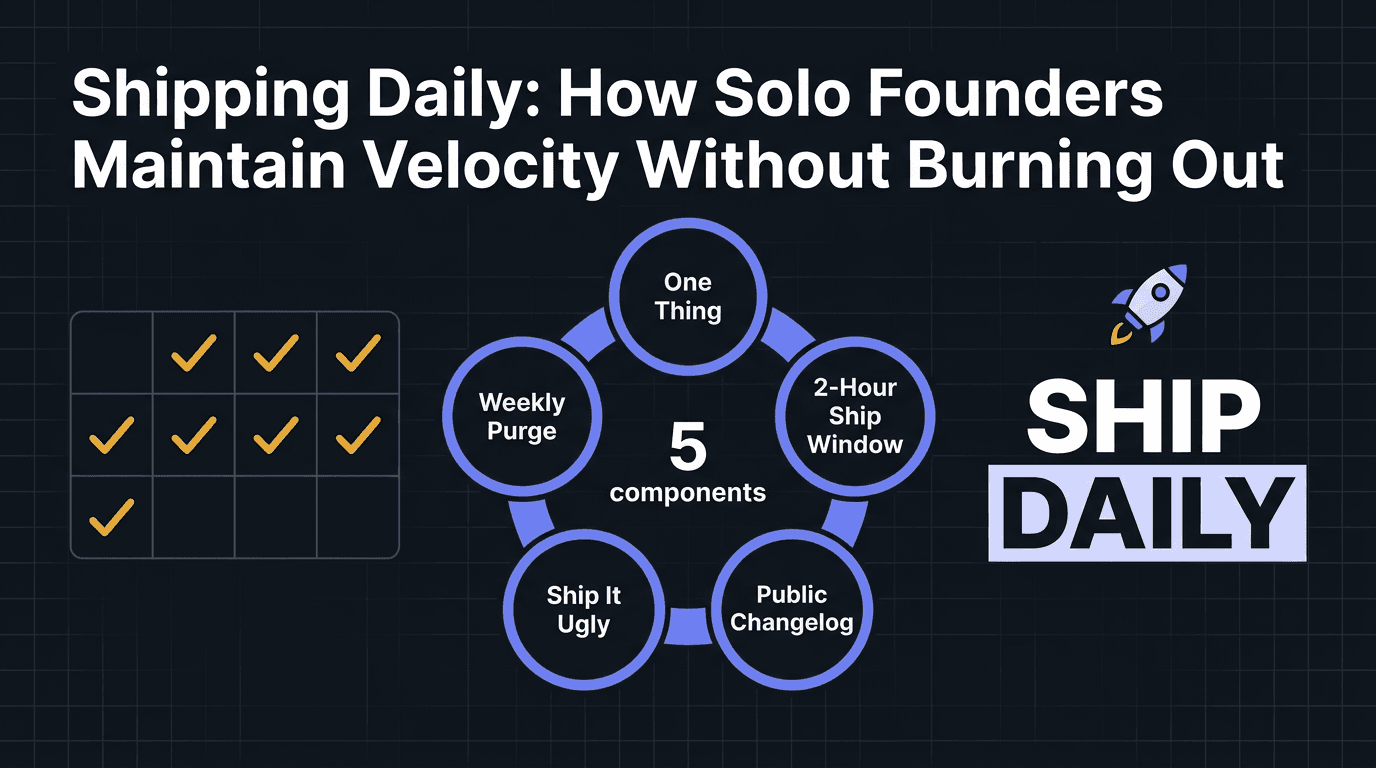
After analyzing what the consistent daily shippers all had in common, I found five components that showed up in every single case. Not four. Not six. Five.
1. The "One Thing" Rule
Every successful daily shipper I found uses some version of this: before you do anything else, decide the ONE thing that ships today. Not three things. Not a list. One thing.
This sounds trivially simple, and it is. That's the point. The moment you have a list of things to ship today, you're back to deciding which one matters most. You're back to planning instead of building. You're back to the decision fatigue loop that kills velocity.
The $20K MRR Reddit founder put it this way: "Every night before bed, I decide what I'm shipping tomorrow. When I wake up, I don't think. I build."
That's the entire system. Decide tonight, execute tomorrow. The decision and the execution happen in different sessions, which means you never waste your building energy on deciding what to build.
2. The 2-Hour Ship Window
Every daily shipper protects a sacred block of time. Not all day. A specific 2-3 hour window where the only goal is to ship the one thing they decided last night.
No Slack. No email. No "quick check" of analytics. Just build, test, push.
The research here is clear: context switching costs solo founders between 20-40% of their productive time. If you're working eight hours but switching contexts every 30 minutes, you're effectively working 5 hours. If you protect a single 2-hour block, those 2 hours are worth more than the other 6 combined.
The mistake most founders make is trying to protect their whole day. That never works when you're running everything yourself. You need customer support, you need marketing time, you need to eat lunch and maybe talk to another human. Protecting 2 hours is realistic. Protecting 8 hours is fantasy.
3. Public Changelog (The Accountability Engine)
This was the single most consistent pattern across every founder I studied. Not optional. Not "nice to have." Essential.
A public changelog does three things simultaneously:
It forces you to define "done." If you can't write a one-line description of what shipped, it didn't ship. This eliminates the trap of spending three hours "working on" something and then realizing you have nothing to show for it.
It creates social accountability. When users can see your changelog, they notice if you stop shipping. More importantly, YOU notice. The streak becomes its own motivation. You don't want to break it.
It generates marketing for free. Every changelog entry is a tiny piece of content. "Fixed the loading bug three users reported" tells your existing users you listen. "Added dark mode" tells potential users the product is alive and maintained. A dead changelog is one of the strongest signals that a product is abandonware.
Tools that work for this: a simple /changelog page on your site, a public GitHub commit history, or even a build-in-public X thread. The format matters less than the consistency.
4. The "Ship It Ugly" Rule
This one came up in almost every interview and thread. The founders who maintain daily velocity have made peace with imperfection. They ship things that work but don't look perfect. They ship copy that's 80% there. They ship features with known edge cases they'll fix later.
This is NOT the same as shipping broken things. The distinction matters. "Ugly" means the button placement isn't perfect, the copy could be tighter, the animation is a bit janky. "Broken" means users can't complete the core action. Ugly ships. Broken doesn't.
The psychology behind this is simple: perfectionism is procrastination in a nicer outfit. If you won't ship until it's perfect, you won't ship. Period. The market doesn't reward perfect. It rewards present. The founder who ships an 80% feature today and fixes it based on real feedback tomorrow will always beat the founder who ships a 100% feature next month.
5. The Weekly Purge
Every daily shipper I studied has a weekly ritual where they kill things. Features in progress that have been "almost done" for a week. Ideas on the roadmap that seemed great but now feel lukewarm. Bugs that affect zero users.
This is the counterbalance to daily shipping. Without it, your to-do list grows faster than you can ship, and the "one thing" decision becomes harder every day because the list of candidates keeps expanding.
The rule is simple: if it's been on your list for more than a week and you haven't shipped it, either ship it today or kill it. There is no "I'll get to it eventually." Eventually is where good products go to die.
The Velocity Killer Nobody Talks About
Here's the insight that surprised me most in my research.
The number one reason daily shipping fails isn't burnout. It isn't scope creep. It isn't technical debt. It's building the wrong thing.
Think about it. If you ship a small improvement every day for 30 days, and every improvement moves the needle, you'll be energized. The feedback loop is tight. Users respond. Metrics move. You feel the progress.
But if you ship a small improvement every day for 30 days and none of them matter, you'll quit. Not because shipping is hard, but because shipping without impact is demoralizing. You're running on a treadmill, not running a race.
This is where most "ship daily" advice falls apart. It tells you to ship but doesn't tell you how to decide WHAT to ship. And that decision, the "what," is where everything breaks down.
The founders who sustain daily shipping velocity for months and years all have the same trait: they're obsessed with knowing which problem actually matters. Not which feature sounds cool. Not which competitor just launched something. Which specific problem, backed by data, is the biggest blocker to growth right now.
The hard part isn't shipping. It's aiming.
That tension between shipping fast and shipping the right thing is the core struggle of being a solo founder. You can maintain perfect velocity and still go nowhere if your compass is off. Your analytics say one thing, your users say another, your gut says a third. And you're supposed to synthesize all of that into one clear priority every single night before bed.
That's the problem Luka is built for. It connects your actual data sources, GA, Sentry, App Store reviews, social signals, reads them together, and finds what's genuinely blocking your growth at your current stage. Not a generic list of best practices. Your specific bottleneck, based on your numbers. You check it in the morning, know exactly what to ship today, and go do it. One decision, already made. See how Luka works.
The Morning Routine That Compounds
Every high-velocity founder I studied has a specific morning routine. Not a "5 AM cold plunge gratitude journal" routine. A work routine.
It looks almost identical across all of them:
6-8 minutes: Check overnight metrics. What moved? What broke? Any support requests that indicate a real problem?
2 minutes: Confirm or adjust tonight's shipping decision based on anything that changed overnight.
Immediately into the 2-hour ship window.
That's it. No planning session. No standup with yourself. No "let me review the roadmap." The planning happened last night. The morning is for execution.
The founders who add planning to their morning routine consistently ship less than the ones who don't. This showed up in thread after thread. Morning planning feels productive but actively destroys shipping velocity because it uses your freshest, sharpest cognitive hours on a task that could happen at 9 PM.
When Daily Shipping Stops Working
I want to be honest about the limits.
Daily shipping works incredibly well from $0 to about $10K MRR. In that range, your product is small enough that one person can meaningfully improve it every day. Your user base is small enough that you can feel the impact of each change. The feedback loops are tight.
Somewhere between $10K and $50K MRR, daily shipping starts to strain. Not because the concept is wrong, but because the changes that matter get bigger. Rearchitecting your billing system isn't a 2-hour task. Building integrations isn't a one-day job. The scope of what "meaningful" means changes.
The solution isn't to abandon daily shipping. It's to redefine what you ship. At $10K+ MRR, your daily ship might be:
- Completing one step in a multi-day project (and logging that step publicly)
- Shipping a small quality-of-life fix while the big project progresses in the background
- Publishing documentation that reduces support load
- A customer interview that shapes the roadmap
The key is maintaining the HABIT of daily forward motion, even when individual outputs take longer. The streak is the system. The streak is what keeps you from sliding into the "big release every quarter" trap that kills solo founder velocity.
The Compound Effect Nobody Mentions
Here's the part that makes this more than just productivity advice.
When you ship daily and maintain a public changelog, something happens after about 60-90 days. People start noticing. Not in a viral way. In a quiet, compounding way.
Users start recommending your product specifically because "they ship fast." Potential users check your changelog before signing up and see a wall of consistent progress. Other founders start following your build-in-public thread. The product itself becomes better at an exponential rate because each improvement builds on the last.
This is the real moat for solo founders. Not technology. Not features. Velocity. A solo founder who ships daily will outpace a team of five that ships monthly. Not because they work harder, but because they learn faster. Every daily ship is a learning cycle. Every learning cycle makes the next ship better.
The Reddit founder with $20K MRR said something that stuck with me: "My competitors have bigger teams. But I've shipped more improvements this month than they have this year. My users know it. Their users know it."
That's the game. And it starts with one decision tonight about what you're shipping tomorrow.
Common Mistakes That Kill Daily Shipping Streaks
Mistake 1: Making the streak about quantity, not quality
Shipping a typo fix to keep the streak alive isn't shipping. You'll know you're cheating, and the motivation will drain. Every daily ship should pass the test: "Would a user notice this?"
Mistake 2: Not having a "break glass" plan
You will get sick. You will have family emergencies. You will have days where nothing works. Plan for it. Keep a list of 5 "break glass" ships, small improvements you can do in 30 minutes, that you can deploy when life explodes. The streak survives because you planned for chaos, not because you avoided it.
Mistake 3: Ignoring the feedback
Daily shipping without reading the feedback is just daily coding. The whole point is the tight feedback loop. If you ship and don't check how users respond, you're flying blind at high speed. That's not velocity. That's recklessness.
Mistake 4: Comparing your daily ship to someone else's launch
Someone on X will always be launching something that looks bigger than your daily improvement. That's irrelevant. Their launch is a moment. Your streak is a system. Systems beat moments every time.
Mistake 5: Trying to make every ship a content piece
Not every daily ship needs a build-in-public thread. Some days, you update the changelog and move on. Trying to turn every improvement into content creates a second job on top of the first one. Ship first. Document what's interesting. Skip what isn't.
Frequently Asked Questions
How do I start shipping daily if I'm currently shipping monthly?
Start this week. Tonight, pick one thing from your backlog that takes under 2 hours. Ship it tomorrow morning. Then do it again the next day. Don't announce a "daily shipping challenge." Don't tell anyone. Just do it for 7 days. After 7 days, you'll know if the system fits your product and working style. Most founders who make it 7 days make it 90.
What if my product is too complex for daily improvements?
It isn't. Every product has a backlog of small fixes, UX tweaks, documentation gaps, and performance improvements. If you genuinely can't find a meaningful 2-hour improvement to make, you're either not listening to your users or your product doesn't have any yet. Both are bigger problems than shipping velocity.
Does daily shipping work if I have a day job?
Yes, but you need to adjust the time budget. Instead of a 2-hour window, use a 1-hour window. The scope of each daily ship gets smaller, but the habit and compound effect are the same. Many of the founders in my research started their daily shipping habit while employed, using the first hour of their morning before work.
How do I handle multi-day features with daily shipping?
Break them into visible milestones. If you're building a Stripe integration, day one might be "create billing page UI." Day two: "connect Stripe test mode." Day three: "add plan selection flow." Each step ships to production (behind a feature flag if needed). Each step gets logged. The feature launches when all steps are done, but the daily habit never breaks.
Won't daily shipping create more bugs?
The opposite. Smaller, more frequent changes are easier to test and easier to debug. When something breaks after a daily ship, you know exactly what caused it, you changed one thing. When something breaks after a monthly release with 40 changes, good luck figuring out which one did it.
About the Author