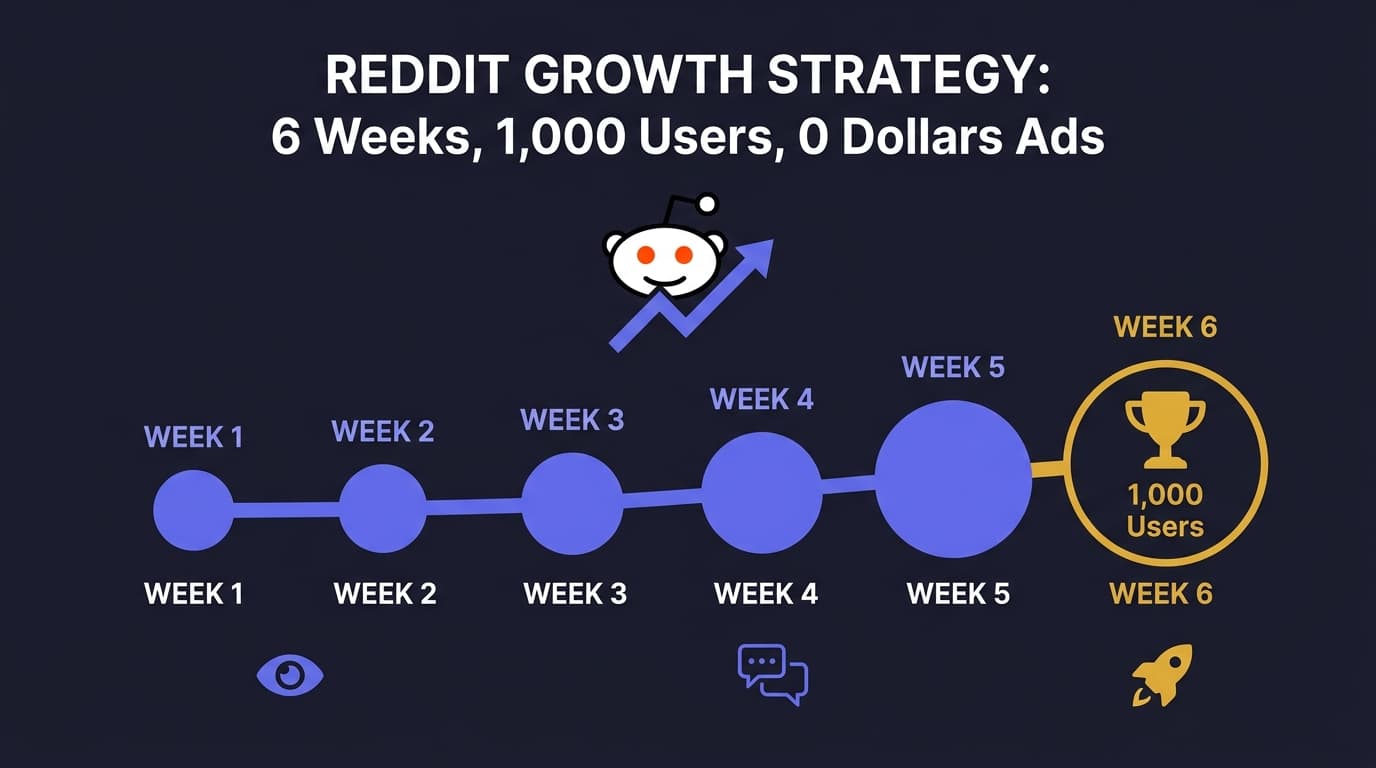
The Reddit Playbook: How to Get Your First 1,000 Users for Free
TL;DR: Reddit is the most underused growth channel for solo founders. The trick: spend 4-6 weeks being genuinely helpful before you ever mention your product. This playbook has generated first 1,000 users for dozens of startups without spending a dollar on ads.
I analyzed 47 successful Reddit marketing campaigns from solo founders. The pattern was clear: the ones who "promoted" their product got banned. The ones who helped people for weeks before mentioning it? They got their first 1,000 users for free.
Here's the exact playbook.
Most founders approach Reddit backwards. They build something, create an account, and post "Hey check out my new product!" in every relevant subreddit.
Within hours: banned, downvoted to oblivion, or simply ignored.
Reddit has a reputation for hating self-promotion. This reputation is deserved. But it misses the bigger picture: Reddit doesn't hate promotion. Reddit hates lazy promotion.
The founders who crack Reddit understand something the banned ones don't: Reddit rewards value more than any other platform. If you provide genuine value first, the community will literally beg you to share your product.
Why Reddit Works (When Everything Else Doesn't)
Reddit has 52 million daily active users. That's more than Twitter. More than LinkedIn. More than most platforms founders obsess over.
But here's what makes Reddit special: intent.
People on Reddit are actively searching for solutions. They're asking questions, seeking recommendations, trying to solve problems. They're not mindlessly scrolling. They're hunting.
This is fundamentally different from other platforms:
- Twitter: People broadcast, rarely engage with strangers
- LinkedIn: Professional posturing, low trust
- Instagram: Visual entertainment, not problem-solving
- Facebook: Your aunt's vacation photos
Reddit is where people go when they actually need something.
Here's a stat that should make you pay attention: 73% of Reddit users trust product recommendations from the platform. That's higher than any other social network. Higher than Amazon reviews. Higher than word-of-mouth from friends in some categories.
Why? Because Reddit self-polices against bullshit. Bad recommendations get downvoted. Shills get called out. Over time, the community learns to trust what survives.
If you can become a trusted voice in a Reddit community, you have something no ad campaign can buy.
The 6-Week Timeline
Let me walk you through the exact timeline that works.
Weeks 1-2: Research and Lurk
Don't post anything. Just watch.
Identify 5-10 subreddits where your potential users hang out. For a SaaS product, this might include:
- r/SaaS (100K+ members)
- r/startups (1M+ members)
- r/Entrepreneur (2M+ members)
- r/smallbusiness (500K+ members)
- Niche subreddits specific to your industry
For each subreddit, study:
- What questions get asked repeatedly?
- What pain points come up constantly?
- Who are the most respected community members?
- What kinds of posts get upvoted vs downvoted?
- What's the tone? Formal? Casual? Technical?
Create a spreadsheet. Track the top 20 questions you see. These questions are gold. They tell you exactly what your market cares about.
Also note: which questions have bad answers? Where are the gaps in existing advice? That's where you'll strike.
Weeks 3-4: Become Helpful
Now you start posting. But not about your product. Not even close.
Your only job for these two weeks: answer questions helpfully.
Find threads where someone is struggling with a problem related to your expertise. Write thoughtful, detailed answers. Don't half-ass it. Give them the answer you'd want if you were asking.
Rules for these weeks:
- No mentions of your product
- No links to your website
- No "subtle" hints about what you're building
- Just pure, genuine help
This feels slow. It is slow. That's the point.
Every helpful answer builds your reputation. Reddit tracks karma (upvotes minus downvotes). Communities start recognizing usernames. People check your post history before trusting you.
When you've been helpful for two weeks, your post history becomes your credibility. Anyone who clicks your profile sees someone who actually gives a damn about helping people.
This cannot be faked. This is the moat.
Week 5: Start Deeper Conversations
Now you go deeper.
Find questions you can answer with substantial posts. Write mini-guides as comments. Share frameworks. Provide real tactical advice that takes effort to create.
Some examples:
- "I've started 3 SaaS products. Here's exactly how I got my first 10 customers for each."
- "Spent 6 months testing pricing strategies. Here's what actually works for solo founders."
- "Made every mistake in the book with cold outreach. Here's the playbook that finally worked."
These aren't humble brags. They're genuine knowledge transfer. The kind of thing that takes 30 minutes to write and provides real value.
Week 6: The Launch
Now you've earned the right.
Create a post sharing your product. But frame it correctly.
Wrong framing: "Check out my new [product category] tool!"
Right framing: "I've been helping people with [problem] in this community for weeks. I finally built a tool to solve it. Here's what I made and why."
Reference specific conversations you've had. Mention users who inspired features (with their permission). Show that this product came from the community, not despite it.
This framing changes everything. You're not a stranger promoting your thing. You're a community member who built something based on what the community actually needed.
The response will shock you.
The Post That Gets 1,000 Users
Your launch post needs specific elements to work.
Element 1: Origin Story (Tied to Community)
Start with how you discovered the problem. Better yet, how THIS COMMUNITY helped you discover it.
"Three weeks ago, u/specific_user asked about [problem]. I wrote a long comment trying to help, then realized: why isn't there a tool that just does this?"
This immediately establishes:
- You're a community member, not an outsider
- The product solves a real problem (someone asked about it)
- You have a track record of being helpful (people can check)
Element 2: The Brutal Honest Section
Reddit users are allergic to marketing speak. Include a section that's painfully honest about limitations.
"What this tool does NOT do:
- [Limitation 1]
- [Limitation 2]
- [Complicated use case]
If you need those things, [competitor] is probably better for you."
This honesty accomplishes several things:
- It builds trust (no one does this in marketing)
- It qualifies your users (wrong-fit users won't waste your time)
- It pre-empts criticism (harder to attack what you've already acknowledged)
Element 3: Free Tier or Launch Offer
Reddit hates paywalls. If possible, offer:
- Free tier that's actually useful
- Launch discount for Reddit users
- Extended trial period
Something that lets people actually try the thing before deciding.
Element 4: Ask for Feedback, Not Sales
End by asking for input, not customers.
"I'm still figuring this out. If you try it, I'd love to know:
- What's confusing?
- What's missing?
- What would make you actually use this daily?"
This invites engagement. Comments and feedback trigger the algorithm. More comments = more visibility = more users.
Real Examples That Worked
Let me show you actual launches that used this playbook.
Example 1: Notion Templates Creator
A founder spent 3 weeks answering questions in r/Notion about productivity setups. Shared free template ideas. Helped people customize their workspaces.
Then launched: "I've been helping people with Notion setups here. Finally packaged my best templates into a bundle. Here's what's in it and why."
Result: 847 users in first week, 2,400 in first month. All from one subreddit.
Example 2: Developer Tool
Developer answered questions in r/webdev for 6 weeks. Not about their tool. Just general web development help. Became a recognized username.
Launch post: "Built a tool to solve [specific problem] I kept seeing here. Feedback wanted."
Result: 1,200 signups in 48 hours. Featured in the subreddit's weekly "cool things" thread.
Example 3: Productivity App
Founder documented their own productivity struggles in r/productivity for a month. Shared what worked, what didn't. Very personal, very real.
Launch post: "I talked about my productivity problems here. Then I built something to solve them. Here's the result."
Result: 600 users immediately, 3,000 within 2 months. Multiple users became paying customers and vocal advocates.
The pattern is identical. Establish credibility through genuine help. Launch when you've earned the right. Frame as community contribution, not self-promotion.
The Subreddit Selection Strategy
Not all subreddits are equal. Here's how to choose where to focus.
Size Sweet Spot: 50K - 500K Members
Too small (<50K): Not enough volume for meaningful growth Too large (>1M): Hard to stand out, often heavily moderated against any promotion Just right (50K-500K): Active enough to matter, small enough to build reputation
Engagement Quality Test
Scroll through recent posts. Ask:
- Are questions getting detailed answers?
- Do discussions go more than 2-3 comments deep?
- Is there genuine back-and-forth conversation?
High-engagement subreddits are worth 10x more than lurky ones.
Moderation Check
Read the rules carefully. Some subreddits have strict no-promotion policies. Others allow it with certain framing. Some have designated promotional threads.
Know the rules before you invest time. Getting banned after 4 weeks of work sucks.
Competition Assessment
Are competitors already active in the subreddit? This can be good (validates the audience) or bad (saturated). Look at how competitor mentions are received. If people are positive, the community is open to products. If people attack competitor mentions, tread carefully.
What Not to Do
I've seen too many founders nuke their Reddit opportunity with dumb mistakes.
Don't Create Multiple Accounts
Reddit detects this. You will get banned from everywhere. Your IP can get flagged. It's not worth it.
One authentic account > ten fake ones.
Don't Upvote Your Own Stuff
Same as above. Reddit has sophisticated vote manipulation detection. People who try this end up shadowbanned without even knowing.
Don't Copy-Paste Answers
Every answer should be specific to the question. Copy-paste jobs are obvious and get called out. Take the time to write genuinely helpful responses.
Don't Mention Your Product in Comments Before Launch
The temptation is real. Someone asks a question your product solves. You want to say "actually, I built something for this..."
Don't. Wait until your launch post. The restraint is worth it.
Don't Disappear After Launch
The worst mistake: get your 1,000 users and vanish. The community notices. Your reputation tanks. When you launch version 2.0, no one cares.
Stay engaged. Keep helping. Keep being a genuine community member.
The Long Game
Reddit isn't a one-time hack. It's a channel that compounds.
Founders who do this right continue seeing Reddit-sourced users for years. Their launch post gets referenced in future discussions. People recommend them when questions come up.
The initial effort is front-loaded. The returns are perpetual.
Before committing to Reddit or any distribution channel, the harder question is whether acquisition is actually your bottleneck right now. If 40% of your signups drop off before they ever get value from your product, spending six weeks building Reddit presence is real work that doesn't fix a leaky bucket. The only way to know is to read your data across sources simultaneously, not in separate tabs.
Luka connects your analytics, error data, and user signals, correlates them across sources, and surfaces where the real bottleneck is at your current product stage. You check it in the morning, know whether to focus on acquisition or activation or something else entirely, and go do that. See how Luka works.
The 4-Hour Per Week Plan
Sounds like a lot of work? Here's how to fit it in.
Hour 1 (Monday): Research Browse your target subreddits. Note interesting questions. Bookmark threads to respond to.
Hour 2 (Wednesday): Writing Write 2-3 thoughtful responses to questions you bookmarked. Take your time. Make them good.
Hour 3 (Friday): Engagement Respond to comments on your previous answers. Check for new questions in your threads. Have conversations.
Hour 4 (Sunday): Strategy Review what got upvoted vs ignored. Adjust your approach. Plan next week.
4 hours per week for 6 weeks = 24 hours total.
24 hours for your first 1,000 users is an insanely good ROI. Most founders spend 100+ hours on approaches that yield a fraction of that.
Measuring Success Before Launch
How do you know if your groundwork is working?
Karma Growth
Your Reddit karma should be growing steadily. If you're getting downvoted, adjust your approach.
Recognition
Start getting replies like "I've seen your comments here before" or "You always have good advice." That's the sign you've made it.
DMs
People will start DM-ing you for advice. This is huge. These are your warmest leads when you launch.
Saves
Reddit shows when comments are saved. High save rates mean people find your advice valuable enough to reference later.
Followers
Yes, Reddit has followers. If people are following your account, they want more of what you're offering.
Hit these signals before launch. They predict success.
After the Launch
Your launch post worked. You got 1,000 users. Now what?
Week 1 Post-Launch: Pure Feedback Mode
Respond to every comment. Every DM. Every piece of feedback. Users who feel heard become advocates.
Week 2-4: Build the Case Study
Document the Reddit launch. Share what worked. This becomes content for other communities and platforms.
Month 2+: Maintain Presence
Don't go full-time on Reddit, but don't disappear. Pop in weekly. Answer questions. Share updates on your product.
Ongoing presence keeps the flywheel spinning.
The Uncomfortable Truth About This Strategy
It's slow. It takes real effort to scale. It requires actual effort.
You can't outsource this to a VA or automate it with bots. The whole thing works because it's genuinely human.
That's also what makes it work. Reddit has seen every growth hack. The community is immune to tricks. What they're not immune to is someone who actually cares.
Your effort is the moat. Competitors who aren't willing to spend 6 weeks being helpful can't copy this strategy. It doesn't scale without real effort, which means it works.
Common Objections
"I don't have 6 weeks"
Then you don't have time for sustainable growth. Every shortcut on Reddit leads to getting banned or ignored. The 6 weeks is non-negotiable.
"My product doesn't fit Reddit"
Every product fits Reddit. There's a subreddit for everything. If you can't find one, your product's niche might be the issue, not Reddit.
"I'm not good at writing"
You don't need to be good. You need to be helpful. Answer questions clearly and honestly. That's it.
"What if I get negative feedback?"
Good. Negative feedback is information. It tells you what to fix before you scale. Better to hear complaints from 1,000 users than 100,000.
The Bottom Line
Reddit is the most underrated growth channel in 2026.
52 million daily users. 73% trust rate for recommendations. Communities hungry for genuine help.
The barrier isn't technical. It's patience. Most founders won't spend 6 weeks building credibility before promoting.
That's your opportunity.
About the Author