The 60-Minute Quarterly Ritual That Prevents the Slow Slide Into Burnout
TL;DR: Most burnout doesn't come from working too hard. It comes from working without a compass long enough that you lose track of why you're doing it. The founders who avoid this don't have better discipline. They have one specific ritual: 60 minutes every quarter, mapping purpose, values, and long-term vision before the drift becomes a crisis. Here's the exact structure.
I watched a founder friend go from high-performance to hollow in about eight months.
Not a dramatic collapse. Not a shutdown or a crisis moment. Just a slow fade where the energy went out of how he talked about his product, the mentions of "I remember why I'm doing this" stopped, and eventually he was putting in the hours but the spark was gone.
He wasn't lazy. He wasn't undisciplined. He was working hard on the wrong thing without knowing it, and nobody caught it because there was no system that forced the check-in.
This is the burnout mode nobody talks about. Not the overnight crash from overwork. The slow drift from misalignment that builds for months before anyone notices, including you.
The Drift Nobody Catches
There's a specific failure mode that precedes founder burnout. It looks like this:
You're building something that made sense at the start. Over months, the market shifted, your users evolved, your own thinking changed. But you kept executing the original plan because that's what you committed to, and nobody had a mechanism to question whether the plan still made sense.
The misalignment compounds. You spend more time on things that feel increasingly meaningless. The gap between "what I'm doing" and "why I started" widens. You don't notice because you're heads-down in execution, and execution still produces outputs.
Then one day you realize you haven't cared about the product in weeks. You just show up and do the work because that's what you said you'd do.
This is the slow slide into burnout. And it's almost entirely preventable with one structure.
What the Quarterly Compass Check Actually Is
The ritual that prevents this isn't complicated. It's one hour, every quarter, before you set the next quarter's goals.
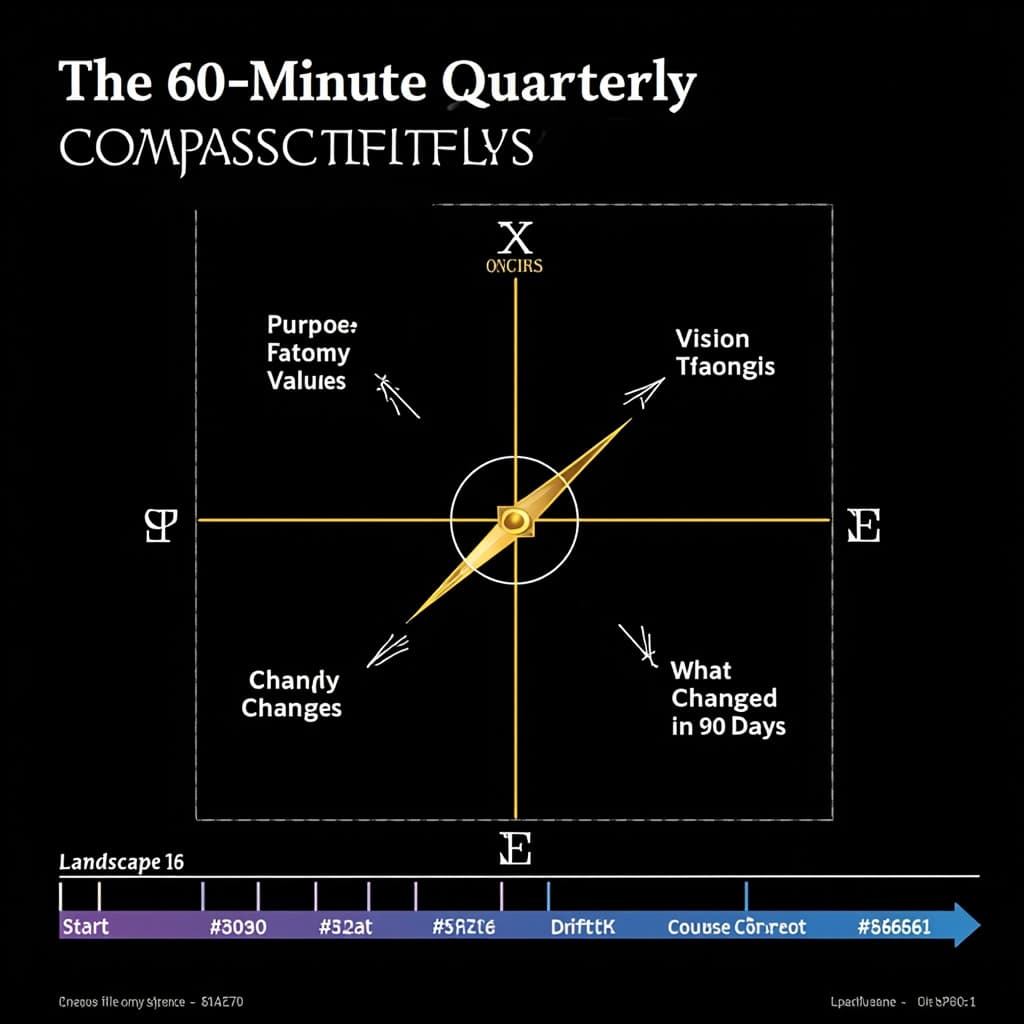
The structure comes from something Malte Kramer shared: map your purpose, your values, your long-term vision, and what changed in the last 90 days. Then check whether the work you're doing actually connects to any of it.
Purpose: Why did you start this? Not the company story. The real reason you got into this instead of a job.
Values: What matters in how you operate? What would you not compromise on even if it cost you growth?
Vision: Where is this going if everything goes right? What are you building toward?
Changes: What's changed in the last 90 days? In the market, in your users, in your own thinking, in what you want?
Then the hard question: Is the work you're currently doing still connected to all four of these?
This takes an hour because you have to actually sit with it. Most founders never do.
Why This Works When "Take Breaks" Doesn't
The advice to "take breaks" and "maintain work-life balance" misses the cause. You're not burning out because you're working too much. You're burning out because you're working on something that's stopped being meaningful to you, and you've been doing it long enough that the mismatch is eroding everything.
Taking a vacation fixes the symptom. It doesn't fix the misalignment.
The quarterly compass check fixes the cause. It forces the confrontation with whether what you're doing still connects to why you started, before the gap becomes a crisis.
The founders who do this consistently aren't more disciplined about rest. They're more honest about whether their work still matters to them. The ritual is a forcing function for that honesty.
The Five Questions That Make Up the Hour
Here's the exact structure, broken into five parts, roughly 10-15 minutes each:
Question 1: What's the real purpose here? Why did you start this instead of doing something else? What problem were you solving that you genuinely cared about? Don't write the pitch deck version. Write the version you'd tell a friend at 2am when they're asking why you quit your job.
If you can't answer this clearly, that's data. The purpose has been lost or buried under the operational noise. That's what the rest of the hour is for.
Question 2: What are my operating values? What do I refuse to compromise on, even when it would be easier or more profitable? What's the line I won't cross?
Most founders answer this vaguely. Push harder. Name the specific values that actually govern your decisions. If "integrity" is on the list, what does it mean in a concrete decision you've faced? If "speed" is on the list, what did you sacrifice for it?
Question 3: Where is this actually going? If everything went perfectly for the next three years, what would this become? What's the actual vision, not the safe version you've been telling people?
The safe version is what you say in pitch meetings. The real version is what you'd tell your closest friend. They're usually different, and the gap is important.
Question 4: What changed in the last 90 days? This is the diagnostic section. What changed in the market, in your users, in your own thinking, in what you want out of this?
Be honest here. If you stopped caring about a feature six weeks ago and you've been avoiding working on it, that's a change. If a competitor launched something that changes your positioning, that's a change. If your own thinking evolved and you're now solving a different problem than you were in January, that's a change.
Write them down without filtering.
Question 5: Does the current plan still connect to all four of these? This is the conclusion. Look at what you planned to do this quarter. Look at your purpose, values, vision, and the changes you've documented. Does the work still connect?
If yes: proceed with more clarity about why. If no: the plan needs to change, not the vacation need to increase.
What This Prevents That Time Off Can't
The specific thing this ritual prevents: the eight-month drift from misalignment to exhaustion.
The mechanism is simple. Without a forcing function for the quarterly check-in, you keep executing the plan. The plan was right when you made it. But markets move, users evolve, your thinking deepens, and the plan might not be right anymore.
You don't notice because execution is comfortable. You're good at it. The outputs keep coming. The revenue keeps growing or stable. On the surface, everything looks fine.
Underneath, you're building toward a destination that might not be the right one anymore. And every week that passes, you're more committed to it, which makes it harder to change course, which makes you more likely to just keep going until the hollow feeling becomes impossible to ignore.
The quarterly ritual breaks this cycle by forcing the check before the drift compounds.
What the Founders Who Do This Have in Common
I looked at the founders who maintain energy and clarity over multi-year periods versus the ones who flame out around year two or three. The ones who sustain it almost all have some version of this ritual.
Not all of them call it this. Some do annual planning, some do quarterly retreats, some have a coach they meet with quarterly. But the common thread is the same: a structured pause where they check whether what they're doing still connects to why they started.
The ones who skip it are running on momentum. Momentum is useful when you're pointed in the right direction. When you're not, it's the thing that makes the crash worse because you've gone further off course.
The Honest Version of This
Here's what the ritual won't do: it won't make you happy if you're building the wrong product for the wrong market. The purpose check will reveal that, but only if you're honest in answering it.
Most founders aren't. They answer the purpose question with what sounds good rather than what's true. They say "I want to help creators" when the real answer is "I want to build something impressive and prove I'm not a failure."
The ritual only works if you answer the questions honestly. The questions are designed to surface the gap between what you're doing and why you're doing it. If you lie in the answers, you get the comfort of having done the ritual without any of the benefit.
The best test of honesty: would you be comfortable sharing the answers with someone close to you? If not, that's a signal the answers might not be true.
The founders who burn out aren't usually the ones working the hardest. They're the ones who stopped checking whether the direction was still right. The quarterly compass check is the mechanism that keeps the direction honest.
The part nobody tells you: this gets harder the longer you've been going. Early-stage, you're close enough to the founding moment that the clarity is fresh. Two years in, the market moved, the users shifted, your own thinking evolved, and you're still executing the original plan because that's what you know and changing feels expensive.
Luka reads your data signals and shows you which growth stage is actually blocking you. Sometimes the bottleneck isn't distribution or product. It's the misalignment that comes from operating without a compass check for too long. It helps you surface that before the drift compounds. You check it in the morning, know what to work on, close it, go execute. See how Luka works.
Frequently Asked Questions
How is this different from a quarterly planning meeting?
The difference is the questions. Most quarterly planning starts with "what did we accomplish last quarter?" and "what are our goals for next quarter?" This ritual starts with purpose, values, vision, and what changed. The planning follows from that grounding, not the other way around. Without this order, quarterly planning tends to optimize for what felt urgent rather than what's actually right.
What if I don't have time for a 60-minute ritual?
If you don't have 60 minutes every quarter to check whether you're still pointed in the right direction, the misalignment risk is probably already running. The ritual takes an hour. The recovery from not doing it takes months, if it recovers at all. This is the highest-leverage hour in your quarter.
How do I know if the ritual is working?
You'll feel it before the data shows it. The energy around the work shifts. The "why" becomes clearer. The decisions that felt ambiguous start resolving more clearly because you have a stronger sense of what's actually important. If you're doing the ritual and none of that is happening, the issue is probably honesty in the answers rather than the ritual itself.
What if I find out I've been building the wrong thing?
That's the point. Better to find out after one quarter of the wrong direction than four. The discovery is painful but fixable. The compounding drift without discovery is the thing that ends ventures. If the ritual reveals deep misalignment, the answer is course correction, not more execution in the wrong direction.
About the Author