Product Hunt Is Dead for Indie Hackers. Here's Where First Users Actually Come From in 2026
TL;DR: Product Hunt used to be THE launch platform for indie builders. In 2026, it's a vanity badge factory drowning in 500+ daily submissions. The founders actually getting users are skipping it entirely and running multi-platform launches across Reddit, X, niche communities, and directory sites. Here's the playbook that's working right now with real numbers.
I spent a day reading every launch retrospective I could find from the last 6 months. 25+ Reddit threads from founders sharing their actual signup numbers per channel. 15 Indie Hackers posts with before/after traffic breakdowns. Launch guides from OpenHunts, Firsto, IndieHunt, and half a dozen directory sites. Plus the actual data from founders who posted transparent "here are my real numbers" breakdowns.
The pattern was clear. Founders who put all their eggs in the Product Hunt basket consistently underperformed founders who treated launch day as a coordinated multi-platform campaign. And some founders who skipped Product Hunt entirely got 3-8x more signups from Reddit and X alone.
The Product Hunt Reality Check (2026 Edition)
Let me be direct. Product Hunt isn't worthless. But it's not what it was in 2020, and treating it as your primary launch strategy in 2026 is a mistake.
Here's what changed:
Volume killed discovery. Product Hunt now gets 500+ submissions daily. Getting featured requires either an existing audience, strategic upvote coordination, or landing in the top 3 within the first 4 hours. For a solo founder launching their first product with no following, the odds are brutal.
The audience shifted. Product Hunt's core user base has evolved from early-adopter builders into a mix of investors, marketers, and other founders. That's great if you're building devtools or B2B SaaS. It's terrible if your ICP is non-technical users, small business owners, or consumers.
Gaming is rampant. Upvote pods, launch services charging $500-$2,000 for coordinated campaigns, and "Product Hunt optimization consultants" have turned the platform into a pay-to-play environment. When the top products of the day consistently have suspiciously coordinated voting patterns, the signal-to-noise ratio collapses.
The traffic spike doesn't convert. This is the one that matters most. Multiple founders reported getting thousands of Product Hunt visitors on launch day but single-digit signups. The traffic is curious, not motivated. They click, browse for 30 seconds, and leave. Meanwhile, a Reddit thread with 50 upvotes in the right subreddit can drive 20-30 qualified signups because the audience was already looking for a solution to that specific problem.
One founder posted a transparent breakdown on r/buildinpublic: "Reddit + Indie Hackers threads beat Product Hunt for early users in 2026 (3-8x more signups from honest updates)." This isn't an outlier. It's the emerging pattern.
The Multi-Platform Launch Framework (What Actually Works)
The founders getting real results in 2026 aren't picking one platform. They're running coordinated campaigns across 4-6 channels simultaneously. Same core message, different tone for each platform, all on the same day.
Here's the framework, built from the actual strategies that worked.
Phase 1: Pre-Launch (2-4 Weeks Before)
Build in public on X. Not "I'm building something cool" vague posts. Specific, detailed progress updates that demonstrate you're solving a real problem. Share screenshots, design decisions, architecture choices, and the problems you're struggling with.
Why this works: you're building an audience of people who are emotionally invested in your product before it exists. They've watched it get built. They want it to succeed. When launch day comes, they show up.
Seed conversations on Reddit. Find the 3-5 subreddits where your ICP hangs out. Don't spam your product. Answer questions. Be genuinely helpful. Build karma and recognition. When you eventually share your launch, you're a known community member, not a drive-by marketer.
The best subreddits for indie launches in 2026: r/SaaS (120K+ members), r/indiehackers (60K+), r/startups (1M+), r/buildinpublic (growing fast), and whatever niche sub serves your specific ICP.
Warm up Indie Hackers. Post a "what I'm building and why" on Indie Hackers 2-3 weeks before launch. Ask for genuine feedback. The community responds well to honesty and poorly to hype. If your product actually solves a problem they recognize, they'll remember you on launch day.
Phase 2: Launch Day (The Coordinated Strike)
Here's where most founders get it wrong. They launch on Product Hunt and wait. The founders who win launch everywhere within a 4-hour window.
Reddit (highest signal): Post on your primary subreddit with the format: "[title of product]: what I built, why, and the real numbers." Reddit hates marketing. Reddit loves honesty. Share your story, your struggles, your actual metrics. Link to your product. Answer every single comment personally within the first 2 hours.
X/Twitter (amplification): Thread format works best. Hook with a specific result or insight. Walk through the problem you solve. Show the product. End with a link and ask. Your pre-launch audience is primed to engage, which signals the algorithm to push wider.
Product Hunt (if you want the badge): Yes, still launch here. But treat it as a badge and SEO play, not your primary user acquisition channel. The dofollow backlink from Product Hunt is genuinely valuable for SEO. A "Product of the Day" badge adds social proof to your landing page. Just don't expect significant conversions.
Hacker News (if your product is technical): Submit to Show HN with a clear, no-bullshit description. Hacker News can drive enormous traffic if the community finds your product interesting. But they're merciless about self-promotion and hype. Technical depth and honest framing are mandatory.
Niche directories (long-tail discovery): Submit to every relevant directory on the same day. IndieHunt (weekly curated launches), Aura++, EarlyHunt, Uno Directory, BetaList, and any industry-specific directories for your niche. Each one is small traffic individually. Collectively, they add up. And the backlinks compound your SEO over time.
Phase 3: The Week After (This Is Where Most Founders Stop)
Launch day traffic is a sugar high. What you do in the 7 days after launch determines whether that traffic converts into a sustainable user base.
Follow up on every Reddit comment. If someone asked a question or gave feedback, respond with what you did about it. "You mentioned X. I shipped a fix yesterday. Here's what changed." This builds trust and converts lurkers into users.
Publish a "launch results" post. Be transparent about what happened. How many visitors per channel. How many signups. What surprised you. What failed. The transparency is itself marketing. Other founders share it, discuss it, and discover your product through it.
Cross-post your results to other platforms. Your Reddit launch post did well? Write a different version for X. Your X thread got engagement? Turn it into an Indie Hackers post. Every piece of content does double duty across platforms.
Email everyone who signed up. Personal emails. Not automated sequences. "Hey, I'm [name], I built [product]. Thanks for signing up on launch day. What's the first problem you're trying to solve?" One sentence replies will tell you more about product-market fit than any survey.
The Channel-by-Channel Breakdown (Real Numbers)
Based on the launch retrospectives I analyzed, here's what typical results look like per channel for a solo founder launching their first product:
Reddit (right subreddit, honest post)
- Visitors: 500-3,000
- Signups: 20-150
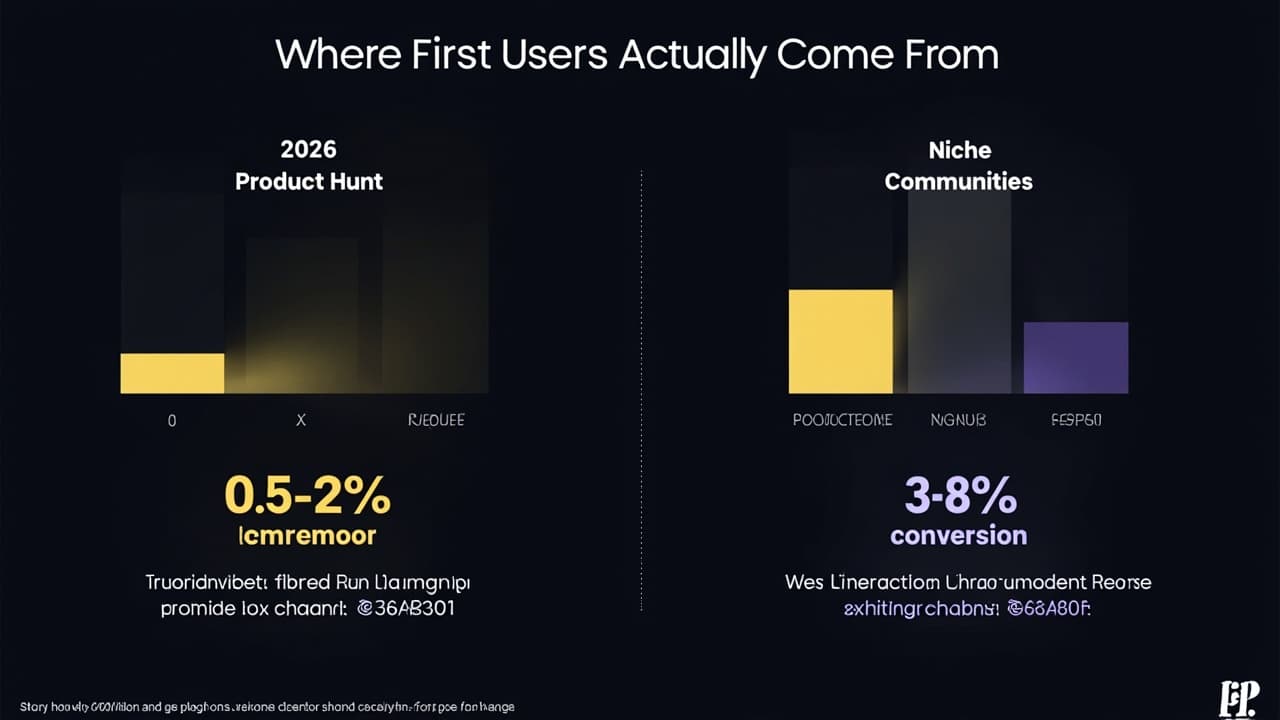
- Conversion rate: 3-8%
- Why it works: intent-rich audience already seeking solutions
X/Twitter (pre-built audience of 500+)
- Visitors: 200-2,000
- Signups: 10-80
- Conversion rate: 2-5%
- Why it works: warm audience, algorithmic amplification of engagement
Product Hunt (featured, top 5)
- Visitors: 2,000-10,000
- Signups: 15-100
- Conversion rate: 0.5-2%
- Why it works: volume compensates for low intent
Hacker News (Show HN, front page)
- Visitors: 5,000-50,000
- Signups: 50-500
- Conversion rate: 1-3%
- Why it works: massive reach if content resonates
Indie Hackers (well-written post)
- Visitors: 200-1,000
- Signups: 10-50
- Conversion rate: 3-7%
- Why it works: community of builders who understand and support
Niche directories (combined)
- Visitors: 100-500
- Signups: 5-30
- Conversion rate: 3-8%
- Why it works: long-tail discovery, SEO value compounds
Notice the pattern. Product Hunt drives the most traffic but converts the worst. Reddit and niche communities drive less traffic but convert 3-5x better. If you optimize for signups (not vanity traffic), the "boring" channels win.
The Launch Mistakes That Kill Momentum
Launching on a Friday. Reddit engagement drops on weekends. Product Hunt votes slow down. X engagement is lower. Tuesday through Thursday is the window. Monday if you're desperate. Never Friday.
Writing the same post for every platform. Reddit wants honesty and detail. X wants hooks and threads. Product Hunt wants a clean tagline and description. Hacker News wants technical substance. Same message, different packaging. Writing one post and copying it everywhere is the fastest way to get ignored everywhere.
Not having a landing page that converts. You can drive 10,000 visitors from a perfect multi-platform launch and get zero signups if your landing page doesn't immediately communicate what you do, why it matters, and how to start. Above the fold: problem, solution, CTA. That's it.
Ignoring the first 2 hours. Reddit and Hacker News algorithms heavily weight early engagement. If you launch and go to bed, your post dies while you sleep. Plan your launch for when you can personally respond to every comment for at least 2 hours straight.
Only launching once. Your first launch is version 1. You'll learn more from that launch than from months of building. Take the feedback, improve the product, and launch again in 4-6 weeks on different subreddits and directories. Some founders do 3-4 launch cycles before finding product-market fit.
The SEO Play Nobody Talks About
Here's something that doesn't show up in launch day metrics but matters enormously for long-term growth.
Every launch creates backlinks. Product Hunt gives you a dofollow link. Directory listings give you links. Reddit posts that stay up give you links. Indie Hackers posts give you links.
If you launch across 10 platforms on the same day, you get 10+ backlinks pointing to your domain within a 24-hour window. Google notices that. For a brand new domain, this can be the difference between indexing in days versus weeks.
One founder I found launched across 15 platforms simultaneously and saw their domain go from zero to ranking on page 2 for their primary keyword within 3 weeks. That sustained organic traffic outlasted the launch day spike by months.
The directories compound this effect over time. Sites like IndieHunt, BetaList, and niche directories get crawled regularly. Your listing stays live. The backlink stays active. Six months after launch, you're still getting trickle traffic from directory listings you submitted on day one.
The Real First Users Playbook (Step by Step)
If I were launching a product today as a solo founder with zero audience, here's exactly what I'd do:
Weeks 1-2: Start posting on X about the problem I'm solving. Not the product. The problem. "I noticed that [specific thing] is broken for [specific people]. Here's why." Build a small but interested audience.
Week 3: Post on Indie Hackers: "I'm building X because of Y. Here's my prototype. What am I missing?" Collect feedback. Make changes. Document the process publicly.
Week 4 (Launch Week):
- Monday: Tease on X. "Launching [product] on Wednesday. Here's what it does and why I built it." Include a waitlist link.
- Tuesday: Submit to all directories. Most take 24-48 hours to review. You want listings to go live near launch day.
- Wednesday (Launch Day, 8am PT):
- Post Reddit thread in primary subreddit
- Post X thread
- Launch on Product Hunt
- Submit to Hacker News (Show HN)
- Post on Indie Hackers
- Spend 4 hours responding to every comment everywhere
- Thursday: Follow up on all conversations. DM anyone who showed particular interest.
- Friday: Post "Day 2 results" on X. Transparent numbers. What worked. What didn't.
Week 5: Email every person who signed up. Ask one question: "What's the first thing you're trying to do with [product]?" The answers are your product roadmap.
Why Community-First Beats Platform-First
The biggest shift in 2026 launch strategy isn't about which platforms to use. It's about building relationships before you need them.
The founders who get 200+ signups on launch day didn't just pick the right platforms. They spent weeks or months being useful in those communities first. They answered questions. They helped other founders. They shared insights without asking for anything in return.
When they finally launched, the community showed up because the community already knew them. That's not a "growth hack." It's how human relationships work. People help people they know and trust. No amount of Product Hunt upvote gaming replicates genuine community goodwill.
Every channel looks promising from the outside. Reddit, X, Product Hunt, directories. The question isn't which one to try. It's which one matters most for your specific product, at your specific stage, with your specific audience. That kind of answer requires knowing your own data, not just general advice. Luka connects your analytics, user signals, and engagement data across sources and tells you where your actual growth bottleneck is today. Not which channel is trendy. Which one is right for you right now. Check it in the morning and go focus on the one thing that moves the needle. See how Luka works.
Apply This Today
Pick the one subreddit where your ICP spends the most time. Post there today. Not about your product. About the problem your product solves. See what resonates.
If you have a launch coming up, create a spreadsheet with every platform you'll hit on launch day. Write the different versions of your post for each one now. Not on launch day.
Count your existing community relationships. How many people in your target market know your name? If the answer is fewer than 50, you're not ready to launch. Spend 2 more weeks being useful in the right communities first.
Set up tracking before you launch. UTM parameters on every link from every platform. If you can't measure which channel drove which signups, you can't optimize for the next launch.
Common Mistakes to Avoid
Don't pay for Product Hunt launch services. If your product needs paid upvote coordination to succeed on launch day, the problem isn't your launch strategy. It's your product or positioning.
Don't launch without a follow-up plan. Launch day is day 1 of a 30-day campaign, not the entire campaign. Most founders spend 4 weeks preparing for launch and zero minutes planning what happens after.
Don't optimize for traffic over signups. 10,000 visitors and 5 signups is worse than 500 visitors and 50 signups. Focus on channels where the audience has intent, not just volume.
Don't ignore niche directories because they're "small." They convert better than big platforms, their backlinks help SEO, and collectively they can drive meaningful traffic. Submit to all of them.
Frequently Asked Questions
Is Product Hunt still worth using in 2026?
Yes, but not as your primary launch strategy. Use it for the dofollow backlink (SEO value), the badge (social proof on your landing page), and exposure to investors and tech press. Don't rely on it for actual user acquisition. Reddit and niche communities consistently convert 3-5x better.
What's the best day to launch a product in 2026?
Tuesday through Thursday. Reddit, Product Hunt, and X all see peak engagement midweek. Monday is acceptable but not ideal. Friday through Sunday is a dead zone for launches. Aim for 8am Pacific Time to catch both US coasts and European evening browsers.
How many users should I expect from my first launch?
For a solo founder with a small existing audience (under 500 followers), expect 50-200 signups from a well-executed multi-platform launch. For a founder with zero audience launching on Product Hunt alone, expect 10-30. The variance depends on your product's appeal, your landing page conversion rate, and how actively you engage in the first 2 hours.
Should I use a launch service for Product Hunt?
No. Paid upvote services violate Product Hunt's terms, create artificial engagement that doesn't convert to real users, and cost $500-$2,000 that's better spent on literally anything else. If your product can't earn genuine interest, a paid launch won't fix that.
How do I build an audience before my first launch?
Spend 2-4 weeks posting about the problem you solve (not your product) on X and Reddit. Answer questions in relevant communities. Share useful insights without asking for anything. The goal is to become a recognized, helpful voice so that when you do launch, people already trust you.