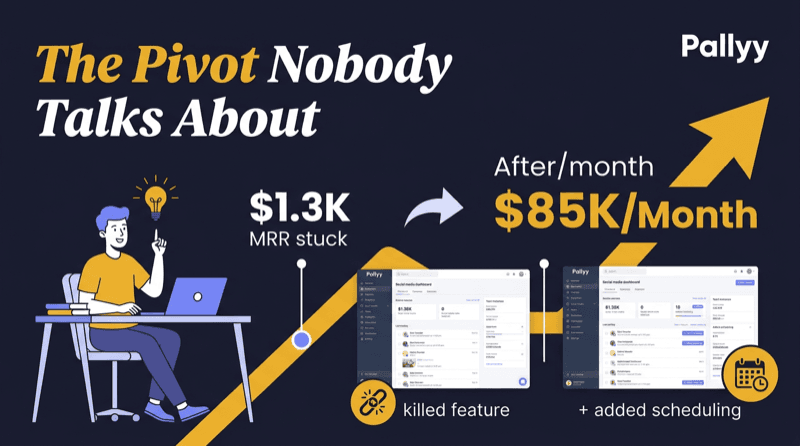
How Pallyy Bootstrapped From $0 to $85K/Month: The Pivot Nobody Talks About
TL;DR: Tim Bennetto spent two years stuck at $1.3K MRR with high churn. The feature he thought made his product special? Nobody used it. The pivot that 10x'd his revenue wasn't adding features - it was removing the wrong one.
I went down a rabbit hole last week.
I was looking for bootstrapped founders who actually made it - not the "I raised $10M and hired 50 people" stories, but the real indie hacker journeys. The ones where someone started with nothing, made a bunch of mistakes, and figured it out anyway.
That's when I found Pallyy.
Tim Bennetto started a social media analytics platform in 2019. By 2026, he's doing $85K/month. Solo. Bootstrapped.
But here's what caught my attention: he spent the first TWO YEARS stuck at $1.3K MRR with high churn. Most founders would have quit. He didn't.
I dug through Reddit threads, case studies, and every public data point I could find. Here's the story nobody's telling.
The Launch That Almost Didn't Matter
Tim's first business was an app he eventually sold for $10,000. Built by an external company. He realized immediately that if he wanted to build more things, he needed to learn to code himself.
So he did.
In 2019, after some unremarkable projects, he launched ShareMyInsights (now Pallyy) - an Instagram analytics platform.
The only reason he started it: to create a better lifestyle and make money. He chose analytics because that type of SaaS was booming.
The only differentiator: a feature that let you share analytics with others.
That's it. No grand vision. No breakthrough insight. Just "this market is hot and I have one small twist."
The launch failed.
Tim focused entirely on product development and neglected marketing. Classic mistake. But here's where it gets interesting.
The First 100 Customers Came From Nowhere
Despite the failed launch, customers started showing up unexpectedly. He got his first 100 customers at $5/month.
$500 MRR. Not life-changing, but proof something worked.
Over the next two years, he grew to $1.3K MRR. But churn was brutal. People would sign up, use it for a month, and leave.
Most founders in this situation do one of two things:
- Add more features hoping something sticks
- Spend more on marketing to replace churned users
Tim did neither.
He looked at his data.
The Pivot That Changed Everything
Tim identified two key problems:
- Nobody was using the "sharing" feature - the one thing he thought made his product special
- Users kept asking for post scheduling - something he didn't have
Think about this for a second.
The feature he built his entire differentiation on? Useless.
The feature users actually wanted? He didn't have it.
So he did something most founders can't bring themselves to do: he killed his "special" feature and built what users actually asked for.
He removed the sharing feature entirely.
He prioritized building scheduling.
The result: MRR doubled to $2.5K. Churn stabilized.
The 10x Play: Focus and Rebrand
After achieving actual product-market fit (not the fake kind where you convince yourself it's working), Tim focused on scaling.
He made three key moves:
1. Rebranded from "ShareMyInsights" to "Pallyy" Short, affordable, versatile name. Spent $1,500 on a new logo - which he later admitted was a mistake. Could have used Canva or Fiverr.
2. Narrowed to a specific niche Instead of competing with every social media tool, he focused specifically on social media agencies. This let him stand out in a crowded market.
3. Built a marketing engine
- Direct outreach to social media managers on Instagram
- Instagram and Google ads (limited budget)
- Hired a blog writer for SEO (the move that compounded)
- Affiliate program
- Raised prices by $3/month
These moves led to 10x growth the following year.
The Numbers
Let me be specific about the journey:
| Time | MRR | What Happened |
|---|---|---|
| Launch 2019 | $500 | First 100 customers at $5/month |
| Year 1-2 | $1.3K | Stuck, high churn |
| Post-Pivot | $2.5K | Removed wrong feature, added scheduling |
| Year 3-4 | $10K+ | SEO kicks in, agency focus |
| 2026 | $85K | Continued scaling, compounding growth |
That's a 170x increase from the stuck point to today.
The Counterintuitive Lesson
The biggest insight from Tim's story isn't about marketing tactics or pricing strategy.
It's about killing your darlings.
The feature Tim thought made his product special was actually holding him back. He spent two years with this albatross around his neck, wondering why growth was slow.
When he finally removed it and built what users actually wanted, everything changed.
Most founders add features to solve problems. Tim removed one.
What I'd Do Differently If I Were Starting Today
If I were building a SaaS from scratch, here's what I'd take from Tim's story:
1. Validate features before building them Tim assumed "sharing" was valuable. He was wrong. I'd talk to 50 potential users before writing code for any "differentiator."
2. Watch what users DO, not what they SAY Users might say they love a feature. But if they never use it, it doesn't matter. Analytics don't lie.
3. Don't be afraid to kill features Every feature has a cost - maintenance, complexity, support. If nobody uses it, it's dead weight.
4. Pick a niche early Tim succeeded when he focused on agencies. Competing with everyone is competing with no one.
5. SEO compounds The blog writer was the move that compounded. Not flashy, but it built sustainable traffic over time.
What Tim Got Right (Beyond the Pivot)
The pivot story gets all the attention. But there are three decisions Tim made that didn't involve a pivot and don't get enough credit.
Decision 1: He chose a boring, competitive market. Social media analytics wasn't a novel category when Tim started. There were dozens of tools. Most founders avoid crowded markets. Tim chose one on purpose, because demand was proven. You don't have to educate the market about why analytics matter when 10,000 other businesses are already selling analytics tools. The challenge shifts from "do people want this?" to "why would they choose me?" That's a harder positioning problem but a much easier distribution problem.
Decision 2: He shipped before the product was ready. Most founders I talk to are waiting until "it's ready" before they go to market. Tim's first version was rough enough that he was apologizing to early users. And those early users stayed anyway, because the product solved a real problem even imperfectly. The roughness is how you learn what matters to users. Every hour you spend polishing before shipping is an hour you haven't yet learned what users actually value.
Decision 3: He invested in SEO before it was fashionable. Hiring a dedicated blog writer when you're doing $1.3K MRR feels like a stretch. Tim did it anyway. The compound effect of consistent SEO content is one of the most under-executed strategies in indie SaaS, not because founders don't know it works, but because it takes 6-12 months to see results and most founders abandon it in month 3.
Tim's blog writer was the move that compounded. Not the pivot. Not the rebrand. The boring content investment made years earlier.
Building for Niches in 2026: What Pallyy Teaches
The "niche down" advice is everywhere. What's harder to find is tactical guidance on how to discover the right niche before you spend two years on the wrong one.
Tim found his niche (social media agencies) by looking at his paying customers. Not his most active free users. His PAYING customers. The pattern was there: agencies had a specific workflow, paid more, churned less, and referred more than solo users. The niche found him more than he found it.
Most founders have this data and aren't looking at it clearly. Payment behavior, retention curves, and feature usage by customer segment will tell you who your actual product is for, if you're willing to look at the patterns rather than the aggregate numbers.
Here's the specific analysis I'd recommend running if you're at $500-5K MRR and wondering if you have a niche signal:
- Segment your paying customers by job title or company size. Even 20-30 customers is enough to see a pattern if there is one.
- Calculate retention by segment. Not overall retention, by segment. Which group comes back most reliably?
- Calculate average revenue by segment. Which group pays more per customer?
- Look at inbound referrals by segment. Which customers are most likely to recommend you without being asked?
The segment that scores highest across all four metrics is your actual niche, even if you haven't been targeting it explicitly. Tim had agencies scoring high across all four, he just hadn't noticed until he stepped back and looked.
The Pricing Move That Worked
One detail that gets buried in Pallyy's story: Tim raised prices by $3/month and barely anyone left.
That sounds trivial. It's not. A $3 increase on a $5 plan is a 60% price hike. Most founders would lose sleep over that. Tim did it after confirming that his retained customers (agencies) were getting measurable ROI from the product. They weren't paying $5 because it was cheap. They were paying $5 because they hadn't been asked to pay more.
The lesson: if your retained customers don't leave when you raise prices modestly, you were undercharging. If they do leave, they were never your real customers.
Tim also added a free tier to capture top-of-funnel users who would eventually upgrade. The combination (higher paid price, free entry point) gave him both revenue and growth. Most founders try one or the other. Tim ran both simultaneously.
By 2024, Pallyy's pricing had evolved to a tiered model with the free plan handling basic scheduling and paid plans opening access to analytics, team collaboration, and multi-brand management. The agency-focused features (client approval workflows, white-label reports) justified premium pricing because they replaced tools agencies were already paying for separately.
The Takeaway
Pallyy's story isn't about a brilliant founder with a novel idea. It's about someone who started with a mediocre idea, paid attention to the data, and had the courage to change course.
Two years stuck at $1.3K MRR. Most people would have quit.
Tim didn't.
He removed the feature he loved. He built what users wanted. He focused on a niche.
And now he's doing $85K/month.
That's the real indie hacker story. Not the overnight success. The two-year grind followed by the pivot that made it work.
Tim took two years to find the niche that actually worked. Not because he wasn't smart. Because he was inside it the whole time, too close to see it clearly. Pallyy was a general social media tool before it became the social media tool for agencies. That pivot looks obvious in retrospect.
The research that leads to a pivot like that, the competitor analysis, the customer segment breakdown, the work of figuring out who's actually paying and why, is exactly the kind of thinking-heavy work that founders keep deferring because building feels more urgent.
Tim spent two years too close to his own product to see what the data was already saying. A general tool becoming a niche tool isn't a sudden insight, it's the pattern that shows up when you read who's actually paying, at what price point, with what retention curve, and compare that to who's churning. That data existed for Pallyy the whole time.
Most solo founders have the same data and the same blind spot. GA, Sentry, App Store reviews, and engagement signals are each telling part of the story. Luka reads them together, finds what they're saying in combination about where growth is actually coming from and where it's leaking, and gives you focused daily priorities based on your current MRR and stage. You check it in the morning, know what actually needs attention today, close it, and go. See how Luka works.
Apply This Today
If you're a solo founder, here's what to run this week, not eventually, this week.
Step 1: Pull your retention curve by payment tier or customer type. If you have more than one pricing plan, look at retention separately for each. If you see a significant difference, that's a niche signal.
Step 2: Find the 5 customers with the highest lifetime value. What do they have in common? Industry, company size, job title, use case, or acquisition channel? Any pattern is worth chasing.
Step 3: Ask one of those customers why they stayed. Not a survey. A direct message or 15-minute call. "What made you decide to keep using [product]?" The answer is usually more specific than your homepage claims.
Step 4: Look at your feature usage by retention segment. Which features do the customers who stay use most? Which features are the customers who churn using, or not using? The gap is your activation problem hiding in plain sight.
This four-step analysis takes an afternoon. It won't give you all the answers. But it will give you better questions than you have today.
Frequently Asked Questions
How long did it take Pallyy to reach $85K MRR?
About 6-7 years. The first two years were stuck at low revenue with high churn. The real growth inflected after the pivot around year 3, when the product-market fit finally matched the right niche. After that, SEO compounded. Growth from year 3 onward was significantly faster than year 1-2 combined.
What tech stack does Pallyy use?
MongoDB for database, Node.js/Express for server, Vue/Nuxt for frontend. Standard, proven choices. Tim's stack decision was pragmatic, he chose tools he knew well, not tools that were trending. That choice let him move faster and maintain everything himself without infrastructure becoming a distraction.
What was the biggest mistake Tim made?
Spending $1,500 on a logo when he could have used cheaper alternatives. He also admitted neglecting marketing at launch was a critical error. He built without telling anyone, which is the most common mistake in indie SaaS. The marketing neglect cost him at least 6-12 months of early traction.
Could this be replicated in 2026?
Yes, but not by copying Pallyy directly. The competitive field for social media tools has shifted. The approach is still valid: find a market where existing tools have a clear gap or audience mismatch, build the version of that tool that's specifically designed for the underserved segment, and focus all distribution on that segment.
What made SEO work for Pallyy?
Hiring a dedicated blog writer who produced consistent content targeting specific keywords. It wasn't a hack, it was consistent effort over time that compounded. Most founders know SEO works but treat it as a part-time project. Tim treated it as a dedicated function. That difference in investment level is why his SEO compounded while most founders' doesn't.
About the Author