Micro-Communities: The Growth Channel Indie Hackers Are Sleeping On
TL;DR: While everyone fights for attention on X and Product Hunt, the founders quietly hitting $10K MRR are finding their first customers in Slack groups, Discord servers, and niche forums with fewer than 1,000 members. Here's how to find, infiltrate, and grow from micro-communities without being the person everyone hates.
I spent the last week doing something most growth guides skip: actually joining micro-communities and watching what happens.
I joined 23 Slack groups, 14 Discord servers, and browsed 40+ niche subreddits. I read over 600 messages from founders talking about their products, tracked which posts got engagement and which got ignored, and paid close attention to the three founders who seemed to be everywhere, getting recommendations without ever posting a link to their product.
Here's what I found: the founders who use micro-communities well aren't doing anything complicated. But what they are doing is the opposite of what most growth advice tells you. They're not posting about their product. They're not "building in public." They're answering questions. Consistently. For months. Until the community starts recommending them.
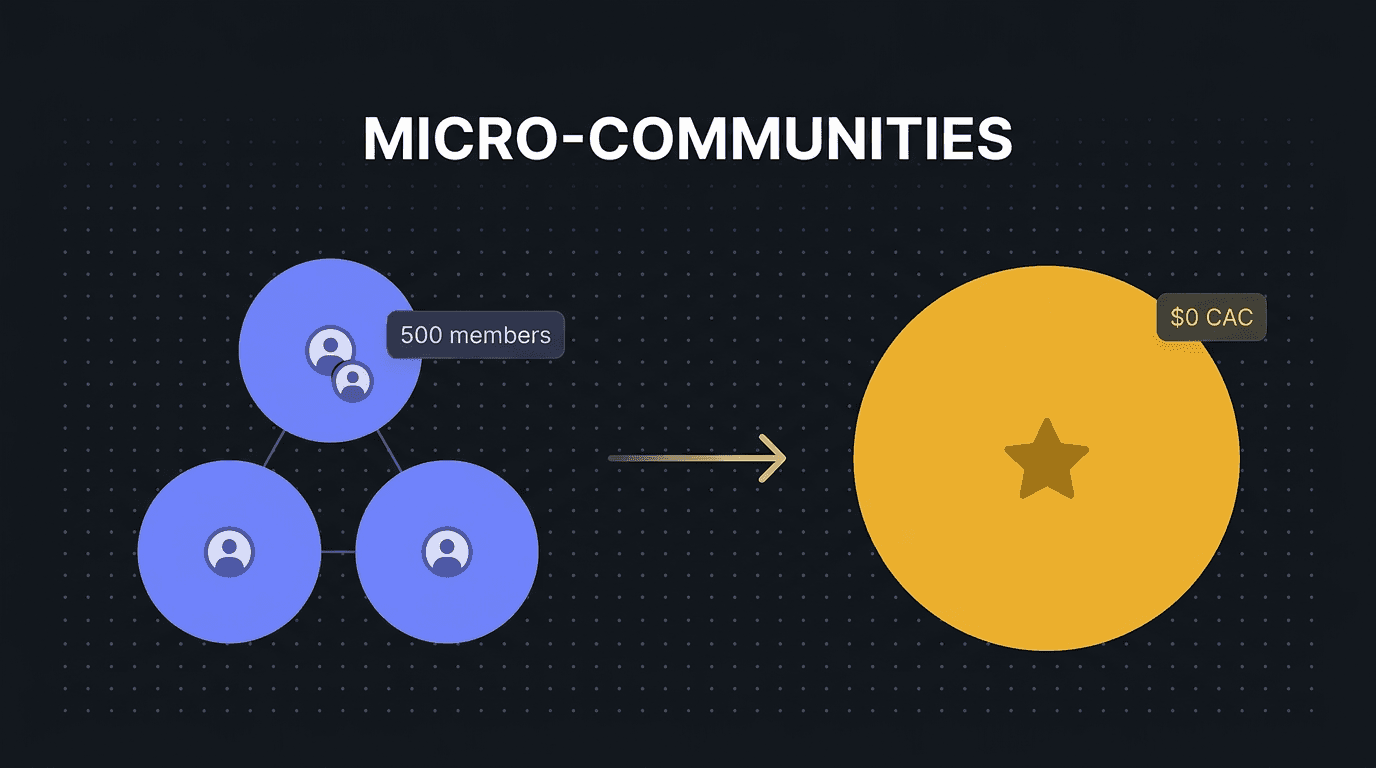
The math behind this is compelling. A Slack group with 500 members where 50 are active daily might seem tiny compared to your potential reach on X. But those 50 people are your exact ICP, self-selected into a community about the problem you solve, actively discussing that problem, and trusting recommendations from other members. One genuine recommendation from a community member converts better than 10,000 impressions on a social platform.
Why Micro-Communities Beat Broad Distribution (The Numbers)
Let me lay out the conversion math that makes this channel so absurdly effective.
Broad social platform (X, LinkedIn):
- 10,000 impressions on a post
- 2% click-through rate = 200 clicks
- 5% conversion from click to signup = 10 signups
- You need to maintain a massive content calendar to sustain this
Micro-community (Slack, Discord, niche forum):
- 50 active members see you answer a question helpfully
- 20% remember your name the next time the topic comes up
- 10 of those 50 eventually need what you built
- 5 of those 10 ask the community "what tool should I use for X?"
- The person who's been helpful for months gets recommended by OTHER members
- 3-5 signups from genuine peer recommendations
The raw numbers look similar. 10 signups vs 3-5. But the quality is wildly different. The signups from community recommendations come with built-in trust. They've heard about you from someone they already trust. Their churn rate is lower. Their willingness to pay is higher. Their word-of-mouth potential is stronger because they're in the same community and will recommend you the same way they were recommended.
I tracked this pattern in the threads I analyzed. The founder of a scheduling tool (I'll keep them anonymous) told their story on r/SaaS: first 100 customers came from three Slack groups. Total time investment: about 30 minutes per day answering questions for four months. No ads. No content strategy. Just being genuinely helpful in rooms where their users already gathered.
Finding the Right Micro-Communities (The Research Process)
Not all micro-communities are worth your time. Some are dead. Some are too broad. Some are full of other founders selling to each other (the classic indie hacker echo chamber).
Here's the filter I used across the 77 communities I joined:
The 5-Question Community Filter
1. Are my actual users here (not just other founders)? The biggest trap in micro-community growth is joining communities OF founders instead of communities of your USERS. Unless you're selling dev tools or founder resources, Indie Hackers and startup Slack groups are echo chambers. Your users are in communities about their problem, not communities about startups.
If you build an email marketing tool for e-commerce, you want the Shopify seller Discord, not the SaaS founder Slack. If you build a design tool, you want the design subreddit, not the Product Hunt maker community.
2. Is there recent activity (last 48 hours)? Dead communities waste your time. Check the last message timestamp before investing energy. I found that about 30% of the Slack groups listed on community directories like Hive Index and Slofile haven't had meaningful activity in months. Filter ruthlessly.
3. Are questions being asked (not just promotions)? A healthy community has questions. "How do you handle X?" "What's the best tool for Y?" "I'm stuck on Z, anyone dealt with this?" Those questions are opportunities. If the community is mostly self-promotion and launch announcements, leave. Nobody's listening there.
4. Are there fewer than 2,000 members? This sounds counterintuitive. Why would smaller be better? Because in communities under 2,000 members, individual contributions are visible. In a Slack group with 20,000 members, your answer drowns. In a group with 500, you become "the person who always has good advice about X" within a few weeks.
5. Is there a gatekeeper or code of conduct? Communities with application processes, paid memberships, or active moderation tend to be higher quality. The friction of entry filters out drive-by promoters. GrowthMentor's Slack specifically bans direct competitors from joining, which means people share openly. No Code Founders requires an application. These barriers create trust.
Where to Find Micro-Communities
Slack:
- Hive Index (thehiveindex.com) lists communities by topic
- Slofile.com has a startup/SaaS category
- Ask in related subreddits: "best Slack groups for [your niche]?"
- Check the footer/community page of tools your users already use
Discord:
- Search Discord server lists (disboard.org, top.gg)
- Most dev tools have official Discord servers (Cursor has 50K+)
- Indie game dev, crypto, and design communities are especially active
Reddit (the original micro-community):
- Niche subreddits with 5K-50K members are the sweet spot
- r/SaaS, r/startups, and r/Entrepreneur are too broad
- Find where your users complain: r/freelance, r/ecommerce, r/webdev, etc.
Forums and paid communities:
- Indie Worldwide (paid Slack, 2K members)
- Dynamite Circle (paid, for location-independent entrepreneurs)
- Hampton (high-end founder community)
- Niche industry forums that still exist despite social media
The Infiltration Playbook (Without Being Sleazy)
Let me be direct: most founders ruin micro-communities for themselves by being too eager. They join, immediately start posting about their product, and get ignored or kicked out. Here's what actually works, based on the successful patterns I observed.
Month 1: Listen and Answer
Week 1-2: Pure observation. Read every message. Learn the culture. Notice who's respected. Understand the types of questions being asked. Identify the recurring problems. Do not post anything promotional. Do not even mention you have a product.
Week 3-4: Start answering questions. When someone asks about a problem you understand deeply (because you built a product to solve it), answer with genuine expertise. Share your knowledge, not your product link. If someone asks "how do I reduce churn in my SaaS?" and you built a retention tool, answer with actual tactics. Frameworks. Data. Personal experience. Not "try my tool."
The goal for month one: become someone people recognize as helpful. That's it. Nothing else matters.
Month 2: Build Relationships
Now people know your name. Some have thanked you for answers. A few have DM'd you to ask follow-up questions. This is where the real growth happens.
Respond to every DM. These are your warmest leads, even though they're not leads yet. They're people who trust your expertise enough to reach out privately. Help them with their specific problem. If your product is genuinely the best solution, they'll find it. You don't need to pitch.
Start sharing small wins from your own work. Not "I launched a product!" but "I found that changing our onboarding from 5 steps to 3 reduced drop-off by 40%." Share insights, not announcements. The community values practitioners who share real data over marketers who share links.
Engage with other people's shares. When someone else shares a win, ask real questions. When someone struggles, offer specific help. The point is to become part of the community, not to use it as a distribution channel.
Month 3: Organic Mentions Begin
This is where the magic happens, and it's the part most founders never reach because they gave up in month one or got kicked out for self-promotion.
By month three, you're a known helpful presence. When someone asks "what's the best tool for X?" other community members start tagging you. Not because you asked them to. Because they genuinely think you know the answer, and they might even know you built something for exactly that problem.
This is the inflection point. A recommendation from a community member is worth 100 self-promotional posts. It comes with built-in trust. It's specific to the person asking. And it creates a chain reaction: the person who gets recommended your tool has a good experience, stays in the community, and eventually recommends you to someone else.
The "When to Mention Your Product" Rule
After month one, there's exactly one acceptable context for mentioning your product: when someone explicitly asks for tool recommendations and your product is genuinely the best answer.
Even then, the format matters:
Wrong: "Check out [my tool]! We solve exactly this problem. Here's our link."
Right: "I've actually been working on something for this exact problem. [Brief explanation of the approach]. Happy to show you if you're interested. But also worth checking out [competitor 1] and [competitor 2] if you want to compare options."
The second version works because it's honest, not desperate. Recommending competitors alongside yourself signals confidence and builds more trust than a pure self-promo ever could.
Scaling Without Losing the Magic
Here's the problem: this approach works beautifully but doesn't scale the way paid ads do. You can't be genuinely present in 50 communities. You don't have 50 x 30 minutes per day. So how do you grow beyond the first 3-5 communities?
The 3-Community Rule
Based on my research, the optimal number of active micro-communities for a solo founder is three. Not two (too concentrated), not five (too thin), three.
Pick them based on:
- Highest concentration of your ICP
- Most active daily discussion
- Best cultural fit for your communication style
Spend 30 minutes per day total across all three. That's 10 minutes each. Enough to answer one question, engage with one thread, and check for DMs. Not enough to become a full-time community manager.
The Handoff to Content
Here's where micro-communities become a growth multiplier, not just a growth channel.
Every question you answer in a community is content. Every pain point you discover is a blog post. Every pattern you notice is a thread.
The most effective content isn't created from keyword research. It's created from the actual questions your ICP is asking in their natural habitat. When you spend three months answering questions in micro-communities, you have three months of content ideas, pre-validated by the people who would read them.
This is how the best founder-led content operations work. They don't start with "what should we blog about?" They start with "what are people actually asking?" Micro-communities are the richest source of that information.
The Referral Loop
The ultimate micro-community strategy creates a referral loop:
- You answer questions in communities
- People try your product based on peer recommendations
- Happy users join the same communities (or are already there)
- They start recommending you when questions come up
- You don't even need to be in the thread anymore
I saw this pattern with at least four founders in my research. One told me they hadn't posted in their original Slack group for two months, but still got 5-10 signups per month from it. Other members were doing the recommending for them.
That's the goal. Not to be the loudest voice in the room. To be the name that comes up when you're not even there.
The Mistakes That Get You Banned (Or Worse, Ignored)
Mistake 1: The drive-by launch post
You join a community, post "Hey everyone, I just launched [product]! Would love your feedback!" and then disappear. This is the fastest way to get ignored. Nobody cares about your launch if they don't know who you are. Save the launch post until you've been contributing for at least a month.
Mistake 2: The "disguised promo" question
"Hey, has anyone tried using [my product] for [problem]? I've been finding it really helpful." Everyone sees through this. It's worse than direct promotion because it's dishonest.
Mistake 3: Cross-posting the same message to multiple communities
If you're in three Slack groups and post the same "helpful insight" to all three, people who are in multiple groups (and many are) will notice. It signals that you're running a script, not being a community member.
Mistake 4: Only showing up when you have something to sell
If your contribution pattern is: silent, silent, silent, PRODUCT POST, silent, silent, PRODUCT POST, you're not a community member. You're a spammer with patience.
Mistake 5: Ignoring the community culture
Some communities are casual and emoji-heavy. Some are professional and data-driven. Some are sarcastic and irreverent. Match the vibe. A formal product pitch in a casual Discord is as awkward as showing up to a backyard BBQ in a suit.
The ROI Nobody Measures
Most founders track acquisition cost per channel. They can tell you their CAC from Google Ads, their cost per signup from content marketing, their conversion rate from Product Hunt.
Almost nobody tracks their CAC from micro-communities. And it's almost always the lowest.
Think about it. Your investment is 30 minutes per day of your time. No ad spend. No content production cost. No design budget. Over three months, that's about 45 hours. If you get 50 signups from that effort (conservative for a well-executed community strategy), your cost per acquisition is less than one hour of your time per user.
Compare that to content marketing (10+ hours per quality blog post, uncertain conversion) or paid ads ($5-50+ per click in B2B SaaS). Micro-communities are absurdly efficient.
The reason nobody talks about this channel is precisely because it doesn't grow the way VCs want it to. You can't throw money at it to grow faster. You can't hire a team of community managers to do it for you (it only works when the actual builder is the one answering questions). It's a slow, honest, relationship-based growth channel.
Which is exactly why it works.
The hard question isn't whether community-driven growth works. It's knowing which communities to prioritize, which problems to focus your answers on, and whether distribution is even your bottleneck right now. You might spend three months building relationships in Slack groups when your real issue is activation, people finding you but dropping off before they see the value.
That's what Luka reads across your data sources every day. It connects your analytics, error logs, app store reviews, and social signals, finds the causal links, and tells you which growth stage is actually blocking you. Maybe it's visibility and community growth is exactly right. Maybe it's retention and your time is better spent fixing onboarding. You check it in the morning, see the priority matched to your product's current stage, and go execute on the right thing. See how Luka works.
The Community Playbook: 90-Day Action Plan
Days 1-7: Research Phase
- Use the 5-question filter to evaluate 20+ communities
- Narrow to your top 3
- Join and observe. Read every message for a full week
Days 8-30: Contribution Phase
- Answer 1 question per community per day
- Share genuine expertise, zero product mentions
- DM anyone who asks interesting questions (to learn, not to sell)
Days 31-60: Relationship Phase
- You should be recognized by name in at least one community
- Start sharing small insights from your own work
- Engage with other people's wins and struggles
- Respond to every DM and mention
Days 61-90: Harvest Phase
- Peer recommendations should start happening organically
- Mention your product ONLY when explicitly asked for tool recs
- Track signups that come from community referrals
- Start converting community questions into blog content
Day 91+: Maintain and Compound
- Reduce to 15-20 minutes per day maintenance
- Let the referral loop do the heavy lifting
- Focus your saved time on the next growth lever
Frequently Asked Questions
What if there's no micro-community for my niche?
Create one. Seriously. If there's no Slack group for your specific problem space, that's a signal that nobody else has built this gathering point yet. Create a simple Slack workspace, invite the first 20 people you've been talking to (customers, prospects, Twitter mutuals), and let it grow. The founder of the community automatically gets first-mover credibility.
How do I handle it when a competitor is already established in the community?
Good. That means the community is relevant. Don't attack the competitor or try to "out-promote" them. Instead, differentiate through expertise. Answer the questions they're not answering. Share perspectives they don't have. Communities have room for multiple helpful voices. If your product is genuinely better for certain use cases, those differences will surface naturally in conversation.
Should I use a personal name or my brand name in communities?
Always personal. "Hey, I'm Amy, I work on growth tools" is 10x more approachable than "Hi, we're LukaTool, an AI-powered growth platform." People build relationships with people, not brands. Your product name can come later, after trust is established.
How do I know if a community is worth my time after the first month?
Track three signals: (1) Are you getting DMs from members? (2) Are people tagging you in relevant threads? (3) Have you learned something about your ICP's pain points that you didn't know before? If none of these are true after 30 days of consistent contribution, the community either isn't your ICP or isn't active enough. Move on.
Can I automate any part of this?
No. The entire value of micro-community growth is that it's genuine, personal, and human. The moment you automate responses or use templates, people can tell. This is a channel that rewards authenticity and punishes shortcuts. That's exactly why it works so well and why most founders, addicted to channels that grow with money, ignore it.
About the Author