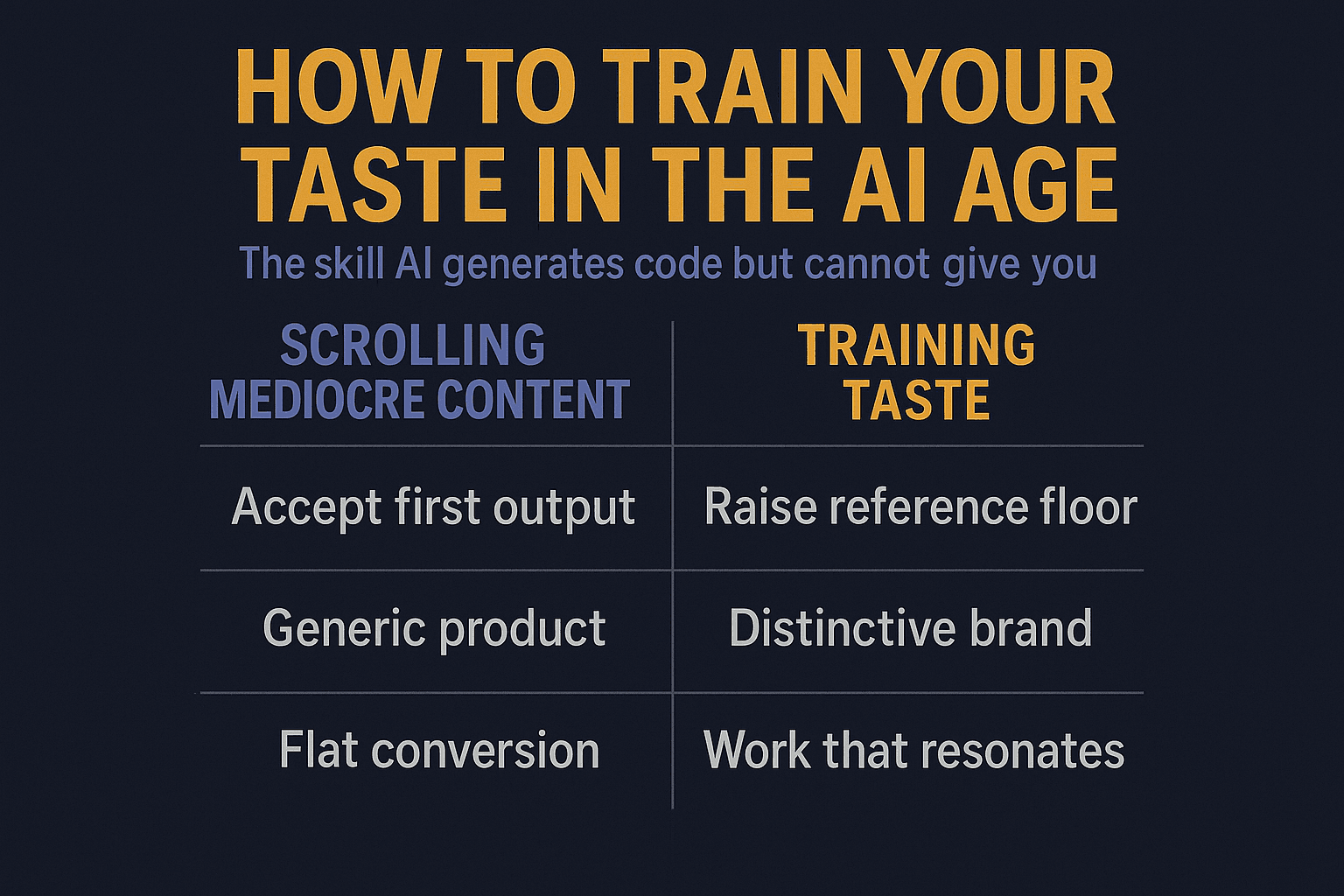
How to Train Your Taste: The Practical Guide for Builders in the AI Age
TL;DR: Taste is not a personality trait. It's a skill you can train. And in 2026, when AI can generate code, copy, and designs in seconds, taste is the thing that separates work that resonates from work that's technically functional but completely forgettable.
Most people scroll mediocre content all day and wonder why their work feels flat. The input determines the output. Here's the actual process for building taste, and why it matters more right now than it ever has.
I spent a week reading everything I could find on how great designers, founders, and product builders developed their aesthetic judgment. Emil Kowalski on developing taste. Paul Graham on the relationship between taste and success. Multiple threads from indie hackers about why their products "look cheap." Design theory resources. And dozens of examples of vibe coders who ship something functional but can't understand why it doesn't convert.
The pattern that emerged: taste is not mysterious. It's learnable. And most builders are skipping the training entirely.
Why AI Makes Taste More Valuable, Not Less
The standard take is that AI levels the playing field. Anyone can generate code, write copy, create designs. The skills that used to take years to learn are now accessible in an afternoon.
That take is right about access. It's wrong about the conclusion.
When the floor rises, the ceiling gets more valuable. If everyone can generate a serviceable homepage in 20 minutes, the thing that differentiates your product is the judgment about what "good" actually looks like. That judgment is taste.
Here's the test: give the same prompt to ten different people in Lovable or v0. They'll get ten roughly similar outputs. Some of them will refine and iterate until the result is genuinely beautiful and compelling. Most will accept the first decent-looking output. The difference between those groups is entirely about whether they can tell the difference between decent and excellent.
That's taste. And AI doesn't give it to you. You have to build it.
The Real Definition of Taste
Before the practical guide, a working definition.
Taste is the ability to recognize and produce quality. It has two components: input (can you tell when something is good or bad) and output (can you make something good). Most people develop one without the other, which is its own kind of frustrating. Critics who can't create. Builders who can't tell when their work is weak.
What taste is not: it's not subjective personal preference. Some things really are better than others. A landing page where the headline clearly states what you get and the CTA is obvious outperforms one where the headline is clever and the CTA is buried, reliably, across markets, audiences, and industries. That's not preference. That's function serving form.
What it's also not: elitism or gatekeeping. The "some people just have it" narrative is wrong and convenient for the people who claim to have it naturally. Taste is developed through exposure, practice, and intentional feedback. Anyone can build it.
Phase 1: Raise Your Floor of Reference
You cannot make something better than your best mental reference point. If you've only seen mediocre work, mediocre will feel like success. The first job is building a reference library.
The practice: Spend 30 minutes per week consuming work that is better than anything you're capable of right now. Not work that's good. Work that makes you feel the gap.
For builders specifically, this means:
- Study landing pages that convert extremely well. Stripe. Linear. Notion. Vercel's own site. Ask not "what does it look like?" but "what is it communicating and how?" Every word choice is a decision. Every spacing choice communicates hierarchy. Every color serves a function.
- Read copywriting from people who are measurably good at it. Not bloggers. David Abbott ads. Joanna Wiebe's work at Copyhackers. Gary Halbert letters if you want to understand persuasion mechanics. Read slowly.
- Find products with unusually high retention or NPS and study what the onboarding experience actually feels like. Sign up. Go through the full flow. Ask why every element is there.
The key is NOT to consume passively. The scroll-and-forget is how you stay at the same level forever. You need to stop, look hard, and ask why.
The forcing question: Before moving on from any piece of good work you encounter, write down one specific thing it does that you haven't seen done better elsewhere. One thing. This forces active attention instead of passive absorption.
Phase 2: Build a Critical Eye for Your Own Work
Consuming great work raises your floor. But the translation to your own output requires a different kind of practice: developing a critical eye for work-in-progress.
The problem most builders have is they evaluate their work in comparison to what they had before, not in comparison to what's possible. "It's better than yesterday's version" is not the right standard. "Would someone who builds great products look at this and see a problem?" is.
The practice: For every significant piece of work you produce, run it through a specific set of questions before calling it done.
For landing pages:
- If I knew nothing about this product, would I understand in 5 seconds what I get from it?
- Does the headline describe an outcome the user wants, or describe a feature I'm proud of?
- Is the CTA asking for something that feels proportionate to how much I've explained?
- Would I click this if I saw it in a tweet?
For onboarding flows:
- What is the user thinking at each step? What question do they have that this screen needs to answer?
- Where am I asking them to do work before I've given them value?
- What would I remove to make this faster without breaking the logic?
For product design overall:
- What is the most important action the user should take? Is it visually the most prominent element?
- Where is friction that isn't serving the user?
- What would a user who is slightly confused, slightly skeptical, slightly impatient experience here?
The calibration problem: Your own work is the hardest to evaluate because you're too close to it. You know what everything is supposed to mean. Users don't. The fix is regular exposure to user research, even informal. Watch one person use your product without helping them. It will destroy your assumptions and teach you more about your taste gaps than any article.
Phase 3: Develop a Point of View
Here's where taste gets interesting. Consuming great work and developing a critical eye are table stakes. The builders with real taste do something further: they have a specific point of view about what makes something good in their domain.
This is not "I prefer minimal design." That's a preference, not a point of view. A point of view looks like: "The best B2B SaaS products earn trust before they ask for action. The first 60 seconds of any onboarding should give value before asking for information." That's a belief you can test, refine, and apply consistently.
How to build a point of view:
Look for patterns across the great work you've been studying. What do the best landing pages you've found have in common? What do the best onboarding flows share? What do the products with the best retention do consistently?
Document the patterns. Not as rules. As hypotheses. "I notice that products I love tend to do X. Products I find frustrating tend to do Y."
Then test them. Apply them to your own work. See if they hold.
Over time, your hypotheses become convictions. Your convictions become the taste that makes your work recognizable and differentiated. This is how great product people develop a "house style" that isn't just aesthetics but a complete philosophy about what makes something good.
Phase 4: Create Things That Hurt a Little
Taste develops in the gap between what you can see and what you can make. The seeing part comes from consumption. The making part requires pushing past comfort.
Emil Kowalski put it well: a designer should design. A writer should write. Taste grows through practice, not just observation. But not all practice is equal.
The practice that builds taste the fastest is the practice that makes you feel the gap between what you made and what you wanted to make. Comfortable work keeps you comfortable. Ambitious work, work where you're reaching beyond your current ceiling, builds taste because the gap is visible and painful.
The practice: Set a constraint that forces a higher standard than your default.
Examples:
- Build a landing page and give yourself a rule: every word must earn its place. Remove anything that doesn't directly serve the goal. (Most landing pages can be cut by 40% and get better.)
- Design an onboarding flow with a rule: the user must get value before they reach the third screen.
- Write a product description with a rule: no feature names, only outcomes the user actually wants.
The constraint makes the gap visible. The gap is where the growth is.
Phase 5: Get Feedback from the Right People
Feedback is the fastest accelerator of taste development. But bad feedback actively slows you down.
Feedback to avoid: Generic approval or disapproval. "I like it" or "it's too busy" gives you nothing. People who don't understand your domain or your user.
Feedback to seek: Specific, observed behavior. A person using your thing and telling you what they're thinking. Feedback from people whose taste you respect and who can articulate why something works or doesn't.
The most valuable feedback format: show your work to someone whose taste you respect and ask them to point to one specific thing that they think could be better. One thing. Asking for more gives you an overwhelming list you don't know how to prioritize. One thing forces them to identify what actually matters most.
Do this regularly and with a range of people. Taste that's only calibrated against one source of feedback starts to narrow. The best builders have a wide reference network: people from different disciplines who have different aesthetic influences.
The hardest part of this phase: finding people whose taste is genuinely better than yours and who will be honest with you. Most feedback environments are social, not honest. You need people who will say "this headline is confusing" even when you're proud of it. That's a relationship worth building deliberately.
This is also where the insight from training taste becomes most practical. You've consumed great work, developed a critical eye, built a point of view, made ambitious work, and gotten calibrating feedback. The last question is applying taste to the right thing at the right time. There's a final trap that skilled builders fall into: they develop excellent taste and then apply it to the wrong problem. Spending three weeks perfecting your landing page when your actual growth blocker is a 40% drop-off in onboarding. Redesigning your UI when your users are churning because of a missing feature. Beautiful execution of the wrong priority is still the wrong priority.
Knowing which part of your product actually needs your taste-trained attention right now is exactly the kind of question that requires data, not instinct. Luka connects to your Google Analytics, Sentry error logs, App Store reviews, and social signals, reads them together, and surfaces what's genuinely blocking your growth at your current stage. Not "everything needs work." The specific bottleneck, matched to where your product is right now. You check it in the morning, know what to focus your taste on, close it, and go do the work. See how Luka works.
Apply This Today
Here's the practice schedule that builds taste fastest:
Daily (5 minutes): Look at one piece of great work you find in the wild. A landing page, an ad, a well-designed email. Ask one question: what is this doing specifically well that I could learn from?
Weekly (30 minutes): Deep study of one product, company, or creative work you find genuinely impressive. Document two specific things it does that you want to understand and apply.
Monthly: Create one piece of ambitious work with a constraint that forces you past your current ceiling. Get feedback from someone whose taste you respect.
Ongoing: Build your reference library actively. Screenshots, notes, saved examples of great work. Searchable. Categorized. The reference library is how you think when you create, even if you don't consciously reference it.
Taste compounds. The more you develop it, the better your eye gets, the faster you can produce quality work, and the further ahead you get of the people who accepted the first decent-looking AI output and called it done. The builders who develop taste in 2026 are not building against the current. They are using AI as a force multiplier on top of a trained eye, which is the combination that produces work that stands out in a world where the floor just got raised for everyone.
Frequently Asked Questions
How long does it take to develop taste?
There is no finish line. Taste is continuous development. But you'll notice meaningful improvement in 3-6 months of consistent practice. The first signal: you start feeling dissatisfied with work you would have accepted before. That discomfort means your eye has gotten ahead of your hand. That's progress.
I'm not a designer. Does taste still matter for me?
Especially for you. Founders, product builders, marketers, and copywriters all make taste-dependent decisions constantly. Headline choices are taste decisions. Feature prioritization has a taste dimension. Onboarding flow design is taste. None of these require a design background.
Can I just hire someone with good taste instead of developing my own?
You can, for execution. But you can't delegate the judgment about whether the work is good. If you can't evaluate whether your designer's output is excellent or just acceptable, you can't give meaningful feedback or make informed decisions. You need enough taste to direct the people executing for you.
What's the difference between taste and copying what's successful?
Copying what's successful without understanding why it works is mimicry, not taste. Taste means understanding the principles well enough to apply them in new contexts. The builders with real taste don't copy Linear's design, they understand why Linear's design decisions work and apply those principles to their own product in a way that's original.
Where do I start if I have no reference points?
Start with products you personally use and love. Ask why you love them. Then find the landing pages, onboarding flows, and design systems for those products. Study them. Then ask who the builders of those products look up to. Follow that chain backward. You'll find the same names appearing repeatedly: people who have taste and have influenced others. Study their work intensively.
About the Author