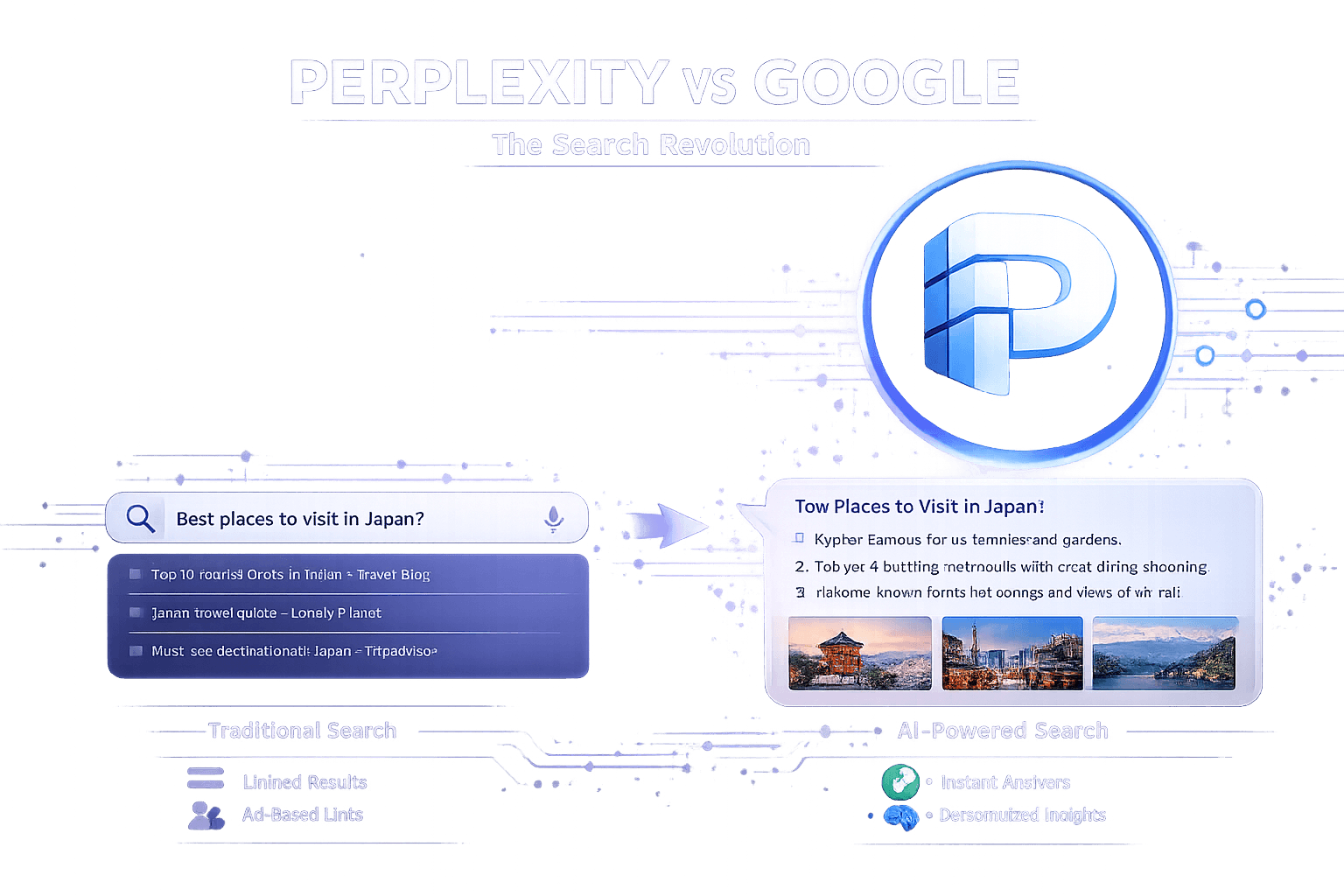
How Perplexity Is Killing Google Search: The $28B Startup That Actually Delivers
TL;DR: While everyone debated whether ChatGPT would replace Google, Perplexity quietly built the actual Google killer. $120M ARR, 500% YoY growth, and a product that does what Google stopped doing years ago: giving you answers instead of ads.
The Numbers That Should Terrify Google
Let's start with the receipts:
- $120M ARR by May 2025
- 500% year-over-year growth
- 45 million active users
- 780 million queries per month
- $28 billion valuation
For context: Google handles about 8.5 billion searches per day. Perplexity's 780 million monthly queries is a rounding error.
But here's what those numbers miss: Perplexity users aren't casual searchers typing "weather" or "pizza near me." They're researchers, developers, professionals, and knowledge workers doing the complex queries that Google used to be good at.
These are the queries worth money. And they're migrating.
What Perplexity Actually Does Different
Answers, Not Links
Google's original value proposition was simple: type a question, get a ranked list of pages that might have the answer. You click through, scan the content, maybe find what you need.
That model made sense when the web was smaller and pages were more trustworthy. Now? The first page of Google results is:
- 3-4 ads
- A featured snippet (often wrong)
- "People also ask" boxes
- More ads
- SEO-optimized content farms
- Maybe one useful result buried below the fold
Perplexity inverts this entirely. You ask a question, you get an answer. Not links to answers. The actual answer, synthesized from multiple sources, with citations.
This sounds incremental. It's not. It's a fundamental shift in what a search engine does.
Citations Built In
Every claim in a Perplexity answer includes a numbered citation. Click the number, see the source. Want to go deeper? The sources are right there.
This solves the trust problem that plagues ChatGPT. When GPT-4 tells you something, you have no idea if it's hallucinating. When Perplexity tells you something, you can verify it in one click.
For research-heavy work, this is transformative. I used to spend 20 minutes triangulating sources to verify a single claim. Now I spend 20 seconds.
Follow-Up Questions That Actually Work
Google's "related searches" are useless suggestions generated by an algorithm that doesn't understand context. Perplexity maintains conversation state.
Ask about a company's revenue. Then ask "how does that compare to their competitors?" Perplexity knows you're still talking about the same company. Google would give you a generic page about competitive analysis.
This is how humans actually research. One question leads to another. The tool should follow your train of thought, not reset with every query.
Pro Search: Actually Useful AI
The Pro tier ($20/month) adds something Google doesn't have at any price: genuine reasoning about your query.
Ask a complex question and Pro Search will:
- Break it into sub-questions
- Search for each component
- Synthesize the results
- Present a coherent answer with sources
This is what people thought ChatGPT would do for search. Perplexity actually did it.
Why Google Can't Just Copy This
Here's the uncomfortable truth for Google: their business model prevents them from building what Perplexity built.
Google makes money when you click ads. Perplexity makes money when you get answers.
These incentives are fundamentally opposed.
The Ad Problem
Google Search revenue in 2024: $175 billion. Almost all of it from ads.
If Google gave you the answer directly, you wouldn't click through to websites. If you don't click through, advertisers don't pay. If advertisers don't pay, Google doesn't make $175 billion.
Every feature that makes search better for users makes it worse for Google's business model. This is why search quality has degraded for a decade while Google's revenue grew.
Perplexity doesn't have this problem. Their $20/month subscription means they're incentivized to give you answers as fast as possible. No ads. No SEO games. Just utility.
The Content Problem
Google has spent 25 years building relationships with publishers. "We send you traffic, you create content, everyone wins."
Perplexity's model threatens this. If users get answers without clicking through, publishers get no traffic. Publishers are already suing Perplexity over this. It's going to get ugly.
But here's the thing: users don't care about Google's relationships with publishers. They care about getting answers. And right now, Perplexity delivers answers better.
The Data Problem
Google has more search data than anyone. They know what people search for, what they click, what makes them come back.
But this data is optimized for the old model: predicting which links you'll click. Perplexity is building data for a new model: predicting what answer will satisfy your query.
Google's data advantage might actually be a liability. They're so good at the old game that pivoting to the new one is organizationally impossible.
What This Means for Builders
If you're building a product, Perplexity's rise has immediate implications:
SEO Is Dying (Finally)
The SEO game - stuffing keywords, building backlinks, optimizing for featured snippets - was always a tax on content creators. You had to play Google's game to get traffic.
In an answer-engine world, this changes. Perplexity cites sources based on actual content quality and relevance, not SEO manipulation. Creating genuinely useful content becomes the winning strategy again.
Documentation Matters More
Perplexity pulls from documentation, GitHub, forums, and other technical sources. If your product has great docs, Perplexity will recommend it when relevant queries come up.
This is free, targeted distribution to people actively looking for solutions. Way better than gaming Google's algorithm.
The Research Layer Is Unbundled
Google was the default research tool for everything. Now that default is fragmenting:
- Perplexity for research queries
- ChatGPT for creative/generative tasks
- Google for navigation and local
- Vertical search for specific domains
If your product involves helping people find information, think about where you fit in this new stack.
The Playbook They're Running
Perplexity's growth strategy is worth studying:
1. Focus on Power Users First
They didn't try to replace Google for "what time is it in Tokyo." They went after researchers, developers, and professionals doing complex queries. These users have higher willingness to pay and become vocal advocates.
2. Free Tier That's Actually Good
The free version of Perplexity is better than Google for most research queries. This creates massive word-of-mouth. The Pro tier adds power features, but the free tier isn't crippled.
3. Mobile That Doesn't Suck
Their mobile app is genuinely good. This matters because mobile is where the volume is. Most AI products treat mobile as an afterthought.
4. Enterprise Before It's Obvious
They launched Perplexity Enterprise while still small. Smart move: enterprise deals provide stable revenue and validation while consumer growth compounds.
Will Google Respond?
Google is trying. AI Overviews, Gemini integration, all the obvious moves. But they're constrained by:
- Can't cannibalize ads - Every good answer costs them money
- Can't upset publishers - They need the content ecosystem
- Can't move fast - Bureaucracy of a 180,000-person company
- Can't take risks - Antitrust scrutiny on everything they do
Perplexity has none of these constraints. They can build the best answer engine without worrying about a $175B ad business.
My Prediction
Perplexity won't "kill" Google in the sense of replacing it entirely. Google will remain dominant for navigation queries, local search, and casual lookups.
But for research? For complex questions? For anything where you actually need to learn something?
Perplexity is already better, and they're improving faster than Google can respond.
Within 3 years, "just Perplexity it" will be as natural as "just Google it" for a certain type of user. That type of user tends to be influential.
The ripple effects will reshape how content is created, how products are discovered, and how we think about search as a category.
Perplexity didn't try to be a better Google. They asked a different question: what do people actually need when they search, and is a list of ten blue links the right answer? It wasn't. They found the gap between what the market said it wanted and what it actually needed.
That kind of market analysis, finding the gap between stated preference and revealed behavior, is the hardest research to do on your own when you're inside a space. You need distance from your assumptions to see it clearly.
Luka is a research and growth agent that does this kind of strategic market analysis for solo founders: mapping competitor weaknesses, finding underserved segments, identifying where the market says one thing but buys another. If you're trying to find your Perplexity angle, the one where the obvious player is structurally unable to copy you, Luka is worth looking at.
Try It Today
If you haven't used Perplexity yet, here's a test:
- Think of a complex question you'd normally spend 20 minutes researching
- Ask Perplexity (free tier is fine)
- Compare the experience to doing the same search on Google
The difference is jarring. Not slightly better. Fundamentally different.
That's how you know a paradigm is shifting.
This is the kind of shift Luka helps you navigate - identifying what matters before it's obvious.
About the Author