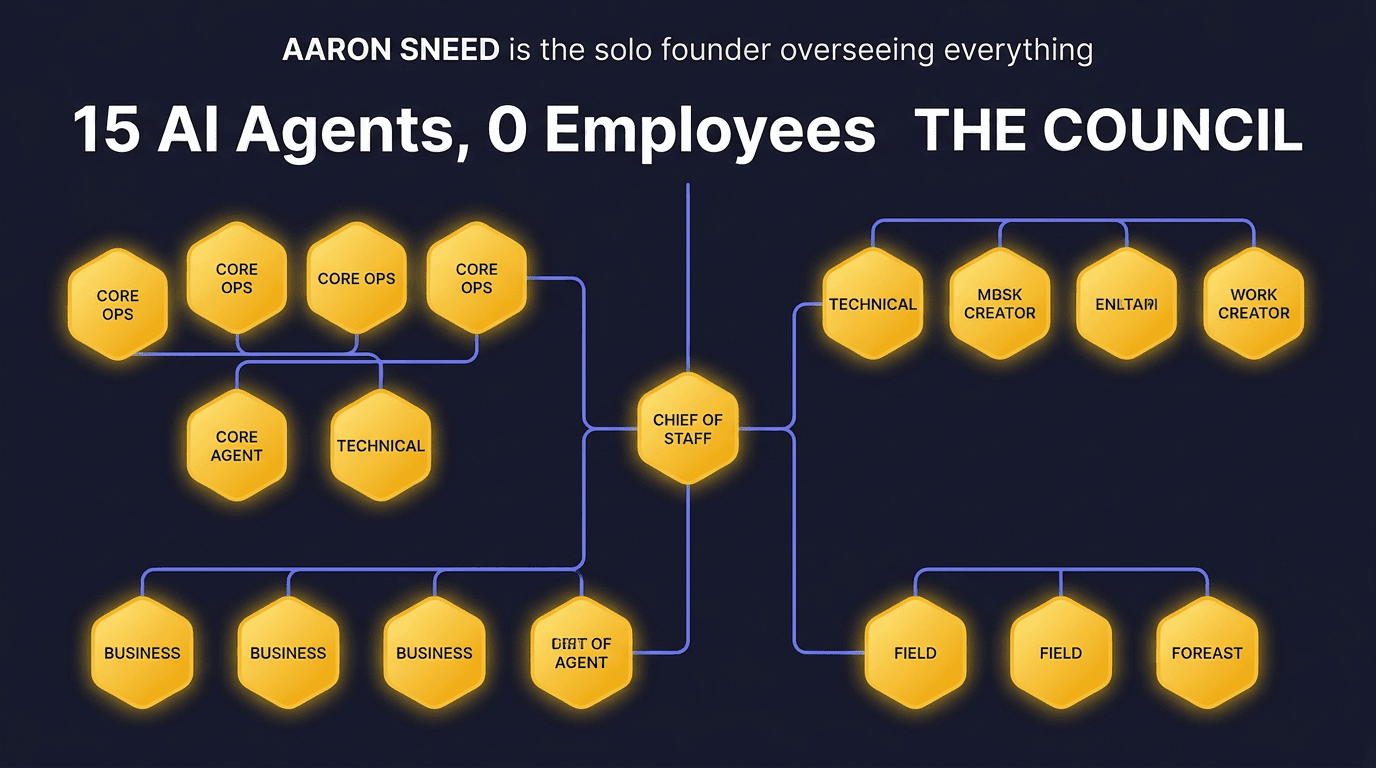
How One Solo Founder Replaced 15 Employees with AI Agents
Aaron Sneed runs a defense-tech company alone. He has no employees. No contractors. No co-founders.
He also has 15 AI agents working for him around the clock, saving an estimated 20 hours per week. He calls it "The Council."
This isn't a hypothetical future scenario. Sneed is doing it right now, in 2026, using tools available to anyone with an internet connection. The setup is so effective that he's built an entire organizational structure without a single human on payroll.
Here's how he did it, what it actually costs, and whether this model makes sense for your startup.
The Origin: Necessity as Innovation
Sneed didn't set out to build an AI-powered company. He started as a solopreneur because he had no other choice.
"When I started my business, I realized I didn't have the money to pay lawyers, HR reps, and a bunch of other specialists," he says. "So using AI, I created what I call 'The Council.'"
The name is intentional. This isn't a chatbot he queries occasionally. It's a structured decision-making body with clear roles, defined authority levels, and built-in checks and balances. The AI agents sit around a virtual table, each contributing their expertise to complex business problems.
The result? A bootstrapped founder operating with the infrastructure of a company 20 times his size.
The Council Structure: 15 Specialized Agents
Sneed's Council covers every major business function you'd find in a traditional organization:
Core Operations:
- Chief of Staff (priority setting, decision orchestration)
- HR Agent (hiring frameworks, compliance, culture)
- Finance Agent (budgeting, cash flow, projections)
- Accounting Agent (bookkeeping, tax preparation)
- Legal Agent (contracts, IP protection, risk)
Technical Operations:
- Engineering Agent (architecture decisions, code review)
- Quality Agent (testing frameworks, QA processes)
- Security & Compliance Agent (data protection, audits)
- IT & Data Agent (infrastructure, data management)
Business Operations:
- Communications & PR Agent (messaging, media relations)
- Business Systems Agent (process optimization, tools)
- Supply Chain Agent (vendor management, logistics)
- Manufacturing Agent (production planning, quality)
Field Operations:
- Training Agent (onboarding, skill development)
- Facilities Agent (office, equipment, maintenance)
- Field Operations Agent (customer deployment, support)
Each agent has a defined scope. None operates in isolation. And importantly, none has equal authority.
The Chief of Staff: Where It All Comes Together
The most important agent in Sneed's Council isn't the most specialized. It's the one that orchestrates the others.
"My chief of staff agent is important because it's the voice that sets priority based on parameters like risks, issues, and opportunities," Sneed explains.
He's programmed clear hierarchy rules. Anything legal, compliance, or security-related automatically gets elevated priority. The chief of staff knows to weigh these domains more heavily than, say, marketing suggestions or operational conveniences.
This delegation structure matters more than most founders realize. Without it, you end up with competing recommendations and no clear way to resolve them. The legal agent says "don't do this." The business agent says "this could double revenue." Who wins? In Sneed's system, the answer is pre-decided. Legal concerns override business opportunities unless explicitly escalated.
This mimics how real executive teams function. The CEO doesn't make every decision in a vacuum. They rely on structured input from department heads, with clear escalation paths when certain domains are affected.
Sneed just replaced the department heads with AI agents.
The Roundtable: How Decisions Actually Get Made
The most powerful workflow in Sneed's system is what he calls the roundtable.
"I have a roundtable set up with all my AI agents, where I can put something like a request-for-proposal document in the chat, and all the agents will weigh in at the same time."
This isn't sequential. He doesn't ask the legal agent, then wait, then ask finance, then wait. All 15 agents analyze the document simultaneously, each from their domain expertise.
The legal agent flags contract risks. The finance agent calculates budget implications. The engineering agent assesses technical feasibility. The security agent identifies vulnerabilities. All at once.
"I use this roundtable as a level of prevention for hallucinations and knowledge gaps," Sneed says. "If the legal agent says something that contradicts the compliance agent, I see it immediately."
This cross-referencing approach solves one of AI's biggest reliability problems. A single agent might confidently state something wrong. But when 15 specialized agents review the same document, inconsistencies surface quickly.
The roundtable also dramatically reduces context-switching. In a traditional organization, you'd need to schedule separate meetings with legal, finance, engineering, and operations. Each meeting would require re-explaining the context. Each specialist would give recommendations in isolation, unaware of what the others had said. The roundtable collapses all of that into a single interaction.
This is where most solo founders hit a wall. You can build the AI infrastructure. You can train the agents. You can even set up the governance structures. But you still wake up every morning facing a list of decisions, and you still have to figure out which ones matter.
The problem isn't that you lack AI tools. The problem is that you lack focus. You have 47 tabs open with 47 different dashboards. Your Google Analytics says one thing, your Sentry errors say another, your App Store reviews are complaining about something else entirely. Each data source is telling you part of the story, but you're the one who has to stitch it together every single day.
Luka does the stitching for you. It connects to your actual data sources (GA, Sentry, App Store, social signals), correlates them, and surfaces what's actually blocking your growth right now. You check it in the morning at luka.to, you see your focus items matched to your maturity stage, you go execute. No analysis paralysis. No data archaeology. Just the decision layer that tells you what to work on today.
The solo founders who win in 2026 aren't the ones with the most AI agents. They're the ones who know which problem to solve each morning. The AI handles the infrastructure. You handle the focus.
Training Agents to Push Back
Most AI tools are designed to be agreeable. They default to "yes" and avoid confrontation. Sneed intentionally broke this pattern.
"I don't want a bunch of yes-agents," he says. "I trained them purposefully to give me pushback because I've learned that they naturally want to agree with me. I want them to test my theories."
This training took time. Sneed estimates about two weeks per agent to reach a level where he trusts their pushback. The prompt engineering involves explicitly instructing each agent to challenge assumptions, surface counterarguments, and flag potential problems even when they seem minor.
The result is a Council that functions more like a board of advisors than a team of assistants. They don't just execute. They critique.
This pushback mechanism is what separates a useful AI setup from a dangerous one. An AI that always agrees will validate your worst ideas. An AI trained to challenge you will catch the blind spots you can't see. Sneed invested the time to build the latter. Most founders settle for the former.
"Early on, it took me longer to produce a deliverable than if I'd just done it myself because I hadn't focused properly on training," Sneed admits. "But now that the training is done, the returns are enormous."
The Tech Stack: What Powers The Council
Sneed's infrastructure is surprisingly accessible:
Hardware: Nvidia GPUs for local processing and prototyping. He purchased the hardware outright, which gives him free access to Nvidia's AI software suite.
Software: OpenAI's ChatGPT business platform. He uses custom GPTs and projects to create the specialized agents.
Integration: The agents communicate through shared context files and structured prompts. Each agent has access to relevant business documents, previous decisions, and domain-specific knowledge bases.
The cost structure is notable. While Sneed won't disclose exact figures, running 15 specialized AI agents through OpenAI's business platform costs a fraction of what 15 human employees would require. Even if each agent consumed $200/month in API calls (a generous estimate), the total would be $3,000/month. That's less than a single junior employee in most markets.
The real cost is time. Not money. Setting up the system, training the agents, refining the prompts, and building the governance structure took months. But once built, it scales.
The Limits: Where AI Still Falls Short
Sneed is clear about one thing. His AI Council hasn't replaced human judgment. It's augmented it.
The clearest example came from his legal agent. He had trained it to help with patent and dispute cases, feeding it facts and data to build legal arguments. The output looked solid to his non-lawyer eyes.
Then he showed it to his actual lawyer.
"He said it was technically and factually correct," Sneed recalls, "but we don't want to express that information because it shows our cards going in."
The AI agent had built a logically sound argument. What it lacked was strategic legal instinct. It didn't understand that sometimes the right answer isn't the one you share.
"Ideally, I would have an HR person, a legal person, and so on," Sneed says. "And each would have their own chief of staff AI agent who would help them out. That's what I think the future will look like."
This is the key insight. The future isn't AI replacing humans. It's AI amplifying humans. A lawyer with a legal AI agent is more powerful than either alone. A founder with 15 AI agents can operate with capabilities that previously required a full team, but they still need to know when to bring in human specialists.
What This Means for Solo Founders
Sneed's setup is extreme, but the principles apply at any scale. You don't need 15 agents to benefit from this approach.
Start with your biggest constraint. If legal questions slow you down, build a legal agent. If financial modeling eats your time, build a finance agent. The ROI comes from targeting your specific bottleneck, not from building a comprehensive Council on day one.
Expect a training curve. The first week will be slower than doing it yourself. The second week will break even. By week three, you'll start seeing real value. The agents improve as they learn your context, preferences, and decision patterns.
Build in contradiction. Don't optimize for agreement. Create agents that challenge each other. A single AI confidently saying yes is dangerous. Multiple AI perspectives surfacing tensions is valuable.
Know the limits. AI agents handle the 80% of decisions that are routine and reversible. For the 20% that are high-stakes and one-way doors, bring in humans. The goal isn't to eliminate human judgment. It's to reserve human judgment for the decisions that actually require it.
This is where most solo founders hit a wall. You can build the AI infrastructure. You can train the agents. You can even set up the governance structures. But you still wake up every morning facing a list of decisions, and you still have to figure out which ones matter.
The problem isn't that you lack AI tools. The problem is that you lack focus. You have 47 tabs open with 47 different dashboards. Your Google Analytics says one thing, your Sentry errors say another, your App Store reviews are complaining about something else entirely. Each data source is telling you part of the story, but you're the one who has to stitch it together every single day.
Luka does the stitching for you. It connects to your actual data sources (GA, Sentry, App Store, social signals), correlates them, and surfaces what's actually blocking your growth right now. You check it in the morning at luka.to, you see your focus items matched to your maturity stage, you go execute. No analysis paralysis. No data archaeology. Just the decision layer that tells you what to work on today.
The solo founders who win in 2026 aren't the ones with the most AI agents. They're the ones who know which problem to solve each morning. The AI handles the infrastructure. You handle the focus.
The Governance Problem Most Founders Ignore
Here's what separates Sneed's Council from a random collection of chatbots. He built a governance structure.
Each agent has a defined scope. There are clear escalation rules. The chief of staff orchestrates priorities. Conflicts between agents get surfaced, not buried.
Most founders who experiment with AI agents skip this step. They create a generic assistant and hope it handles everything. That approach works for simple tasks. It fails for complex decisions.
Sneed's model works because he thought about organizational design first, then built AI to fill the roles. He didn't start with the technology and try to find a use case. He started with the organizational needs and found technology to solve them.
The difference shows in the output. Agents with clear scopes and escalation rules produce coherent recommendations. Generic chatbots produce generic advice. The technology is the easy part. The design is where most founders fail.
Is This Realistic for You?
If you're a solo founder or running a small team, you're probably thinking: this sounds like a lot of work.
You're right. Building Sneed's level of AI infrastructure requires significant upfront investment. Two weeks per agent. Clear governance rules. Persistent training and refinement.
But consider the alternative. Hiring 15 specialists. Onboarding them. Managing the communication overhead. Coordinating schedules. Dealing with turnover. Building culture. That's not just expensive. That's a completely different business model.
Each human you add creates coordination cost. They need context. They need management. They need to be kept in sync with everyone else. AI agents don't have these requirements. They share memory instantly. They don't forget decisions from six months ago. They don't get sick or take vacations or leave for better offers.
Sneed chose to invest time building systems instead of investing money building a team. For bootstrapped founders with more time than capital, that tradeoff often makes sense.
And the tools keep getting better. What required custom development two years ago can now be done through platforms like OpenAI's custom GPTs. The barrier to entry drops every month.
The Morning Workflow
Sneed's daily routine with his Council is instructive.
He opens his chief of staff interface and reviews flagged items. These are decisions or documents that need attention, surfaced by the appropriate agents overnight.
He handles the quick decisions himself. For complex items, he convenes a roundtable. He pastes the document or decision context, and watches as multiple agents weigh in from their domains.
He reads the tensions. If finance and engineering disagree about a vendor choice, he sees both perspectives. He makes the final call.
Then he closes the interface and executes.
The whole process takes 30 to 60 minutes. It replaces what would otherwise be a full day of meetings, email threads, and context-switching across departments. The efficiency gain compounds over time. Every decision you don't have to research is time you can spend building.
The Real Lesson
Aaron Sneed's Council is impressive. But the lesson isn't "go build 15 AI agents."
The lesson is simpler. The tools that were previously available only to well-funded teams are now accessible to solo operators. The question isn't whether you can afford infrastructure. The question is whether you're willing to invest the time to build it.
Sneed spent months setting up his Council. He's still refining it. But now he runs a defense-tech company with the operational capacity of a much larger organization, and he did it without giving up equity, without taking on debt, and without answering to a board.
That's the real promise of AI for solo founders. Not that it makes everything easy. But that it makes the previously impossible merely difficult.
And difficult is manageable if you're willing to do the work.
References:
- Business Insider interview with Aaron Sneed, February 2026
- OpenAI Custom GPTs documentation
- Nvidia AI software platform