How Lovable Failed Two Launches Before Becoming Europe's Fastest-Growing Startup
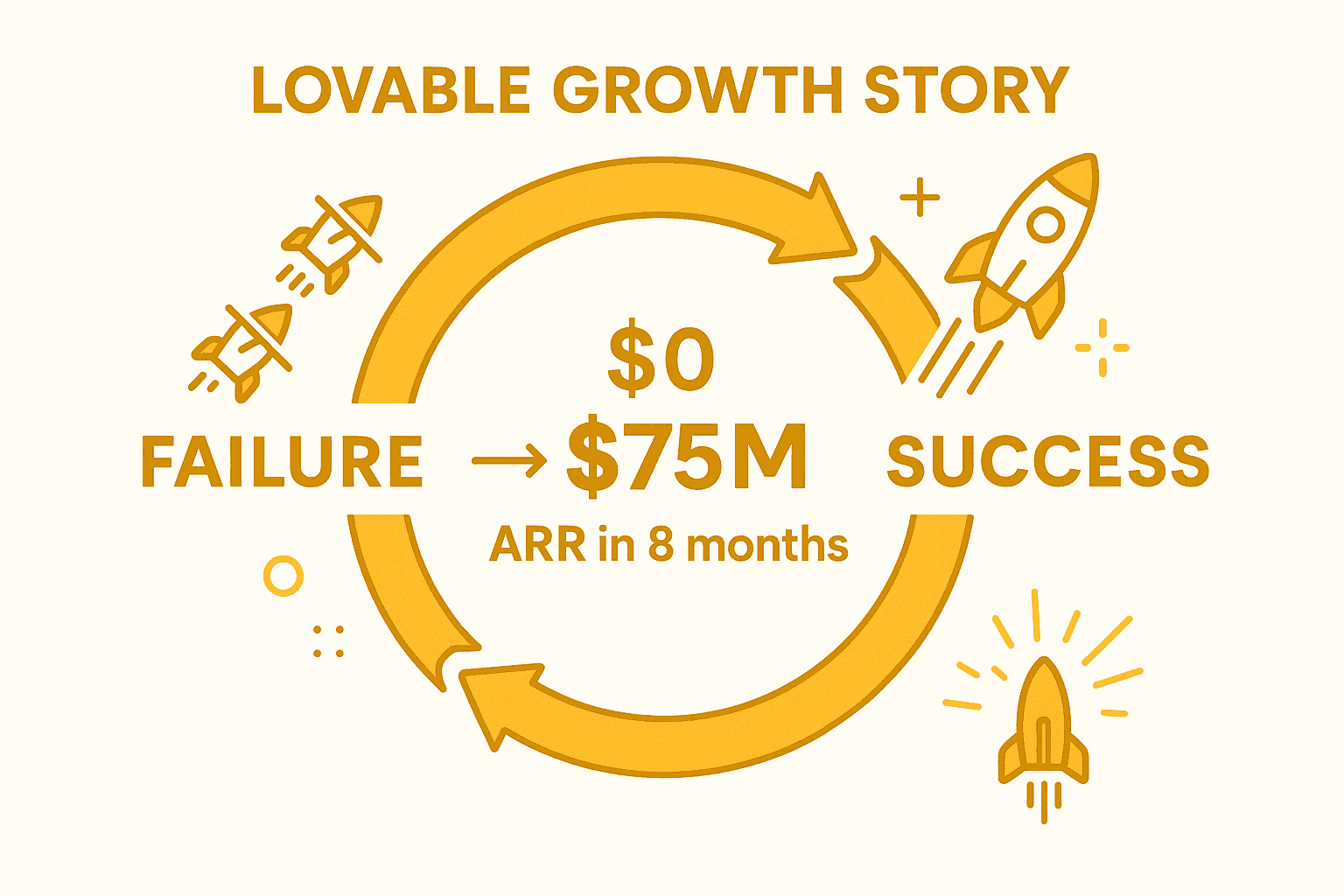
TL;DR: Lovable went from $0 to $75M ARR in 8 months with 45 people. But they failed twice first. The difference between their flopped August 2024 launch and their November explosion wasn't more features or bigger funding. It was fixing one technical problem and changing one word in their name.
Lovable failed twice before becoming Europe's fastest-growing startup.
In August 2024, their growth flatlined. The team had built what they thought was a solid product. Users disagreed. Three months later, they were adding $2M in new revenue every single week.
I spent hours digging through every public interview with founder Anton Osika, every funding announcement, every growth breakdown I could find. The pattern that emerged is wilder than the hype suggests.
This isn't a story about getting lucky with AI timing. It's about failing publicly, learning fast, and making one decision that changed everything.
The Numbers That Broke My Brain
Before we get into the story, let's talk about what "fastest-growing" actually means:
| Timeline | ARR | Team Size |
|---|---|---|
| Launch (Nov 2024) | $0 | 15 |
| 60 days | $10M | 15 |
| 90 days | $17M | 18 |
| 120 days | $30M | 18 |
| 8 months | $75M | 45 |
That's not a typo. $75 million ARR in eight months with 45 people.
The company burned only $2 million total to get there. That works out to more than $1M ARR per employee. For context, most well-run SaaS companies target $200-300K ARR per employee.
When they announced their $200M Series A at a $1.8 billion valuation, the tech press lost their minds. But the real story started 18 months earlier, when nobody was paying attention.
The Origin: A Side Project That Exploded
In June 2023, Anton Osika was CTO at another startup. On the side, he built gpt-engineer, a CLI tool that could generate code from prompts. He open-sourced it on GitHub.
It blew up. 50,000 stars. Hundreds of thousands of users trying it.
"I woke up a few days after building GPT Engineer and I realized we're going to reimagine how you build software," Anton told TechCrunch. "I biked to my co-founder's place. I woke him up."
That's the founding story everyone loves. The side project that takes off. The midnight bike ride. The audacious pitch.
What nobody talks about is what happened next: eighteen months of failure.
The First Failure: December 2023
Riding the GitHub hype, the team launched a dedicated GPT Engineer app in December 2023.
It flopped.
"Without much fanfare" is how Growth Unhinged described it. Users tried it, hit limitations, and left. The magic of the open-source tool didn't translate to a product people would pay for.
The problem was fundamental: the AI got stuck. On anything beyond simple projects, it would loop, hallucinate, or produce unusable code. Developers, the target users, have zero tolerance for unreliable tools.
The team went back to building.
The Second Failure: August 2024
Eight months later, they tried again. A better version. More features. Improved reliability.
"Modest success," according to the growth data. Then it flatlined.
This is where most startups die. You've launched twice. You've improved the product. Users are still bouncing. The VC money is running out. Your GitHub stars mean nothing if people won't pay.
The GPT Engineer team had a decision to make: iterate on the same approach, or question everything.
The Breakthrough: What Actually Changed
Between August and November 2024, the team made three changes. Only one of them was technical.
1. They Fixed the "Stuck" Problem
The AI getting stuck wasn't a bug. It was the core limitation of the entire approach. Every competitor had the same issue. When an AI coding assistant hits a wall, it spirals.
The team found a way to prevent it. I couldn't find the technical details, but the result was clear: Lovable could now handle large codebases without falling apart.
This sounds incremental. It wasn't. It's the difference between a toy and a tool.
2. They Changed the Target User
GPT Engineer was for developers. The name said it: Engineer.
But here's the insight Anton had: developers already know how to code. They're skeptical of AI tools. They have high standards.
Non-developers, on the other hand, have a problem nobody's solving. They have ideas but can't build them. They're not judging code quality. They're asking: "Did it make the thing I wanted?"
The rebrand to Lovable wasn't just marketing. It signaled a completely different user.
3. They Rebranded with Purpose
"GPT Engineer" was a limitation. It sounded like a developer tool. It referenced a specific AI model (GPT). It attracted the wrong users and scared away the right ones.
"Lovable" is approachable. It's a feeling, not a function. It says: "You'll love what you build with this."
The team announced the rebrand publicly, making it clear this wasn't the same product that had failed twice. They got a second chance at a first impression.
The Explosion
November 2024: Lovable launches.
Week 1: The growth curve goes vertical.
Week 4: $4M ARR.
Day 60: $10M ARR.
This wasn't gradual adoption. It was explosive word-of-mouth. Users were building apps in minutes and posting them everywhere. The product finally worked well enough that people couldn't shut up about it.
The retention numbers tell the story. Lovable hit 85% Day 30 retention. That's higher than ChatGPT. Users weren't just trying it once. They were coming back, building more, paying for subscriptions.
By month eight, half of Fortune 500 companies had employees using Lovable. Not because of enterprise sales. Because workers discovered it on their own.
What Made the Difference (The Uncomfortable Truth)
Here's what most growth analyses miss about Lovable: timing wasn't luck.
The team could have launched the rebrand in August 2024. They didn't because the product wasn't ready. They could have kept the GPT Engineer name. They didn't because it limited their market.
Every decision was sequenced deliberately:
- Build in public with open source ‚Üí Establish credibility, get feedback
- Launch product before it's ready ‚Üí Learn what's actually broken
- Fail publicly ‚Üí Earn the right to rebrand
- Fix the one thing that matters ‚Üí The AI can't get stuck
- Change the user ‚Üí Non-developers are more forgiving and underserved
- Rebrand to signal the change ‚Üí Permission to try again
The uncomfortable truth is that most startups don't earn this sequence. They either give up after failure one, or they keep iterating on the same broken approach.
Lovable failed their way to product-market fit. Each failure taught them something specific. The rebrand wasn't desperate. It was earned.
The $1M Per Employee Question
One number keeps jumping out: $1M+ ARR per employee.
At $30M ARR with 18 people, Lovable was operating at 5x the efficiency of a typical SaaS company. How?
They Stayed Small on Purpose
When you're adding $2M in weekly revenue, the temptation is to hire fast. Build a sales team. Expand support. Layer in management.
Lovable didn't. They grew from 15 to 45 people over eight months. That's deliberate restraint.
The logic: every person you add increases coordination costs. In a company moving this fast, coordination is the bottleneck. Fewer people means faster decisions.
They Skipped Enterprise Sales
At $75M ARR with Fortune 500 customers, you'd expect an enterprise sales motion. Account executives. Solution engineers. Custom implementations.
Lovable doesn't have that. The product is self-serve. You sign up, you build. If your company wants more seats, you buy more seats.
This isn't sustainable forever. Eventually they'll need enterprise infrastructure. But in the explosive growth phase, removing friction beats adding salespeople.
They Let the Product Do the Work
The best growth hack is a product people can't stop talking about. Lovable nailed the "show your friend" moment. You build something in minutes. You share it. Your friend signs up.
No referral program. No growth hacking tactics. Just a product that makes people feel powerful.
What Solo Founders Should Learn
I know what you're thinking: "Cool, but I'm not building an AI coding platform with $200M in funding."
Fair. Here's what actually translates:
1. Fail Fast, Fail Public
Lovable's GitHub history is a record of public failure. Every commit, every bug, every limitation was visible. This built trust and earned them feedback.
If you're hiding your product until it's "ready," you're losing the learning advantage. Ship broken things. Let people tell you what's actually broken.
2. The Technical Breakthrough Matters
Lovable's growth didn't come from marketing or timing. It came from solving the "stuck" problem. The product finally worked well enough.
No amount of growth tactics will save a product that doesn't work. Fix the core issue first.
3. Your First User Isn't Always Your Best User
GPT Engineer targeted developers. Lovable targets everyone. Same underlying technology, completely different outcome.
If your product isn't growing, question who you're building for. Sometimes the right user is the one you haven't considered.
4. Rebranding Can Be Strategic
Most startups rebrand for vanity reasons. Lovable rebranded because their name was limiting their market.
"GPT Engineer" ‚Üí developers "Lovable" ‚Üí anyone
If your name, positioning, or messaging is attracting the wrong users, change it. The market doesn't owe you a chance to explain.
5. Stay Small Longer Than Comfortable
Lovable could have hired 200 people. They stayed at 45. This forced them to prioritize ruthlessly and move fast.
When you're small, every person feels the weight of decisions. That's not a bug. That's survival.
The Pattern Nobody's Talking About
After digging through all this, here's what I keep coming back to:
Lovable didn't outwork or outspend the competition. They out-failed them.
Two public launches that flopped. Eighteen months of building before breakout. A rebrand that could have looked desperate but felt earned.
Most founders would have quit after August 2024. The growth flatlined. The name felt toxic. The product wasn't working.
The Lovable team questioned their assumptions instead. They changed the user. They fixed the core problem. They earned permission to try again.
That's the uncomfortable truth about explosive growth: it usually follows explosive failure. The companies that seem to come out of nowhere spent years in the wilderness first.
What Happens Next
As I write this, Lovable is at $75M ARR and growing. They've raised $200M. They're building teams in new markets.
The question everyone's asking: can they sustain this?
I don't know. Nobody does. The AI landscape is shifting fast. Competitors are well-funded. Enterprise customers will demand features that conflict with the simple, self-serve model.
But here's what I do know: the team has already proven they can fail, learn, and come back stronger. That's worth more than growth projections.
If Lovable stumbles again, I'd bet on them to figure it out. They've done it twice before.
Lovable failed twice before they figured out who actually needed what they were building. The breakthrough wasn't a new feature. It was identifying that they'd been targeting developers when non-technical founders were the ones who would pay and stay.
Most solo founders who struggle with PMF are in the same spot: they know the product works, but they're not sure who it works for. Getting to that answer faster means doing the research most founders put off: talking to churned users, analyzing who converts vs. who doesn't, mapping the actual gap between "interested" and "paying."
Luka is a research and growth agent for solo founders trying to find their PMF. It handles the customer and market analysis: ICP research, competitive positioning, segment testing. The work that turns a second failed launch into a breakthrough. If you're trying to find your Lovable moment, Luka is worth a look.
Frequently Asked Questions
What does Lovable actually do?
Lovable is an AI tool that builds working applications from plain English prompts. You describe what you want, and it generates the code, design, and deployment. It targets non-developers who have ideas but can't code.
How did Lovable grow so fast?
Product-market fit plus word-of-mouth. The product is good enough that users share it spontaneously. There's no aggressive marketing or sales motion. People build something, post it, and their followers sign up.
Is Lovable profitable?
The company hasn't disclosed profitability, but the efficiency metrics are remarkable. $75M ARR with 45 people and only $2M burned suggests they're close to, or already, profitable. The $200M raise was likely for growth rather than survival.
Who founded Lovable?
Anton Osika, a physicist turned engineer who previously worked at CERN, Sana, and co-founded Depict.ai. He started the gpt-engineer project on GitHub in 2023.
How is Lovable different from Cursor or Bolt.new?
Cursor targets professional developers who want AI assistance with existing code. Bolt.new and Lovable both target non-developers. Lovable's main differentiator is reliability: they solved the "AI getting stuck" problem that plagues competitors.
About the Author