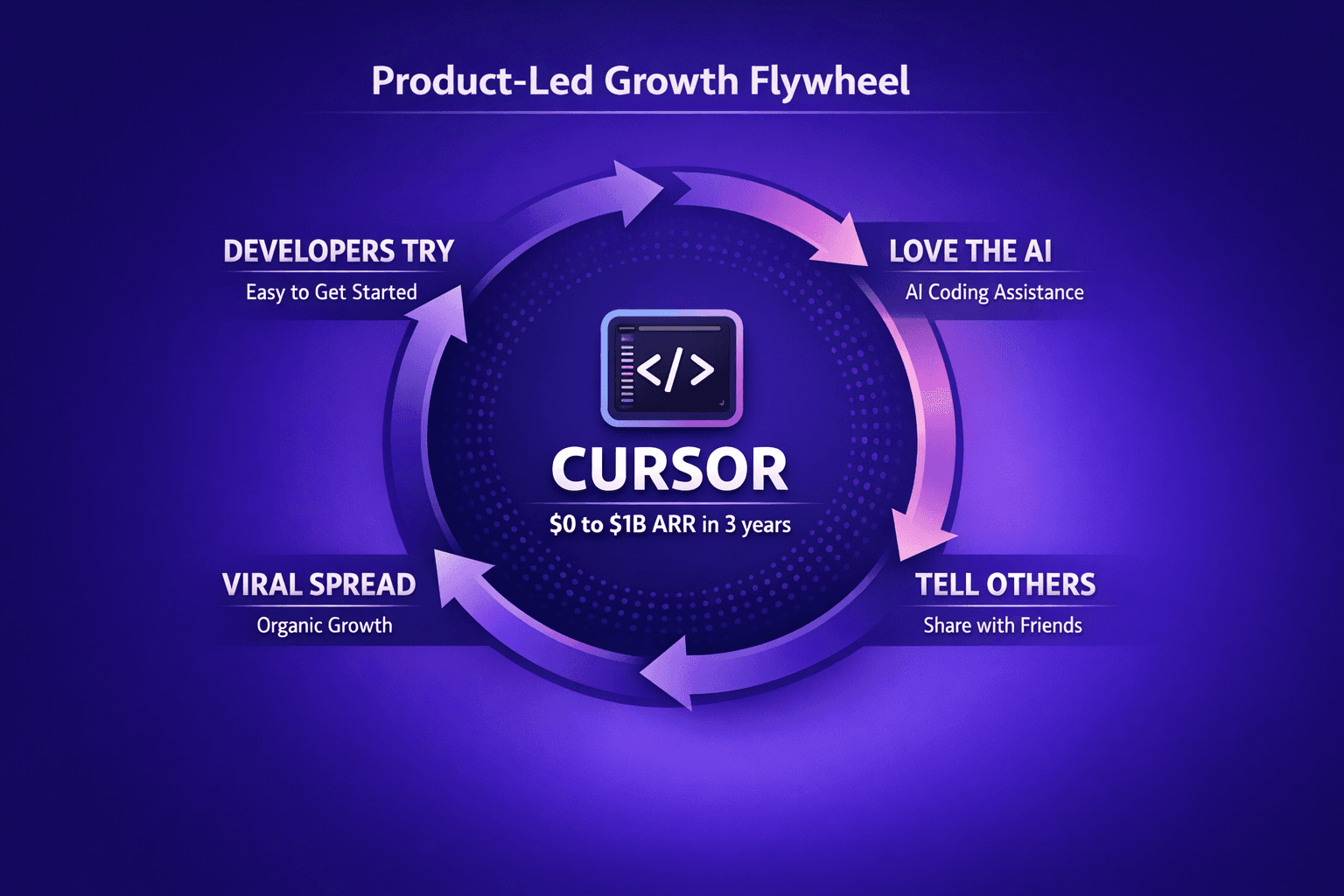
Four MIT students left school in 2022 to build AI tools for mechanical engineers. By late 2025, they were all billionaires (under 30) running the fastest-growing code editor in history.
What happened in between is one of the cleanest growth stories in tech.
The Numbers
- $0 to $300M ARR in 24 months (March 2023 to May 2025)
- $1B+ ARR by November 2025
- 9,900% year-over-year growth
- 1 million+ daily active users
- 50,000+ businesses
- $29.3 billion valuation
For context: most SaaS companies never hit $1B ARR. Cursor did it in under 3 years.
The Pivot That Changed Everything
Michael Truell (now CEO), Sualeh Asif (CPO), Arvid Lunnemark, and Aman Sanger met at MIT studying computer science and math. All four had competed in international olympiads. Their first idea was AI autocomplete for CAD software, helping mechanical engineers design faster.
It flopped.
The CAD market was stagnant, uncompetitive, and they had no domain expertise. Worse, there wasn't enough training data to build good models.
But they noticed something: GitHub Copilot, the dominant AI coding tool, felt incomplete. It suggested code line by line but couldn't understand your entire project. It was a smart autocomplete, not a smart collaborator.
Mid-2022, they pivoted. Instead of building AI for mechanical engineers, they'd build the AI coding tool they actually wanted to use.
The Strategic Bet: Fork VS Code
Here's where most startups would have screwed up.
The obvious play: build a revolutionary new IDE from scratch. Make it "AI-native." Differentiate on architecture.
Cursor's play: fork VS Code.
Why? Because 74% of developers already use VS Code. Same layout. Same extensions. Same keyboard shortcuts. Users could migrate in 60 seconds. Cursor offers one-click import of all your VS Code settings.
This is classic "meet users where they are." Don't make people learn something new. Make the thing they already use better.
What Made Cursor Different
Copilot is a plugin. Cursor is purpose-built.
That distinction matters. When AI is bolted onto an existing editor, it can only work within the constraints of that editor. When the editor is built for AI, everything changes.
Full Codebase Understanding
Copilot worked line by line. Cursor understands your entire project.
The technical magic: a Retrieval-Augmented Generation (RAG) system with a Merkle tree that tracks file changes. Instead of re-uploading your whole codebase every interaction, Cursor only syncs what changed. This lets it give context-aware suggestions across thousands of files.
For developers working on large projects, this is the difference between an assistant who read one page of your book and one who read the whole thing.
Multi-File Editing
Before Cursor, if you wanted to rename a function and update every file that called it, you did it manually. Or you hoped your IDE's refactoring tools worked.
Cursor's Agent Mode handles this automatically. "Add a menu bar to my website" doesn't just generate code. It identifies every file that needs to change, plans the modifications, and executes them.
Custom Models (The Hidden Moat)
This is the moat nobody talks about.
Cursor doesn't just wrap GPT. They trained custom models for specific tasks, particularly autocomplete. Foundation models are good at everything; custom models are great at one thing.
As CEO Michael Truell put it in a Lenny's Newsletter interview: the future of AI products isn't just using the best models. It's knowing when to build your own.
The Growth Engine
Cursor's growth wasn't driven by marketing. It was driven by obsessive product quality.
Dogfooding
The founding team used Cursor to build Cursor. Every friction point, every missing feature, every annoying behavior, they felt it first. This feedback loop is why the product improved so fast.
Word of Mouth in a High-Trust Market
Developers don't trust marketing. They trust other developers.
When @levelsio (Pieter Levels) built a 3D flight simulator in three hours using Cursor, it wasn't an ad. It was proof. When engineers at OpenAI, Shopify, and Stripe started switching, others followed.
The Vibe Coding Wave
Cursor launched at the perfect moment: right as "vibe coding" went mainstream.
Vibe coding is the practice of building software by describing what you want in natural language. It turned non-technical founders into shippers. And Cursor became the default tool.
This wasn't luck. The founders saw the shift coming. They bet that AI capabilities would improve through scaling, even without fundamental breakthroughs. They positioned Cursor as the tool for the AI-first future.
Why Microsoft Can't Just Copy This
Here's what everyone asks: why can't Microsoft just copy this?
They're trying. Copilot has added multi-file editing. It's improving context handling. By late 2024, it had many of the features Cursor pioneered.
But Cursor keeps moving faster.
When you're a 50-person team building one product, you iterate faster than a trillion-dollar company with a thousand priorities. Cursor ships features weekly. Copilot ships features quarterly.
More importantly, Cursor's moat isn't any single feature. It's the compound effect of hundreds of small improvements, each informed by dogfooding. You can copy a feature. You can't copy a culture.
Three Lessons for Builders
1. Distribution Over Differentiation
Cursor didn't win by being radically different. They won by being radically better at something people already wanted. Forking VS Code wasn't lazy. It was strategic. Lower switching costs = faster adoption.
2. Build What You'd Use
The founders built Cursor because they were frustrated with existing tools. They weren't guessing what developers wanted. They knew.
If you're building for a market you don't understand, you're competing on research. If you're building for yourself, you're competing on instinct.
3. Timing Beats Tactics
Cursor launched right as AI coding tools became viable and before the market consolidated. A year earlier, the models weren't good enough. A year later, Copilot might have locked in the market.
The founders didn't predict the future. They positioned for it.
The Bigger Picture
Cursor's story illustrates something important: the bottleneck is shifting.
Building software used to be the hard part. Now AI handles that. The new hard part is deciding what to build, for whom, and why.
Cursor didn't remove the need for developers. It changed what developers need to be good at. Less syntax memorization. More "taste," knowing what should exist and how it should work.
The tool isn't the constraint anymore. Your judgment is.
The bottom line: Cursor went from CAD pivot to $1B ARR in under 3 years by building the tool they wished existed, distributing it through familiar channels, and riding the vibe coding wave at exactly the right moment.
Four MIT friends, one VS Code fork, and relentless iteration.
That's the playbook.
Building something and struggling with the "what to build next" decisions? That's what we're solving at Luka. AI handles the building. We help with the deciding.
About the Author