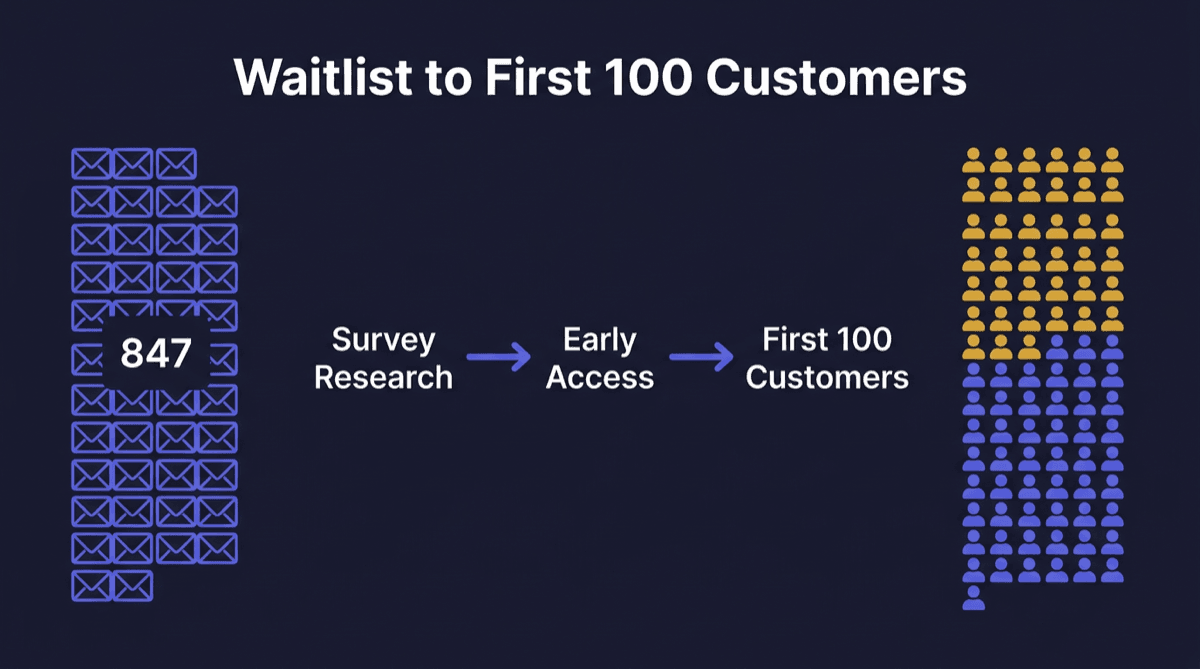
TL;DR: Most waitlists fail because founders treat them like a captive audience. They are not. They are a research instrument. And the founders who figured that out converted at 15-20%.
You spent 3 months building a waitlist of 847 people. You launched. 23 bought. That is a 2.7% conversion rate, which is actually good. The question is not why the other 824 did not buy. It is why those 23 did.
Why Most Waitlists Fail
Most waitlists fail because founders treat them like a captive audience. They are not. They are a research instrument.
The founders who figured that out converted at 15-20%. They understood that the waitlist was not a list of ready-to-buy customers. It was a focus group that had already self-selected into being interested.
The Survey That Works
Do not ask "would you buy this?" Ask instead:
- "What are you currently using to solve this problem?"
- "What would have to be true for you to pay on day one?"
Behavioral questions beat intent questions every time. You get real answers instead of polite lies.
The Segment That Converts First
I call them "pain-aware itch-scratchers." People already spending time and money on the problem. They have budget. They have urgency. They have authority. Find them in your waitlist.
The 3-Email Launch Sequence
Email 1: Delivers the research you gathered from waitlist survey responses, in their language.
Email 2: A product walkthrough as a story.
Email 3: One ask, one deadline.
Price Is Not the Conversion Lever
"Value articulation is." For $X/month you get [specific outcome] in [specific timeframe] or your money back converts better than "$X/month with 30% early adopter discount."
The Follow-Up That Converts the Silence
Wait 3 days after launch, then send: "We launched. [X] people bought. What is stopping you?"
Disarming. You get real feedback AND you surface the reason people did not convert.
Do Not Delete the 80% Who Did Not Buy
Move them to a monthly nurture sequence. Share what you learned, what you built, what failed. These people convert in month 6 or 12 when your product has matured.
About the Author