From Broke to $100K MRR: The No-Code Pivot That Changed Everything
Dustin Stout had two failed products, depleted savings, and no idea how he'd pay rent.
Four years later, Magai is pulling in nearly $100,000 per month.
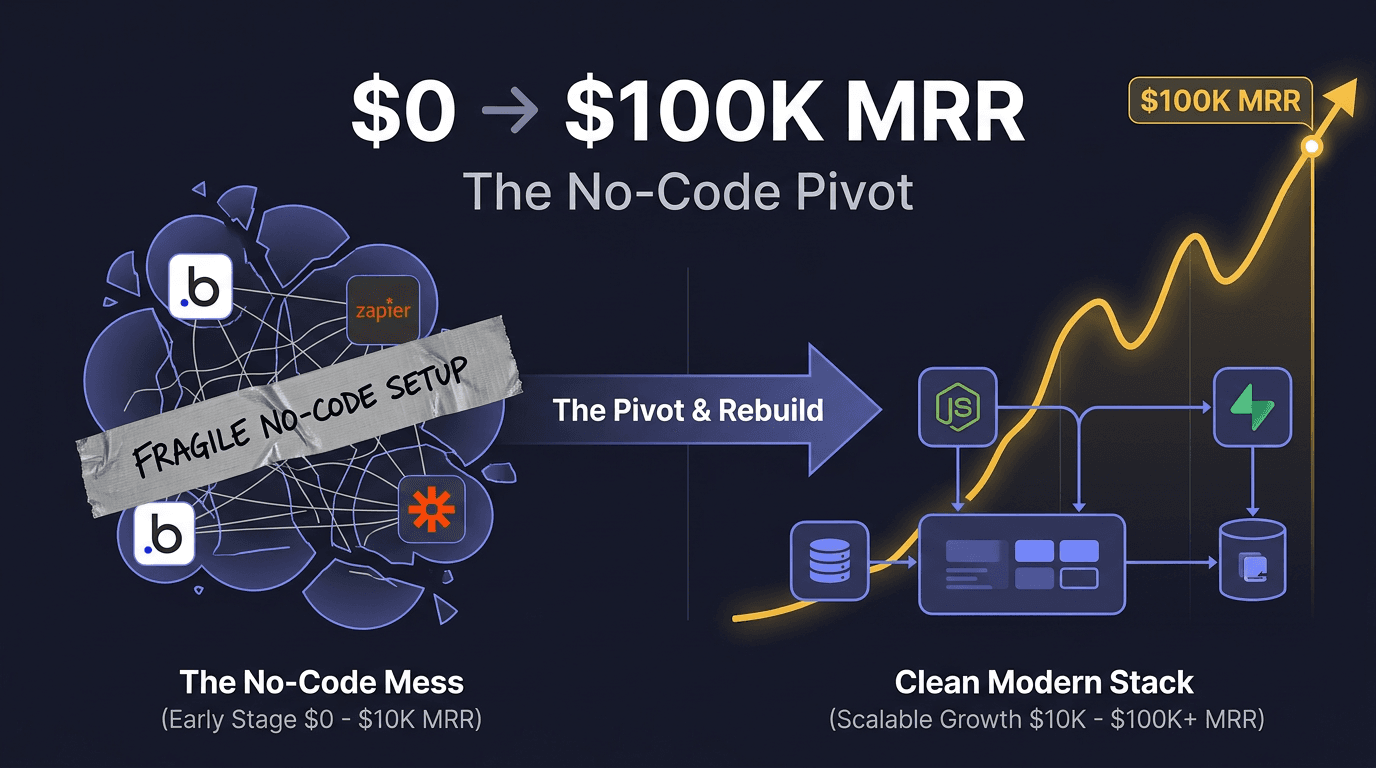
The company wasn't built by a team of engineers. It wasn't funded by venture capital. The first version was held together by Bubble, Zapier, and what Stout calls "digital duct tape."
This is the story of how a broke founder used no-code tools to build an AI platform that now serves thousands of users, and what his journey teaches about the real economics of indie building.
The Rock Bottom Before the Rise
Stout's path to $100K MRR didn't start with a brilliant insight. It started with failure.
He'd spent years building marketing products. First as a consultant, then as a co-founder of a digital products company. By 2020, that partnership had collapsed. Two products he'd poured time into had failed. His savings were gone.
"Rock bottom is a powerful motivator," Stout says.
Most founders who hit that point quit. They go back to jobs. They tell themselves the startup dream was never realistic. Stout did the opposite. He kept building.
The difference? When ChatGPT launched in late 2022, he saw it immediately. Not as a novelty, but as the foundation for something he'd been trying to build for years.
"I saw it immediately, where this was all going over the next decade," Stout recalls. "I started using ChatGPT obsessively and kept running into the same frustrations. Why doesn't it do this? Why can't I access that model? Why is the interface so clunky?"
Instead of complaining, he built the solution himself.
Magai: The AI Platform That Started as Duct Tape
Magai is an all-in-one AI platform. One subscription gives you access to the world's best AI models: text, image, video, soon audio. No juggling subscriptions. No managing API keys. Just the best of AI, simplified.
That's the product today. The first version was something entirely different.
"I built Magai before vibe coding was even possible," Stout says. "The initial product was built entirely with no-code tools, some digital duct tape, and sheer determination."
He's not a developer. He refused to let that stop him.
The first prototype used Bubble for the frontend, webhooks and Zapier for automation, and every integration tool he could find. It was scrappy. It was held together by willpower more than elegant code. But it worked.
The name came from a simple idea: the AI revolution felt almost magical. Magic + AI = Magai.
He built it to solve his own problems first. Every feature in that first version existed because he personally needed it. No market research. No user interviews. Just one founder scratching his own itch.
No funding. No team. Just him, working nights and weekends, figuring it out as he went.
The No-Code Ceiling (And Why He Hit It)
The duct tape approach worked for validation. It failed for scale.
"Our biggest challenge was building on a foundation that couldn't scale," Stout admits. "As we grew, we hit Bubble's ceiling, but we kept pushing."
His team, some of the best engineers he'd ever worked with, got creative. Custom Python and Node.js proxy servers. Workarounds that pushed no-code further than it was designed to go. It worked until it didn't.
Eventually, they had no choice but to rebuild the entire application from scratch on a custom codebase. That transition consumed enormous time and resources.
Version 3 is a complete rebuild: Node.js, Supabase, and a modern stack optimized for Vercel. Stripe handles payments. ConvertKit manages email marketing. ClickUp for organization, Slack for communication.
That's the core. Everything else is negotiable.
If he had to start over, Stout says he'd make the same choice to launch with no-code. It let him validate the idea fast with zero technical resources. But he'd plan for the migration sooner. He'd build with the assumption that success would require a complete rebuild, and he'd start laying that groundwork earlier.
The Trust Foundation Most Founders Skip
Magai grew through word of mouth. No paid ads. No growth hacks. No shortcuts.
That's the headline. The real story is what made word-of-mouth possible.
Before Magai existed, Stout had spent a decade building an audience through blogging and social media. He'd learned early from Michael Hyatt that you build a platform by consistently providing value and being transparent about your journey. So that's what he did.
By the time he launched Magai, he had nearly 100,000 email subscribers and genuine relationships with domain experts and influencers. When he shared what he was building, they didn't just pay attention. They helped spread the word.
He shared everything as he built: the good, the bad, the messy middle. No polished marketing. Just raw, honest progress. That transparency built trust.
His early users weren't just customers. They were invested in the journey. They became evangelists because they felt like part of the story.
The product also solved a real, felt need. People were drowning in AI subscriptions and scattered tools. Magai simplified everything into one platform. When you solve a genuine problem, your users do your marketing for you.
"Relationships compound," Stout says. "The connections you invest in today become your unfair advantage tomorrow. You can't manufacture that overnight."
Transparency is the language of trust. Speak it consistently, and people will show up when it matters.
But here's the thing most founders miss about building in public. It only works if you actually have something valuable to share. Stout spent years learning marketing, testing strategies, figuring out what worked. By the time he started sharing, he had real insights. He wasn't just documenting his journey. He was teaching.
The lesson isn't "build in public." The lesson is "become worth listening to, then build in public."
The audience of 100,000 subscribers didn't appear overnight. It accumulated over a decade of consistent value delivery. Every blog post, every social media update, every piece of content added to the foundation. When he finally had something to sell, the trust was already there.
This is where most indie founders get stuck. You can build in public. You can share your journey. You can even have a great product. But you still have to figure out which growth lever to pull each day.
The problem isn't that you lack strategies. It's that you have too many options and no way to know which one matters for YOUR product right now. Your Google Analytics tells you traffic dropped. Your Sentry alerts show errors spiking. Your App Store reviews complain about crashes. Each data source is shouting at you, but you're the one who has to figure out what to do about it.
Luka does the figuring for you. It connects to your actual data sources (GA, Sentry, App Store, social signals), correlates them across your entire growth funnel, and surfaces what's actually blocking your growth right now. You check it in the morning at luka.to, you see your focus items matched to your maturity stage, you go execute. No analysis paralysis. No data archaeology. Just the decision layer that tells you what to work on today.
The indie founders who hit $100K MRR aren't the ones with the most tools. They're the ones who know which problem to solve each morning.
The Business Model That Makes Growth Sustainable
Magai's business model is radically simple. One subscription, everything included.
You pay a monthly fee and get access to all the AI models, all the tools, all the features. No tiered feature gates. No confusing pricing matrices. The only difference between plans is usage volume.
Magai pays the AI providers based on what users consume. They handle the complexity: the API management, the billing relationships, the infrastructure. Users don't have to.
This model has implications most founders miss.
When you simplify pricing, you reduce decision fatigue. Users don't have to calculate which tier they need. They don't have to worry about hitting feature limits. They just pay and use.
When you bundle everything, you increase perceived value. A user paying $20/month for access to 10 AI models feels like they're getting a deal, even if they only use two of them regularly.
When you focus on retention over acquisition, you build something sustainable. A simple, valuable product that people actually use creates long-term customers. Stout would rather have loyal users who stick around for years than a flood of signups who churn in a month.
"Sustainable growth beats vanity metrics every time."
This philosophy has real financial implications. Customer acquisition cost (CAC) is one of the most dangerous metrics for indie founders. If you're spending $50 to acquire a customer who pays $20/month and churns in month two, you're losing money on every signup. But if that customer stays for two years, the math flips entirely.
Stout's simple pricing model, combined with a product that genuinely solves problems, creates the conditions for long retention. Users aren't constantly reevaluating whether they're getting their money's worth. They're not hitting feature walls that make them question their subscription. They're just using the product.
The pricing simplicity isn't an accident. It's a strategic choice that aligns the company's incentives with the customer's experience. When the only upsell is usage volume, the company wins by helping customers use more. Not by nickel-and-diming them for features they might need someday.
Building While Broke: The Clarifying Pressure
"Building while broke" sounds like a disadvantage. Stout sees it differently.
"Every decision carried weight because failure meant losing my home," he says. "That pressure was both crushing and clarifying. There was no room for distraction or vanity metrics. Every feature had to matter. Every dollar had to count."
Looking back, he wouldn't trade that pressure. It forced discipline that still shapes how Magai operates today.
This is the part most founders don't want to hear. Constraints are features, not bugs. When you have unlimited resources, you build unnecessary things. When every dollar matters, you build only what matters.
Stout's constraint wasn't self-imposed. It was forced on him by circumstance. But the result was a leaner, more focused product than he would have built with a fat bank account.
Three Pieces of Advice From a $100K MRR Founder
Stout's journey offers lessons for anyone building indie products. Here are the three he emphasizes most:
Lead with value
"If you're building a company just to make money, you might succeed, but you probably won't survive the hard parts," Stout says. "When the revenue dries up, when the product fails, when everything falls apart, money isn't enough motivation to keep going."
You need a clear reason why you're doing this. Not a mission statement for your website. A real, visceral reason that gets you out of bed when everything is broken.
For Stout, that reason was democratizing AI access. Making the most powerful technology in a generation accessible to anyone willing to use it. Not just developers and data scientists, but everyday people doing everyday work.
Build in public relentlessly
"Transparency is the language of trust," Stout says. "In a world full of faceless companies and polished marketing, being genuinely open about your journey, the wins AND the failures, is a competitive advantage."
People don't just buy products. They buy into people they trust.
Stout built a 100,000-person email list by consistently sharing what he was learning. Not by optimizing funnels or running ads. By being useful and honest over a long period of time.
Start before you're ready
"Launch before it's perfect," Stout says. "Your first version will be embarrassing. Ship it anyway. You'll learn more from real users in a week than from planning in isolation for a year."
The first version of Magai was held together by duct tape. It worked well enough. That's all that mattered. He could refine later. He couldn't refine something he never shipped.
"Decide to be an unstoppable force," Stout says. "Then prove it by showing your work."
What Comes After $100K MRR
Stout isn't shy about his ambitions.
"Magai will be a billion-dollar company serving one million customers within the next three years," he says. "But the revenue is just a byproduct of the real mission: democratizing AI access for everyone."
The company isn't building for Silicon Valley. Not for developers and data scientists. It's building for everyday people doing everyday work: the office worker, the electrician, the plumber, the coach, the consultant, the marketer, the admin assistant, the side-hustling mom, the founder balancing all the plates at once.
AI shouldn't require a technical background to use effectively. It shouldn't require juggling ten subscriptions and managing API keys. The most powerful technology in a generation should be accessible to anyone willing to use it.
That's what Magai is building. One platform. All the best AI. For everyone.
The Real Lesson
Dustin Stout's story isn't about no-code tools. It's about resourcefulness.
He didn't have engineers. He didn't have funding. He didn't have a technical co-founder. He had a problem he understood deeply, tools that were good enough, and the willingness to ship something ugly and improve it later.
Most founders wait for perfect conditions. The right team. The right funding. The right market timing. Stout built with whatever he had.
The no-code tools were a means, not the point. The point was solving a real problem for real people, and doing it without asking permission or waiting for resources that might never come.
Four years from broke to $100K MRR. Not because he had advantages others didn't. Because he used the advantages he had.
What makes Stout's story particularly instructive is the timeline. Four years sounds fast when you only see the outcome. It feels slow when you're in the middle of it. He spent years building audience before he had a product to sell. He spent months validating before he could afford to hire help. He spent countless nights and weekends working on something that might never work.
The overnight success narrative is comforting because it suggests you can skip the hard parts. Stout's story is uncomfortable because it shows you can't. The constraints, the pressure, the years of groundwork, none of it was optional. It was the price of admission.
But here's the encouraging part. The price gets paid one day at a time. You don't need 100,000 subscribers tomorrow. You need to write something useful today. You don't need a full engineering team. You need a no-code prototype that works well enough. You don't need perfect conditions. You need to start.
Stout's story proves that resourcefulness beats resources. Not always. Not for every product. But for founders willing to embrace constraints instead of waiting for them to disappear, the path exists. It's just harder and longer than the stories we tell about overnight successes.
The question isn't whether you have what Dustin Stout had. The question is whether you're using what you have.
References:
- Indie Hackers interview with Dustin Stout, February 2026
- Magai website: magai.co
- Michael Hyatt's Platform building methodology