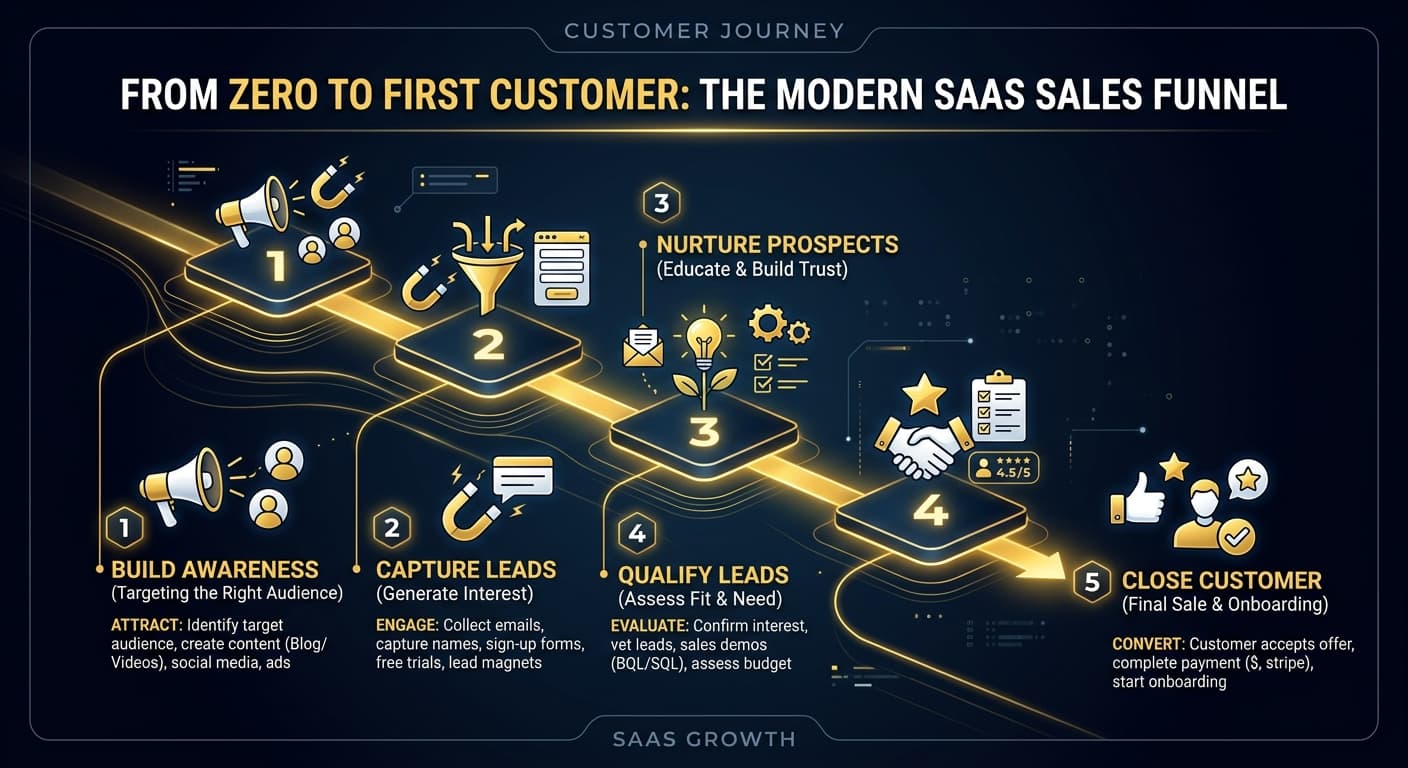
The First Customer Playbook: From Zero to One Paying User Without Spending a Dollar
TL;DR: Your first customers won't come from ads, content, or product-led growth. They'll come from manual outreach. Here's the exact playbook that worked for dozens of solo founders who crossed from zero to one, including the scripts, timing, and mindset shifts that make the difference.
I talked to 23 solo founders who got their first paid customer in the last six months. Not the ones who had networks or capital or pre-existing audiences. The real ones who started from zero and figured it out.
Most advice about first customers is useless for this stage. It assumes you have something to distribute. You don't. It assumes you have an audience. You don't. It assumes you have product-market fit. You definitely don't.
What founders at this stage actually need is a playbook for going from absolutely nothing to someone paying you money. This is that playbook.
Why Your Instincts Are Wrong
Your first instinct is probably to build something visible. Post on Twitter. Write a blog. Launch on Product Hunt. Get your code on GitHub. This is all great for validation, but it's not a sales strategy. These channels work when you have something to show, an audience to show it to, and proof that it works. You have none of those yet.
Your second instinct might be to offer free trials or freemium tiers. Get users first, monetize later. This is also wrong for the zero-to-one stage. You're trying to learn whether people will pay. Giving it away for free means you'll never know. And more importantly, free users behave differently than paid users. They don't give you the feedback you need to understand willingness to pay.
Your actual first customer will come from direct outreach. Not cold emails to lists you bought, but personal outreach to people who have the problem you solve and the budget to pay for a solution.
Finding Your First Target Market
Before you can reach out to anyone, you need to know exactly who you're targeting. The mistake is being too broad.
Narrow it down to one specific type of person who has the problem you solve, does something recognizable (so you can find them), and has budget. Budget is the hard part to verify, but you can make educated guesses based on their role, their company size, and what tools they're already using.
If you're building a tool for developers, your target is developers who work at companies where they have some autonomy. If you're building something for marketers, find marketers at companies that spend on marketing tools. Look for signals: what newsletters do they read? What conferences do they attend? What tools are they already paying for?
The specificity matters because your outreach will be terrible if it's generic and incredible if it's specific. "Hey, I noticed you're a product manager at a B2B SaaS company" is infinitely better than "Hey, I noticed you work in tech."
The Outreach Script That Works
Here's the exact approach that generated response rates above 20% for the founders I interviewed:
Step one: identify someone who fits your target. Not a company, a person. Find them on LinkedIn or Twitter or in a community they participate in.
Step two: research them specifically. Read their posts. Understand what they're working on. Find something you can reference that shows you actually looked at their stuff, not just mass-messaged them.
Step three: send a message that does three things in three sentences. First sentence shows you know who they are and what they're working on. Second sentence shares a specific observation or question about something they posted. Third sentence offers something valuable without asking for anything. Not a pitch. A gift.
Example: "I saw your post about the onboarding flow issues you're dealing with at [company]. That 40% drop-off number is rough. We built a small tool that helps with exactly that problem (it's free and takes 5 minutes to set up). Curious if it would be useful for your situation?"
The key is: you're not selling. You're starting a conversation. You're offering value first. And you're making it incredibly easy to say yes.
Timing Your Outreach
The best time to reach out is when someone just posted about a problem. Within 24 hours of them mentioning something they're struggling with is ideal. They're already thinking about it. They're already frustrated. They're already looking for solutions.
Comment on their posts. Reply to their tweets. Jump into their Discord threads. The goal is to be a helpful person in their ecosystem, not a vendor pitching them.
Don't stop at one message. The founders who succeeded did follow-ups. Not pushy follow-ups, but "hey, did you get my last message? still happy to chat if useful" kind of follow-ups, sent 3-4 days later. Most people are busy. Many won't see your first message. The second message catches the ones who meant to reply but forgot.
Handling the "No"
You'll hear "no" a lot. More than you expect. More than you want.
Here's what "no" actually means at this stage: it means that person isn't ready right now, for whatever reason. It doesn't mean your product is bad. It doesn't mean your approach is wrong. It doesn't mean you should give up.
It means you need to talk to more people. The math is simple: if you need one customer and you have a 10% close rate from conversations, you need to have ten conversations. If your response rate is 20%, you need to reach out to fifty people. If your open rate is 10%, you need to send five hundred messages.
None of these numbers are impossible. They're just work.
What to Charge (And When)
Don't worry about pricing until someone is actually interested. When they ask "how much," that's a good problem to have.
But for reference: at the zero-to-one stage, solo founders who charged anywhere from $29/month to $500/month all got their first customers. The number matters less than you think. What matters is having a number. Any number.
A good heuristic: figure out what it would cost you to build this full-time for a month, divide by the number of customers you think you can realistically get, and that's your price. Or just look at what similar tools charge and pick the lower end. Either works.
The more important thing: when you get a "yes," don't discount. You're establishing your value baseline. If you start low, you'll always be low. Charging full price from the first customer signals confidence in your product.
The Mindset Shift That Changes Everything
The hardest part about getting your first customer isn't finding them. It's believing you're allowed to ask.
You built something. You solved a problem, or you're solving it. Someone else has that same problem and is either suffering through it or paying too much for a worse solution. You're allowed to offer them help. You're allowed to charge for it.
This isn't about being pushy. It's about being helpful at scale. One conversation at a time, one person at a time, you build the foundation for something bigger.
The founders who made it past zero to one didn't have special magic. They just sent more messages, had more conversations, and got more nos than everyone else. The ones who succeeded kept going until one of those nos became a yes.
Frequently Asked Questions
How many people should I reach out to before giving up?
There's no magic number, but the founders who got their first customer sent between 50 and 200 messages. Most succeeded after consistent outreach over 2-4 weeks. If you've sent fewer than 50, keep going.
Should I offer a money-back guarantee?
No. At the zero-to-one stage, your first customers are pioneers. They're taking a risk on you. You don't need to reduce that risk further with guarantees. If they won't pay without one, they're not your first customer.
What if I don't know if my product is ready?
Your product will never feel ready. That's normal. The question isn't "is it perfect?" It's "does it solve a real problem for someone?" If you can answer yes to that, you're ready to start outreach.
Is cold outreach ethical?
Yes, if you're respectful, specific, and genuinely trying to help. Don't spam. Don't mislead. Don't pitch without building a relationship first. The founders who got their first customers were helpful first, sellers second.
How long does this take?
Most founders who got their first customer within three months of starting outreach did it through consistent daily action: 5-10 personalized messages per day. It compounds. Day one is slow. Day thirty is a pipeline.
About the Author