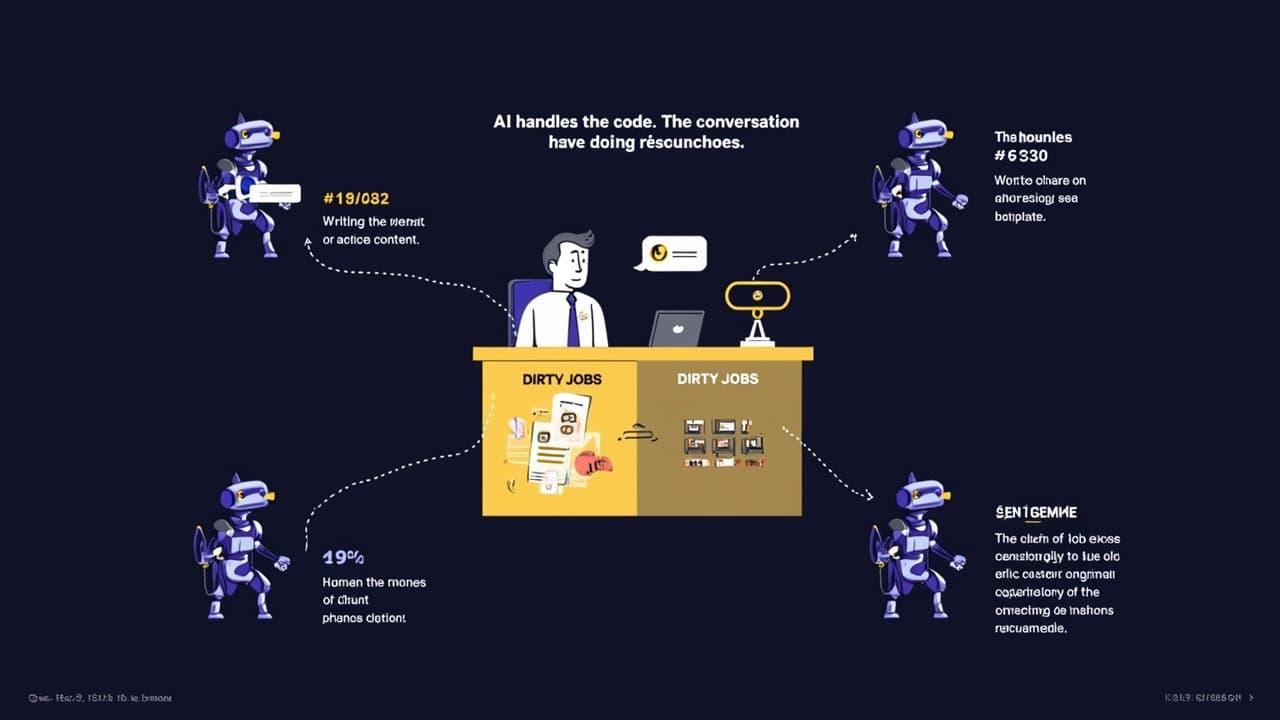
Why the Dirty Jobs Are the Only Ones That Compound
TL;DR: AI can write your code, draft your emails, and generate your content. What it cannot do is sit across from a frustrated customer, read the room, and decide to fire them anyway. Those judgment calls are the only work that compounds. Everything else can be automated. The dirty jobs are where your edge lives.
I spent three weeks watching indie hackers in various corners of the internet, and a pattern kept surfacing. Founders who were drowning would describe the same experience: they had outsourced everything possible to AI tools. The code wrote itself. The copy generated itself. The content schedule ran on autopilot. And yet they were more exhausted than before.
The reason is simple and nobody talks about it plainly enough.
AI automates execution. It cannot automate judgment. And judgment is the only thing that compounds.
What Compound Actually Means
A task compounds when doing it once makes every future version of that task easier, more valuable, or more leverage-able. The classic examples are backlinks, brand equity, and customer relationships. But there's a deeper layer most founders miss.
Some tasks have negative compounding. You do them, the problem gets temporarily better, and then it returns or gets worse. The temporary relief creates dependency. You end up doing the same task forever.
Other tasks have positive compounding. You do them, you learn something irreversible about your customer or your product or yourself, and every future decision benefits from that learning. The work builds on itself.
Most founders default to negative-compounding work because it feels productive. Responding to customer complaints. Fixing bugs reported by users. Writing content that explains what the product does. These feel urgent. They give you dopamine hits of completion. But they don't compound.
The dirty jobs are the ones that have positive compounding. And almost no founder wants to do them.
The Three Dirty Jobs That Actually Matter
Job One: The First User Conversation
Every indie hacker knows they should talk to users. Most never do it in a way that actually generates compound learning.
The difference between a useless customer conversation and a compounding one is whether you're collecting judgment material or just validating your assumptions.
Here's what I mean. A useless conversation: you show someone your product, they say "looks cool," you feel good about yourself, they leave, you learn nothing new.
A compounding conversation: you show someone your product, they tell you exactly why they would not pay for it, you ask why three times until you hit the actual belief underneath, you write down that belief, and three months later when you're debating a feature prioritization decision, you remember what they said and make a different call.
That second conversation cost you the same amount of time. But it generated an asset. A piece of judgment material that lives in your head forever and improves every future decision.
AI cannot do this conversation. It can summarize what users said. It cannot sit in the discomfort of being told your baby is ugly and extract the precise belief underneath the rejection.
The first user conversation is where you learn whether you're building the right thing. If you skip it because it feels bad, you're opting out of the only compounding learning loop that matters at the early stage.
Job Two: The Churn Conversation
This one destroys more indie hackers than any other single cause.
Churn happens. Customers cancel. Most founders handle it by clicking a button in Stripe, maybe sending a passive-aggressive exit survey, and moving on. The churn happened and the learning from it died in the survey tool nobody reads.
The dirty version is this: you get on a call with every customer who cancels in the first ninety days. You ask them why, and you do not accept the first answer. The first answer is almost never the real answer. "It was too expensive" might be sitting on top of "I never actually saw value from it" which might be sitting on top of "your onboarding was a nightmare and I gave up after day three."
Your job is to keep asking why until you hit bedrock. Then you write down what you found.
The reason this compounds: six months later, when you're debating whether to raise prices, you'll remember that three of your four churned customers said they never actually understood the value during onboarding. That changes your entire pricing conversation. You're no longer guessing about price elasticity. You have a specific, learned-from churn reason that informs the decision.
AI can send a churn email. It cannot sit on a thirty-minute call and extract the precise operational truth from someone who is already leaving your product. And that operational truth is the most valuable information you have as a founder, because it tells you exactly where your business is leaking and why.
Job Three: The Customer Discovery Ask
This is the one founders avoid most aggressively, and the avoidance costs more than any other single behavior.
Customer discovery means reaching out to people who have the problem you think you're solving, asking them about their current solution, and building a mental model of what would actually make them switch. Not what they say would make them switch. What would actually make them switch, which is usually different and harder.
Most founders do one of two things. They either skip this entirely and build based on their own intuition, or they do it badly by asking leading questions that confirm what they already believe.
The dirty version: you find ten people who have the problem, you reach out to each of them personally with a specific question about how they currently handle the problem, and you listen without pitching anything. You're not allowed to mention your product. You're not allowed to ask if they'd be interested in a solution. You're only allowed to learn.
What you build after this is fundamentally different from what you would have built without it. The features are different. The positioning is different. The first page of your landing page is different. And every decision downstream is anchored in actual customer reality, not assumed customer reality.
AI cannot do this discovery. It can synthesize what a focus group said. It cannot replace the specific, unreplicable experience of one human being genuinely curious about another human being's problem, in real time, without an agenda.
Why Founders Keep Avoiding the Dirty Jobs
The dirty jobs feel like they're not progress. Writing code feels like progress. Shipping features feels like progress. Posting on Twitter about the thing you're building feels like progress. Getting on a call with a customer who cancelled feels like failure and cleanup.
This is the trap. The work that feels like progress is often the work that compounds least. The work that feels like failure is often the only work that generates compounding judgment.
There's a second reason founders avoid these jobs, and it's worth naming because it's uncomfortable. The dirty jobs require you to be wrong in real time, in front of another human being, and to extract the learning without defending yourself. That is genuinely unpleasant. It requires ego suppression that AI tools actively enable you to avoid.
When you let AI handle customer interactions, you never have to sit in the discomfort of being told you're wrong. The AI delivers the feedback in a summarized, sanitized format that lets you maintain the story you've built about your product. But that story, if it's not grounded in reality, is the thing that's killing you.
The dirty jobs are where your edge lives. Not because they're hard in the way that coding is hard, or marketing is hard. They're hard in a completely different way: they require you to be present, wrong, and learning simultaneously.
That's a skill. It compounds like any other skill. And unlike your code or your content or your marketing assets, AI cannot build it for you.
Frequently Asked Questions
How do I find time for customer conversations when I'm already working 16-hour days?
You don't find time. You make it by not doing something else. The question is what you're willing to stop doing. Most indie hackers spending 16-hour days are spending at least 4 of those hours on work that could be automated or eliminated. The dirty jobs are highest-leverage. They're the ones you should protect time for, not deprioritize.
What if I'm in pre-PMF stage and don't have customers to have churn conversations with?
Then your equivalent dirty job is discovery conversations. You're looking for the ten people who have the problem you're solving and having real conversations with them about their current solution. The goal is to learn enough about their situation that you could describe back to them exactly how they currently handle the problem, including where they feel friction. That's the compound learning that will anchor your entire product direction.
How do I know if a conversation generated compound learning?
You know if you learned something that would change a decision you make in the future. If you walked away from a conversation with information that sits in your head and informs how you think about the next feature, the next pricing decision, the next positioning conversation: that's compounding. If you walked away feeling validated and nothing else changed: that conversation cost you time and gave you nothing compounding in return. Be honest about which one you're having.
Isn't this just "customer development" renamed?
The concept is old. The specific framing matters because the trap has gotten worse, not better. AI tools now make it possible to avoid every uncomfortable customer conversation indefinitely. You can generate synthetic user research. You can run AI-moderated surveys. You can read synthesized transcripts. The skills that made customer development valuable are being actively eroded by the tools that claim to replace it. What's actually happening is that the founders who still do the real work have less competition in that lane than ever before.
About the Author