Decision Fatigue Is Killing Your Startup: What Solo Founders Get Wrong About Productivity
TL;DR: You're not running out of time. You're running out of decisions. Every choice you make, from what to work on to which email to answer first, depletes the same mental reservoir. By 3pm, most solo founders are making garbage decisions on autopilot. Here's how to fix it before it tanks your business.
Here's a question: why are your best ideas always in the shower?
It's not the water. It's the absence of decisions.
In the shower, you're not choosing what to eat, which email to respond to, what task to tackle first, or whether that Slack notification is urgent. Your brain finally has space to think. And suddenly, the solution that eluded you all day becomes obvious.
This is decision fatigue in action. And if you're a solo founder, it's probably the biggest hidden drain on your productivity.
What Decision Fatigue Actually Is
Every decision you make costs mental energy. Big decisions, small decisions, trivial decisions, important decisions. They all draw from the same limited well.
This isn't self-help woo. It's neuroscience.
A famous 2011 study looked at judges making parole decisions. Judges granted parole about 65% of the time right after meals. By the end of a session, that dropped to nearly 0%. The default "no" required less mental effort than evaluating each case properly.
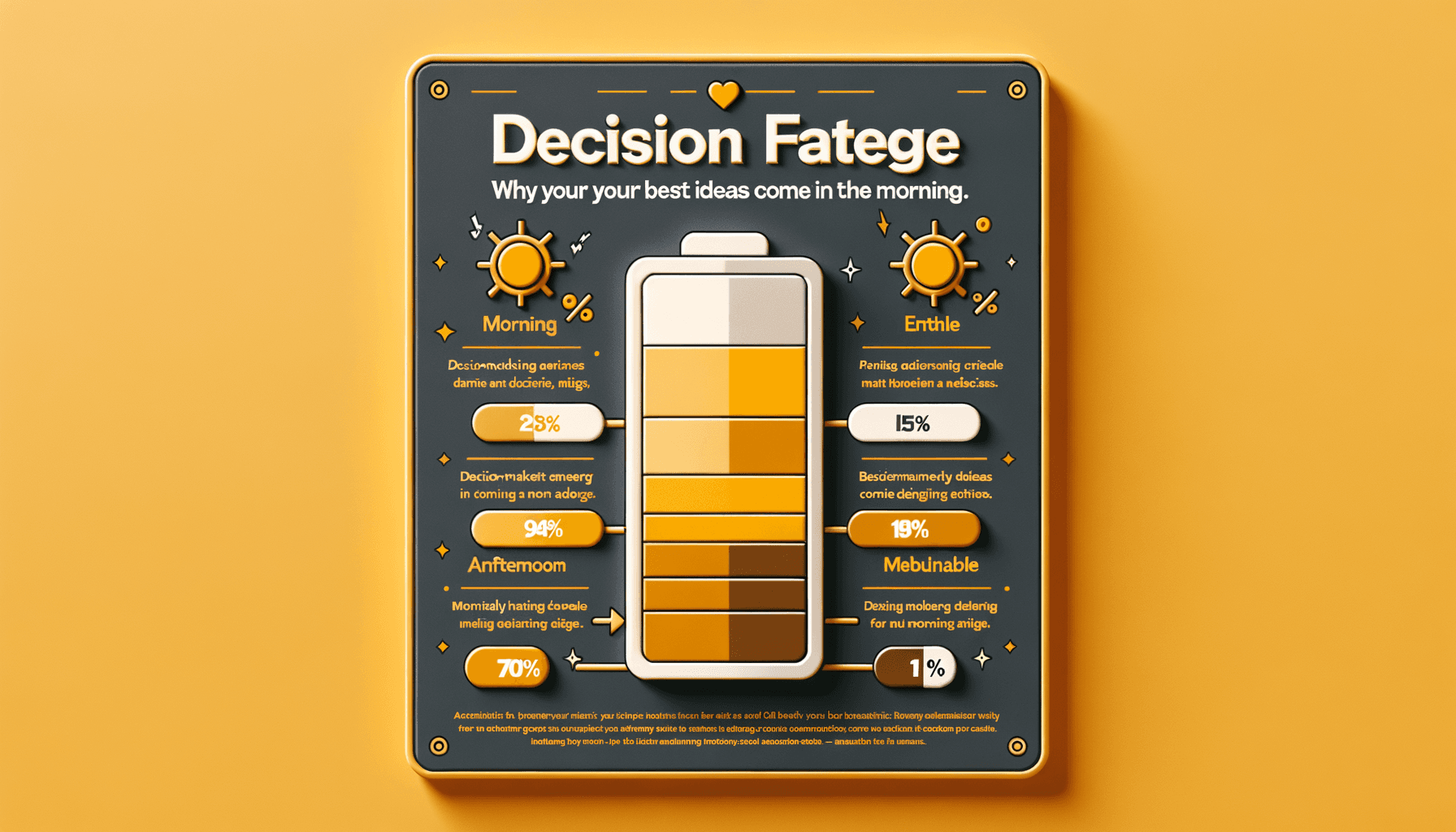
The same thing happens to you. Fresh in the morning, you make thoughtful choices about your product, your messaging, your priorities. By afternoon, you're clicking "reply all" without thinking, agreeing to calls you don't need, and pushing hard decisions to tomorrow.
But here's what most productivity advice misses: for solo founders, the problem is 10x worse.
Why Solo Founders Are Uniquely Screwed
Employees make decisions within constraints. Their job scope is defined. They have bosses who set priorities. They have systems that channel their work.
You have none of that.
As a solo founder, every decision is your decision:
Product decisions: What feature should I build next? Is this bug worth fixing now? How should this flow work?
Marketing decisions: What should I post today? Which channel deserves more focus? Should I respond to this comment?
Business decisions: Should I take this meeting? Is this partnership worth pursuing? How should I price this?
Operational decisions: Which email tool should I use? Is this expense justified? Should I hire for this?
Micro decisions: What should I work on right now? Should I check email? Is it okay to take a break?
Employees might make 30-50 work decisions daily. You make hundreds. And each one chips away at your ability to make the next one well.
The Hidden Cost of "Small" Decisions
Most founders worry about big decisions: pricing, hiring, pivoting. Those feel important.
But the small decisions are what actually kill you.
Every time you look at your to-do list and decide what to work on, that's a decision. Every time you open your email and choose whether to respond now or later, that's a decision. Every time you see a Slack notification and judge its urgency, that's a decision.
These micro-decisions happen dozens of times per hour. They're so small you don't notice them. But they accumulate.
By mid-afternoon, you're not making decisions anymore. You're reacting. Doing whatever feels urgent. Avoiding anything that requires real thought. Pushing important work to tomorrow because your brain is fried.
This is why you can work 12 hours and feel like you accomplished nothing. You spent all your decision-making capacity on trivia, and the important stuff never got your best thinking.
The Decision Fatigue Death Spiral
Here's where it gets dangerous.
When you're decision-fatigued, you default to two behaviors:
1. You avoid deciding altogether.
This looks like procrastination. Refreshing Twitter instead of writing that email. Working on "busy work" instead of the hard stuff. Telling yourself you'll figure it out tomorrow.
But it's not laziness. It's depletion. Your brain literally doesn't have the resources to make another decision, so it avoids situations that require decisions.
2. You default to the easy choice.
This looks like impulsiveness. Saying yes to meetings you should decline. Buying that tool without researching alternatives. Clicking publish without editing.
The easy choice requires less mental effort. When you're depleted, easy wins. Even if easy is wrong.
Both patterns compound. Avoid a decision today? It's still there tomorrow, now with more urgency and less time. Make a bad default choice? Now you're dealing with the consequences while still depleted.
This is the death spiral. Poor decisions create problems. Problems require more decisions. More decisions increase fatigue. More fatigue leads to worse decisions.
How to Know If Decision Fatigue Is Your Problem
Honest audit time. How many of these sound familiar?
- You feel productive in the morning but "brain dead" by afternoon
- You end days feeling exhausted but unclear what you actually accomplished
- You procrastinate on big decisions while staying "busy" with small tasks
- You've been "about to make" the same decision for weeks
- You feel relieved when someone else makes a choice for you
- You default to the status quo even when change is clearly needed
- You make different decisions about the same issue depending on when you're asked
- You feel overwhelmed by options, even simple ones like where to eat lunch
If more than three of these hit, decision fatigue is probably costing you.
The Fix: Reduce Decisions, Not Hours
Most productivity advice tells you to manage time. But time isn't your constraint. Decisions are.
The solution isn't working more efficiently. It's deciding less frequently.
Here's how:
Strategy 1: Make Decisions Once, Not Daily
Every recurring decision should be made once and turned into a rule.
Bad: "What should I work on first thing?" Good: "I always work on the most important thing for 90 minutes before checking email."
Bad: "Should I take this meeting?" Good: "I only take calls Tuesdays and Thursdays 2-5pm."
Bad: "What should I post today?" Good: "I post at 9am and 3pm daily. I batch-write content on Fridays."
Rules remove decisions. Instead of evaluating each situation, you follow the rule. Your brain thanks you.
List the decisions you make repeatedly. For each one, ask: can I make this once and create a rule?
Strategy 2: Batch Similar Decisions Together
Context switching is expensive. Every time you shift between types of decisions, your brain has to reload the relevant context.
Batching keeps you in one mode:
Email batching: Check email twice daily at set times. Make all email decisions at once.
Meeting batching: All calls happen in one window. You're in "meeting mode" once, not five times.
Creative batching: All writing happens in one block. All coding happens in another.
When you batch, you make the same type of decision repeatedly. Your brain stays in one context. Decisions get faster and better.
Strategy 3: Use Templates and Defaults
Every decision that could be templated should be templated.
Email replies: Have templates for common responses. Modify slightly rather than writing from scratch.
Meeting agendas: Same structure every time. Fill in the specifics rather than designing each meeting fresh.
Content formats: Consistent structure for posts, articles, updates. Decide the format once; vary the content.
Pricing responses: Pre-written answers for common pricing questions.
Templates don't make you robotic. They free your mind for the parts that actually need creativity.
Strategy 4: Make Important Decisions When Fresh
Your decision quality varies throughout the day. Use this.
Morning: Strategic decisions, creative work, anything requiring judgment. This is your peak decision capacity.
Midday: Meetings, collaborative work, decisions with input from others.
Afternoon: Routine tasks, email, admin. Decisions that are low-stakes or have obvious right answers.
Never make important decisions when depleted. If it's 4pm and you're tired, schedule the decision for tomorrow morning. A fresh decision beats a fast one.
Strategy 5: Reduce Options Aggressively
More options means more decisions. Fewer options means faster choices.
Wardrobe: Same type of clothes every day. Tech founders wearing the same shirt isn't affectation; it's efficiency.
Food: Same breakfast and lunch. Decide once. Save mental energy for work.
Tools: Pick one tool per category and stop evaluating alternatives. The cost of switching is almost always higher than the benefit.
Saying no: Default no to new opportunities. Only yes if it's obviously better than what you're already doing.
Constraint is freedom. Fewer options means faster decisions and more energy for what matters.
Strategy 6: Delegate Decisions, Not Just Tasks
When you hire (or use AI tools), don't just delegate tasks. Delegate the decisions attached to them.
Bad delegation: "Handle customer support" (you still decide escalations, priorities, responses)
Good delegation: "Handle customer support. Only escalate if a customer is threatening legal action or churn is above $500/month. Use these templates. You decide everything else."
The second version removes decisions from your plate. The first just moves the work while leaving you as the decision bottleneck.
This applies to AI tools too. Don't use AI to give you options. Use it to make recommendations you can approve or reject. One decision (yes/no) beats evaluating multiple options.
Strategy 7: Implement "Decision Days"
Some decisions genuinely require thought. Batch those too.
Pick one morning per week for strategic decisions. Monday morning works well for many. During this block:
- Review metrics and data
- Make decisions about priorities, direction, investments
- Resolve anything that's been "pending"
- Set constraints and rules for the week
The rest of the week, you're executing, not deciding. When a decision comes up, you ask: "Can this wait until Monday?" If yes, write it down and move on.
What This Looks Like in Practice
Let me show you two versions of a founder's day:
The Decision-Heavy Day (Before)
6:30am - Wake up. Check email in bed. Decide which ones to respond to now vs later.
7:00am - Get dressed. Decide what to wear.
7:30am - Breakfast. Decide what to eat.
8:00am - Start work. Decide what to work on first.
8:15am - Slack notification. Decide if it's urgent. Decide how to respond.
8:30am - Back to work. Wait, what was I doing? Decide again.
9:00am - Email. 15 emails. 15 decisions about responses.
9:30am - Meeting request. Decide if I should take it. What time? What platform?
10:00am - Finally deep work. Decide which feature to build. Decide the approach.
... and so on, all day, hundreds of decisions.
The Decision-Light Day (After)
6:30am - Wake up. Phone stays in another room until 9am.
7:00am - Wear the same thing I always wear.
7:30am - Eat the same breakfast I always eat.
8:00am - Deep work block starts. I work on whatever is at the top of my priority list (decided Sunday).
11:00am - First email check. All email decisions batched in 30 minutes.
11:30am - Meetings (Tuesday/Thursday only, 11:30-1pm window).
1:00pm - Lunch. Same place, same meal.
1:30pm - Deep work block two. Continue top priority.
4:00pm - Second email check. Admin and shallow work.
5:30pm - Done.
Same hours. Fraction of the decisions. Dramatically more energy for what matters.
The Deepest Cut: Decision Fatigue and Founder Mistakes
Look at the worst decisions founders make. Almost all happen when they're depleted:
Taking bad deals: "I was tired of fundraising, so I took the term sheet in front of me."
Hiring wrong: "They seemed fine in the interview. I just needed someone."
Pivoting impulsively: "We weren't growing fast enough, so I changed everything."
Burning out: "I kept saying yes to everything because I didn't have energy to evaluate what mattered."
These aren't intellectual failures. They're exhaustion failures. The founder knew better in principle. They just didn't have the decision capacity left to apply what they knew.
Protecting your decision-making ability isn't a productivity hack. It's existential risk management for your startup.
The Counterintuitive Truth
Here's what took me too long to learn:
The most productive founders don't make more decisions. They make fewer decisions, better.
They build systems that decide for them. They create constraints that eliminate options. They protect their peak decision-making hours for what actually matters. They delegate not just work but judgment.
From the outside, they might look less "in control." They don't weigh in on everything. They don't respond to every message. They let systems and rules handle most situations.
But that's exactly why they ship more, build better, and burn out less. They conserve their decision-making capacity for the decisions that actually need them.
You can't eliminate decision fatigue entirely. You're a founder; decisions are the job. But you can reduce the trivial decisions that steal capacity from the important ones.
Every rule you create, every template you build, every option you eliminate, every decision you delegate: that's decision-making capacity you get back for what matters.
You just read about making 47 decisions before 10 AM. The honest diagnosis: most of those decisions are things you could have decided once and never decided again. But some of them are the strategic thinking work, what to build, who to target, what to research, that's genuinely hard to pre-decide because it changes week to week.
The second category is what kills startups quietly. Not the trivial decisions, but the important ones that keep getting deferred because your decision budget is gone by 11 AM.
Luka is a research and growth agent that takes the strategic thinking work off your plate: competitive analysis, market research, content drafts, growth experiments. The work that requires fresh thinking that you keep running on empty. If decision fatigue is compounding with deferred strategic work, Luka is worth a look.
Apply This Today
Audit your recurring decisions. For one day, notice every decision you make, especially the small repetitive ones. Write them down. This is where your energy is leaking.
Turn three decisions into rules. Pick three recurring decisions from your audit. Create a rule for each one. "I always X when Y." Follow the rules for one week.
Batch one category. Pick email, meetings, or some other decision-heavy category. Batch it into one or two windows. Refuse to make those decisions outside the window.
Protect your mornings. For one week, save important decisions for before noon. Anything big that comes up in the afternoon gets scheduled for the next morning.
Count your options. When you catch yourself evaluating multiple options, ask: can I reduce this to two? Can I make it a yes/no? Fewer options means faster decisions.
The goal isn't to never decide. It's to spend your decision-making capacity on what deserves it.
Your startup needs your best decisions. Stop wasting them on what to eat for lunch.
Frequently Asked Questions
Isn't avoiding decisions just procrastination?
No. Procrastination is avoiding a specific decision you need to make. What I'm describing is systematically eliminating unnecessary decisions so you have capacity for the necessary ones. Rules and batching don't avoid decisions; they pre-make them or cluster them.
What if I make a bad rule and lock myself into a poor choice?
Rules aren't permanent. Review your rules monthly. Ask: is this still serving me? If not, update the rule. The goal is to avoid making the same decision daily, not to carve decisions in stone forever.
How do I handle truly urgent decisions that come up randomly?
True urgency breaks through any system, and that's fine. The problem is false urgency: things that feel urgent but aren't. Most "urgent" decisions can wait 2-4 hours for your next decision window. Train yourself (and others) to distinguish real urgency from manufactured urgency.
Doesn't this make me less responsive and hurt relationships?
Counterintuitively, it often improves relationships. When you batch communication, you respond more thoughtfully. When you protect deep work, you deliver better results. People respect clear boundaries more than constant availability paired with distraction.
How long until I feel the difference?
Most people notice within a week of consistent practice. The afternoon "brain dead" feeling diminishes. You end days feeling like you actually accomplished something. The compounding effect takes longer: over months, you'll notice you're making better strategic decisions because you're not depleted when you make them.
About the Author