Cursor vs Windsurf vs Claude Code in 2026: Which AI Code Editor Actually Wins
TL;DR: Cursor just hit $2B ARR. Windsurf got acquired by Cognition after the OpenAI deal collapsed. Claude Code is a terminal agent, not an IDE. They're solving different problems. Here's which one fits your workflow after months of using all three.
I've been using all three tools on production code for months. Not demos. Not tutorials. Real projects with real deadlines and real bugs that need fixing at 2am.
The conversation online is mostly people defending whichever tool they paid for. That's useless. What matters is understanding that these three tools represent fundamentally different bets on how developers should work with AI. And the answer to "which one is best" depends entirely on what kind of work you're doing.
Let me break it down with specifics.
The Three Philosophies (This Matters More Than Features)
Before comparing features, understand the design philosophy. Each tool is built around a different assumption about what developers actually need.
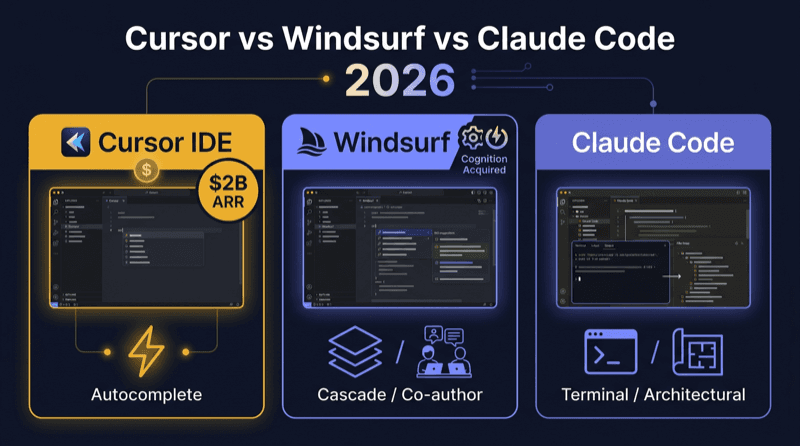
Cursor: AI inside your existing workflow. Cursor is a VS Code fork. If you already use VS Code, everything feels familiar. The AI is woven into tab completion, inline edits, and multi-file refactoring. You're still driving. The AI predicts what you're about to do and does it faster.
Windsurf: AI and developer as co-authors. Windsurf (now owned by Cognition, the company behind Devin) positions itself as AI-native. Their "Cascade" system blurs the line between you typing and the AI typing. It's less "tool you invoke" and more "partner you collaborate with."
Claude Code: AI as a senior engineer on your team. Claude Code isn't an IDE at all. It's a terminal-based agent that reads your codebase, edits files, runs commands, and solves architectural problems. You give it a task ("refactor authentication to use JWTs") and it executes. You review the result.
These aren't competing products. They're competing philosophies. And each one is right for certain workflows and wrong for others.
The Revenue and Ownership Story (Context Matters)
Before getting into features, the business context shapes where each product is headed.
Cursor: $2B ARR as of February 2026. Doubled in three months. The fastest-growing SaaS company from $1M to $500M ARR ever recorded, surpassing Wiz, Deel, and Ramp. Four-year-old company founded by MIT dropouts. Revenue is doubling every two months. They're the category leader by a mile.
Windsurf: $82M ARR when Cognition acquired it in mid-2025. The original OpenAI deal ($3B) collapsed because Microsoft's partnership agreement gave them access to any OpenAI acquisition's IP. Windsurf's CEO refused to let GitHub Copilot's team access their technology. Cognition (which raised $400M at a $10.2B valuation in September 2025) is now merging Windsurf with their autonomous coding agent, Devin.
Claude Code: Part of Anthropic's broader Claude ecosystem. Usage-based pricing through the API, or bundled into Claude Pro ($20/month) and Claude Max ($100-200/month). Not a separate company. The strategic play is keeping developers inside the Anthropic ecosystem.
Why does this matter? Because Cursor has infinite runway to invest in features. Windsurf's roadmap is now tied to Cognition's vision for Devin integration. Claude Code's development is driven by Anthropic's model improvements, not by an IDE team.
The Autocomplete Shootout
For the 80% of coding that's straightforward (boilerplate, CRUD, known patterns) autocomplete quality is the most important thing.
Cursor wins here. The "Tab Tab Tab" workflow is genuinely addictive. It doesn't just complete the current line. It predicts the next 3-5 lines based on what you're about to do. The predictions are context-aware: it knows your ORM, your error handling patterns, your naming conventions. After a week with Cursor, going back to regular VS Code feels like typing with boxing gloves.
Windsurf is close. Their "Super Complete" feature is comparable to Cursor for projects under 50 files. For larger codebases, Cursor's predictions are more contextually accurate. Windsurf has one trick Cursor doesn't: multi-cursor predictions. When you're editing multiple locations simultaneously, Windsurf predicts changes across all cursors. That's a real advantage for specific workflows.
Claude Code doesn't do autocomplete. It's not trying to. Comparing Claude Code's autocomplete to Cursor is like comparing a hammer's ability to tighten screws. Wrong tool, wrong job.
The Complex Refactoring Test
This is where the tools diverge dramatically. "Refactor the authentication system across 15 files" is a fundamentally different task than "complete this function."
Claude Code dominates complex refactoring. Give it a task like "replace the session-based auth with JWT tokens across the entire codebase" and it will: read every relevant file, understand the dependency chain, make coordinated changes across all affected files, update tests, and explain what it did. The 200K+ token context window means it can hold your entire codebase in memory.
Cursor's Agent Mode (Composer) handles it well. Since the major update in late 2025, Cursor's agent mode can handle multi-file refactoring. It's not as autonomous as Claude Code. You'll need to guide it more. But for projects you're actively working in, the tight IDE integration means less context switching.
Windsurf's Cascade is the middle ground. It's more autonomous than Cursor's agent mode but less capable than Claude Code for large-scale changes. The Cascade system does well with 5-10 file changes. Beyond that, it starts losing coherence.
The honest summary: for small changes (1-3 files), Cursor. For medium changes (5-10 files), any of the three. For large architectural changes (15+ files), Claude Code.
The "I'm Stuck" Scenario
You've been debugging for an hour. Something's wrong and you can't figure out what. This is where the tools' philosophies create very different experiences.
With Cursor: Select the broken code, open inline chat (Cmd+K), describe the problem. Cursor will suggest a fix in context. If the first suggestion doesn't work, you iterate. The feedback loop is fast because you never leave the editor.
With Claude Code: Paste the error, describe the context, and Claude Code will investigate. It will read related files, check your package.json, look at your configuration, maybe run a diagnostic command. It thinks architecturally. If the bug is actually a design problem (which it often is), Claude Code is more likely to spot that.
With Windsurf: Cascade will attempt a back-and-forth debugging session. It's good at following a logical chain of investigation. Where it struggles: when the debugging requires understanding context from more than 5-6 files, it can lose the thread.
My honest take: Cursor for "I know roughly where the bug is." Claude Code for "I have no idea what's wrong and I need fresh eyes."
Pricing for Solo Founders (The Real Math)
This matters more than most comparisons admit. If you're bootstrapping, every dollar counts.
Cursor Pro: $20/month. Credit-based usage. For most solo developers, the Pro plan is sufficient. You'll hit limits if you're doing heavy agent mode work, but for everyday coding, $20/month is the sweet spot.
Windsurf Pro: $15/month. Cheapest of the three IDEs. The lower price reflects Cognition's strategy to grow the user base before the Devin integration. If budget is your primary constraint, Windsurf is the pragmatic choice.
Claude Code: This depends on how you use it. Through Claude Pro ($20/month), you get Claude Code bundled but with usage limits. Through Max ($100-200/month), limits are much higher. Through the API directly, you pay per token. Heavy Claude Code usage through the API can run $200-500/month easily.
The combo that most vibe coders are running: Cursor Pro ($20/month) for daily coding plus Claude Code through Claude Pro ($20/month) for complex tasks. Total: $40/month. That covers 95% of use cases.
Model Flexibility
Cursor: Supports GPT-4o, Claude, Gemini, and custom models. You can switch models per task. This flexibility is one of Cursor's biggest advantages. Use a cheaper model for autocomplete, a better one for complex reasoning.
Windsurf: Supports SWE-1.5 (their own model), GPT-4o, Claude Sonnet, and DeepSeek-R1. The SWE-1.5 model is specifically trained for coding tasks and often outperforms larger models on standard coding benchmarks.
Claude Code: Locked to Claude models (Opus 4.6, Sonnet 4.6). No model switching. This is both a limitation and an advantage. You don't waste time choosing models. And Claude's coding ability is genuinely the strongest available for complex reasoning.
What Developers Actually Report
I went through r/cursor, r/windsurf, and developer forums to see what the community consensus looks like. Here's what I found across hundreds of posts:
Cursor praise: "Best autocomplete I've ever used." "Tab completion is addictive." "Agent mode keeps getting better." Cursor complaints: "Getting expensive with credit burns on agent mode." "Sometimes generates hallucinated imports." "Background indexing can be slow on large monorepos."
Windsurf praise: "Cascade feels like pair programming." "Cheaper than Cursor." "Multi-cursor predictions are great." Windsurf complaints: "Struggles beyond 5 files." "Acquisition uncertainty." "Less polished than Cursor."
Claude Code praise: "Best for complex refactoring." "Thinks architecturally." "Caught design problems I missed." Claude Code complaints: "Terminal UI is not for everyone." "Expensive at scale." "Overkill for simple tasks."
The Convergence Problem
Here's what nobody in the comparison articles is saying: these tools are converging.
Cursor is adding more agent capabilities. Windsurf is integrating with Devin for autonomous coding. Claude Code added an IDE extension. In 12 months, the functional differences will be smaller.
The bet you're making when you choose a tool today isn't about current features. It's about which team you trust to execute fastest.
Cursor has the revenue ($2B ARR), the team, and the momentum. They're the safe bet.
Windsurf has Cognition's $400M in funding and the Devin integration. They're the wild card that could leapfrog everyone if the autonomous coding vision works.
Claude Code has Anthropic's model advantage. As Claude gets smarter, Claude Code gets better automatically. They're the bet on AI intelligence outweighing IDE features.
My Recommendation (Opinionated, As Promised)
If you're a solo founder shipping a product: Start with Cursor. The autocomplete alone saves hours per day. The agent mode handles 90% of complex tasks. The $20/month is the best value in AI coding tools.
If you're doing complex architecture work: Add Claude Code. Don't replace Cursor with it. Use both. Claude Code for the thinking and planning. Cursor for the typing and iteration.
If you're budget-constrained: Windsurf at $15/month is genuine value. The Cascade system is good enough for most projects. Just understand that the product's future depends on the Cognition integration working out.
If you're a team: Cursor. The ecosystem, the community, the reliability, and the model flexibility make it the safest choice for teams that need consistency.
The stack nobody talks about: Some developers are running Cursor plus Claude Code plus Windsurf's free tier. They use Cursor as their primary editor, Claude Code for heavy refactoring, and keep Windsurf installed for its multi-cursor predictions on specific editing tasks. Is this overkill? Probably. Does it cost $55/month total? Yes. But for developers shipping production code daily, the combined toolset covers every workflow type without compromise. The marginal cost per tool is tiny compared to the time saved.
The worst decision is analysis paralysis. Pick one. Start building. Switch later if it's not working.
The real problem with AI coding tools isn't choosing the right one. It's that the tool only amplifies what you're already doing. If you're building the right feature, Cursor makes you build it faster. If you're building the wrong feature, Cursor makes you build the wrong thing faster.
The direction question sits upstream of every tool choice. Which feature matters most right now? Which bug is actually losing you users? Which part of the stack needs attention first? These are the questions your tools can't answer.
Your data can. But it's scattered. GA shows traffic patterns, Sentry captures errors, App Store reviews surface complaints, and none of them talk to each other. Luka connects those data sources, finds the causal links between what's breaking and what's blocking growth, and gives you one clear priority for today based on where your product actually is. Check it in the morning, know what to point your tools at, go build. See how Luka works.
Apply This Today
Step 1: Audit your current workflow. Write down every coding task from the last week. Categorize each as: autocomplete (simple), agent (multi-file), or architectural (complex refactoring). If 80%+ is autocomplete, Cursor alone is enough. If you're doing significant architectural work, add Claude Code.
Step 2: Try the $40/month combo. Cursor Pro + Claude Pro for one month. Use Cursor for daily coding. Use Claude Code for anything touching more than 5 files. Track how many hours each tool saves you per week. If the total saved time is worth more than $40, keep it.
Step 3: Set a model strategy. Don't just use the default model. In Cursor, use a faster model for autocomplete and a stronger model for agent tasks. This alone can cut your credit usage by 30-40% while maintaining quality on the tasks that matter.
Step 4: Measure before switching. If you're considering switching tools, measure your output first. Lines of code shipped, features completed, bugs fixed. Then switch and measure again. Most developers who switch tools based on hype see no measurable productivity difference. The tool you know well almost always outperforms the tool you're learning.
Frequently Asked Questions
Is Cursor worth $20/month for solo founders?
Yes, if you write code for more than 10 hours per week. The autocomplete alone saves 30-60 minutes per day for most developers. At $20/month, that's roughly $0.15 per hour of coding. The agent mode adds even more value for multi-file tasks. If you code less than 10 hours per week, the free tier may be sufficient.
What happened to the OpenAI-Windsurf acquisition?
OpenAI agreed to acquire Windsurf for approximately $3B in 2025. The deal collapsed because Microsoft's partnership agreement with OpenAI gave Microsoft access to any acquisition's intellectual property. Windsurf's CEO refused to allow GitHub Copilot's team access to Windsurf's technology. Cognition (makers of Devin) subsequently acquired Windsurf, including its 210 employees and $82M ARR.
Can Claude Code replace Cursor entirely?
For most developers, no. Claude Code excels at complex, multi-file tasks and architectural reasoning. But it runs in the terminal, doesn't have autocomplete, and isn't designed for the fast, iterative coding that makes up most of a developer's day. The best setup for most developers is using both: Cursor for daily coding and Claude Code for complex tasks.
Which AI code editor is best for vibe coding (non-programmers)?
None of these three. Cursor, Windsurf, and Claude Code are designed for developers. If you're a non-programmer building apps through prompts, look at Base44, Lovable, Bolt, or v0. Those platforms handle the entire stack (database, auth, hosting) without requiring you to understand code.
Will these tools converge into one product eventually?
Probably not into one product, but the feature sets will overlap significantly. Cursor is adding autonomous agent features. Windsurf is integrating with Devin. Claude Code launched an IDE extension. Within 12-18 months, choosing between them will be more about ecosystem preference and pricing than fundamental capability differences.
About the Author