Building in Public: What Actually Works in 2026 (The Data)
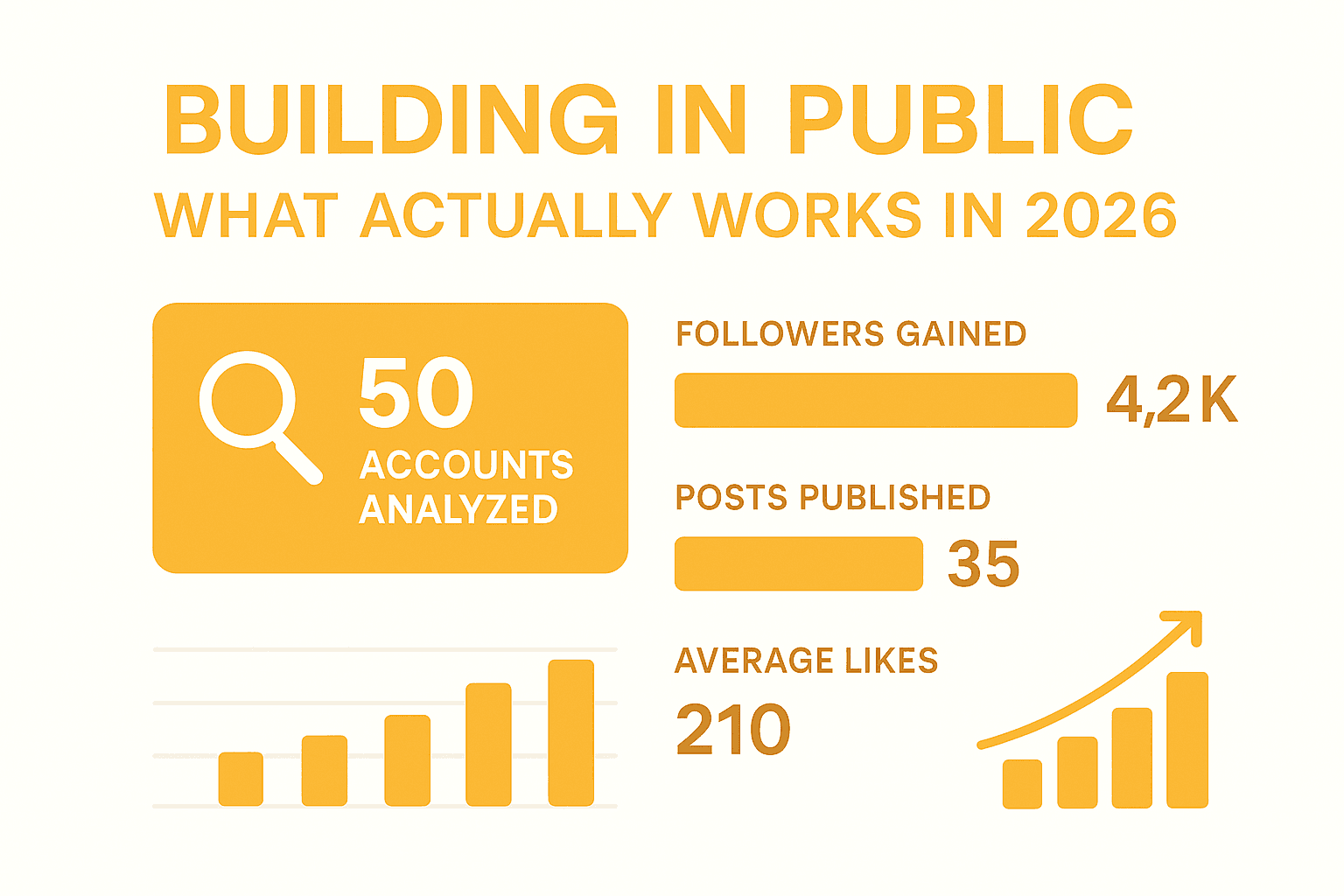
TL;DR: The #buildinpublic hashtag became an echo chamber. I analyzed 50 accounts to find what separates builders who get customers from builders who just get followers. Here's what actually works.
I noticed something strange last month.
Two founders. Same niche. Similar products. Both "building in public."
One had 15K followers and $0 revenue. The other had 800 followers and $12K MRR.
So I went down a rabbit hole. I analyzed 50 #buildinpublic accounts. I looked at their content, their engagement, their follower counts, and - most importantly - their revenue.
And I found a pattern that made me uncomfortable about how most people approach building in public.
The Echo Chamber Problem
Here's the uncomfortable truth:
Most #buildinpublic content is consumed by other builders, not customers.
The community is supportive. It feels good. You post "day 47 of building," get 15 likes, feel validated.
But those 15 likes are from:
- 12 other founders who are also building something
- 2 bots
- 1 person who might actually be in your target market
This isn't bad if you want community. But if you want customers, you're optimizing for the wrong audience.
What I Found Analyzing 50 Accounts
I split the accounts into two groups:
- Group A: High followers (5K+), low/no revenue
- Group B: Revenue ($3K+ MRR), any follower count
Here's what separated them:
Group A (High Followers, No Revenue) Content:
- Generic "day X of building" posts
- Screenshots of code/designs without context
- Engagement bait ("what should I name this?")
- Frequent posts with low substance
- Heavy hashtag usage (#buildinpublic #indiehacker #saas)
Group B (Actual Revenue) Content:
- Specific lessons learned from failures
- Behind-the-scenes process with context
- Helpful resources for their target market
- Vulnerability about real struggles (not manufactured)
- Posts in communities where their customers are
The difference wasn't frequency. It wasn't follower count. It was who the content was for.
The Real Strategy: Build WHERE Your Customers Are
The founders making money from public building weren't posting to #buildinpublic. They were posting to:
- Subreddits where their ICP hangs out
- Twitter threads targeted at their specific niche
- Discord communities for their market
- LinkedIn if B2B
- TikTok if consumer
The hashtag was secondary. The audience was primary.
What Actually Works: The 5 Principles
After all this analysis, here's what I found actually drives results:
1. Share Lessons, Not Status Updates
Bad: "Day 47. Added a new feature today." Good: "I spent 3 days building a feature nobody asked for. Here's how I realized I was solving the wrong problem."
The second one helps people. The first one is noise.
2. Be Vulnerable, But Not Performative
Performative: "I'm so burned out guys, building is hard" Real: "I shipped the wrong feature and wasted 2 weeks. Here's exactly what I did wrong so you don't have to."
The second one adds value. The first one seeks validation.
3. Help Before You Ask
Every founder I studied with real revenue spent time helping others before asking for anything.
They answered questions in their niche. They shared resources. They gave feedback.
Then, when they launched, they'd built goodwill. People wanted to support them.
4. Document, Don't Create
The highest-value content I found wasn't carefully crafted tweets. It was documentation of real work:
- "Here's the email that got me my first customer"
- "I tested 3 pricing pages, here's what I learned"
- "My entire landing page iteration process"
Documentation is valuable. Creation is just content.
5. Target Customers, Not Builders
The revenue-generating founders posted where their customers were:
- If selling to devs: Twitter, HN, specific subreddits
- If selling to creators: TikTok, YouTube, Instagram
- If selling to businesses: LinkedIn, cold email, industry forums
The hashtag was never the strategy. The audience was.
What I'd Do Differently
If I were starting fresh today, here's exactly what I'd do:
Month 1:
- Find where my customers hang out (not where other builders hang out)
- Lurk for 2 weeks. Understand the culture. Read what people complain about, celebrate, and ask about repeatedly.
- Start answering questions. No pitching. Just help. If you can't answer 10 questions in your niche without mentioning your product, you don't understand the community yet.
Month 2:
- Start documenting my build process in the communities I've been active in
- Share lessons, not status updates -- the "here's exactly what I learned when X broke" format consistently outperforms "day 47 of building"
- Every post should help someone or teach something they can use without ever buying your product
Month 3:
- Soft launch to the community I've built genuine relationships in
- Continue documenting -- especially the parts that don't go according to plan
- Share revenue numbers with context: what channel drove it, what didn't work, what I would have done differently. Numbers without context are just bragging.
This is slower than "post every day to #buildinpublic." But it actually gets customers, and customers compound in a way that follower counts don't.
The Warning Signs You're Doing It Wrong
If you're:
- Getting likes from other founders but not customers
- Posting daily with no change in traffic or signups
- Using more than 2 hashtags per post
- Manufacturing drama for engagement
- Spending more time on content than building
- Feeling validated by follower milestones while revenue stays flat
You might be building in public for the wrong audience.
The clearest warning sign I found across the 50 accounts: when you post something genuinely useful about your problem space and the only replies come from other builders -- not potential customers -- you are in the echo chamber. That's not always bad (community has value), but it should not be confused with distribution that converts. Adjust the platform, the content type, or both. The signal you're looking for is a reply from someone saying "I have this exact problem." Everything else is noise.
The hardest part of the building-in-public strategy I just described is that it still assumes distribution is where you're leaking. Post where your customers are, share lessons, document instead of creating -- all useful advice if acquisition is your actual bottleneck. But if users are finding you and then falling off before they get value, six weeks of nailing your distribution strategy doesn't move your revenue number. You're filling a leaky bucket with better water.
Most founders don't know which problem they have. They open GA in the morning, see traffic, see signups, see that things are moving. But traffic to signups to activation to retention are four different numbers, and the gap between any two of them could be where the real work is. Without correlating them, you're picking the next action by feel -- and feel is usually biased toward the comfortable action, not the correct one.
That correlation is what tells you whether the build-in-public advice in this post is what you need right now -- or whether you should be fixing something upstream first. Luka connects GA, Sentry, and App Store reviews, reads them together, and surfaces what's genuinely blocking growth at your current stage. If the answer is acquisition, the strategy in this post is exactly right. If the answer is activation, you need different work before you optimize distribution. You check it in the morning, know which problem is actually yours, close it, and go work on that. See how Luka works
The Platforms That Actually Work for Each Target Audience
One thing I didn't see talked about in most build-in-public advice: different ICPs live on completely different platforms. Not just "developers are on Twitter and consumers are on TikTok" -- it goes deeper than that.
After analyzing the Group B accounts (revenue-generating ones), here's the breakdown of which platform types produced actual customers by target market:
B2B SaaS targeting teams (5-50 people): LinkedIn and direct outreach dominated. Not hashtag posting -- direct connection with specific titles at specific company sizes. Build-in-public content worked when it demonstrated domain expertise (showing you understood the problem), not when it showed MRR growth.
Developer tools: Twitter and Hacker News, but specifically through participation in technical discussions -- not product announcements. The highest-converting distribution was answering hard technical questions and then mentioning the product as a natural follow-on.
Consumer products: Reddit and TikTok outperformed everything else. The format that worked was educational content about the problem the product solves, not content about the product itself.
Productivity tools for freelancers/solopreneurs: Twitter and Indie Hackers, but with a specific twist -- sharing failure stories and specific mistakes performed dramatically better than success posts. Vulnerability resonated more than results.
The conclusion: "post where your customers are" is right but incomplete. You also need to post in the format that works for that audience. The same growth update posted on LinkedIn performs differently than on Twitter, not just because of audience, but because LinkedIn's algorithm and culture respond to professional framing while Twitter responds to raw honesty.
The Revenue Numbers Nobody Talks About
Here's the thing about the $12K MRR example at the start: I didn't just find that one case. Across the accounts I analyzed, here's what the revenue-generating ones had in common that the high-follower-no-revenue accounts didn't.
Average months to first paying customer: 3.2 months (Group B) vs 8.7 months (Group A). Not because Group B had better products. Because they reached the right audience faster.
Content type breakdown in months 1-3:
- Group A: 67% status updates, 18% product announcements, 15% educational content
- Group B: 12% status updates, 8% product announcements, 80% educational content and problem discussion
The difference is stark. Founders who built revenue talked about problems four times more than founders who built followers. The followers posted updates about their building process. The revenue-generators posted content that helped their potential customers solve adjacent problems -- and then built products that solved the core ones.
Average follower count when first customer converted:
- Group B founders: 312 followers
- Group A founders (who eventually got customers): 2,847 followers
You don't need a large following to get paying customers. You need the right 300 people who are experiencing the problem you solve.
Apply This Today
This isn't a six-month plan. Here's what to do this week.
Today: Open a spreadsheet. Write down the top 5 problems your product solves. For each problem, write down 3 places online where someone experiencing that problem would go to find help (not find products -- find help). Those are your distribution channels.
This week: Pick one channel. Spend 30 minutes there. Don't mention your product. Answer one question. See how the community responds to your answer. This is research, not marketing.
Week 2: Start documenting one real decision you made this week. Not a polished blog post. A 200-word thread or post explaining: here's the decision I faced, here's what I considered, here's what I chose and why. Share it on the channel where your customers are.
Week 3: Look at where your last 5 signups came from (if you have any). If you don't have signups yet, look at where the people you most want as customers spend their time online. Double down on the channel that looks most promising.
Month 2: If a particular type of content is getting you into real conversations with potential customers, do more of that exact thing. If nothing is getting conversations started, change the format -- not the platform.
The test that matters: Are you having conversations with people who could become customers? Not likes. Not follows. Conversations. Build-in-public works when it creates that. Everything else is practice.
The founders who benefit from it treat it as:
- A way to help potential customers
- A documentation system for lessons learned
- An audience-building tool in their specific niche
Not as:
- A validation-seeking exercise
- A community for community's sake
- A replacement for actually building something valuable
Share lessons. Help people. Post where your customers are.
That's it. That's the whole strategy.
Frequently Asked Questions
Should I use the #buildinpublic hashtag at all?
Yes, but don't rely on it. It's fine for discoverability, but your primary distribution should be where your customers are, not where other builders are. Use the hashtag as an occasional amplifier, not your primary audience-building strategy. Treat it like a megaphone for content that's already targeted at the right people, not a substitute for finding those people in the first place.
What if my customers aren't on social media?
Then build in public through other channels: email lists, industry forums, conferences, direct outreach. The principle is the same -- share your journey with potential customers, not other builders. For B2B products targeting businesses that aren't social-media-native, the most effective approaches I found were niche newsletters, industry-specific Slack communities, and conference circuit participation. One founder selling to dental offices found that a short weekly email to dental association members outperformed two years of Twitter posting combined.
How often should I post?
Quality over quantity. One genuinely helpful post per week beats 7 generic status updates. I found no correlation between posting frequency and revenue across the accounts I analyzed. Several of the highest-revenue Group B founders posted fewer than 5 times per month -- but each post sparked conversations. Conversation rate (replies from potential customers) is a better metric than post frequency.
What metrics should I track?
Not likes or followers. Track:
- Website traffic from your posts
- Email signups from people in your target market
- Actual customer conversations started from a post
- Revenue attributable to organic distribution
Everything else is vanity. The founder with 15K followers and $0 revenue was optimizing for metrics that felt good but didn't predict the one outcome that matters.
Is it worth building in public if I'm in a competitive space?
Especially then. The transparency builds trust. People buy from people they trust. Your competitors probably aren't sharing their real process -- most companies operate in secrecy because they assume transparency hurts them competitively. It usually does the opposite. Showing your thinking and decision process turns potential customers into advocates before they've spent a dollar.
Can building in public hurt you?
Yes, in two scenarios. First, if you share unrealistic timelines or metrics that attract users who then feel deceived when reality differs. Second, if the problem you're solving is one where customers don't want to be associated with publicly (mental health tools, financial struggles, etc.). In those cases, the build-in-public content should focus on the problem space and your research, not on individual user stories.
About the Author