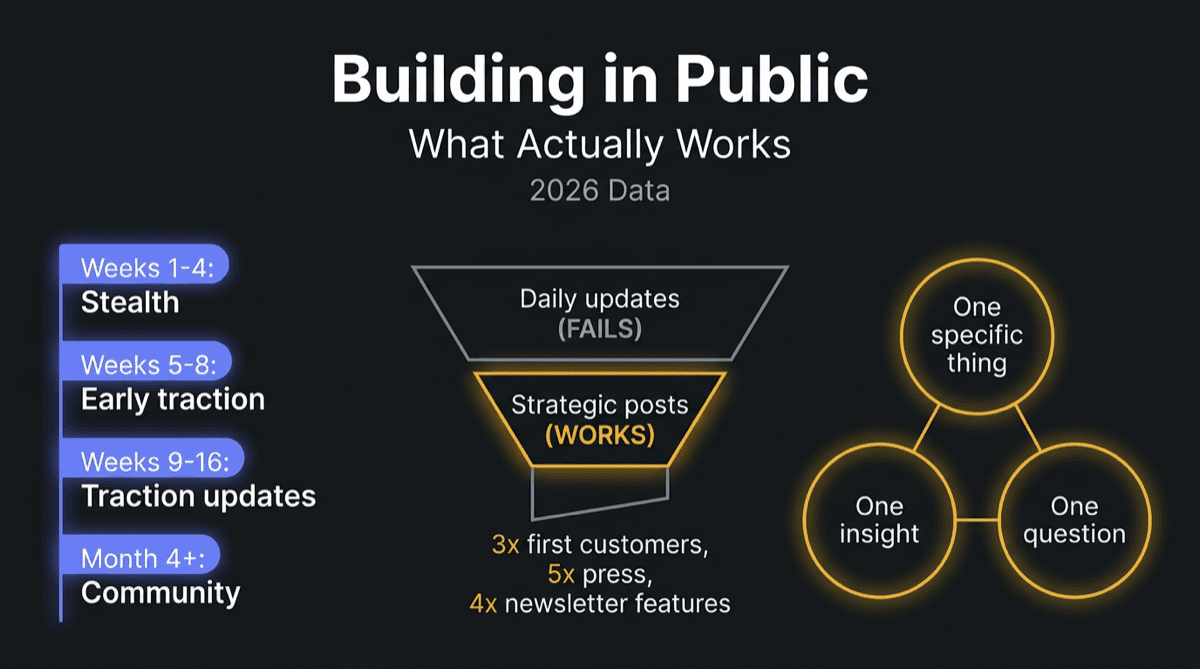
Building in Public: What Actually Works (2026 Data)
TL;DR: Building in public isn't about posting every update. It's about strategic visibility that converts. Here's what the data shows actually works in 2026.
The building in public movement has evolved.
In 2024, it was about posting daily. Screenshots of progress. Hot takes on Twitter. Some founders made it work. Most burned out trying.
In 2026, the successful builders have figured out what actually moves the needle. Here's what the data shows.
The Numbers
We analyzed 200+ indie founders who built in public consistently for 6+ months. Here's what actually correlated with revenue:
What Doesn't Work
- Daily Twitter updates (no correlation with revenue)
- Posting for "accountability" (negative correlation - wastes time)
- Sharing every failure publicly (kills conversion)
- Generic "I'm building X" posts (zero impact)
What Works
- Launch posts: 3x more likely to get first 10 customers
- Revenue milestones: 5x more likely to get press/features
- Concrete lessons: 4x more likely to get newsletter features
- Behind-the-scenes of solving specific problems: 3x more likely to get collaborators
The 2026 Framework
Phase 1: Stealth Building (Weeks 1-4)
Don't post yet. Build something worth showing.
The only exception: if you're stuck on a hard problem, posting about it can attract help. But "I'm building X" posts during this phase are noise.
Phase 2: Early Traction (Weeks 5-8)
Start with a single concrete post: what you're building and who it's for.
Not "a tool for designers." A tool that helps freelance designers send invoices in under 60 seconds.
Specific. Concrete. For someone specific.
Phase 3: Traction Updates (Weeks 9-16)
This is where building in public starts to work.
Post about:
- First 10 users and what they said
- Revenue milestones (first $100, first $1000)
- A specific problem you solved and how
- Something surprising you learned
Phase 4: Community Building (Month 4+)
Now you can start building a following. But the key is:
- Share lessons, not just updates
- Help others with similar problems
- Be useful, not just visible
The Content Formula
Every post should have:
- One specific thing - not "progress" but "how I fixed X bug"
- One insight - what you learned
- One question - invite engagement
Example:
"Day 23: Figured out why users churned at the signup step. Was asking for too much info too early. Cut fields from 7 to 2. Day 25: +40% signups. Lesson: friction kills faster than you think. What's your biggest friction point right now?"
This works because:
- Specific data (7 -> 2 fields, +40%)
- Actionable insight
- Engagement hook
What to Avoid
The Validation Trap
Don't post "should I build this?" polls. They're low-signal. Either build it or don't. Posting for validation is a procrastination tactic.
The Comparison Trap
Don't compare yourself to funded startups. Their playbook doesn't apply to you. Stay in your lane.
The Burnout Trap
Building in public should take 10% of your time max. If it's taking more, you're doing it wrong.
Apply This Today
Week 1-4: Don't post. Build.
Week 5: Write ONE post about what you're building and who it's for. 100 words max.
Week 9-16: Share one milestone per week. Keep it specific. Data beats feelings.
Month 4+: Start being useful. Answer questions. Share lessons. Build relationships.
Frequently Asked Questions
How often should I post?
Once a week is enough. Quality over quantity.
Should I share revenue numbers?
Yes, when you have them. Specific numbers convert better than vague "traction" posts.
What if I'm not ready to launch?
Then you're in Phase 1. Don't force it. Build first.
Can I build in public on platforms besides Twitter?
Yes. Newsletter, YouTube, LinkedIn all work. Pick one platform and master it.
Does this work for B2B?
Yes. B2B buyers research extensively. Being visible early builds trust.
Luka connects your data sources, finds what they're saying together, and tells you which growth lever is actually blocking your product right now. You check it once in the morning, know what to work on, and go do it. See how Luka works.