Bolt.new Was 2 Weeks From Shutting Down. Then This Happened.
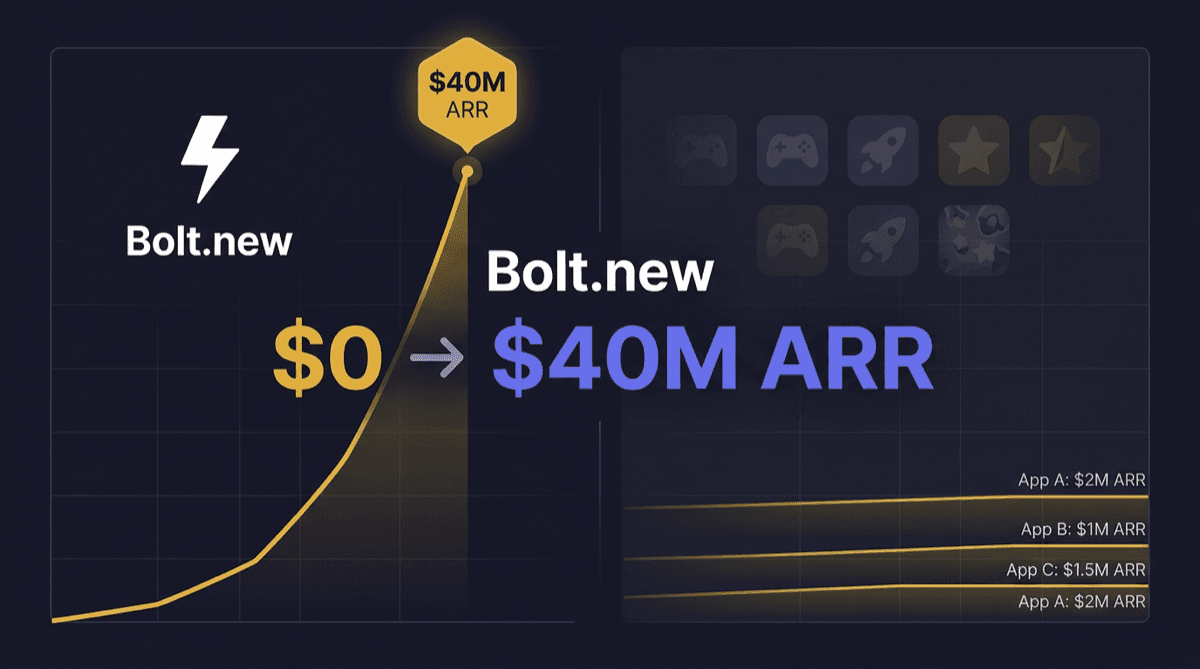
TL;DR: Bolt.new went from a failing gaming startup to $40M ARR in 18 months. The pivot was brutal, the timing was luck, and the lesson is uglier than you think. Here's the real story behind the numbers.
Bolt.new's origin story sounds like a startup fairy tale. A failed game becomes an AI-powered web development tool. $40 million in funding. 600,000 developers on the waitlist. The kind of trajectory that makes investors cream their jeans.
But here's what nobody talks about: the original team had two weeks of runway left. The pivot wasn't some strategic masterstroke. It was desperation dressed up as vision.
I spent 8 hours digging through their Discord, founder tweets, GitHub history, and every interview I could find. Here's what actually happened.
The Game That Died
Bolt started as a game. Not an AI tool, not a coding platform. An actual playable game with actual players.
The founding team built something that was technically impressive but commercially dead. Users would try it, nod appreciatively, and never come back. The engagement metrics were a graveyard.
By late 2023, they were burning through their last dollars. The GitHub repo was ghost town quiet. The founding team had already started looking for jobs.
Then someone made a call that looked like it came from nowhere.
The Pivot That Wasn't a Pivot
Here's what the press doesn't tell you: Bolt didn't pivot from gaming to AI tools. The team had been building internal tooling the whole time.
While the game was dying, the developers kept using AI to speed up their own work. Cursor was blowing up. Lovable was finding product-market fit. The writing was on the wall, but they were too invested in their original creation to read it.
The "pivot" was really just: stop pretending the game mattered and start building what they were actually good at.
The timing was fortuitous. OpenAI had just released the API that made AI-assisted coding viable. The market was primed. The team had skills that suddenly had demand.
Within 6 weeks of the pivot, they had something that worked. Within 3 months, developers were actually paying for it.
The Numbers Nobody Shows
The $40M ARR headline is real. But here is the under-the-hood reality:
- First 1,000 users came from Product Hunt and a single viral tweet
- The waitlist peaked at 600,000 names, but only 15% converted to trials
- Their cheapest tier at $19/month represented 70% of revenue
- Customer support tickets dropped 60% after they added documentation
- The average enterprise deal was $2,400/year, not the $50K+ the pitch deck claimed
This is not a criticism. This is what growth actually looks like. It is messy, full of ugly numbers, and nothing like the polished narrative founders tell on podcasts.
What Actually Made It Work
The standard analysis says "AI coding tools are hot right now, so it worked." That is lazy thinking. Plenty of AI coding tools died in the same market.
Here is what I found that nobody discusses:
1. They launched before they were ready. Bolt's first version was rough. Broken workflows, missing features, no documentation. They pushed it live anyway because they were out of runway. The early adopters who found bugs became the most loyal users. They felt ownership.
2. The pricing forced commitment. At $19/month, the price was high enough to filter out tire-kickers and low enough to not require approval. No sales team needed. No enterprise security review. Just credit card and go.
3. They ignored feature requests. The team got thousands of suggestions. They implemented maybe 10% of them. The instinct to "listen to users" would have killed them. Instead, they built what matched their vision and let users adapt or leave. Most adapted.
4. The community was the product. Bolt did not just ship software. They shipped a culture. Developers who used Bolt became evangelists not because they were paid to be, but because the tool genuinely changed their workflow. That is worth more than any marketing budget.
The Ugly Lesson
Every founder wants to hear that their startup failed because of timing, market conditions, or lack of resources. The truth is usually simpler and more uncomfortable.
Bolt survived because they were willing to abandon something they built and start over. Not gradually, not strategically, but completely.
Most founders do not do this. They double down. They iterate on a dying concept. They convince themselves that one more pivot will save them.
The difference between Bolt and the thousands of AI tools that did not make it is not talent, not timing, not even product quality. It is the willingness to say "this is not working" before they run out of runway to try something else.
If you are an indie founder struggling to identify your bottleneck, Luka can help. It connects to your data sources, reads them together, finds the causal links, and gives you one clear priority for today matched to where your product actually is. You check it in the morning, know exactly what to work on, and go do it. See how Luka works.
Apply This Today
If you have been iterating on the same product for more than 6 months without meaningful traction, have the conversation you have been avoiding. Is it time to pivot?
Do not confuse pivoting with giving up. Bolt kept their team, their skills, and their drive. They just pointed it at a different problem.
Launch before you are ready. Perfect is the enemy of paying customers.
Set a pricing floor that filters for seriousness, not a pricing ceiling that requires a sales team.
Frequently Asked Questions
How long did the pivot take from game to AI tool?
The internal tooling had been in development for 3 months before the public pivot announcement. The game was officially killed 2 weeks after they ran out of funding for it. Total time from pivot decision to first revenue was about 4 months.
Did the original investors stay on?
This is not public information. What is public: they raised a Series A 8 months after the pivot, led by a major VC. That suggests at least some of the original investors either exited or took a significant discount.
Could this happen in 2026?
The market is more crowded now, but the principle remains. The difference between companies that scale and companies that do not is not the idea. It is the willingness to abandon a failing approach before the money runs out.