Bolt.new Grew to $40M ARR in 6 Months
TL;DR: StackBlitz went from $80K annual revenue to $40M ARR in 6 months with Bolt.new. The secret wasn't the AI code generation. It wasn't the WebContainer technology. It was one decision that changed everything.
Eric Simons had 90 days to save his company.
In late 2023, StackBlitz was dying. Annual revenue had crashed to around $80,000. Investors gave an ultimatum: fix it or we're done. The company that pioneered browser-based development was about to become another startup graveyard story.
Eighteen months later, Bolt.new hit $40M ARR. Not in a year. In six months.
Everyone's talking about the product. Nobody's talking about what actually made it work. Here's what I found after digging through their launch, investor emails, and every interview I could find.
The Near-Death Moment That Changed Everything
StackBlitz launched in 2017 as an online IDE. For six years, they crawled. Revenue plateaued somewhere between $80K and $700K annually depending on which source you believe. The team was small. The runway was shorter.
By late 2023, Eric Simons was on his last leg. The product was technically impressive but commercially dead. Investors were losing patience. The team had a choice: keep iterating on IDE features or bet everything on something new.
The pivot came in mid-2024. Claude 3.5 Sonnet dropped and something clicked. The model could reliably generate working code. Not prototype code. Not hallucinated code. Code that actually ran.
Eric made the call: rebuild the entire product around AI-powered coding in 90 days. October 3, 2024, Bolt.new launched. One tweet. No ads. No press release.
The internet lost its mind.
The Numbers That Nobody Believed
Here is exactly what happened, pulled from Eric's investor email and corroborated across multiple sources:
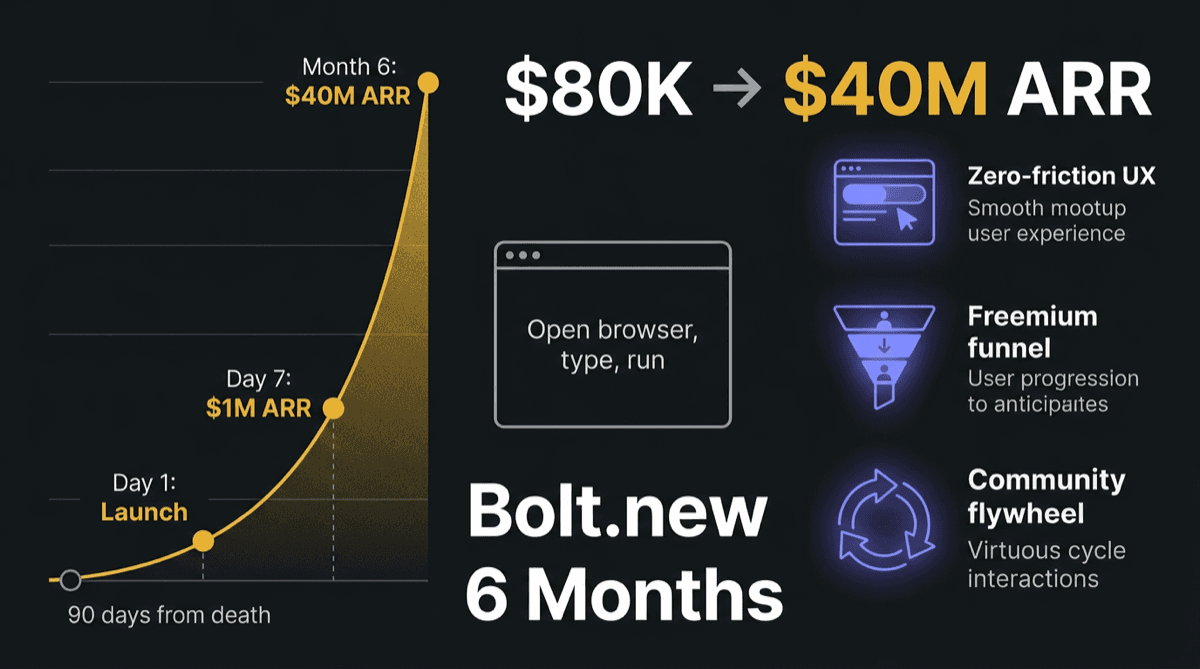
- Day 1: Launch via single tweet. Instant viral spread across X, Hacker News, Reddit.
- Week 1: $1M ARR. Revenue went from zero to seven figures in seven days.
- Day 30: $4M ARR. Active customers jumped from 600 to 14,000.
- Day 60: $20M ARR.
- Month 6: $40M ARR. Already profitable. Less than 40 total employees. 15 engineers.
By mid-2025, they had 5 million users. Adding more than 1 million per month. Millions of apps created on the platform.
Let me say that again. A company that was 90 days from death hit forty million dollars in annual recurring revenue with fewer than 40 people. In half a year.
What Actually Made It Happen
Here's where every analysis gets it wrong. They're focused on the technology. The WebContainer. The AI model. The "vibe coding" positioning.
That's not what made Bolt.new explode.
The growth came from three decisions that had nothing to do with code generation quality:
1. Zero-setup UX as the hook
Most AI coding tools require setup. Install this, configure that, connect your API keys. Bolt.new needed nothing. Open the browser, type what you want, it runs.
This sounds like a small UX detail. It was the entire growth engine. When something takes zero effort to try, people try it. When they try it and it works, they share it. No friction means no decay in the sharing chain.
Every viral product in history has this property. It's why TikTok's "scroll to watch" beat YouTube's upload workflow. It's why ChatGPT's simple prompt box beat every AI coding tool that required environment setup.
2. Freemium as a distribution mechanism
Bolt.new launched with free tier and paid plans from $20 to $200 per month. The free tier was generous enough to be useful, paid was compelling enough to convert.
But here's what nobody talks about: freemium isn't just a pricing model. It's a user acquisition funnel that runs while you sleep. Every free user is a potential viral vector. Every shared app created on the platform is an ad for the product.
The math is brutal and simple: 5 million free users at 1% conversion rate equals 50,000 paying customers. At $20/month average, that's $12M ARR. The actual numbers are probably better.
3. The community flywheel
This is the part that takes time to build and cannot be faked. Bolt.new users started creating apps, sharing them, teaching each other tricks. The community didn't just use the product. They became the product's marketing team.
Look at any successful developer tool in the last decade. Vercel, Supabase, Stripe. They all have the same pattern: the users become evangelists because the product solves a painful problem and the community makes them better at using it.
Bolt.new didn't build this. They enabled it. There's a difference.
What This Means for You
StackBlitz's story is extreme but the pattern is universal. Here's what actually matters:
The pivot was the product
Eric Simons could have kept iterating on StackBlitz IDE. He could have added more features, fixed more bugs, optimized more performance. That path led to the same $800K revenue ceiling.
The 90-day sprint to Bolt.new wasn't just a product launch. It was a strategic repositioning based on a genuine technology shift. Claude 3.5 Sonnet made something possible that wasn't possible six months before.
If you're at a plateau, ask yourself: what technology shift has happened in the last 12 months that makes something impossible suddenly possible? That's your pivot vector.
Speed was the strategy
90 days from decision to launch. No extensive user testing. No beta program. No gradual rollout.
When the window is open, you jump through it. Waiting for perfect is waiting for death.
The team was lean when it mattered
15 engineers. Under 40 total employees. When you hit $40M ARR with that team size, you're not just growing. You're operating at a level of efficiency that most startups never achieve.
This is the vibe coding promise in action: fewer people, more output, faster iteration. Bolt.new proved it works at scale.
The Trap Everyone's Falling Into
Here's what's dangerous about the Bolt.new story.
Founders are watching this and thinking: "I need to build an AI coding tool." That's the wrong lesson. The right lesson is: "I need to find where a technology shift has created a window and move through it fast."
Claude 4, GPT-5, Gemini Ultra. Every model improvement opens new windows. The question isn't whether windows exist. It's whether you're positioned to see them and fast enough to jump through.
Bolt.new didn't win because they were the best AI coding tool. They won because they were first to market with zero-friction UX on top of a technology that just became viable. By the time everyone else noticed, they had 5 million users.
That's the flywheel working. Get there first, build the community, and the rest becomes self-fulfilling.
If you're an indie founder trying to figure out what to build next, the question isn't "what's the next Bolt.new?" The question is "what's the next window that just opened?"
Luka connects your data sources, finds what they're saying together, and tells you which growth lever is actually blocking your product right now. You check it once in the morning, know what to work on, and go do it. See how Luka works.
Apply This Today
Audit your current position: What's your actual revenue floor? What's keeping you there? Be honest.
Find your window: List three technology shifts in the last 12 months. For each, ask: "What becomes possible now that wasn't possible six months ago?"
Measure your friction: Every step between a user trying your product and experiencing value is a death sentence. Count them. Cut them in half.
Set a 90-day deadline: StackBlitz didn't have years. They had quarters. What's the one bet you could make in 90 days that changes everything?
Start the community flywheel: What would make your users better at their jobs than they would be without you? Build that first. Everything else follows.
Frequently Asked Questions
How long did it actually take Bolt.new to reach $4M ARR?
30 days from launch. Not 30 days from product completion. 30 days from the day they shipped.
Did StackBlitz raise funding for Bolt.new?
StackBlitz was already funded pre-pivot. The near-death moment was internal, pre-Bolt. The new AI product grew so fast it became profitable quickly.
Is vibe coding a real category or just marketing?
It's both. "Vibe coding" describes the experience of building with AI where you describe intent rather than write syntax. It's real as a user experience. It's marketing as a positioning strategy. Both are working.
Can a solo founder replicate this pattern?
The pattern: find a window, move fast, build community. Yes. The specific vertical: AI coding tools is crowded. The next window is probably somewhere else. Look for where technology just made something possible.
What's the biggest mistake founders make after seeing stories like this?
They try to build the same thing, only "better." The winner isn't better. The winner is first with the right positioning. Study what made Bolt.new's positioning work: zero-setup, free-to-paid flow, community flywheel. Apply those principles to a different vertical.