How Base44 Went From Side Project to $100M ARR in One Year (The Solo Founder Playbook)
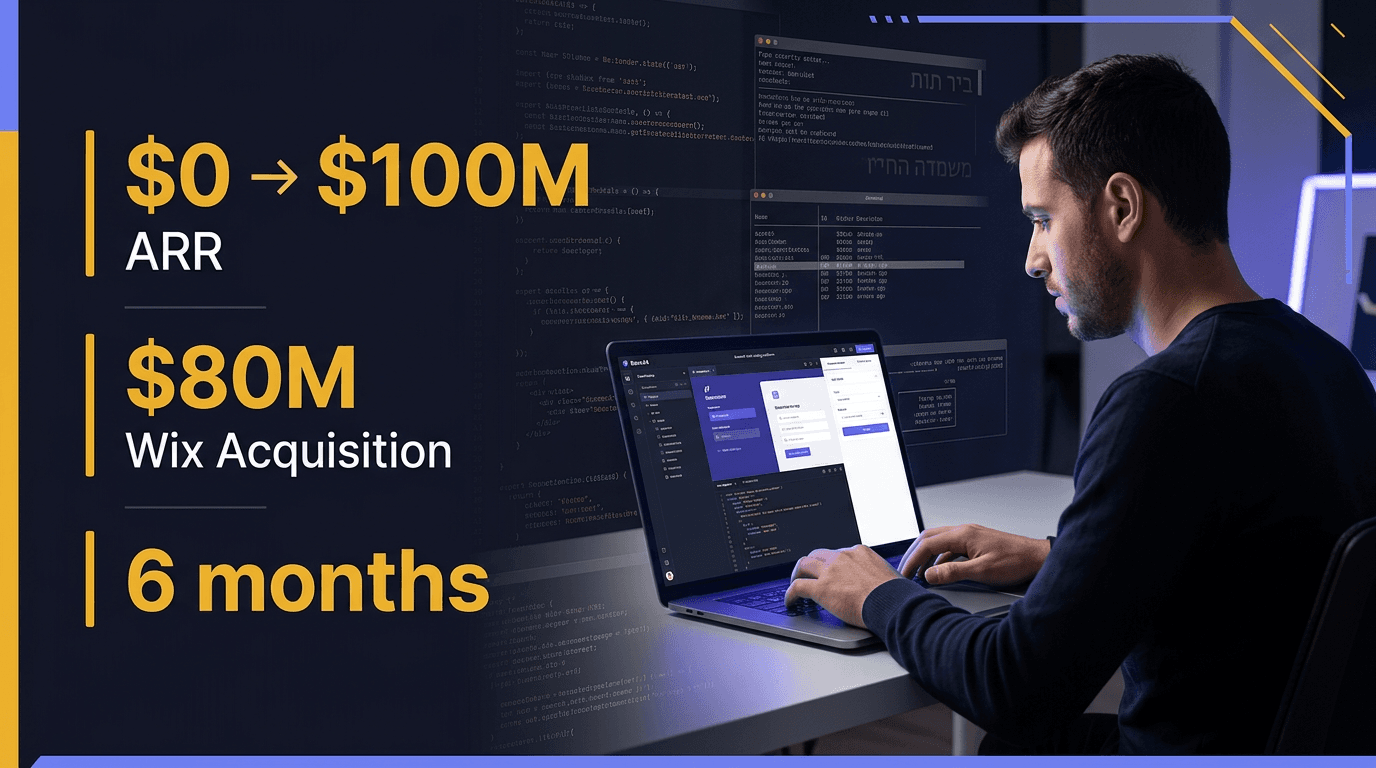
TL;DR: Maor Shlomo built Base44 alone after military reserve duty, hit 250,000 users in 6 months, sold to Wix for $80M without raising a dollar, and reached $100M ARR nine months after acquisition. The playbook: build in public, choose Claude over GPT for cost, and sell before you scale.
I spent two days digging through every piece of this story. TechCrunch coverage, Wix quarterly earnings, LinkedIn posts from launch week, Reddit threads dissecting the deal, Israeli tech press in Hebrew, and a CTech article from five days ago revealing Shlomo is about to pocket an additional $90M in milestone bonuses.
One pattern kept showing up that nobody's highlighting: the decisions that look reckless in real time are the ones that made this work.
The Numbers That Don't Make Sense
Here's the timeline:
- Late 2024: Maor Shlomo finishes extended military reserve duty after the October 7 attacks
- January 2025: Launches Base44 as a side project
- First 3 weeks: 10,000 users
- Month 6: 250,000 users, 8 employees, $189K profit in May alone
- June 2025: Sells to Wix for $80M cash. Zero outside funding raised.
- March 2026: $100M ARR under Wix. Super Bowl commercial aired.
- This week: Shlomo on track for an additional $90M in milestone bonuses
Read that again. A solo developer, coming off military reserve duty, with no funding, built a product to $100M ARR in roughly one year. The $80M acquisition price now looks like a bargain. The milestone bonuses could push his total payout past $170M.
This isn't a Silicon Valley story. This is an Israeli developer who started building during a war.
What Base44 Actually Is
Base44 is a vibe coding platform. You type what you want in plain English. It builds the entire application: database, authentication, storage, analytics, email, texting, maps, API integrations. No code required.
If that sounds like Lovable, Bolt, or Replit, you're right. It is. The category is crowded.
So why did Base44 win?
Not because the technology was better. Not because the timing was perfect (though it was). Because Shlomo made three decisions that most founders get wrong.
Decision 1: Build in Public Before "Building in Public" Was the Plan
Shlomo didn't set out to do a "build in public" strategy. He was a developer who posted about what he was building on LinkedIn and X. That's it.
But here's what happened. Every post documented a real milestone: user count, revenue numbers, technical decisions, mistakes. Not curated content. Not polished threads. Raw updates from someone who was clearly in the middle of figuring things out.
The transparency wasn't a marketing tactic. It was just how he communicated. And that authenticity is exactly what made it spread.
By the time TechCrunch covered the acquisition, Shlomo had already built a following of people who felt like they'd watched the whole journey. They weren't reading about Base44 for the first time. They'd been following along for months.
The lesson isn't "post more on LinkedIn." The lesson is that documenting real decisions, including the ones you're unsure about, builds trust faster than any marketing campaign.
Decision 2: Claude Over GPT (The $189K Profit Month)
This is the technical decision that separated Base44 from competitors burning cash.
Shlomo publicly documented his choice to use Anthropic's Claude through AWS instead of OpenAI's GPT models. His reasoning was cost-per-performance. Not ideology. Not preference. Pure unit economics.
At 250,000 users generating apps through LLM prompts, token costs are your biggest variable expense. The difference between a 20% margin and a 60% margin on each generation comes down to which model you're calling and how efficiently you're doing it.
May 2025: $189,000 in profit. After covering all LLM token costs. With 8 employees.
Most vibe coding startups in 2025 were burning cash trying to grow. Base44 was profitable. Not "will be profitable eventually" profitable. Actually profitable. Right now. Money in the bank.
That profitability made the Wix acquisition possible on Shlomo's terms. When you don't need money, you negotiate differently. He wasn't selling because he had to. He was selling because the price was right.
Amazon noticed the Claude choice too. They invited Base44 to demo at an AWS event in Tel Aviv. Free distribution from a tech giant, earned by making a public technical decision and explaining why.
Decision 3: Sell Before You Scale
This is the one that confuses people.
Six months in. 250,000 users. Growing fast. Profitable. No outside investors to answer to. Why sell?
The conventional wisdom says: keep going. Raise a Series A. Scale to millions of users. Build a billion-dollar company.
Shlomo sold for $80M cash. As the sole shareholder (minus $25M in retention bonuses for his 8 employees), he walked away with roughly $55M for six months of work.
Here's why this might have been the smartest move in the story.
Vibe coding in 2025 was a gold rush. Lovable raised $200M. Bolt was doing $40M ARR. Replit had massive funding. OpenAI was about to acquire Windsurf for $3B (a deal that eventually collapsed). The window was open, and every major platform was buying.
Shlomo recognized something that most founders miss: the value of a hot asset is highest when multiple buyers want it and the market is still growing. Wait another year and the competitive dynamics could shift. Someone bigger could clone your features. The LLM cost advantage could disappear.
He took the money. And then he kept building inside Wix, where Base44 had access to Wix's 250 million registered users, enterprise sales team, and a Super Bowl ad budget.
The result? $100M ARR nine months after acquisition. He couldn't have gotten there alone in that timeframe. The Wix acquisition wasn't an exit. It was an acceleration.
The Super Bowl Moment
February 8, 2026. Super Bowl LX.
Base44, a product that didn't exist 14 months earlier, aired a 30-second commercial during the biggest sporting event in America.
The ad showed an office worker building a budgeting app during a boring meeting. The slogan: "It's App to You." The audience: 120 million viewers.
For context, a Super Bowl ad costs roughly $7-8 million for 30 seconds of airtime. That's not counting production costs. This was Wix betting big on Base44 as their growth engine, not just an acqui-hire they were integrating quietly.
Shay Korin, VP of Marketing at Base44: "The pace of growth at Base44 over the past year has been extraordinary, and appearing during the Big Game is a marker of that momentum."
The $90M Bonus Nobody's Talking About
Five days ago, CTech reported something buried in Wix's Q4 2025 earnings: Shlomo is on track for an additional $90M in cash bonuses tied to revenue milestones.
Let me do the math on what this means.
Original acquisition: $80M cash. Retention bonuses for team: $25M. Shlomo's share of original deal: roughly $55M. Milestone bonus: $90M. Total potential payout: $145M+ for Shlomo personally.
For a company he founded roughly 14 months ago. With no outside investors. Eight employees.
The milestone structure tells you something about how the deal was designed. Wix didn't just buy Base44. They bought Shlomo's continued execution. The $80M was the entry. The $90M bonus ensures he keeps shipping.
Wix's Q4 2025 numbers confirm the bet is paying off. Business solutions revenue (the segment including Base44) grew 18% year-over-year to $153.8M. Total Wix revenue: $524.3M quarterly.
What This Means for Solo Founders
The Base44 story is not replicable in the obvious sense. You can't just "build a vibe coding tool and sell it to Wix." The timing, the market, the specific circumstances of the acquisition window, none of that repeats.
But the principles do.
Principle 1: Profitability is power. Every conversation changes when you don't need money. Shlomo negotiated an $80M all-cash deal because he could walk away. If he'd raised a Series A at a $200M valuation, his negotiating position would have been weaker, not stronger, because he'd have investors with preferences about exit timing and price.
Principle 2: Public technical decisions are marketing. The Claude-over-GPT post wasn't a marketing campaign. It was a genuine technical decision, shared publicly. But it accomplished what no ad campaign could: it positioned Base44 as a thoughtful, cost-conscious operation in a market full of cash-burning startups. Amazon noticed. The developer community noticed. Potential acquirers noticed.
Principle 3: The window matters more than the trajectory. Base44 could have kept growing independently. Maybe it would have reached $100M ARR on its own. Maybe not. What Shlomo recognized was that the acquisition window, multiple buyers in a hot market, was a more certain path to a massive outcome than the uncertain path of independent scaling.
Principle 4: Build what works, not what's novel. Base44 wasn't a breakthrough technology. It was a well-executed version of something several other companies were also building. The differentiation wasn't the product. It was the execution speed, the cost structure, and the distribution (building in public).
The Uncomfortable Truth About Timing
I want to be honest about something.
Base44's success is partly a function of timing that cannot be manufactured. Vibe coding exploded in late 2024 and early 2025. The LLMs were good enough. The infrastructure was ready. The market was hungry.
If Shlomo had built Base44 in 2023, the LLMs wouldn't have been capable enough. If he builds it in 2027, the market is saturated and the acquisition premiums are gone.
He caught the wave. Skill mattered. Decisions mattered. But so did timing.
The takeaway isn't "wait for the perfect moment." It's "when the moment arrives, move fast and don't overthink it." Shlomo went from idea to $80M exit in six months. Not because he had a perfect plan. Because he executed while the window was open.
The Comparison Nobody's Making
Let me put Base44 in context with other vibe coding exits:
| Company | Founded | Revenue at Exit | Exit Price | Acquirer |
|---|---|---|---|---|
| Base44 | Jan 2025 | ~$3.5M ARR | $80M cash | Wix |
| Windsurf | 2020 | $82M ARR | $3B (collapsed) | OpenAI (failed) |
| Windsurf | 2020 | $82M ARR | Acquired | Cognition |
Base44 was acquired at a 22x revenue multiple on roughly $3.5M ARR. That's aggressive even by 2025 standards. But given that it reached $100M ARR within nine months, Wix's bet was validated almost immediately.
The Windsurf story is the cautionary contrast. OpenAI agreed to acquire Windsurf for $3B. The deal collapsed because Microsoft's partnership agreement gave them access to any OpenAI acquisition's IP. Windsurf's CEO refused to let GitHub Copilot's team access their technology. Cognition (the company behind Devin) eventually acquired them instead.
Shlomo avoided this entirely by selling to Wix, a company without complicated partnership agreements or competing products that would cannibalize Base44.
What Happens Next
The vibe coding market is consolidating fast. Wix has Base44. Cognition has Windsurf. Cursor just hit $2B ARR (as of March 2026, doubling in three months). The indie vibe coding startups that haven't found a buyer or reached scale are running out of runway.
For solo founders watching this space, the signal is clear: the tools are getting better and cheaper. Building a SaaS product without coding experience is now genuinely possible, not theoretical. The barrier to entry has collapsed.
That also means the barrier to competition has collapsed. If anyone can build an app in minutes, your competitive advantage isn't your code. It's your understanding of the problem, your distribution, and your speed of iteration.
The hardest part of the Base44 story isn't the building. It's the deciding. When to sell. When to pivot. When to invest in one architecture over another. Shlomo made those calls fast, with real data, and he was right enough times in a row that the outcome looks inevitable. It wasn't.
Every solo founder faces a version of these decisions. The data that helps you make them is scattered across your analytics, your error logs, your user feedback, your revenue by segment. Reading all of it separately gives you fragments. Reading it together gives you direction.
Luka connects those data sources, finds the causal links between what your analytics say and what your users are actually experiencing, and surfaces the one thing most blocking your growth at your current stage. You check it once in the morning, see what to work on, and go execute. Not a dashboard to analyze. A decision, already made. See how Luka works.
Apply This Today
You don't need to build the next Base44. But you can apply the same decision framework:
1. Calculate your real unit economics this week. Not projected. Actual. What does it cost you per user per month? Per transaction? Per LLM call? If you can't answer this precisely, you don't know if your business model works yet.
2. Make one technical decision public. Write a post about why you chose your database, your hosting provider, your LLM model. Not a tutorial. A decision log with real numbers. This is the cheapest marketing you'll ever do.
3. Know your exit math. What would you accept today? What would need to be true for that number to make sense? If a buyer showed up tomorrow, would you be ready for the conversation? Most founders have never thought about this, and they should. Even if you never sell, knowing your number changes how you build.
4. Check your timing. Is the market you're building for heating up, cooling down, or stable? If it's heating up, speed matters more than perfection. If it's cooling, profitability matters more than growth. If it's stable, distribution matters more than features.
Frequently Asked Questions
How much did Maor Shlomo make from the Base44 acquisition?
The original deal was $80M cash. $25M went to retention bonuses for Base44's 8 employees. Shlomo, as the sole shareholder, received roughly $55M from the initial deal. Wix's Q4 2025 report revealed he's on track for an additional $90M in milestone bonuses, potentially bringing his total payout to $145M or more.
Did Base44 raise any venture capital?
No. Base44 was entirely bootstrapped. Shlomo never raised outside funding. He was the sole shareholder at the time of acquisition. This gave him complete control over the deal structure and timing, which is why he could accept an all-cash offer without needing board approval or investor consent.
What technology does Base44 use?
Base44 uses Anthropic's Claude models through AWS for its LLM layer. Shlomo publicly documented choosing Claude over OpenAI's GPT models for cost-per-performance reasons. This decision contributed to Base44's profitability ($189K profit in May 2025) at a time when competitors were burning cash on token costs.
Is Base44 still independent after the Wix acquisition?
Base44 operates as a product within Wix but maintains its own brand and team. It reached $100M ARR nine months after the acquisition. Wix also aired a Base44 Super Bowl commercial in February 2026, indicating significant investment in the brand's growth independently of the main Wix platform.
Can I build a product like Base44 in 2026?
The vibe coding market is now largely consolidated among well-funded players. Building a direct Base44 competitor would be extremely difficult. However, the playbook (bootstrapped, profitable, built in public, sold at the right window) applies to many other markets. The key is finding a category that's heating up where major platforms might become acquirers.
About the Author