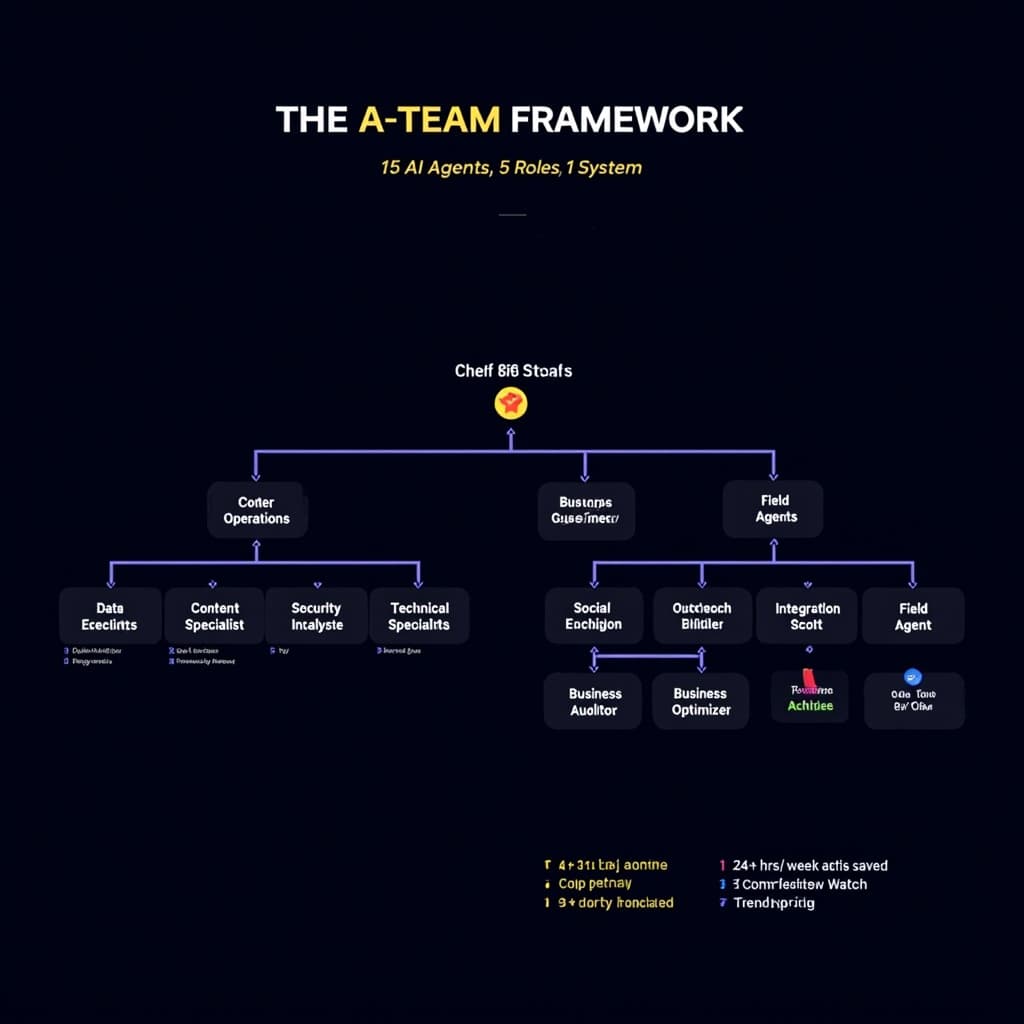
How to Manage Your AI Agent Team: Hiring, Leveling, and Performance Reviews
TL;DR: Most solo founders running multiple AI agents are doing it wrong. They're not managing a team, they're playing whack-a-mole with prompts. Here's the actual framework for treating your agents like employees: hiring protocols, leveling systems, and performance reviews that actually improve output over time.
I spent three months running five AI agents simultaneously before I figured out what was broken. Not the agents. My management of them.
Every morning I was context-switching between four different chat interfaces, re-explaining the same project background to different agents, and watching outputs that felt like they came from strangers who happened to be in the same room. Sound familiar?
What I needed wasn't better prompts. It was an actual management system. And it turns out, managing AI agents isn't that different from managing humans. The principles transfer almost exactly.
Here's what I built.
The Problem With Most AI Agent Setups
If you're running more than one AI agent and it feels chaotic, you're not alone. The typical setup looks like this:
You have a Claude agent for coding. A ChatGPT agent for research. A Midjourney agent for images. Maybe a second Claude instance for writing. And every time you switch context, you're spending 10-15 minutes re-explaining what you're working on, what matters, what's already been tried.
That's not a team. That's a collection of contractors who don't know each other.
Real teams have shared context. They have protocols. They have ways of escalating problems up the chain. They have performance metrics that get reviewed and acted upon.
Your AI agent setup should work the same way.
The Hiring Protocol: How to Onboard a New Agent
Before you add any new agent to your stack, answer these questions:
1. What is this agent's specific job? Not "it'll help with stuff." What exact function does it own? Write out the job description. For my writing agent, the JD looks like this: "Owns all long-form content. Blog posts, landing page copy, email sequences. Feeds into the distribution agent for social promotion. Reports to me."
2. What does success look like in 30 days? What output metric will you use to evaluate this hire? For a research agent, it might be "delivers 3 actionable insights per week that make it into final content." For a coding agent, it might be "reduces my shipping time by 40%."
3. Who does this agent collaborate with? Define the handoff points explicitly. My writing agent hands off to the distribution agent. The distribution agent knows what format to expect, what additional context to add, and where to flag problems back.
4. What is this agent NOT responsible for? Boundary setting prevents role creep and context pollution. When every agent thinks it owns everything, nothing gets owned.
Once you've answered these, you don't just "add the agent." You run a structured onboarding:
Week 1: Feed the agent your best examples of what good output looks like. Not prompts. Examples. Show, don't tell.
Week 2: Give the agent real tasks with close supervision. Review everything. Don't just accept output, understand their reasoning.
Week 3: Trust but verify. Let the agent work more independently but spot-check outputs.
Week 4: First formal performance review. Are they hitting the 30-day success criteria?
This sounds like overkill until you realize you're making a multi-month commitment to these agents. The upfront investment pays off exponentially.
The Leveling System: Junior, Mid, and Senior Agents
Not all agents are created equal, and treating them that way is where most people go wrong.
I run a three-level system:
Junior Agents (Entry Level)
These are single-purpose agents with narrow scope. They do one thing, one way, every time. My first research agent was Junior: it took a topic and returned a structured summary of what it found. No interpretation. No takes. Just information retrieval.
Junior agents need:
- Very specific prompts
- Frequent feedback on quality
- Clear handoff protocols to higher levels
- Lots of examples of "this is right, this is wrong"
Mid-Level Agents
These agents have context and judgment. They understand not just what to do, but when to deviate from standard process. My main writing agent is Mid-level: it knows my voice, knows my audience, and knows when something I wrote is off-brand.
Mid agents need:
- Broad context about your business and priorities
- Permission to push back when instructions don't make sense
- Regular calibration sessions to align on quality bar
- Less frequent but more substantive feedback
Senior Agents
These agents own a domain completely. They don't wait for instructions. They identify problems, propose solutions, and execute. They review the work of lower-level agents. They escalate what they can't resolve.
My "Head of Distribution" agent is Senior. It owns the entire content distribution flow: takes finished blog posts, generates social content, monitors engagement, flags what's working for double-down.
Senior agents need:
- Full context on strategy and priorities
- Authority to make decisions within their domain
- Performance data to self-correct
- Trust to operate without micromanagement
The key insight: you don't start agents at Senior level. You level them up by proving competence at the level below. It's the same career ladder as any good company.
The Performance Review: How to Actually Evaluate Agent Output
Most founders evaluate AI agents like they evaluate a Google search: one-off, transactional, right-or-wrong. That's not a performance review. That's a pop quiz.
Real performance reviews are:
1. Consistent over time You track output quality week over week. Not one good week. A trend. Is the agent getting better? Are errors decreasing?
2. Multi-dimensional You evaluate on several axes, not just "did it complete the task":
- Accuracy (is the output correct?)
- Coherence (does it make sense in context?)
- Efficiency (did it take reasonable time?)
- Initiative (did it catch things you didn't explicitly ask for?)
- Communication (did it flag problems appropriately?)
3. Acted upon The review leads somewhere. If an agent is weak on accuracy, you add validation steps to their process. If they're weak on initiative, you add more context.
Here's my weekly agent review template:
Agent: [Name]
Week of: [Date]

Accuracy: [1-5] Notes: [specific examples]
Coherence: [1-5] Notes: [specific examples]
Efficiency: [1-5] Notes: [timing vs baseline]
Initiative: [1-5] Notes: [what did they catch that you missed?]
Communication: [1-5] Notes: [did they escalate appropriately?]

Issues identified: [specific problems]
Improvement actions: [specific changes to process/prompts/context]
Verdict: [Promoted / Maintained / Put on improvement plan]
Run this weekly. It takes 10 minutes per agent. The compounding effect on output quality is extraordinary.
The Delegation Stack: What Goes to Which Agent
Here's the actual delegation structure I run:
Strategic thinking: Me (no agent替代) Research: Research agent (Junior, escalation to Mid) First drafts: Writing agent (Mid-level) Editing and voice: Me or Writing agent (depends on stakes) Distribution: Distribution agent (Senior) Code and technical: Coding agent (Mid-level) Image generation: Image agent (Junior)
The key principle: don't delegate judgment to lower-level agents. Strategic decisions stay with you or go to your most senior agents. Junior agents execute.
This sounds obvious when stated plainly. But most people are asking Junior agents to do strategic work and wondering why outputs feel shallow.
The Context Management Problem
The single biggest productivity killer with multiple agents is context pollution. Agent A doesn't know what Agent B did. Agent B doesn't know Agent A's constraints. You become the human middleware, constantly re-explaining and re-contextualizing.
The fix: shared context documents that every agent can read.
I maintain a "Team Context" document that every agent has access to. It contains:
- Current project status and priorities
- What's been tried and what failed
- Key constraints and deadlines
- Tone and voice guidelines
- What's working and what's not (from performance reviews)
Before any agent starts work, they read the relevant section of Team Context. This alone cut my context-switching overhead by 60%.
What Luka Does With All This
Here's the thing: running multiple AI agents across your business creates a coordination problem that most founders don't see coming. You have research agents producing insights, writing agents producing content, distribution agents promoting it, and coding agents building features. Every one of them is generating signals about what's working and what isn't.
The problem isn't having the data. The problem is reading it together.
Your research agent tells you what topics are resonant. Your distribution agent tells you what content is getting engagement. Your coding agent tells you what features are causing errors. These are three separate data streams telling you three separate things about the same business.
Luka reads those signals together. It connects across your data sources, finds the causal links, and tells you what to work on today based on where your product actually is. Not what feels urgent. Not what one agent flagged. What the full picture says is blocking your growth right now.
When you run a multi-agent operation, that integration layer isn't nice to have. It's the difference between a team that reports to you and a team that's actually aligned.
You run the strategy. You run the reviews. Luka makes sure you're looking at the right data to make those calls.
The 30-Day Agent Upgrade Plan
Week 1: Audit your current setup Map every agent you have. For each one, document: what is it supposed to do? How do you measure success? When was the last time you reviewed its performance? If you can't answer those three questions for every agent, start there.
Week 2: Implement the hiring protocol For any agent without a clear job description and success criteria, create them. Now. Write out the JD. Define what good looks like in 30 days. Share it with the agent (yes, you can do this).
Week 3: Run your first performance review Use the template above. Evaluate every agent on every dimension. Identify the single biggest gap. Fix that gap first.
Week 4: Implement shared context Create your Team Context document. Start with project status, priorities, and what's been tried. Give every agent read access. Require them to check it before starting new work.
By the end of month one, you have a team that knows what it's supposed to do, how it's performing, and what context it needs to do it well.
That's not a collection of AI tools anymore. That's a team.
Common Mistakes to Avoid
Mistake 1: Over-engineering before you need it Don't build a full org chart for three agents. Start simple. Add structure when the complexity is actually there, not when you imagine it will be.
Mistake 2: Treating all agents as equal A research agent and a strategy agent need completely different management approaches. Level them differently. Evaluate them differently.
Mistake 3: No performance review cadence An agent that never gets reviewed never improves. Weekly reviews are the minimum. Monthly for stable agents.
Mistake 4: Keeping context in your head If the only place context lives is in your brain, you have a single point of failure and a massive bottleneck. Externalize everything.
Mistake 5: Delegating strategy to Junior agents Junior agents execute. Senior agents think. If you're asking a research agent to tell you what to work on next, you're doing it wrong.
Frequently Asked Questions
How many agents should a solo founder run?
Start with two: one for content, one for research or distribution. Get those working well before adding more. Most founders who try to run five agents from day one end up with five agents doing mediocre work instead of two doing excellent work.
Should agents have names?
Yes. It sounds silly, but naming creates ownership and makes it easier to think about them as team members rather than tools. My agents have names, roles, and even personality notes that reflect how they approach problems.
How do I know when to level an agent up?
When a Junior agent consistently performs at 4/5 or higher without requiring correction, give them more autonomy. When a Mid-level agent starts anticipating problems before you flag them, they're ready for Senior-level responsibility.
What if an agent keeps underperforming?
Run three consecutive performance reviews. If the gap persists despite specific feedback and process changes, the agent isn't right for the role. Either retrain with better examples and context, or move them to a simpler role.
Can I automate the performance reviews?
Partially. You can track output metrics automatically (time to complete, error rate, revision requests). But the qualitative dimensions (coherence, initiative, judgment) still require human evaluation. Don't fully automate this away.
About the Author