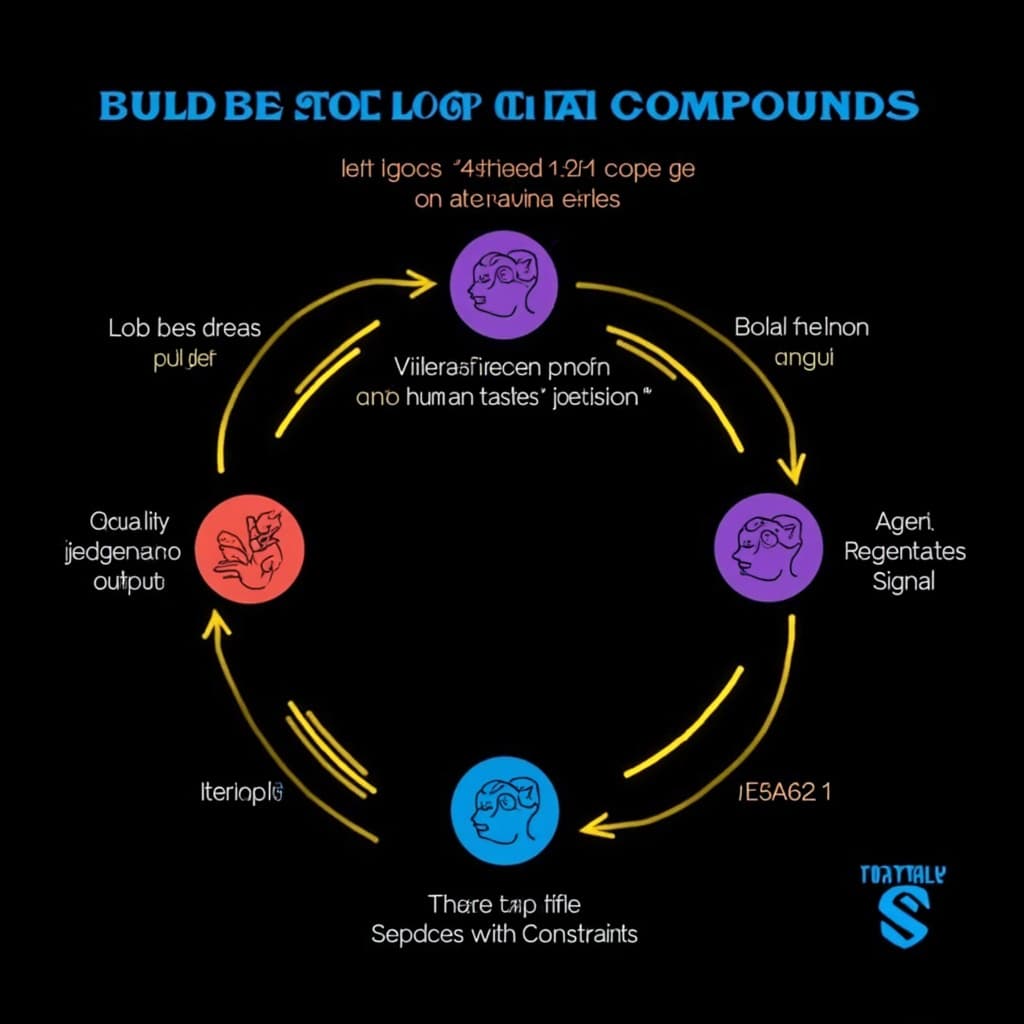
How to Build an Agent Feedback Loop That Actually Self-Improves
TL;DR: Most AI agent setups run the same way forever. Same outputs, same mistakes, same flat performance. The founders who get compound gains from their agents build one specific thing into their architecture: a feedback loop that closes the gap between what the agent produced and what you wanted. Here's exactly how to design one.
I spent three weeks watching why agent setups fail.
Not the dramatic failures. Not the obvious "the agent gave me complete bullshit" moments. The quiet failure mode. The one where the agent is working, technically, and producing output, and you're reviewing it and going "this is fine" and then looking at your analytics and wondering why nothing improved.
The gap is always the same thing. The agent doesn't know what "better" looks like in your specific context, because nobody told it. Not in the prompt. Not in a subsequent message. Nobody built the loop.
Here's what I found in the setups that actually compound over time.
The Quiet Agent Failure Mode
Most solo founders who use AI agents are running a one-way street. They prompt. The agent responds. They use the response. Next task.
No signal goes back about quality. No capture of what landed versus what flopped. No update to the agent's operating context based on what happened downstream.
This works fine for one-off tasks. You need a landing page copy, you prompt, you get copy, you use it. Transaction complete.
But for recurring agent tasks, this is a compounding tax you're paying every single cycle. The agent is optimizing for "complete the task" not "complete the task in a way that moves your metrics." It doesn't have the feedback loop to know the difference.
The founders who get real leverage from agents figured out the loop that closes this gap. It's not more prompting. It's architecture.
What a Real Agent Feedback Loop Looks Like
A feedback loop has four components:
1. Output capture. The agent's work gets saved somewhere that you can reference later. Not just "I have the copy." More like "the agent produced this version of the copy, with these choices, and here's the outcome when it went live."
2. Quality signal. You decide what "better" means for this task and communicate it back. This can be explicit ("this angle on the headline worked 40% better than the other one") or implicit (the A/B test result, the conversion signal, the comment that said exactly the right thing).
3. Context update. The agent's next task starts with this signal folded in. Not just "write a headline" but "write a headline using the angle that tested better last time."
4. Iteration trigger. If quality signal is negative enough, the loop activates a re-run or a redesign rather than accepting the output and moving on.
This sounds obvious when described abstractly. The implementation is where it falls apart for most people.
The Three Loop Architectures That Actually Work
After watching what the top-performing agent setups do, three patterns emerge consistently.
Pattern One: The Outcome Tracker
For every recurring agent task, something tracks what happened when the output went live. Not "did you use it." Did it work.
The simplest version: a shared doc or a simple database table where you log the task, the output reference, and the outcome signal.
When the agent comes back to do the next iteration of that task, the first thing in the prompt is "here's what happened last time." Not "here's the context." Specifically: "last three times you wrote headlines for this campaign, the A/B test results were X, Y, Z. The pattern is Z won. Optimize for Z."
This is the difference between an agent that's learning and one that's repeating.
Pattern Two: The Reject and Refine Trigger
Set a threshold for automatic refinement. If the agent's output doesn't meet a defined quality bar, it gets sent back automatically with the specific failure mode named.
The key is specificity. Not "try again." "The headline you wrote buried the lead. The product name doesn't appear until word 7. It needs to be in the first 5 words. Rewrite."
The failure mode feedback is the learning signal. The agent doesn't learn from "try again." It learns from "you buried the lead."
This requires you to define what "good" looks like before you run the task. Which sounds obvious. Most people don't do it. They just run and hope.
Pattern Three: The Judgment Call Separation
One of the most underrated patterns: separate what the agent does from who decides if it's right.
The agent handles generation, variation, research, first drafts. You handle the judgment call. Then the loop feeds the judgment back in.
The reason this works better than you'd think: humans are better at taste judgment than generation. Agents are better at volume and variation than taste. When you separate these, the agent becomes a taste-amplification tool, not a taste-replacement tool.
The loop closes because the judgment you made gets translated into constraints for the next generation round. "Generate 15 variations." You pick the best 2. The next round of generation gets told "only generate variations with this quality bar."
The Real Reason Most Feedback Loops Fail
Here's what I kept finding: the feedback loops that fail aren't missing the architecture. They're missing specificity in the signal.
Most founders give the agent feedback like this: "good job" or "that didn't work" or "try a different approach."
These are noise as far as the agent is concerned. "Didn't work" tells it nothing about what aspect failed. "Try a different approach" is a redirect, not a learning signal.
The agents that actually improve over time are getting feedback like this: "The intro buried the lead in all 3 versions. The product name needs to be in the first sentence. The tone should be more direct, less explanatory. Here are 5 examples of the tone we're going for."
Specificity is the signal-to-noise ratio in the loop. High specificity = high signal. Generic feedback = noise.
This is also why you need to define quality criteria before the task, not after. If you decide what's "good" only by looking at the output, you can't give the agent the criteria before it generates. You can only say "try again, different." Which is noise.
Building Your First Loop (In Practice)
The fastest path to a working feedback loop:
Step 1: Pick one recurring agent task. Don't try to loop everything at once. Pick the one you run most often, where the quality variance between runs matters most.
Step 2: Define the quality bar explicitly. Before the next run, write down: what does "good" look like? What specific outcome does this output need to produce? What are the 2-3 non-negotiables?
Step 3: Run, capture, judge. Run the task. Save the output. Judge it against the bar. Name the specific failure modes if it doesn't pass.
Step 4: Feed back specifically. For the next run, start the prompt with the quality bar from Step 2 AND the specific failure signals from Step 3. Not "you did this wrong" but "the issue was X, avoid X specifically."
Step 5: Iterate twice before evaluating. Don't evaluate after one loop. Give the agent two rounds of specific feedback before you decide if the loop is working.
The first iteration is learning the specific failure mode. The second iteration is testing whether the learning stuck.
What Gets Better When the Loop Is Working
The compound effect kicks in around iteration 4 or 5. The agent starts converging on your taste. The revisions needed per output drop. The quality floor rises.
You're not prompting better. You're not using a better model. You've built an architecture where the agent is getting smarter about your specific context with every cycle.
That's the leverage nobody talks about. Not "use more agents." Build the loops so the agents you have are compounding rather than repeating.
The founders who figured this out aren't running more agents than anyone else. They're running the same agents with a loop that makes each cycle better than the last.
Most solo founders using AI agents are running them without the loop that closes the gap between "output produced" and "output that actually moves your metrics." The gap is invisible until you measure it. Then it's glaring.
The part that stays hard after you build the loop: specificity in the feedback signal. You have to know what "better" means for your specific context, and you have to translate that into constraints the agent can actually act on. That's a skill that gets easier with practice, but it starts with being explicit about the quality bar before you run anything.
Luka connects your data signals and helps you identify which agent tasks are actually worth optimizing with a feedback loop, based on what your analytics show is moving. It helps you prioritize where the loop architecture will compound fastest. You check it in the morning, know what to work on, close it, go execute. See how Luka works.
Frequently Asked Questions
How long does it take for a feedback loop to start working?
Most founders see measurable improvement by the third or fourth iteration cycle. The first two cycles are the agent learning your specific context and failure modes. The gains accelerate after that. If you're not seeing any improvement by cycle 5, the issue is usually specificity in the feedback signal, not the loop architecture.
Do I need to build this manually or are there tools that handle it?
You can build it manually with a shared doc and explicit prompts. That's the minimum viable loop. There are also frameworks and tools emerging for agent memory and context management. The key distinction: the loop is about your quality judgment getting back into the system, not about a tool storing context. Tools help with storage. The judgment loop is on you.
What if I only use agents for one-off tasks, not recurring work?
One-off tasks don't need a feedback loop, by definition. The loop is only valuable for recurring tasks where the agent is doing the same type of work repeatedly and you'd want the quality to improve over time. For one-off tasks, focus on quality bar definition before running, not loop architecture.
How many feedback loops should I have running at once?
Start with one. Maximum two. The constraint isn't your ability to manage loops, it's your ability to be specific in the feedback signals. Each loop needs high-quality judgment from you. If you spread yourself across three loops before the system is built, you'll give mediocre signal to all three, which means none of them will compound. One tight loop beats three weak ones.
About the Author