The 60-Minute Ritual That Saved Me From Founder Burnout
TL;DR: I was 8 weeks from a complete breakdown. Working 14-hour days, shipping constantly, and getting nothing that mattered done. The fix wasn't more productivity hacks. It was one hour, every morning, that I protected like my company's survival depended on it. Because it did.
By February of this year, I was a mess.
Not "busy" or "a little stressed." A full structural failure of my ability to think clearly, make decisions, or care about what I was building. I'd close my laptop at midnight, lie in bed until 3am anxious about everything I hadn't done, wake up exhausted, and start the whole cycle again.
I knew I was burning out. I just didn't know how to stop.
Everyone's burnout story sounds the same because the mechanics are the same. You start working hard because you care. The work compounds. You keep upping the hours. Eventually you're running on caffeine and cortisol and the quality of everything you produce starts degrading in ways you can't see because you're too close to it.
The breaking point for me was a Sunday afternoon. I'd been "working" for 10 hours. I had nothing to show for it. Not nothing good. Nothing. I opened twelve tabs, closed nine of them, answered some emails, didn't finish anything, and at the end of the day couldn't tell you what I'd actually accomplished.
That's when I knew something had to change fundamentally, not incrementally.
What Everyone Gets Wrong About Burnout
The conventional wisdom on burnout says: work less, sleep more, take vacations, delegate.
That's not wrong. It's also not actionable for most solo founders who can't just take a month off or hire a team overnight.
The thing nobody talks about is that burnout isn't primarily about hours. It's about decision collapse.
Here's what I mean. Every decision you make depletes the same cognitive resource. What to work on first. Whether to send that email now or later. Whether a piece of copy is good enough. Whether to fix that bug or ship the feature. Whether that meeting was worth the time.
At normal operating capacity, your decision-making improves with practice. You develop heuristics. You get faster. You build routines that reduce the cognitive overhead of common choices.
But when you're in high-stress, high-output mode for too long, something changes. The decisions don't get easier. You start avoiding them. Or worse, you make them arbitrarily, without the information or energy they deserve.
I watched myself start making objectively bad decisions at least a dozen times in those eight weeks. Sending emails I'd regret. Committing to features that weren't right. Saying yes to things that were wrong for the business. And each time, I'd look back and think "how did I not see that?"
The answer was that I was running on empty and didn't know it.
The 60-Minute Ritual
The ritual I built is stupidly simple. Every morning, before I check Slack, before I look at my phone, before I open a single tab, I do one hour of focused reflection work.
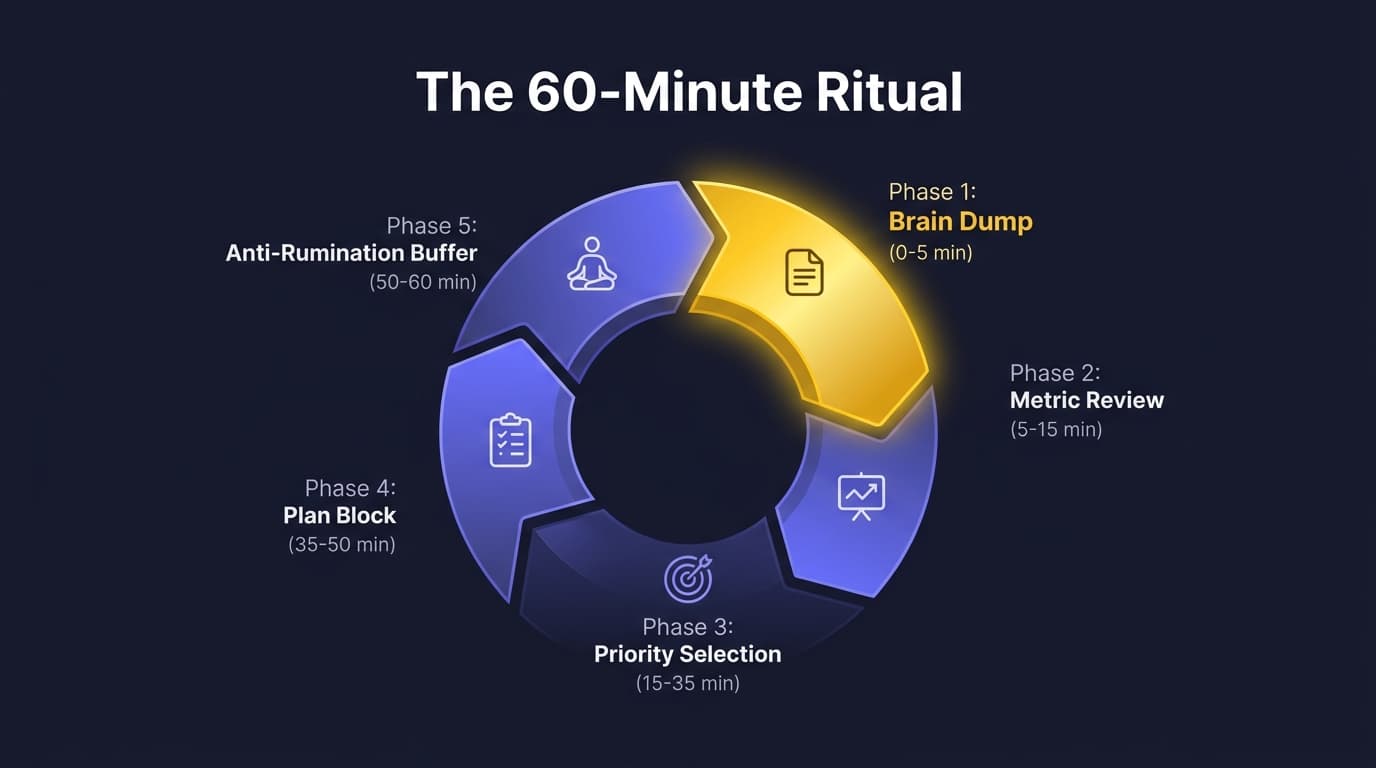
It has four parts. They take exactly 60 minutes.
Part 1: Harvest (10 minutes) I open a blank document and just write. No structure. No agenda. What's in my head right now? What's worrying me? What did I forget to do? What decision am I avoiding? What am I most dreading today?
I don't solve anything here. I just harvest. Like clearing a cache.
The rule is: write until you've emptied the contents of your brain onto the page. Sometimes that's five minutes. Sometimes it's the full ten. When there's nothing left to write, I stop.
Part 2: Categorize (5 minutes) I look at what I wrote and put it into four buckets:
- Today (must happen today)
- This Week (important but not urgent)
- Delegate or Delete (doesn't need to be me)
- Worrying But Not Real (anxiety that needs to be acknowledged and set aside)
The critical move here is the last bucket. Half of what ends up on my mind is not a real problem. It's anxiety wearing a problem's clothes. Naming it separates it from the actionable items and reduces its grip on your thinking.
Part 3: Prioritize (15 minutes) I look at the "Today" bucket and do one round of ruthless prioritization. Not "these are all important" hedging. I pick the one thing that if I do nothing else today, will have mattered most by end of day.
That's my non-negotiable. The one thing I must complete, regardless of what else happens.
Then I look at "This Week" and identify the two or three items that are the real leverage points. These are the things that, if I make significant progress on them, everything else becomes easier or unnecessary.
The reason I spend 15 minutes on this instead of just making a to-do list is that most to-do lists are anxiety manifests, not strategy. They contain everything you thought of, in the order you thought of it, with no sense of which items actually move the needle.
This is different. I'm not making a list. I'm making a decision about where my limited cognitive resources go today.
Part 4: The Weekly Preview (30 minutes) Friday mornings I do a slightly different version. Instead of just categorizing and prioritizing, I look at the full week ahead and ask three questions:
- What is the one thing I want to have accomplished by Friday evening that would make this a successful week?
- What is the biggest risk to that happening?
- What is the single most important thing I can do today to move toward that Friday outcome?
The 30 minutes comes from the weekly version, which requires more reflection. On non-Friday days, this part takes 10-15 minutes max.
Why This Works When Everything Else Failed
I've tried the obvious things. Pomodoro timers. Time blocking. The Ivy Lee Method (which is great, by the way, more on that in a future post). Strict cutoff times for email.
None of them addressed the core problem: I was making decisions from a depleted state without knowing I was depleted.
The ritual works because it does three things that nothing else addresses:
It creates a decision-free zone at the start of the day. The first hour of my day is protected reflection time. I don't make decisions for anyone else during this hour. I don't respond to requests. I don't solve problems. I just get clear on what's in front of me.
It externalizes the anxiety instead of suppressing it. When I write down what's worrying me, something interesting happens: the worry loses its grip. It goes from "the thing looming in my head at 3am" to "the thing I wrote in my journal at 7am and will address at the right time."
It makes the decision about where to focus before the day's inputs contaminate that decision. By 10am, I've received Slack messages, emails, and likely some form of unexpected crisis. My priorities for the day have been partially set by other people's urgency rather than my own judgment. The ritual happens before all of that.
The Data Behind Why This Works
The research here isn't new. It's mostly from the decision-making literature.
Daniel Kahneman's work on cognitive depletion shows that decision quality degrades with fatigue and repeated decisions. The "decision-free morning" concept appears in research on high-performance performers across fields, from Navy SEALs to elite athletes to CEOs.
What I found most useful was the distinction Kahneman makes between "System 1" and "System 2" thinking. System 1 is fast, automatic, intuitive. System 2 is slow, deliberate, analytical. Burnout doesn't just tire you out. It forces you to run on System 1 when you need System 2.
The morning ritual is specifically designed to activate System 2 before the day pulls you back into System 1 mode. You're making deliberate choices about where your attention goes. You're not reacting. You're deciding.
What This Looks Like in Practice
Here's an actual morning from my ritual:
6:30am: Wake up. Coffee. Open the ritual document.
Harvest (6:45-6:55): "Deeply anxious about the product launch next week. Haven't finished the onboarding flow. Getting pushback on the pricing page from two different people and I don't know who's right. Forgot to send the investor update on Friday. Also worried the email sequence I wrote Tuesday is garbage but I'm avoiding re-reading it."
Categorize (6:55-7:00):
- Today: Finish onboarding flow (this is the real blocker, not the pricing page)
- This Week: Investor update, email sequence review
- Delegate or Delete: Pricing page debate can wait until the end of week
- Worrying But Not Real: The investor update anxiety is about perfectionism, not the actual work
Prioritize (7:00-7:15): "One thing: Finish onboarding flow. This is the single biggest conversion blocker and everything else is secondary. The pricing debate can wait. The investor update isn't urgent yet. The email sequence needs review but isn't the pivot point today."
Weekly Preview (on Fridays, 7:00-7:30): "By Friday I want the product launch to be done and live. Risk: I don't finish onboarding flow. Most important thing today: onboarding flow."
7:15am: I open Slack. I've already decided what I'm doing today. I don't start the day in reaction mode.
The Boundaries You Need to Make This Real
A morning ritual only works if you protect it the way you'd protect a critical meeting with your most important investor.
That means:
No phones in the first hour. I charge mine in another room. The temptation to "just check one thing" destroys the whole thing. One "just check" becomes fifteen minutes of scrolling and then you're starting your day three minutes before everyone else who's already been on email for an hour.
No work inputs during ritual time. No Slack, no email, no calendar. The point is to decide your priorities before other people's priorities get injected into your head.
Same time every day. Ritual is not inspiration. It works because it's a habit, not because you feel like doing it. I do mine at 6:30am every weekday. Weekends I do a shorter version (20 minutes) but I don't skip it.
Treat it as sacred time. If someone schedules over it, you reschedule them, not your ritual. This was the hardest boundary to set and the most important one.
What Luka Does With This
The reason most solo founders don't build rituals like this isn't because they don't know they should. It's because they're too deep in the work to see the work's cost clearly.
When you're inside a burning building, you don't think about fire prevention. You're just trying to get out. Founders in high-burnout mode are running toward the flames because it feels like the only option.
Here's the uncomfortable truth: the symptoms of burnout (rushing, overwork, constant firefighting) feel exactly like productivity. They have similar energy signatures. But they move you in opposite directions.
The thing that finally gets you out of the burning building isn't more adrenaline. It's a clear head. The ritual creates that clear head. But it also surfaces what you actually need to work on.
The problem most founders have isn't that they don't know what to do. They have a hundred tabs open and no clarity on which one matters most. The decision about where to focus is the expensive decision. It requires the cognitive resources that burnout depletes.
That's where Luka comes in. Every morning, instead of opening every tool you have trying to figure out what's urgent, Luka reads across your data sources and tells you the one thing that most needs your attention today. It correlates what your analytics are saying, what your error logs are showing, what your engagement data tells you about content performance. The signal, not the noise.
One clear priority. Every morning. You execute, you mark it done, you close the app.
The ritual gives you the mental clarity to do that work well. Luka gives you the clarity about what that work should be.
The Month That Changed Everything
I want to be specific about what happened when I actually committed to this ritual.
In the first two weeks, my output didn't change much. I was still working similar hours. But I started noticing something: I was making fewer bad decisions. The quality of my choices went up even when the quantity of work stayed the same.
By week three, I'd identified three projects that I'd been working on for weeks that weren't actually important. I killed them. The time I'd been spending on them went somewhere else and I felt the relief immediately.
By week four, my average daily focus time had improved by about 90 minutes. Not because I was working more hours. Because I was wasting fewer hours on low-leverage work and context switching.
By week six, I was closing my laptop at a reasonable hour consistently. Not because I was enforcing a rule. Because I had a clear sense of what I'd accomplished that day and it was enough.
By week eight, the anxiety that had been my constant companion was gone. Not because the problems were gone. Because I had a system for working through them that didn't require me to be in crisis mode constantly.
The Hardest Part
The hardest part isn't building the ritual. It's trusting that it will work before you have evidence it will work.
For the first two weeks, every cell in my body wanted to skip the ritual and "just get some real work done." The ritual feels like you're not working. You're just thinking and writing. It doesn't look productive from the outside.
But here's what I learned: the ritual is the work. The decisions you make in that hour determine whether the next eight hours of execution are worth anything.
If you can't find 60 minutes in your morning, you have a prioritization problem that this ritual would fix. If you can find 60 minutes but can't protect them, you have a boundary problem that's going to kill your company faster than any competitor.
If you're in burnout mode right now and think you can't afford an hour, the opposite is true. You can't afford not to take it. Because the decision quality you're losing to burnout is costing you more than 60 minutes every single day.
Common Mistakes to Avoid
Mistake 1: Skipping on hard days The ritual is most valuable on the days you feel like you can't afford it. Those are the days your decision quality has degraded the most. Skipping it because you're overwhelmed is like skipping your workout because you're tired. The workout is how you get un-tired.
Mistake 2: Treating the harvest as a to-do list If you're using the harvest to make lists instead of dump contents, you're doing it wrong. The point is to get the anxiety out of your head, not to create a more organized version of it.
Mistake 3: Not protecting the boundaries If you're doing the ritual but still checking Slack during it, you're not doing the ritual. You're multitasking. The entire value is in the decision-free zone. Any input during that hour contaminates it.
Mistake 4: Doing it alone Tell someone you're doing this. A co-founder, a peer, a friend. Accountability makes it real. And if you don't have someone you can tell, that's actually part of the problem the ritual might surface.
Frequently Asked Questions
How long before this starts working?
You'll feel the cognitive clarity effect immediately, by day three. The decision quality improvement takes about two weeks to notice. The output improvement takes about a month. Give it the full 30 days before evaluating.
What if I can't wake up early enough?
The time of day matters less than the consistency. If you can do this at 9pm after the kids are in bed and protect it the same way, it works. I tried both and found morning was better for me, but evening works if morning is genuinely impossible.
Should I do this on weekends?
Yes, but a shorter version. I do 20 minutes on weekends. The point isn't to pack a full work week into the weekend. It's to maintain the habit and the clarity, even at reduced intensity.
What if I travel?
Bring the ritual with you. I've done it in airports, hotel rooms, and a tent at a festival. It takes less than 30 seconds to set up and the benefit doesn't change because your location does.
I've tried morning routines and they never stick. What's different here?
Most morning routines are optimization routines: how to wake up faster, how to be more productive, how to pack more into the morning. This isn't an optimization routine. It's a thinking protocol. The difference is that optimization routines try to make you do more. This one tries to make you do the right things. That distinction is why this one sticks.
About the Author